
What Should an iPhone 12 Battery Replacement Project Verify?
An iPhone 12 battery replacement should be treated as a controlled repair and product-validation process rather than a simple parts swap. For professional repair shops and refurbishment companies, a successful replacement needs to confirm the exact device model, battery specification, physical fit, connector and flex condition, charging behavior, capacity performance, thermal behavior and post-installation system observations. A phone that boots successfully after installation has passed only one part of the evaluation.
ESC currently publishes an iPhone 12 / iPhone 12 Pro replacement battery with a rated capacity of 2815mAh, nominal voltage of 3.83V and energy of 10.78Wh. The product is positioned for professional repair shops, refurbishers, distributors and wholesale buyers, with a diagnosable smart-recognition configuration. These are supplier-published specifications and should be reconfirmed against the actual quotation, sample and production order.
For B2B buyers, the central question is therefore not only “Can this battery replace the original?” but “Can the approved configuration be reproduced consistently across samples, pilot lots and repeat orders?”
Is the Same Battery Used for iPhone 12 and iPhone 12 Pro?
ESC currently lists its 2815mAh replacement battery as compatible with both iPhone 12 and iPhone 12 Pro. This can simplify inventory for repair chains and wholesalers because one controlled SKU can potentially serve two common repair applications. However, compatibility should still be tied to the supplier’s approved specification and representative-device validation rather than inferred from similar phone dimensions alone.
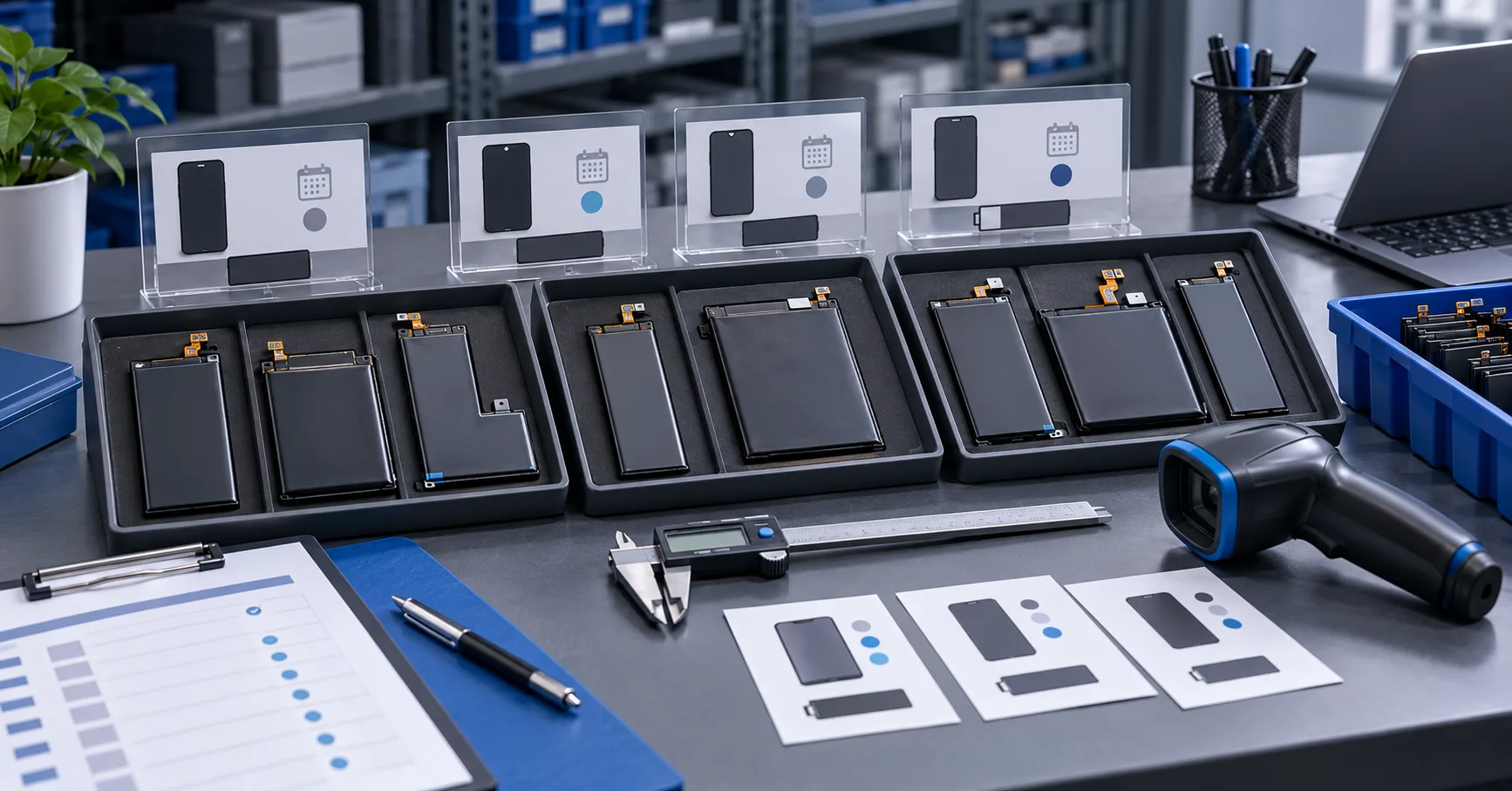
The same rule does not apply to the entire iPhone 12 family. iPhone 12 mini and iPhone 12 Pro Max use different battery configurations and should be managed as separate SKUs. An order described only as “iPhone 12 series battery” is therefore too broad for professional purchasing.
Repair businesses can review ESC’s iPhone 12 / iPhone 12 Pro replacement battery before requesting samples.
Confirm the Battery Specification Before Installation
A written specification should be approved before repair testing begins. This prevents purchasing, technicians and warehouse staff from referring to different versions of the same product.
| Specification item | ESC currently publishes | Buyer verification |
|---|---|---|
| Compatible devices | iPhone 12 / iPhone 12 Pro | Confirm exact device and repair application |
| Battery type | Li-ion replacement battery | Confirm complete battery configuration |
| Rated capacity | 2815mAh | Verify using agreed capacity-test method |
| Nominal voltage | 3.83V | Match approved specification |
| Energy | 10.78Wh | Confirm label and technical file consistency |
| Battery feature | Diagnosable & Smart Recognition | Validate actual repair workflow and system observation |
| Battery condition | Brand-new replacement battery | Confirm sample and lot identity |
| QC | Functional testing published | Request model-specific acceptance details |
| Warranty | 12 months published | Confirm current commercial agreement |
| MOQ | Negotiable | Confirm per SKU and packaging requirement |
| Lead time | 7–15 working days published | Reconfirm for actual quantity and customization |
The figures above come from ESC’s current product and wholesale pages and should not be treated as immutable terms for every future order. MOQ, lead time, documentation and customized packaging may depend on the order scope.
Inspect the Battery Before Opening the Phone
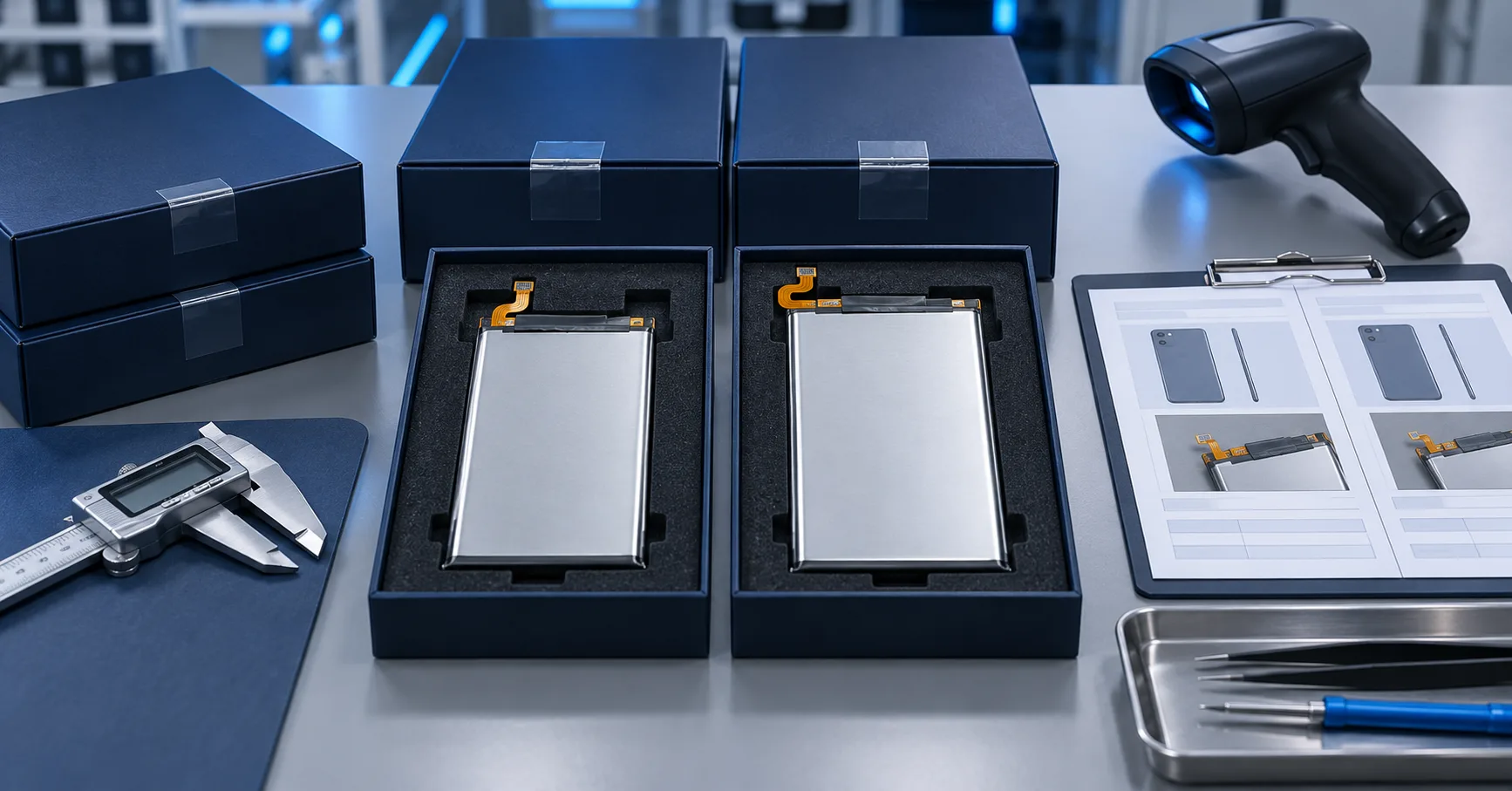
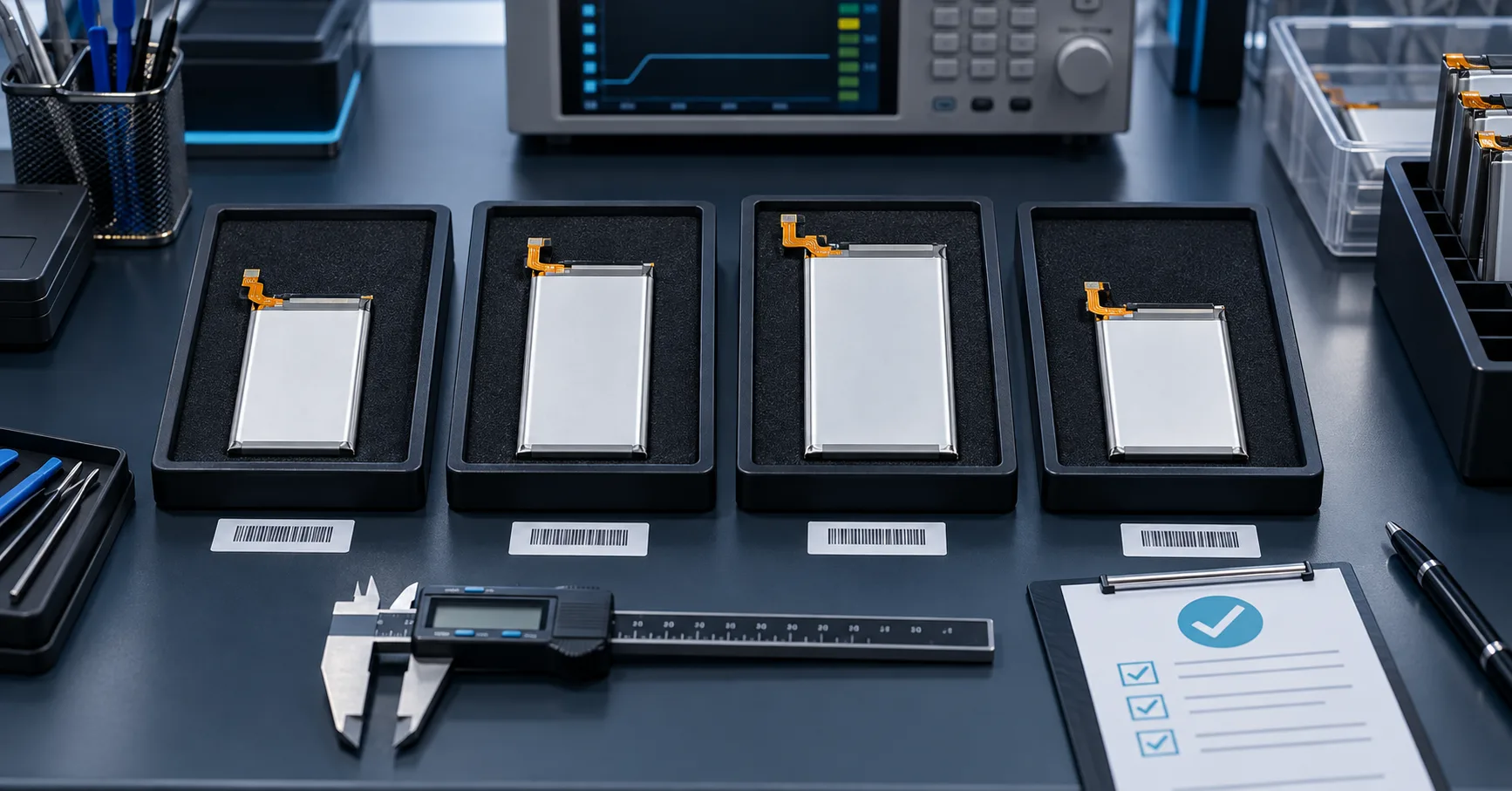
A professional iPhone 12 battery replacement workflow should begin with incoming inspection. Check the battery label, supplier SKU, lot identity and package condition before installation. Visually inspect the pouch, flex cable, connector, insulation and exposed surfaces for deformation, contamination, puncture, crushed areas or transport damage.
Dimensions also matter. A battery may have the correct electrical rating but still create repair problems if thickness, flex routing or connector position differs from the approved configuration. ESC’s iPhone 12 replacement battery validation guide recommends checking identity, dimensions, flex, connector and physical workmanship before the battery is energized or installed.
Do not continue normal installation testing with a visibly swollen, punctured or mechanically damaged lithium-ion battery.
Control Mechanical Fit During iPhone 12 Battery Replacement
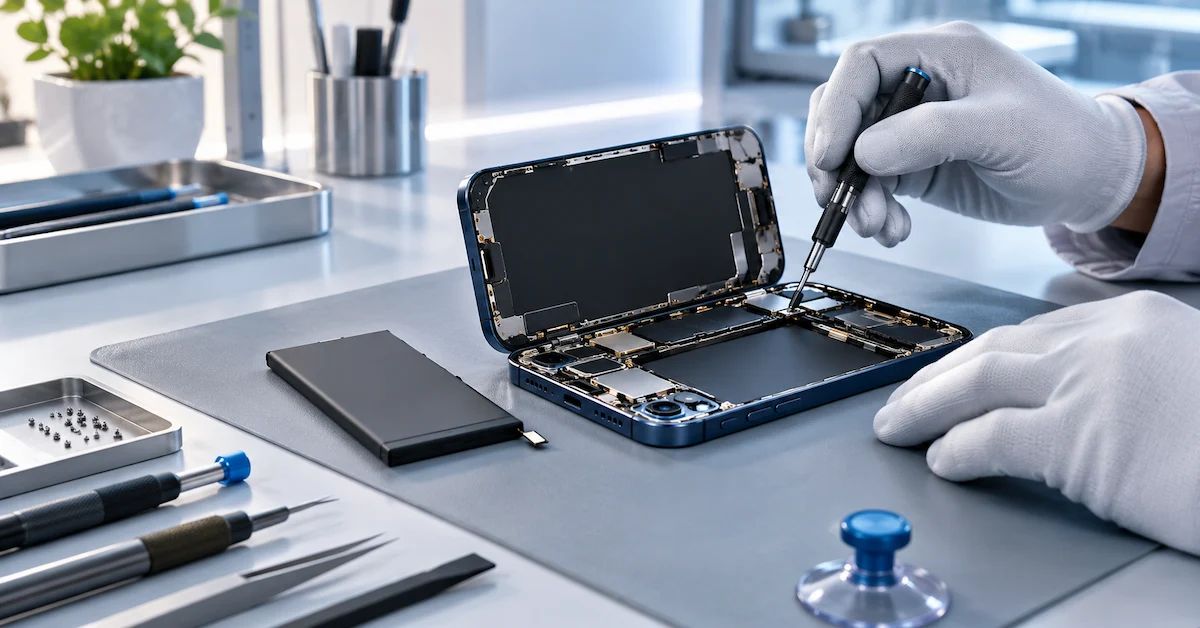
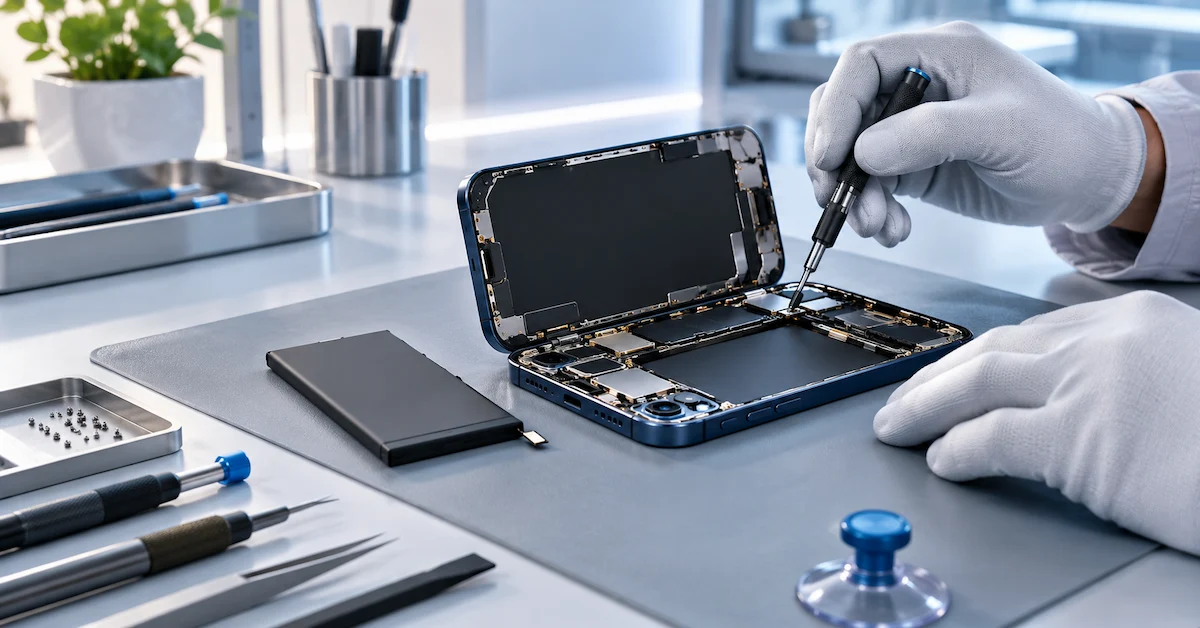
A successful boot does not prove that the battery fits correctly. The technician should evaluate the battery’s seating, connector alignment, flex routing, adhesive position and enclosure clearance during installation.
The battery should not require excessive bending, compression or force to fit the device. After installation, confirm that the connector remains seated, the flex is not under abnormal strain and the phone closes without pressure on the display or enclosure. ESC’s validation guidance specifically recommends recording unusual installation force and rework because these can later become warranty or repeat-order problems.
For repair chains, this step is particularly important because a small dimensional variation repeated across hundreds of batteries can increase technician time and warranty exposure even when the batteries remain electrically functional.
Test Charging Behavior Before Judging Battery Runtime
After installation, confirm that the phone starts normally and begins charging under controlled conditions. Use a known-good charger and cable and record the starting state of charge, device settings and ambient conditions.
The test should look for abnormal charging interruption, unexpected restarts, unstable percentage behavior and unusual temperature increases. Do not confuse a single successful charging session with full battery approval. Charging confirms one part of system behavior, while capacity and runtime need separate evaluation.
ESC’s existing repair content on phone charging problems after battery replacement follows the same principle: diagnose the charging path, battery, installation and host device separately rather than immediately blaming the replacement battery.
Verify the 2815mAh Capacity Under Controlled Conditions
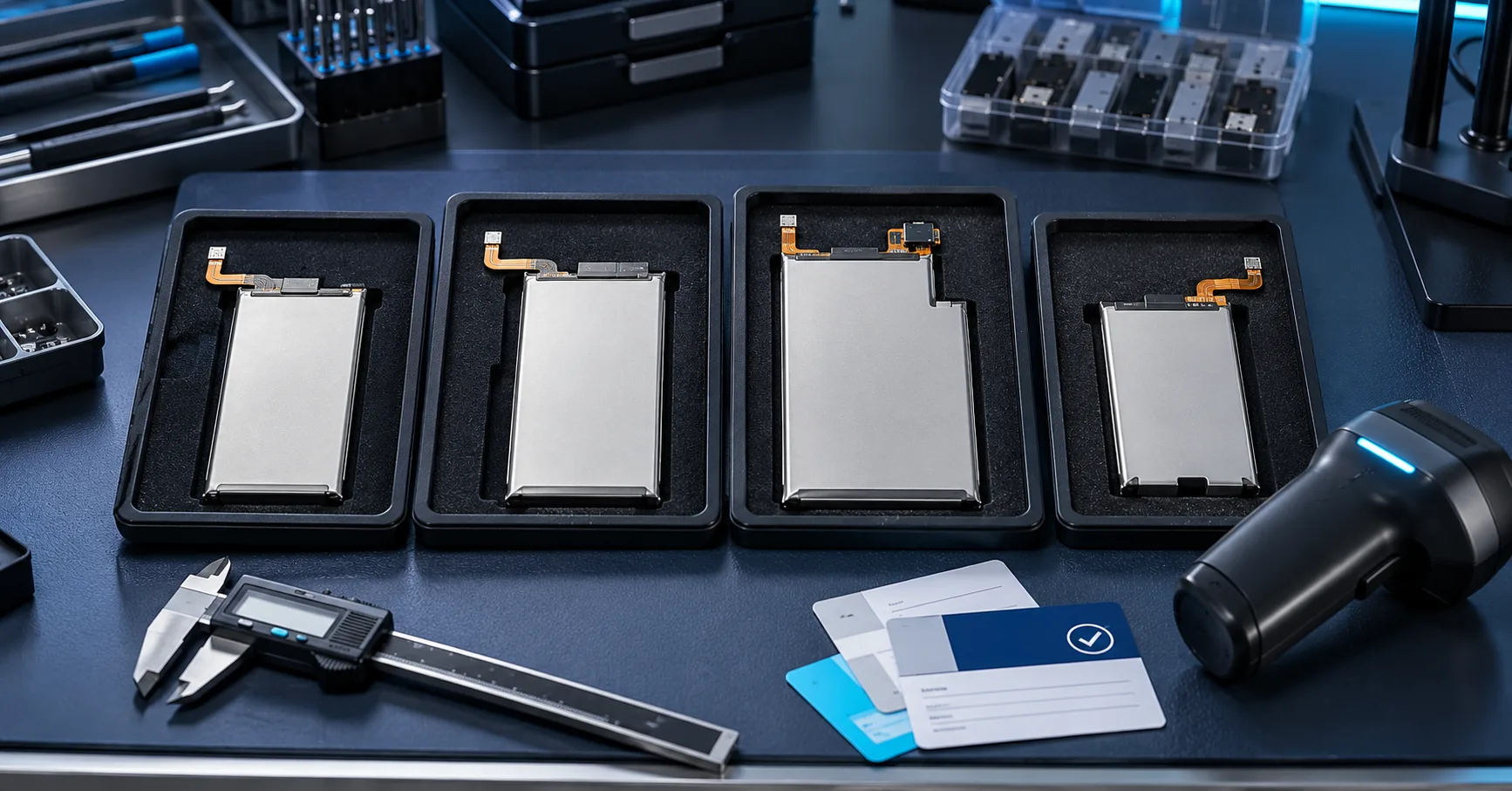
The printed 2815mAh value is the starting specification, not the end of quality verification. Wholesale and refurbishment buyers should establish how capacity is measured, what conditions are used and what tolerance determines acceptance.
ESC’s current iPhone 12 wholesale guide recommends evaluating actual capacity together with voltage, internal resistance, charging behavior, discharge performance and batch consistency rather than buying solely according to the printed mAh figure.
A controlled capacity test should use the same procedure when comparing samples or batches. Changing discharge current, cutoff conditions, temperature or test equipment can make results difficult to compare. If a buyer’s incoming test differs materially from the supplier’s method, both parties should document the difference before using the results to decide a warranty claim.
Check Internal Resistance and Voltage Consistency
Capacity alone does not describe battery behavior under load. Internal resistance can contribute to voltage drop and heat generation, particularly when a phone draws higher current. It is useful as a consistency indicator when the test method and conditions are controlled.
For iPhone 12 battery replacement purchasing, internal resistance should be compared within the same model and battery configuration rather than against one universal limit. Voltage distribution across incoming samples can also help identify abnormal units that require further investigation.
ESC’s phone battery quality control process treats cell grading, capacity, protection electronics, charging/discharging, aging and final inspection as different QC stages because no single number can represent complete battery quality.
Monitor Temperature During Installation Validation
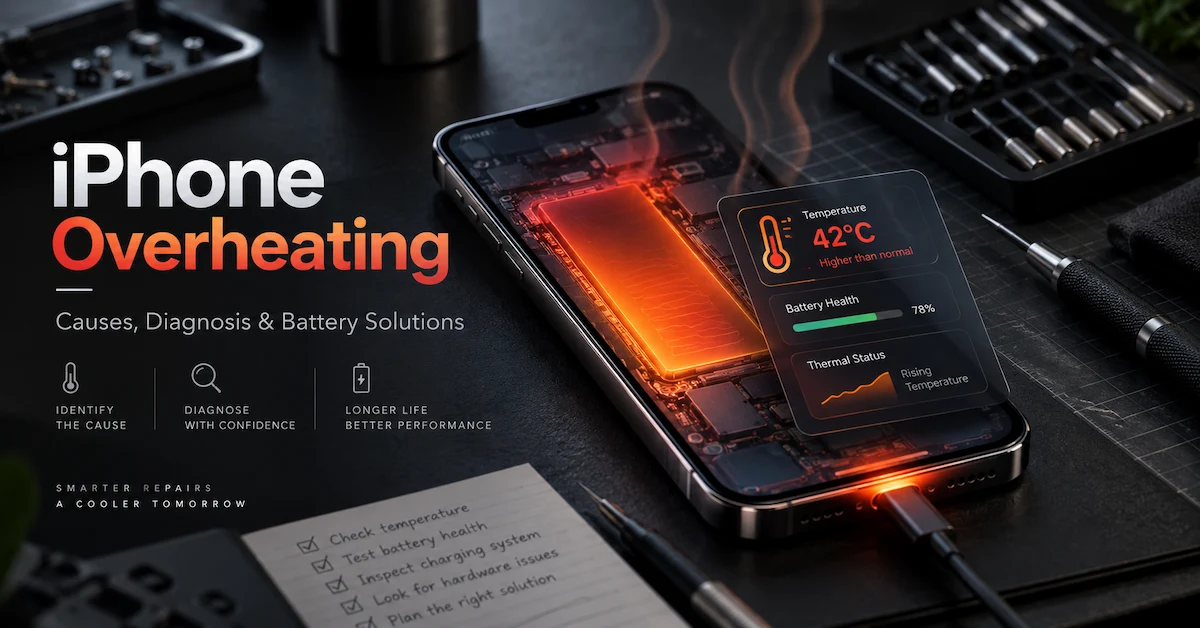
Temperature should be observed during charging and representative device use. A replacement battery that becomes unusually hot requires investigation, but temperature alone does not prove that the battery cell is the failed component.
The technician should consider battery condition, charger, workload, connector condition, device hardware, software activity and ambient temperature. Record the measurement point and conditions so that another sample can be evaluated in the same way.
If the battery shows swelling, severe abnormal heating or visible damage, stop ordinary testing and move the unit into the appropriate safety-handling process.
Do Not Treat Battery Health Display as the Only Quality Test
Post-repair system messages, battery health information and Parts and Service History observations are important for customer experience, but they should remain separate from capacity, fit and electrical testing.
ESC’s iPhone 12 validation guidance recommends recording the actual system status together with the device model, software version and repair method instead of making broad claims about what every third-party battery will display. It also warns against describing third-party replacement batteries as genuine or Apple-authorized products.
A battery that shows a preferred screen status can still fail a capacity or workmanship test. Conversely, a system message does not automatically establish poor cell capacity. Record these as separate evidence categories.
Diagnosable Battery vs Cell Without Flex: Choose the Correct Repair Route
ESC offers both a finished iPhone 12 / iPhone 12 Pro replacement battery and a separate 2815mAh cell without flex or BMS. These products should not be treated as interchangeable even though both publish the same nominal capacity and voltage.
| Comparison | Finished replacement battery | Cell without flex |
|---|---|---|
| Published capacity | 2815mAh | 2815mAh |
| Nominal voltage | 3.83V | 3.83V |
| Flex / BMS | Finished replacement configuration | Not included |
| Main repair approach | Complete battery replacement | Professional cell-transfer or assembly |
| Buyer priority | Fit, recognition, electrical performance and complete QC | Cell quality plus buyer-side integration |
| Suitable customer | Repair shops, refurbishers, distributors | Technically capable repair operations |
Repair shops wanting a ready replacement should evaluate the complete iPhone 12 / 12 Pro battery. Technically capable refurbishment businesses using cell-level repair can review the 2815mAh cell without flex.
When Should Buyers Use a Pilot Lot?
A good sample proves that the supplier can produce at least one acceptable unit. It does not automatically demonstrate normal batch consistency.
For higher-volume iPhone 12 battery replacement programs, a pilot lot can be used after sample approval and before full replenishment. The purpose is to confirm whether labeling, workmanship, capacity distribution, fit and functional behavior remain consistent under normal production conditions.
ESC’s iPhone 12 validation workflow recommends retaining sample records, lot identity and a reference or golden sample, then selecting pilot units from more than one carton position rather than testing only visually ideal units.
If the pilot distribution is materially different from the original approval samples, investigate the cause before releasing the entire shipment.
How Should Repair Chains Control Repeat Orders?
Repeat orders should remain connected to the same approved product definition. Freeze the supplier SKU, capacity, voltage, flex configuration, connector, critical dimensions, label, packaging and reference sample after approval.
Changes to the cell, protection board, connector, flex, adhesive or other important components should trigger technical review. A product name remaining unchanged does not prove that its internal construction is unchanged.
Incoming inspection can then compare each replenishment batch against the approved baseline. This is especially important for repair chains because technicians in different stores need to receive effectively the same product under the same SKU.
What Quality Controls Should a Supplier Apply?
ESC publishes battery-quality processes covering incoming materials, cell grading, capacity testing, protection-related checks, charging and discharging, aging and final inspection. Its iPhone 12 replacement product additionally states that functional, voltage and capacity verification are part of pre-shipment control.
For purchasing, a claim such as “strict QC” is less valuable than knowing which tests apply to the selected SKU and how failed products are handled. Ask whether particular checks are performed on every unit or according to a sampling plan, and how test results or lot identity can support later complaint analysis.
Review Documentation Separately from Battery Performance
ESC’s current iPhone 12 product information lists CE, MSDS and UN38.3 support. These items should still be reviewed according to their specific purpose and applicability to the ordered battery and destination market rather than treated as one universal “battery certificate.”
Product performance approval and documentation approval should remain separate. A battery can have relevant shipping documents while failing the buyer’s capacity requirements, and a battery that passes capacity testing still needs whatever documents apply to the intended shipment.
For broader document verification, buyers can review ESC’s UN38.3 phone battery guide.
How Should Wholesalers Evaluate Cost and MOQ?
The lowest battery price does not necessarily create the lowest repair cost. Buyers should account for sample evaluation, incoming inspection, installation efficiency, returns, technician rework, warranty cases, packaging and inventory consistency.
ESC’s published iPhone 12 battery currently lists MOQ as negotiable and lead time at approximately 7–15 working days, while its wholesale guide advises reconfirming terms for actual order quantity, customization and destination.
Private-label projects may also have separate minimums for batteries, printed labels, retail boxes or other customized materials. Do not assume that one MOQ applies to every part of the program.
OEM and Private-Label iPhone 12 Battery Replacement Programs
Repair brands and distributors may want custom battery labels, barcodes, packaging and other branding. ESC lists OEM/ODM branding and custom packaging support for its iPhone 12 replacement battery.
The technical product should be approved before artwork is finalized. A controlled private-label program should connect the buyer SKU to the supplier model, approved capacity, battery revision, artwork and packaging specification.
If the technical battery changes later, determine whether the printed capacity, product description, barcode mapping or supporting documentation also needs to change. Buyers planning a branded range can discuss requirements through ESC’s customized solution service.
What Should You Send When Requesting iPhone 12 Battery Samples or Pricing?
For a useful quotation, provide the exact device requirement, whether the project covers iPhone 12, iPhone 12 Pro or both, quantity per SKU, target market, repair workflow, packaging needs and any private-label requirements. Also specify whether you require a finished replacement battery or a cell-only configuration, what capacity and incoming-QC methods you plan to use, and what documentation your business or logistics provider needs.
This allows the supplier to quote one defined battery program instead of responding to a vague request such as “Need iPhone 12 battery best price.” Buyers can submit project information through ESC Contact Us.
Frequently Asked Questions
Is the ESC iPhone 12 replacement battery also compatible with iPhone 12 Pro?
ESC currently publishes its 2815mAh replacement battery for both iPhone 12 and iPhone 12 Pro. Buyers should still validate the supplied SKU and representative devices before bulk approval.
What is the published capacity of the iPhone 12 replacement battery?
ESC currently lists 2815mAh, 3.83V and 10.78Wh for its iPhone 12 / iPhone 12 Pro replacement battery. These values should be reconfirmed in the actual purchasing specification.
Can the same battery be used for iPhone 12 mini or iPhone 12 Pro Max?
No assumption should be made. ESC’s iPhone 12 sourcing guidance identifies iPhone 12 mini and iPhone 12 Pro Max as different battery configurations from iPhone 12 and iPhone 12 Pro.
Should capacity be tested after iPhone 12 battery replacement?
For professional sample qualification and wholesale purchasing, capacity should be verified using an agreed test method rather than relying only on the printed mAh rating. Device-level runtime should be evaluated separately.
Does a successful boot prove the replacement battery is good?
No. A successful boot establishes only basic device operation. Mechanical fit, charging behavior, capacity, temperature, system observations and production consistency still require evaluation.
What is the difference between the finished battery and the cell without flex?
The finished replacement battery is supplied as a complete replacement configuration. ESC’s 2815mAh cell-only product excludes the flex cable and BMS and requires an appropriate professional repair or assembly workflow.
Does ESC provide OEM packaging for iPhone 12 batteries?
ESC’s current product page states that customized packaging, OEM logos, private labels and barcode options are available for professional buyers. Confirm requirements and MOQ for the actual project.
What documents are available for iPhone 12 replacement batteries?
ESC currently lists CE, MSDS and UN38.3 support on the product page. Buyers should verify which documents apply to the exact supplied configuration, market and shipment.
How should repair chains approve an iPhone 12 replacement battery?
Use a controlled sample process covering product identity, workmanship, dimensions, mechanical fit, charging, capacity, runtime, temperature and relevant system observations. For larger programs, consider a pilot lot before normal replenishment.
When should an approved iPhone 12 battery be revalidated?
Revalidation should be considered when critical cell, board, connector, flex, adhesive or construction changes occur, or when incoming inspection or field complaints show a meaningful abnormal trend. ESC’s current validation guide recommends change notification and targeted revalidation in these cases.
Conclusion
A professional iPhone 12 battery replacement program should prove more than the ability to power on a phone after installation. Repair shops, refurbishment facilities, wholesalers and private-label buyers should verify the exact iPhone 12 or iPhone 12 Pro application, confirm the 2815mAh product specification, inspect mechanical fit, validate charging and capacity, record thermal and system behavior, and preserve the approved configuration through pilot lots and repeat orders.
ESC currently offers a complete iPhone 12 / iPhone 12 Pro replacement battery as well as a separate 2815mAh cell without flex for different professional repair workflows. Buyers planning repair-chain, refurbishment, wholesale or private-label programs can contact ESC with their target models, quantities, validation requirements and packaging needs to discuss samples and bulk supply.