
What Should a Professional Mobile Phone Repair Kit Include?
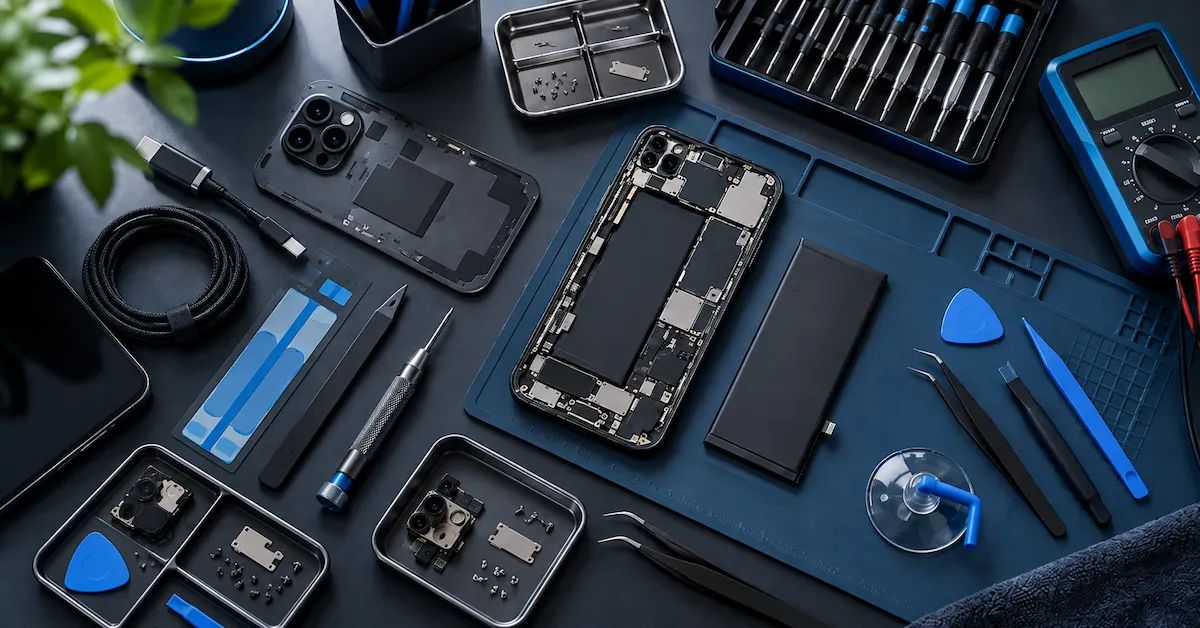
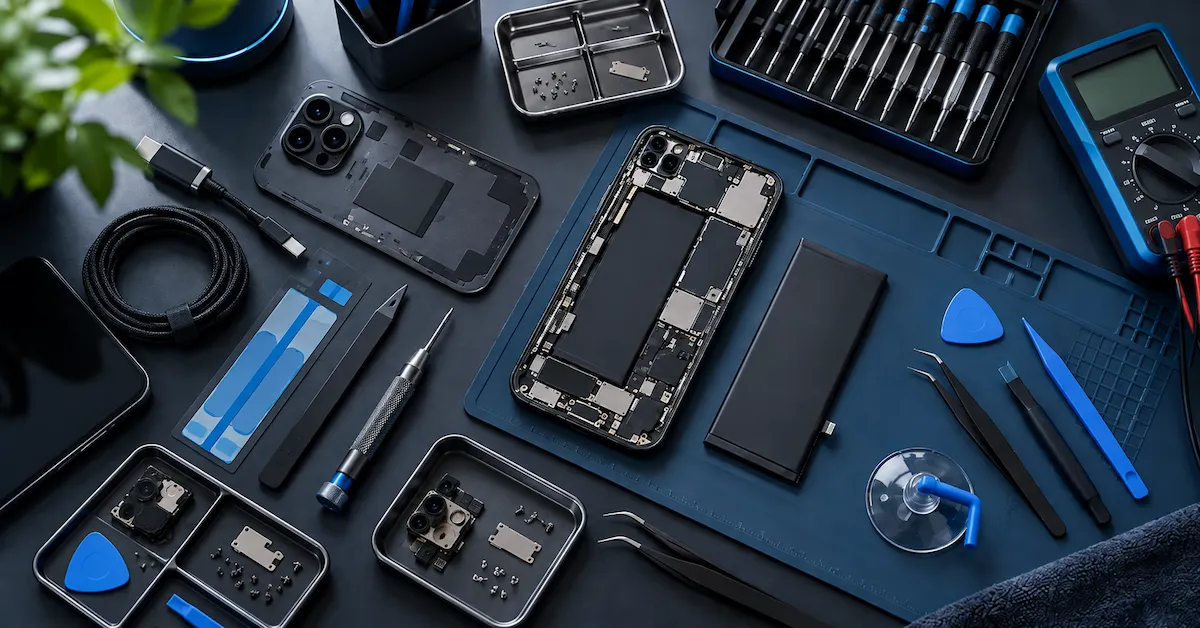
A professional mobile phone repair kit should include precision screwdrivers, safe opening tools, ESD protection, magnification equipment, battery-handling supplies, diagnostic instruments, and model-specific replacement parts. The right combination depends on the devices being serviced, the technician's experience, and the repair volume.
For a small repair shop, a compact toolkit may be enough for basic screen and battery replacements. A repair chain or refurbishment center needs more than tools. It also requires consistent workstations, approved replacement parts, documented testing procedures, and reliable inventory management.
The most important distinction is between opening a phone and completing a reliable repair. A toolset helps the technician access internal components. Diagnosis, replacement-part quality, installation control, and final testing determine whether the repaired device can be returned to the customer confidently.
This distinction is especially important for battery replacement. A technician may perform the opening procedure correctly but still experience problems if the replacement battery has incorrect dimensions, a mismatched connector, inconsistent capacity, or unsuitable protection electronics.
For businesses performing frequent repairs, selecting a mobile phone repair kit should therefore be part of a broader repair-quality and component-sourcing strategy.
Who Needs a Mobile Phone Repair Kit?
Not every repair business needs the same equipment. Buyers should first identify their repair services, technician skill level, and expected workload.
Independent Phone Repair Shops
Independent repair shops usually handle a mixture of battery replacement, screen replacement, charging problems, and minor component repairs.
Their priorities include:
-
Versatile tools for common smartphone models.
-
Compact workstations with sufficient lighting.
-
Reliable opening equipment that minimizes cosmetic damage.
-
Quick access to frequently requested replacement batteries.
-
Reasonable tooling and consumable costs.
-
Efficient testing before returning devices to customers.
For this environment, a well-selected tool collection is more valuable than an oversized kit containing rarely used accessories.
Multi-Location Repair Chains
Repair chains need standardized procedures across different locations.
When technicians use inconsistent equipment and replacement parts, installation results can vary between branches.
A repair chain should consider standardized tool specifications, technician training, approved battery models, incoming inspection, and centralized warranty records.
The purchasing decision should support repeatability rather than simply minimize the initial tool price.
Smartphone Refurbishment Facilities
Refurbishment centers often process large quantities of used smartphones.
Their equipment requirements may include:
-
Dedicated inspection and disassembly stations.
-
Battery condition evaluation.
-
Controlled charging and discharging tests.
-
Model-specific installation fixtures.
-
Production-line tracking.
-
Functional testing.
-
Finished-device grading and documentation.
For refurbishment operations, repair equipment is part of a production system. Throughput, repeatability, and traceability are critical purchasing considerations.
Mobile Phone Parts Wholesalers
Wholesalers may supply repair tools, replacement batteries, adhesives, and other accessories to independent technicians and repair shops.
Their challenge is different from that of a technician. They need to select products that match market demand while avoiding excessive inventory complexity.
Battery compatibility, model coverage, packaging, and repeat-order consistency become important factors when building a wholesale repair-parts portfolio.
Essential Tools Every Professional Mobile Phone Repair Kit Should Have
A useful toolkit should be organized around actual repair operations rather than accessory count.
| Tool Category | Recommended Equipment | Main Purpose |
|---|---|---|
| Precision screwdrivers | Model-appropriate Phillips, Torx, pentalobe, tri-point, and other required bits | Remove and reinstall device fasteners |
| Opening equipment | Suction tools, plastic opening picks, thin opening cards | Separate displays and rear covers |
| Nonconductive handling tools | Plastic spudgers and suitable tweezers | Handle connectors and small components |
| ESD protection | Grounded ESD mat and compatible wrist strap | Reduce electrostatic-discharge risk |
| Magnification | Inspection microscope or magnifying lamp | Check connectors, flex cables, and small components |
| Controlled heating | Electronics repair heating mat or controlled heat source | Soften approved adhesive during disassembly |
| Cleaning supplies | Electronics-grade cleaning materials and lint-free swabs | Remove appropriate residue and contamination |
| Reassembly consumables | Model-specific adhesive, seals, and replacement fasteners | Support controlled reassembly |
| Diagnostic equipment | USB power meter, digital multimeter, and suitable battery-testing instruments | Evaluate charging and electrical behavior |
| Safety equipment | Eye protection and appropriate damaged-battery containment | Support safer battery handling |
The exact tools required depend on the device manufacturer and repair procedure.
For example, screw-head types vary between brands and models. Using an incorrectly sized bit can damage a fastener and turn a routine repair into a more complicated job.
Likewise, aggressive metal prying tools may damage housings, flex cables, or batteries. Technicians should use the tools specified for the relevant repair operation.
Precision Screwdrivers and Fastener Control
A professional screwdriver set should prioritize accurate bit geometry, consistent fit, and durable tips.
Important evaluation criteria include:
-
Compatibility with target device fasteners.
-
Tip accuracy and wear resistance.
-
Comfortable handling during repeated repairs.
-
Organized bit identification.
-
Availability of replacements.
-
Controlled torque where required by the repair procedure.
For repair chains, screw organization is especially important. Mixing screws of different lengths can create serious assembly problems.
Opening Tools and Controlled Heating
Modern smartphones frequently use adhesive to secure displays, rear panels, or internal components.
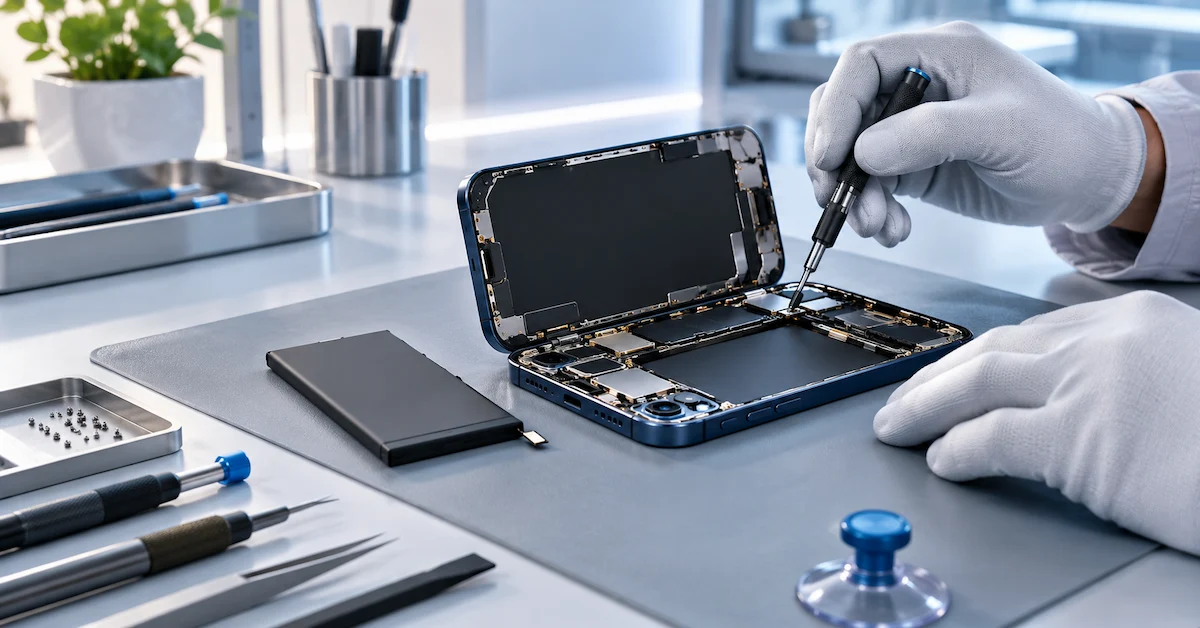
A suitable opening workstation may include suction tools, plastic picks, controlled heating equipment, and approved cleaning materials.
However, more heat is not necessarily better.
Excessive heating can damage components and increase battery-related risks. Technicians should follow model-specific service procedures and approved temperature limits.
Opening equipment should also be evaluated for the likelihood of damaging displays, flexible circuits, cameras, or other nearby components.
ESD Protection and Workstation Organization
Electrostatic discharge can damage sensitive electronic components.
A professional repair bench should provide suitable ESD protection, including properly grounded equipment where applicable, clean working surfaces, and controlled handling procedures.
ESD controls should be maintained and checked rather than assumed effective because a mat or wrist strap is present.
Good workstation organization also reduces the risk of misplaced screws, damaged connectors, and accidental component mixing.
How to Choose the Right Phone Repair Diagnostic Equipment
A mobile phone repair kit becomes more useful when the technician can distinguish the actual fault from the customer's description of the problem.
A phone that does not charge may have a defective cable, damaged charging port, unstable power source, battery problem, connector issue, or board-level fault.
Replacing the battery without verifying the underlying cause may create unnecessary cost and repeat complaints.
USB Charging Power Meters
A compatible USB power meter can help technicians observe charging voltage, current, and power under defined test conditions.
It may be useful for identifying unusual charging behavior or comparing a device with a known-good reference.
However, a USB charging meter cannot independently establish the actual capacity or health of an internal battery.
Charging measurements must also account for the adapter, cable, protocol negotiation, device state, and temperature.
Digital Multimeters
A digital multimeter can support continuity, resistance, and voltage measurements when used by a trained technician following appropriate procedures.
It is useful for selected electrical checks, but it does not replace comprehensive battery validation.
Untrained probing around exposed battery contacts or damaged battery assemblies can create short-circuit hazards.
Battery Testing Equipment
Professional battery testing may involve compatible battery analyzers, charging and discharging equipment, and controlled measurement conditions.
Useful measurements can include:
-
Open-circuit voltage.
-
Measured capacity under a defined test method.
-
Internal resistance where applicable.
-
Charging and discharging behavior.
-
Temperature observations.
-
Abnormal voltage or shutdown behavior.
Testing instruments must be suitable for the specific battery chemistry, configuration, and protection architecture.
An electrical reading should not be interpreted without understanding the test conditions.
Visual Inspection and Thermal Observation
Magnification helps identify bent connectors, damaged flex cables, contamination, and assembly defects.
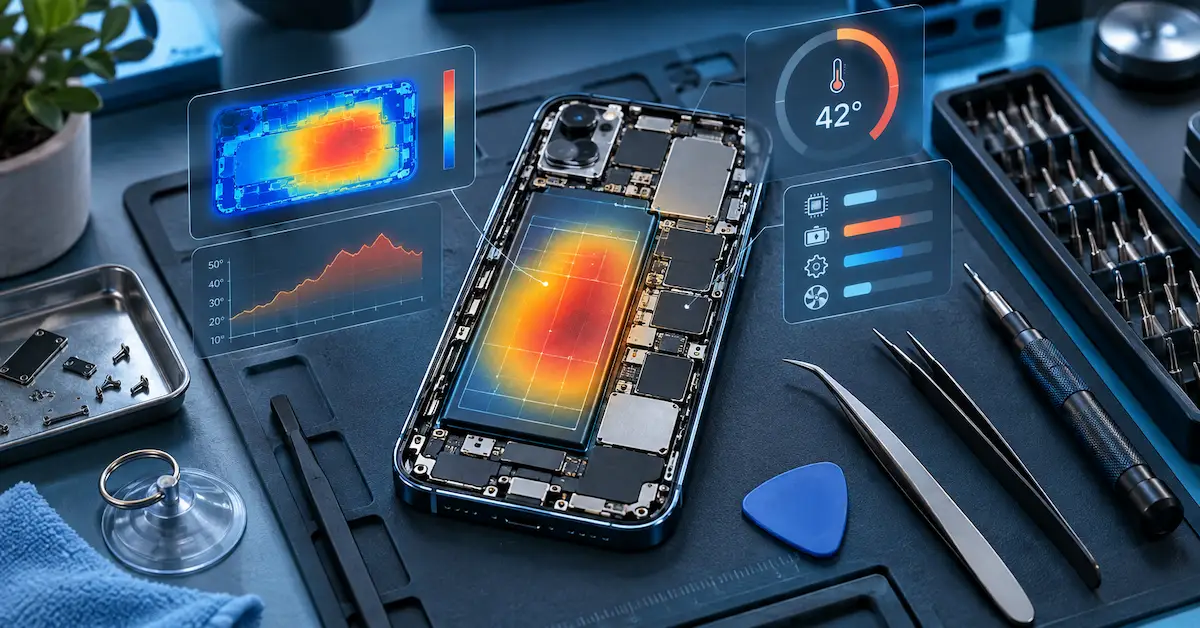
Thermal observation may provide additional diagnostic information, but a temperature reading alone does not identify the failed component.
Technicians should compare observations under repeatable conditions and stop testing when a battery shows signs of swelling, leakage, puncture, or abnormal heating.
Why Replacement Battery Quality Matters as Much as Repair Tools
Tools determine how a technician performs the procedure. Replacement-part quality determines whether the installed component can operate as intended.
For battery replacement businesses, these factors must be evaluated together.
A replacement battery is more than a lithium-ion cell. Depending on the model and product configuration, a complete assembly may include:
-
A lithium-ion cell.
-
Protection electronics or a protection circuit module.
-
Battery-management functions.
-
Flex cables.
-
Electrical connectors.
-
Insulation materials.
-
Model-specific mechanical components.
-
Identification and labeling information.
The complete assembly must be compatible with the intended phone.
For businesses looking to expand their replacement-part coverage, ESC provides a range of mobile phone replacement batteries for repair shops, refurbishers, and wholesale buyers, including multiple iPhone and Android configurations.
Battery Capacity Is Only One Purchasing Criterion
Battery capacity is commonly expressed in milliampere-hours (mAh).
A higher advertised mAh value should not automatically be treated as evidence of longer practical runtime or better overall quality.
Buyers should also evaluate:
-
Nominal voltage.
-
Watt-hour rating where specified.
-
Cell dimensions and thickness.
-
Battery chemistry and construction.
-
Connector and flex arrangement.
-
Charging compatibility.
-
Protection-system behavior.
-
Temperature performance.
-
Manufacturing consistency.
When comparing capacity claims, the measurement method and applicable specification should be defined.
A battery that appears attractive on a product listing may create problems if its mechanical dimensions or electrical characteristics are unsuitable.
Original-Capacity vs. High-Capacity Batteries
Different battery configurations serve different markets.
| Battery Type | Main Characteristics | Typical Buyer Considerations |
|---|---|---|
| Original-capacity replacement | Designed around the original device capacity specification | Fit, compatibility, stable performance, repeatability |
| High-capacity replacement | Advertises increased capacity for a compatible device | Verified capacity, physical fit, temperature behavior |
| Diagnostic or decoding battery | May include model-specific electronics or service-related features | Device support, software behavior, required repair workflow |
| Battery cell without flex | Cell-only configuration requiring a separate approved assembly process | Specialized equipment, electronic integration, safety validation |
High-capacity products require particularly careful evaluation.
Additional advertised capacity is only useful when the complete battery remains electrically and mechanically suitable for the device.
Buyers comparing product options can review ESC's high-capacity iPhone replacement battery range and request model-specific specifications before approving samples.
Mechanical Compatibility and Software Status Are Different
A replacement battery may fit physically and power the phone while producing a particular service or battery-information message.
Conversely, the absence of a warning does not prove that the battery meets its capacity, safety, or runtime requirements.
For professional procurement, compatibility should be evaluated across several separate areas:
-
Device identity and regional model.
-
Physical dimensions and installation fit.
-
Connector and flex configuration.
-
Electrical and charging behavior.
-
Protection functionality.
-
Software and repair-status behavior.
-
Final functional testing.
The specific operating system, device model, and repair procedure can influence the results.
ESC's iPhone replacement battery compatibility matrix guide explains how B2B buyers can connect these requirements to a controlled sample-approval process.
A Safer Battery Replacement Workflow for Repair Shops
Having the right mobile phone repair kit does not eliminate the need for a controlled repair procedure.
A professional workflow should include the following stages.
Step 1: Record Device Condition
Before opening a device, document the customer's complaint, exact device model, visible damage, and relevant operating condition.
Where appropriate, record charging behavior, battery-related messages, and repair history.
This provides a baseline for evaluating the result after servicing.
Step 2: Screen for Battery Safety Problems
Inspect the phone for signs of swelling, deformation, leakage, unusual heat, or previous mechanical damage.
A suspected damaged lithium-ion battery should not be treated as a routine replacement job.
Stop normal repair operations and follow the applicable hazardous-battery handling procedure.
Step 3: Confirm the Repair Requirement
Check whether the symptom supports battery replacement or whether another component requires investigation.
Use non-invasive diagnostics where possible before beginning disassembly.
Step 4: Verify Tools and Replacement Parts
Confirm that the opening tools, screwdrivers, adhesive materials, and replacement battery match the exact device.
Check the replacement battery's SKU, label, physical condition, connector, and packaging before installation.
Step 5: Follow the Approved Service Procedure
Use the device manufacturer's appropriate service guidance and trained personnel.
Avoid excessive heat, forced opening, direct pressure on battery cells, or uncontrolled contact with electrical components.
Battery-cell reconstruction and other advanced operations require dedicated procedures and are not suitable for a basic repair kit.
Step 6: Perform Controlled Reassembly
Inspect the condition and routing of connectors, flex cables, insulation, and adhesive interfaces.
Follow the required fastening and closure procedures.
Replacing adhesive or seals does not automatically guarantee restoration of the device's original water-resistance rating.
Step 7: Complete Functional Testing
After installation, perform appropriate device-level checks.
These may include:
-
Device startup and shutdown.
-
Charging recognition.
-
Battery information display where supported.
-
Abnormal temperature observations.
-
Basic load and runtime checks.
-
Display and touch operation.
-
Other functions potentially affected during disassembly.
The test plan should reflect the device model and the work performed.
Step 8: Record the Repair Result
Record the replacement-part SKU, lot reference where available, technician, test result, and any unresolved condition.
For repair chains and refurbishment facilities, these records support warranty analysis and continuous improvement.
How Should Repair Shops Evaluate Replacement Battery Quality?
A professional mobile phone repair kit helps technicians perform repairs, but it cannot compensate for inconsistent replacement-battery quality.
For B2B buyers, quality assurance should begin before the battery reaches the repair bench.
Incoming Battery Inspection
Incoming inspection should verify product identity and visible condition.
Common checkpoints include:
| Inspection Item | What Buyers Should Verify | Why It Matters |
|---|---|---|
| Model identification | Correct device model and supplier SKU | Prevents wrong-part installation |
| Physical dimensions | Length, width, thickness, and shape | Reduces mechanical-fit problems |
| Connector and flex | Geometry, orientation, and visible condition | Supports reliable installation |
| Battery voltage | Within the agreed incoming specification | Identifies potentially abnormal units |
| Capacity | Compliance with an agreed test method | Evaluates advertised performance |
| Protection electronics | Approved configuration and functional evidence | Supports electrical safety requirements |
| Label and packaging | Correct SKU, revision, and batch identity | Reduces warehouse errors |
| Traceability | Lot and inspection records | Supports complaint investigations |
Inspection limits should be defined for each product rather than copied from an unrelated battery model.
Capacity and Aging Testing
Capacity testing helps determine whether a sample meets its stated performance specification under defined conditions.
Aging and other electrical tests may help identify selected early-life problems.
However, no single test proves every aspect of battery quality or long-term reliability.
Buyers should ask suppliers to explain the acceptance criteria, sampling plan, and failure-handling procedure.
Batch Consistency
A successful sample does not guarantee that every future production lot will behave identically.
Repair businesses should control product revisions and monitor repeat orders.
Important records include the approved sample, specification revision, manufacturing lot, incoming test results, and complaint history.
ESC's published phone battery quality control process provides additional context on cell grading, capacity testing, protection-circuit evaluation, aging, and final inspection.
Mobile Phone Repair Kit Comparison for Different Business Scenarios
The most suitable equipment package depends on the business model.
| Repair Environment | Essential Equipment | Additional Priorities | Purchasing Focus |
|---|---|---|---|
| Small repair shop | Precision drivers, opening tools, ESD mat, basic diagnostics | Common replacement batteries and consumables | Versatility and affordable maintenance |
| Professional battery repair shop | Battery-safe opening equipment, inspection tools, appropriate testers | Model compatibility and installation validation | Battery quality and repeatable results |
| Multi-store repair chain | Standardized tools and diagnostic procedures | Approved SKU lists and shared QC records | Consistency across branches |
| Refurbishment facility | Dedicated workstations, fixtures, and testing equipment | Lot tracking and standardized acceptance | Throughput and traceability |
| Parts wholesaler | Product evaluation and sampling equipment | Broad model coverage and clear packaging | SKU management and repeat-order supply |
A basic consumer toolkit may help with occasional maintenance, but it should not automatically be considered suitable for professional battery testing or high-volume refurbishment.
Specialized board-level repair, microsoldering, and damaged-battery handling require separate equipment, skills, and safety procedures.
How to Calculate the Real Cost of a Mobile Phone Repair Kit
A low initial purchasing price does not necessarily produce a lower repair cost.
Professional buyers should evaluate the total operational cost of the equipment and replacement parts.
A practical comparison includes:
Total Repair Cost = Tool and Equipment Allocation + Replacement Parts + Consumables + Labor + Testing + Rework + Warranty Handling
Initial Equipment Cost
This includes screwdrivers, opening systems, inspection equipment, ESD protection, and testing devices.
Equipment should be compared based on actual functionality, durability, calibration needs, and expected maintenance.
Consumable Cost
Consumables may include adhesive, cleaning supplies, protective materials, and replacement fasteners.
Although individual consumables can appear inexpensive, usage becomes significant when a business processes large numbers of devices.
Technician Labor
Tool quality can influence repair efficiency.
Poorly fitting screwdrivers, unsuitable opening tools, and inconsistent workstation layouts may increase handling time or create damage risks.
The value of improved tools should be evaluated through actual repair-time and defect records.
Rework and Warranty Cost
Repeat repairs can create costs beyond the replacement component.
These may include additional technician time, diagnostic work, replacement parts, shipping, and customer-service handling.
For high-volume businesses, reducing avoidable rework can be more valuable than obtaining the lowest unit price.
The strongest purchasing decision balances tool reliability, replacement-part quality, technician efficiency, and after-sales risk.
What Should Buyers Check Before Ordering Phone Repair Supplies in Bulk?
Bulk purchasing requires a different approach from buying a single toolkit.
Repair chains, refurbishment facilities, and wholesalers should qualify equipment and replacement parts before committing to larger volumes.
1. Define the Device Coverage
Prepare a list of the smartphone brands and exact models the business repairs.
For example, a repair chain may need broad iPhone support alongside selected Samsung, Xiaomi, OPPO, Motorola, or Google Pixel devices.
Coverage should reflect actual repair demand rather than an unnecessarily large model catalog.
2. Separate Tools From Replacement Parts
Repair tools and replacement batteries have different qualification requirements.
A screwdriver can be evaluated for physical fit, durability, and handling.
A replacement battery requires additional electrical, mechanical, functional, safety, and documentation checks.
Businesses should maintain separate approval records even when both categories belong to the same purchasing program.
3. Request Product Specifications
For tools, buyers should request material, dimensional, compatibility, maintenance, and warranty information as appropriate.
For batteries, the request should identify capacity, voltage, configuration, connector, protection electronics, dimensions, and applicable documentation.
Specifications should be sufficiently detailed to distinguish approved products from visually similar alternatives.
4. Approve Samples Before Large Orders
Where the purchasing risk justifies it, test samples using representative devices and technicians.
Evaluate the sample under conditions that resemble the intended repair environment.
Sample results should be documented rather than relying only on an informal statement that the product works.
5. Confirm Minimum Order Quantities and Lead Times
Minimum order quantities, production schedules, and delivery arrangements can vary by product, model, order size, and customization requirements.
Buyers should confirm these terms for the specific quotation.
For lithium-ion batteries, shipment planning should also account for the applicable dangerous-goods requirements and destination-market rules.
6. Establish After-Sales Procedures
Before placing a bulk order, agree on how defective products, incorrect models, warranty claims, and technical questions will be handled.
A clear process should identify the evidence required for claims, response responsibilities, and product traceability.
This prevents avoidable disputes when problems arise after distribution.
OEM and Private-Label Opportunities for Phone Repair Businesses
Repair shops and distributors may want to develop their own branded replacement-battery products.
Private-label sourcing can support consistent packaging, product identification, and channel positioning.
Depending on the agreed project scope, customization may include:
-
Battery labels.
-
Logo printing.
-
Retail or workshop packaging.
-
Model identification and barcodes.
-
Product documentation.
-
Selected battery specifications.
-
Mixed-model purchasing arrangements.
Battery customization is different from branding a basic screwdriver kit.
A professional private-label battery program should verify the underlying cell and assembly design, compatibility, quality controls, documentation, and approved product configuration before finalizing artwork.
For high-capacity or specialized battery configurations, technical sample approval is particularly important.
Buyers should also confirm trademark rights, packaging claims, and applicable destination-market requirements.
Lithium-Ion Battery Safety, Compliance, and Shipping
Lithium-ion batteries require additional attention because they store significant energy in a compact format.
Repair businesses should create procedures for receiving, storing, handling, testing, transporting, and disposing of battery products.
Battery Handling
Technicians should avoid crushing, puncturing, folding, short-circuiting, or exposing battery cells to uncontrolled heat.
Swollen, leaking, or physically damaged batteries require an appropriate isolation and disposal process.
A damaged battery should not be treated as a normal serviceable component simply because it can still power a device.
Storage Conditions
Battery storage practices should account for temperature, physical protection, terminal protection, stock rotation, and manufacturer guidance.
Warehouses should prevent mechanical damage and keep unsuitable batteries out of normal inventory.
Transport Documentation
Lithium battery shipments may require applicable transport documentation and packaging controls.
Buyers may encounter documents such as:
-
UN38.3 test summaries.
-
Safety Data Sheets (SDS).
-
Applicable cell or battery safety test reports.
-
Product-specific declarations or compliance information.
These documents serve different purposes.
For example, a Safety Data Sheet is not equivalent to proof that a finished replacement battery has passed all relevant product-performance or safety tests.
Likewise, transport-test documentation does not automatically establish mechanical compatibility with a smartphone.
International buyers should verify the exact battery configuration, document scope, shipment arrangement, and destination requirements before shipping.
Common Mistakes When Buying a Mobile Phone Repair Kit
Several purchasing mistakes can undermine repair performance even when the equipment initially appears suitable.
Buying Based on Tool Count
A kit advertised with many accessories may contain duplicate or low-value items.
Buyers should prioritize tools that match their actual repair services and device coverage.
Ignoring Tool Precision
Poorly fitted screwdriver tips and unsuitable opening equipment can damage fasteners, housings, and internal components.
Tool precision and construction matter more than promotional accessory counts.
Assuming Every Battery With the Same Model Label Is Identical
Batteries with similar commercial descriptions may differ in construction, flex routing, connector design, capacity, or electronics.
Exact model matching and sample approval are essential.
Treating Startup as a Complete Quality Test
A phone turning on after repair does not prove that the replacement battery meets its electrical and functional requirements.
Charging, temperature, runtime, system behavior, and other relevant functions may still need evaluation.
Ignoring Supplier Change Control
A replacement part that passed initial testing may change over time.
Buyers should define which construction, material, or electronics changes require notification and reapproval.
Choosing the Lowest Price Without Calculating Rework
A cheaper tool or battery may lead to additional labor, complaints, or returns.
Purchasing decisions should compare total operational value rather than the unit price alone.
What Information Should B2B Buyers Include in a Repair Battery RFQ?
A useful request for quotation should contain enough information for the supplier to evaluate compatibility, quantity, and customization requirements.
The following checklist can be adapted for repair chains, wholesalers, and refurbishment businesses.
| RFQ Field | Information to Provide |
|---|---|
| Buyer type | Repair shop, repair chain, refurbisher, distributor, or private-label brand |
| Target market | Country or region of sale or installation |
| Device coverage | Exact smartphone model list and relevant identifiers |
| Battery configuration | Standard, high-capacity, diagnostic, or specialized cell configuration |
| Technical requirements | Capacity, voltage, connector, dimensions, and approved performance criteria |
| Quantity | Units required per SKU and anticipated repeat volume |
| Sample plan | Models and quantities needed for verification |
| Quality requirements | Inspection, testing, traceability, and acceptance expectations |
| Customization | Labels, branding, barcode, and packaging requirements |
| Documentation | Applicable safety, transport, and product documents |
| Commercial terms | Target delivery schedule, shipping destination, and warranty expectations |
Detailed inquiries support more accurate product selection and supplier evaluation.
Businesses seeking compatible battery models, wholesale sourcing, or private-label development can contact ESCCharge with their device list and purchasing requirements for a project-specific discussion.
Frequently Asked Questions About Mobile Phone Repair Kits
1. What is included in a mobile phone repair kit?
A basic kit usually contains precision screwdrivers, opening picks, suction tools, tweezers, and spudgers. Professional workstations may also require ESD protection, magnification, controlled heating, diagnostic instruments, cleaning materials, and appropriate battery-safety equipment.
2. What is the best mobile phone repair kit for a professional technician?
The best option depends on the devices and repairs performed. A professional should prioritize model-compatible tools, accurate screwdriver bits, durable opening equipment, suitable diagnostics, safety controls, and reliable consumables rather than choosing by accessory count alone.
3. Can one smartphone repair kit work with every phone brand?
No. A general kit can cover many common operations, but device-specific fasteners, adhesives, structures, and service procedures may require additional tools. Confirm compatibility with the actual devices before purchasing.
4. What tools are needed for mobile phone battery replacement?
Battery replacement commonly requires suitable opening tools, precision screwdrivers, nonconductive handling tools, controlled adhesive-removal equipment, ESD protection, and model-appropriate reassembly materials. Professional operations also benefit from battery diagnostics, inspection equipment, and documented testing procedures.
5. Does a phone repair kit normally include a replacement battery?
Not necessarily. Many toolkits contain only repair tools. Replacement batteries are usually selected separately because their capacity, dimensions, connector configuration, electronics, and compatibility must match the device. Buyers should verify the contents of any advertised kit.
6. How can a repair shop check replacement battery quality?
A repair shop should verify product identity, physical condition, exact compatibility, and relevant electrical performance. Professional buyers may also use controlled capacity testing, inspection records, sample approval, lot tracking, and supplier quality documentation.
7. Are high-capacity replacement batteries always better?
No. Higher advertised capacity does not automatically guarantee better runtime or overall suitability. Buyers should verify measured capacity, physical fit, charging behavior, temperature performance, and the approved device configuration.
8. What is the difference between a DIY phone repair kit and professional repair equipment?
A DIY kit is generally intended for occasional tasks. Professional equipment is selected for repeated use, precision, testing capability, maintenance, safety controls, and standardized workflows. High-volume refurbishment facilities may also require fixtures, production tracking, and dedicated test stations.
9. What should wholesalers check before buying phone repair supplies?
Wholesalers should evaluate target market demand, product coverage, sample quality, model identification, minimum order quantities, delivery arrangements, packaging, warranty terms, and repeat-order consistency. Battery products also require suitable technical and transport-document reviews.
10. How can repair businesses reduce battery-related warranty claims?
They should use approved replacement parts, verify model compatibility, train technicians, document repairs, perform relevant final testing, and monitor returns by SKU and production lot. Clear supplier quality and change-control procedures also help identify recurring problems.
Conclusion
Choosing a mobile phone repair kit is not simply about collecting more tools. Professional repair businesses need precise equipment, safe handling procedures, reliable diagnostics, and replacement batteries that meet verified compatibility and quality requirements.
For repair chains, refurbishment centers, and wholesalers, the strongest purchasing strategy combines standardized workflows with controlled battery sourcing and traceability. This approach helps improve repair consistency, manage rework risks, and support sustainable business growth.