
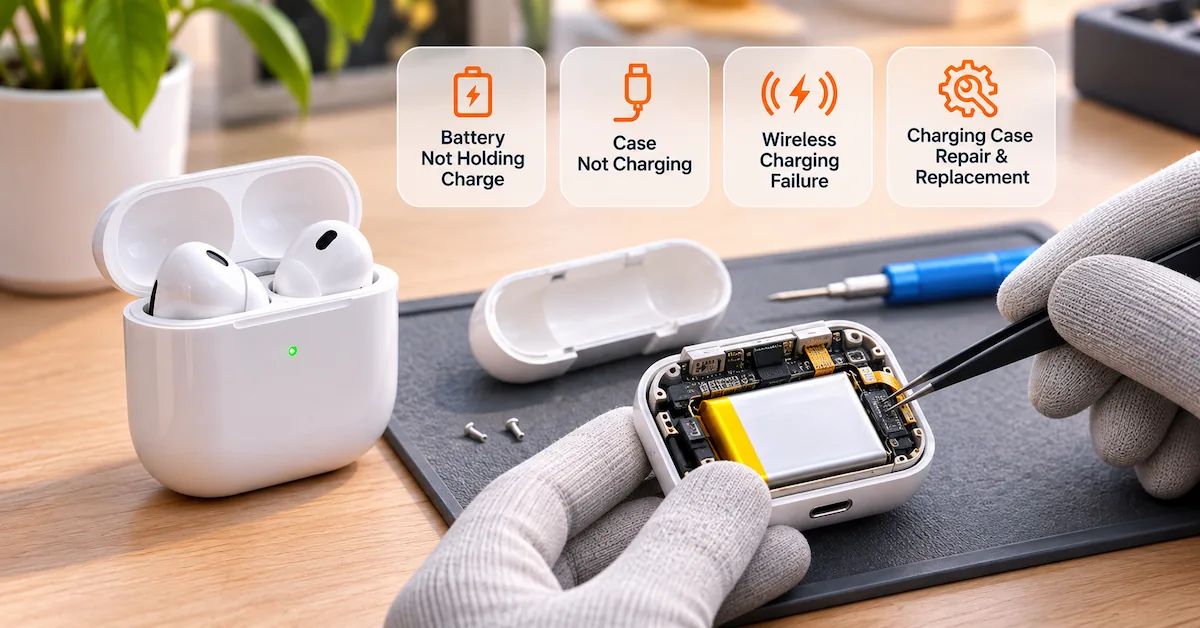
TL;DR: AirPods charging case repair should start with non-invasive troubleshooting. Check the charging cable, power source, charging status, and case contacts before assuming the internal battery is defective. If the case still fails, a qualified technician should determine whether the problem involves battery degradation, the charging connector, or internal electronics. For B2B repair businesses, repairing the battery is worthwhile only when compatibility, safety, labor costs, and final quality requirements justify the work.
An AirPods charging case performs several important functions. It protects the earbuds, stores energy for additional charging, provides a charging interface, and supports device connection or status functions depending on the model.
When the charging case stops working, users may experience several symptoms: no charging indicator, rapid battery drain, earbuds that fail to charge, or a case that cannot maintain its charge.
However, these symptoms do not always indicate battery failure.
A damaged cable, contaminated charging port, poor earbud contact, or charging electronics problem may produce similar results.
For professional repair shops and refurbishment businesses, correctly identifying the fault is essential before purchasing replacement components.
ESC supplies aftermarket batteries for portable electronic devices and maintains an AirPods charging case battery category for professional repair and wholesale sourcing inquiries.
This guide explains how to diagnose charging case failures, compare repair strategies, and establish quality-control procedures for reliable B2B purchasing.
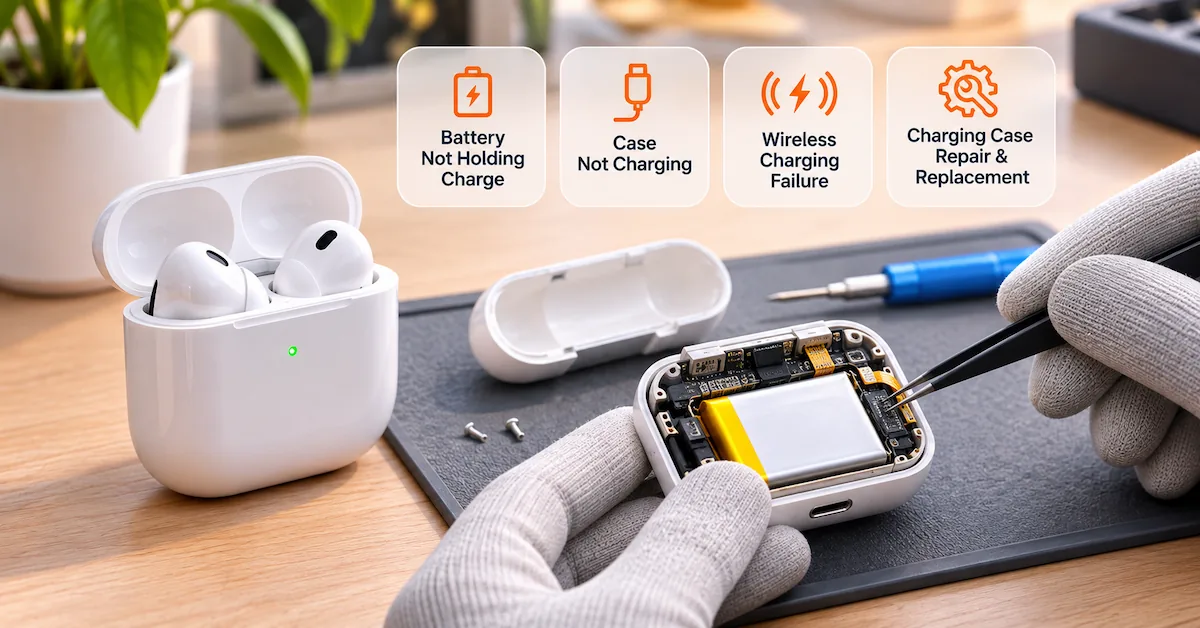
AirPods Charging Case Repair: Quick Fault Comparison
The following table helps identify which component should be investigated first.
| Charging case symptom | Possible cause | Initial diagnostic action | Repair consideration |
|---|---|---|---|
| Case does not charge | Cable, adapter, connector, electronics | Verify compatible external power | Repair or replace after diagnosis |
| No status light | Low charge, charging fault, electronic failure | Connect power and check status | Do not assume battery failure |
| Case loses charge quickly | Battery aging or abnormal consumption | Compare charge retention | Evaluate case battery condition |
| One earbud does not charge | Dirty or damaged contact, earbud fault | Inspect seating and charging status | Diagnose contact or earbud |
| Both earbuds fail to charge | Case battery, contacts, charging circuit | Verify case and earbud charge state | Isolate the affected subsystem |
| Wireless charging fails | Alignment, charger, wireless circuitry | Compare supported wired charging | Evaluate wireless charging system |
| Case becomes unusually hot | Charging fault, battery damage, other abnormality | Stop charging and use | Safety assessment required |
| Case no longer pairs | Software state, compatibility or electronics | Follow model-specific reset guidance | Do not replace battery automatically |
Key takeaway: A charging case that appears defective may not need a new battery. The correct repair depends on identifying the actual failed component.
Key Takeaways
-
Check external charging first. Cables, adapters, wireless alignment, and charging-port contamination can cause charging problems.
-
Separate case and earbud battery faults. The charging case and individual earbuds contain different power-storage components.
-
Identify the exact case model. AirPods generations and charging case variants are not universally interchangeable.
-
Battery repair is technically demanding. Compact enclosures and adhesive construction require specialized repair capabilities.
-
Compare total repair costs. Battery price alone does not determine whether internal repair is economical.
-
Verify replacement batteries before purchasing. Capacity, voltage, dimensions, connector configuration, and lot traceability matter.
-
Do not assume universal compatibility. A battery suitable for one AirPods charging case may not fit another generation.
Why Is My AirPods Charging Case Not Charging?
The most useful first step is to determine whether the problem comes from the external power connection, the charging case itself, or the earbuds.
Check the charging cable and power adapter
Apple recommends connecting the case to a suitable power source and confirming the cable connections.
Depending on the charging case generation, the connection may use Lightning or USB-C.
Use an appropriate cable and a known-working power adapter.
If the case does not respond, allow a normal charging period before deciding that the battery has failed.
Apple recommends charging the earbuds and case for at least 15 minutes during initial troubleshooting.
Inspect the charging port
Dust or debris can interfere with charging.
Apple recommends using a clean, dry, soft-bristled brush to remove external debris.
Avoid inserting metal objects or tools into the charging port, and do not introduce liquids.
If the connector appears physically damaged, the case should be assessed by a qualified repair provider.
Check wireless charging compatibility
Not every AirPods charging case supports wireless charging.
For supported cases, verify the charger and position the case correctly.
A wireless charging problem does not automatically mean the internal battery is defective.
Check the charging status
AirPods battery information can be viewed through a compatible paired Apple device.
The status light also provides useful information.
With the earbuds inside, the light generally indicates earbud charging status. Without the earbuds inside, it indicates the case's charging status.
If the case has no usable charge, the indicator may not illuminate until sufficient power is available.
Reset the AirPods when appropriate
Software or pairing problems may sometimes be resolved through Apple's model-specific reset procedure.
Reset methods differ between generations.
A reset should not be used as a substitute for assessing visible physical damage, overheating, or battery swelling.
How Do You Identify the Correct AirPods Charging Case?
Compatibility is especially important for professional repair and parts sourcing.
Apple AirPods charging cases differ by generation, charging connector, wireless charging capabilities, and internal construction.
AirPods charging case compatibility reference
| Charging case | Model number | Charging connection |
|---|---|---|
| AirPods 1/2 Lightning case | A1602 | Lightning |
| AirPods 1/2 Wireless Charging Case | A1938 | Lightning and supported Qi wireless charging |
| AirPods 3 MagSafe case | A2566 | Lightning and supported wireless charging |
| AirPods 3 Lightning case | A2897 | Lightning |
| AirPods 4 standard case | A3058 | USB-C |
| AirPods 4 ANC case | A3059 | USB-C and supported wireless charging |
| AirPods Pro 2 Lightning case | A2700 | Lightning and supported wireless charging |
| AirPods Pro 2 USB-C case | A2968 | USB-C and supported wireless charging |
| AirPods Pro 3 case | A3122 | USB-C and supported wireless charging |
These model references are based on Apple's published identification information.
Important: A shared charging connector does not establish case interchangeability or internal battery compatibility.
A USB-C case for one AirPods generation should not automatically be considered suitable for another.
For B2B buyers, the charging case model number, the associated earbud generation, and the replacement battery reference should all be verified independently.
How to Distinguish Charging Case Battery Failure From Other Faults
A charging case contains an internal rechargeable battery, charging electronics, connectors, and contacts used to charge the earbuds.
These components can produce similar symptoms when they fail.
Battery degradation
A battery that has experienced significant aging may store less usable energy.
Possible symptoms include reduced charging reserve and shorter operating time between case recharges.
However, short runtime alone is not proof of a defective cell.
Charging connector failure
A damaged Lightning or USB-C interface may prevent the case from receiving power.
A charging case with a functioning battery can still appear completely discharged if its input path is faulty.
Internal charging electronics
The charging circuit manages energy transfer and battery charging.
Problems in this circuit may cause charging interruptions, inaccurate status behavior, or failure to charge.
These faults require professional diagnosis.
Earbud contact problems
The case may charge normally while one earbud fails to receive power.
This can result from contamination, poor seating, damaged contacts, or an earbud-related defect.
ESC's existing AirPods battery replacement and diagnosis guide explains how to distinguish earbud battery problems from charging case battery problems.
Diagnostic comparison
| Test observation | What it may indicate |
|---|---|
| Case charges through cable but not wirelessly | Wireless charging path requires investigation |
| Case fails with multiple known-good cables | Connector, electronics or battery issue possible |
| Case reports charge but has little usable reserve | Battery degradation or abnormal consumption possible |
| Case charges normally but one earbud does not | Contact or individual earbud problem possible |
| Case becomes hot or visibly deformed | Stop ordinary testing and initiate safety response |
A professional diagnosis should use several observations rather than one symptom.
Can You Repair an AirPods Charging Case Battery?
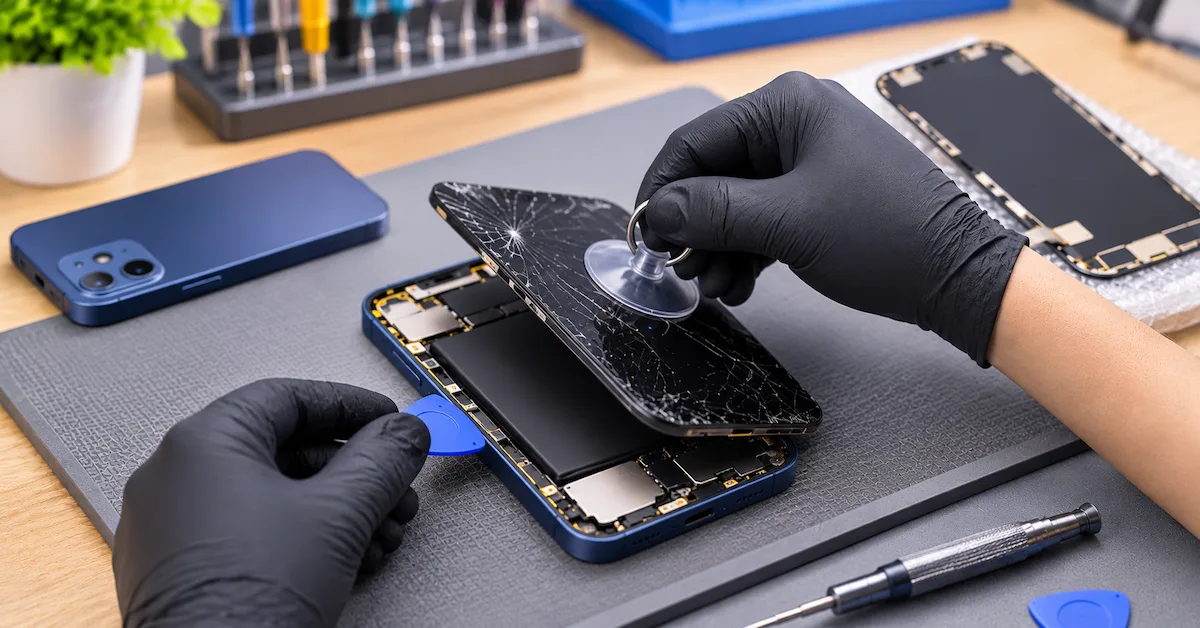
Battery repair is technically possible in certain specialized workflows, but it is not a simple consumer battery replacement.
Charging cases are compact assemblies containing closely positioned electronic components and lithium-ion cells.
Adhesives, internal connections, and enclosure construction can make disassembly difficult.
A community-contributed iFixit guide for early-generation AirPods charging cases describes battery replacement as a very difficult repair.
That repair example should not be generalized to every modern AirPods case.
Why battery replacement is difficult
The main challenges include:
Compact internal space: The replacement cell must fit within strict mechanical limits.
Cell connection: The electrical interface must match the original design.
Enclosure construction: Opening the housing may damage internal components or the case itself.
Battery safety: Physical damage to a lithium-ion cell can create serious hazards.
Reassembly: The completed case must support normal charging and mechanical operation.
Is DIY replacement recommended?
Internal battery repair is better suited to specialized technicians with appropriate equipment, training, and safe handling procedures.
Do not puncture, crush, short-circuit, or apply uncontrolled heat to a lithium-ion cell.
A visibly swollen, leaking, or abnormally hot case should not undergo ordinary charging or repair testing.
AirPods Charging Case Repair vs Battery Replacement vs Full Case Replacement
For professional repair businesses, the decision should be based on technical feasibility and total cost.
| Repair strategy | Suitable situation | Main advantage | Main limitation |
|---|---|---|---|
| External troubleshooting | Power or software issue suspected | No internal disassembly | Does not resolve failed hardware |
| Charging port repair | Confirmed connector fault | May preserve original case | Requires specialized repair capability |
| Internal battery replacement | Confirmed battery degradation | May retain usable case electronics | Difficult assembly and quality validation |
| Complete case replacement | Multiple faults or uneconomical repair | Avoids rebuilding damaged internals | Requires exact compatible case |
| Retirement or parts recovery | Unsafe or uneconomical device | Avoids further repair spending | Requires appropriate handling |
When should a repair shop choose battery replacement?
Consider internal battery replacement when the fault has been properly identified, a compatible cell is available, and the facility has the capability to complete and validate the repair.
When is full case replacement more practical?
Replacement may be preferable when several components are defective, the enclosure is heavily damaged, or internal repair costs exceed the value of the completed case.
What about Apple service?
Apple offers official AirPods service and replacement options.
An authorized service assessment may be more appropriate for customers who require genuine Apple components or official warranty support.
What Battery Specifications Matter for AirPods Charging Case Repair?
A replacement cell should be selected according to the exact case construction.
A similar appearance or advertised capacity does not establish compatibility.
Recommended battery specification checklist
| Specification | B2B purchasing requirement |
|---|---|
| Charging case model | Exact Apple case reference |
| Battery part number | Original or approved replacement reference |
| Battery chemistry | Confirmed rechargeable lithium-ion design |
| Capacity | Rated value and measurement conditions |
| Nominal voltage | Matches the approved electrical design |
| Charging limits | Compatible with case electronics |
| Dimensions | Verified length, width and thickness |
| Connector or leads | Correct connection arrangement |
| Protection features | Appropriate to the actual assembly |
| Physical condition | No unacceptable damage or deformation |
| Traceability | Supplier SKU and lot information |
| Documentation | Relevant product and transport records |
These are recommended purchasing fields, not specifications for a particular ESC charging case battery.
Why capacity alone is insufficient
Two batteries may have the same mAh rating but different dimensions, voltage limits, or electrical connections.
A replacement must satisfy the complete technical requirements of the charging case.
Higher capacity is not automatically better.
If the proposed battery has not been validated within the specific case, the buyer should not approve it for production repair.
How Should Repair Shops Test a Charging Case After Repair?
A completed repair should pass defined functional checks before the case is returned to a customer or sold as refurbished.
Recommended final inspection
| Inspection item | Acceptance consideration |
|---|---|
| Physical condition | No unacceptable damage or deformation |
| Charging input | Normal operation with compatible power |
| Case charging status | Appropriate status behavior |
| Battery retention | Meets agreed performance criteria |
| Earbud charging | Both compatible earbuds charge normally |
| Wireless charging | Verify when supported by the case |
| Pairing behavior | Normal operation with supported devices |
| Lid and enclosure | Proper fit and operation |
| Temperature behavior | No unexplained abnormal heating |
| Final documentation | Repair outcome and relevant part identification |
A case that shows a charging light has not necessarily passed all functional requirements.
Likewise, a successful pairing test does not prove that the internal battery provides adequate charging reserve.
The repair facility should maintain separate records for charging, battery performance, and related functions.
How Much Does AirPods Charging Case Repair Cost?
The total cost depends on the failed component, repair complexity, technician labor, parts availability, testing, and warranty exposure.
For professional repair operations:
Total Repair Cost = Replacement Parts + Labor + Consumables + Inspection + Rework Allowance + Warranty Costs
Illustrative repair economics
Consider a hypothetical repair business evaluating two options.
| Cost component | Internal battery repair | Complete case replacement |
|---|---|---|
| Component | $7 | $24 |
| Professional labor | $20 | $5 |
| Consumables | $3 | $0 |
| Inspection | $5 | $4 |
| Total illustrative cost | $35 | $33 |
These are hypothetical figures, not ESC quotations or current Apple service prices.
The example demonstrates why a cheaper replacement battery does not necessarily produce the lowest completed repair cost.
For high-volume refurbishers, installation success rate and warranty claims can significantly influence the preferred strategy.
Repair-or-replace decision
A business should approve internal repair only when the expected outcome meets the required functional standard and the total cost is commercially justified.
A lower component price should not override safety, compatibility, or quality requirements.
AirPods Charging Case Battery Wholesale: How Should Suppliers Be Evaluated?
Professional battery buyers need evidence that a proposed replacement cell matches the approved case.
ESC maintains an AirPods Charging Case Battery product category describing wholesale battery sourcing, quality testing, and customization services.
However, the current public category page does not display individual purchasable battery SKUs.
Therefore, availability, capacity, compatibility, and commercial terms must be confirmed for the specific requested model.
Supplier qualification checklist
Buyers should request:
-
Exact charging case compatibility
-
Battery reference and configuration
-
Electrical specifications
-
Physical dimensions and connector information
-
Sample availability
-
Capacity and functional test methods
-
Lot identification
-
Packaging and shipping documentation
-
Product-change notification procedures
-
Warranty and nonconforming-goods handling
Why sample approval matters
A working sample does not establish that every future lot will perform identically.
For bulk orders, a qualified technical team should evaluate representative batteries and document the approved configuration.
Incoming inspection should confirm that production material matches the approved sample.
OEM and private-label requirements
ESC describes OEM/ODM and private-label services within its wearable and audio battery portfolio.
Specific customization scope, MOQ, packaging, and lead time require order-level confirmation.
Private-label packaging must remain linked to the actual compatible battery.
B2B Purchasing Case: Repairing 100 Charging Cases
Consider a hypothetical refurbishment business receiving 100 AirPods charging cases with reported charging problems.
The company should not immediately order 100 replacement batteries.
Instead, it separates the cases into diagnostic groups.
Group A: External charging or connection issues that may be resolved without internal repair.
Group B: Cases with evidence supporting internal battery degradation.
Group C: Cases with suspected connector or electronic faults.
Group D: Cases with physical damage, safety concerns, or commercially unsuitable repair conditions.
The business then reviews actual repair outcomes.
Performance indicators
| Metric | Commercial purpose |
|---|---|
| Cases repaired without opening | Measures successful initial troubleshooting |
| Battery-related confirmed failures | Supports replacement battery demand |
| Charging-port failures | Identifies component repair requirements |
| First-pass repair yield | Measures successful completed repairs |
| Labor per accepted case | Supports repair-cost planning |
| Post-repair returns | Identifies recurring quality problems |
| Cost per accepted case | Supports repair-versus-replace decisions |
This is an illustrative workflow, not a documented ESC customer project.
Its purpose is to demonstrate how diagnostics can reduce unnecessary battery purchasing and improve parts planning.
How to Prepare an AirPods Charging Case Battery RFQ
A professional request for quotation should identify exactly which charging case battery is required.
| RFQ field | Information to provide |
|---|---|
| Buyer type | Repair shop, refurbisher, distributor or brand |
| AirPods generation | Exact device generation |
| Charging case model | Apple case model number |
| Requested component | Case battery, not earbud battery |
| Original battery reference | Available markings or specification |
| Electrical requirements | Capacity, voltage and charging limits |
| Mechanical requirements | Dimensions and connection design |
| Order quantity | Samples and expected bulk volume |
| Quality requirements | Inspection and acceptance criteria |
| Packaging | Standard or private-label |
| Documentation | Destination-market and transport requirements |
| Delivery | Destination and requested schedule |
| Warranty | Required claim conditions |
For model-specific sourcing, buyers can contact ESC with the exact charging case model, battery reference, quantities, and technical requirements.
Request confirmation of product availability and sample specifications before committing to a bulk order.
Frequently Asked Questions About AirPods Charging Case Repair
1. Can an AirPods charging case be repaired?
Some charging case faults can be resolved through external troubleshooting, while others may require professional component-level repair. Internal battery or charging-circuit repairs can be difficult because of the compact enclosure. The correct option depends on the exact model, fault, and repair economics.
2. Why is my AirPods charging case not charging?
Possible causes include a damaged cable, unsuitable power source, contaminated connector, battery degradation, or internal charging electronics failure. Check the external power connection and charging status before assuming the battery is defective.
3. Can you replace the battery inside an AirPods charging case?
Battery replacement is technically possible for certain case designs, but it is a specialized repair rather than a simple consumer battery swap. A compatible cell, qualified technician, appropriate equipment, and completed-case testing are necessary.
4. Why does my AirPods case lose charge so quickly?
Rapid discharge may indicate battery aging, abnormal electronic consumption, or another charging-system problem. Review the case's charging and retention behavior before determining that the internal battery requires replacement.
5. Can I use a charging case from another AirPods generation?
Not automatically. Charging cases have different mechanical, electrical, and pairing requirements. Compatibility must be verified using the exact AirPods and case models rather than relying on connector type or appearance.
6. How do I know whether my AirPods case battery is defective?
A technician should first rule out external charging problems, contact issues, and software-related behavior. Battery failure becomes a stronger possibility when controlled testing identifies inadequate energy retention or abnormal battery performance.
7. Is replacing the charging case cheaper than repairing its battery?
It depends on parts and labor costs. Internal battery repair may require significant specialist work, while a compatible replacement case can avoid some disassembly risks. Compare total cost and finished-device quality rather than component price alone.
8. Will resetting AirPods fix charging case battery problems?
Resetting may resolve certain software or connection issues, but it cannot restore a physically degraded battery or repair damaged charging electronics. Follow the appropriate model-specific reset procedure and assess unresolved hardware faults separately.
9. What should wholesalers check when buying AirPods case batteries?
Verify the exact case model, capacity, voltage, dimensions, connection structure, sample performance, traceability, and applicable documentation. Approve the replacement configuration before purchasing production quantities.
10. Does ESC supply AirPods charging case replacement batteries?
ESC publishes an AirPods Charging Case Battery category for professional sourcing inquiries. However, specific battery SKUs are not currently displayed on the public category page. Buyers should contact ESC to confirm compatible models, availability, samples, and commercial terms.
Conclusion
AirPods charging case repair should begin with accurate fault diagnosis rather than immediate battery replacement.
A case that fails to charge may have a cable, connector, charging-contact, battery, or electronics problem. Identifying the cause helps avoid unnecessary repairs and replacement-part purchases.
For professional repair businesses, internal battery repair also requires careful consideration of compatibility, technician capability, lithium-ion battery safety, and completed-device testing.
A replacement battery should meet the charging case's specific electrical and mechanical requirements. Capacity alone does not establish compatibility or performance.
For B2B refurbishers and distributors, a structured process combining initial troubleshooting, supplier qualification, sample approval, final quality inspection, and warranty tracking can support more reliable repair outcomes.
ESC maintains an AirPods charging case replacement battery category and a broader wearable and audio battery portfolio for professional sourcing discussions.
To evaluate compatible replacement batteries, sample availability, wholesale quantities, or customization requirements, contact ESC with your exact charging case models and purchasing specifications.
By separating battery faults from other charging-system problems and qualifying replacement components before use, repair businesses can reduce avoidable rework, improve quality consistency, and make more informed B2B purchasing decisions.