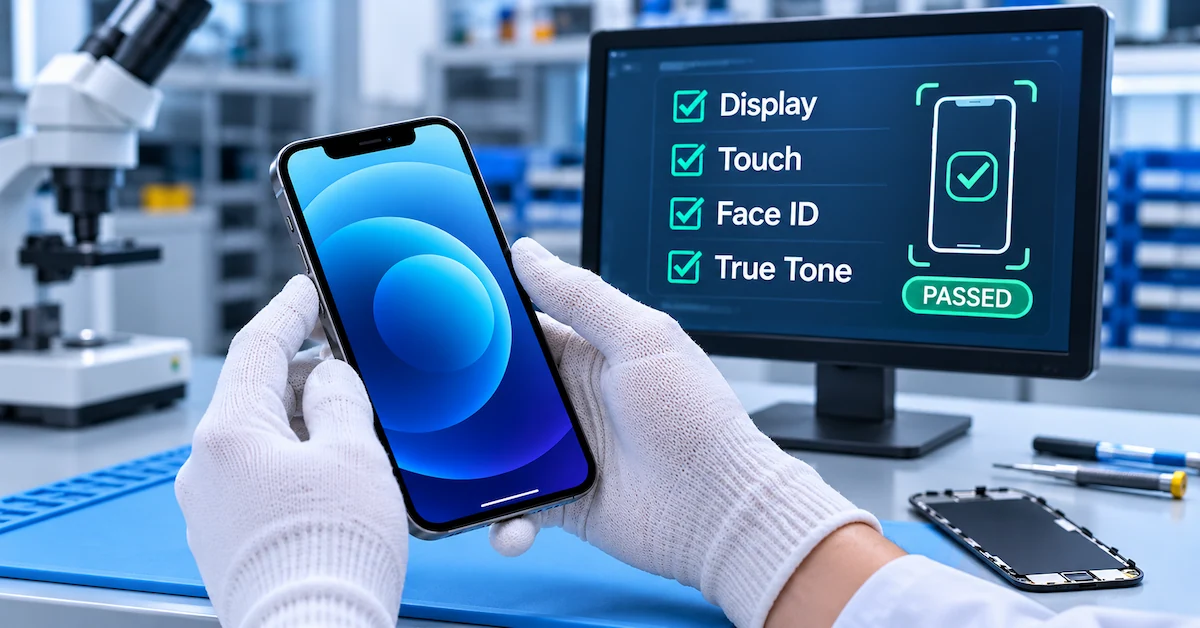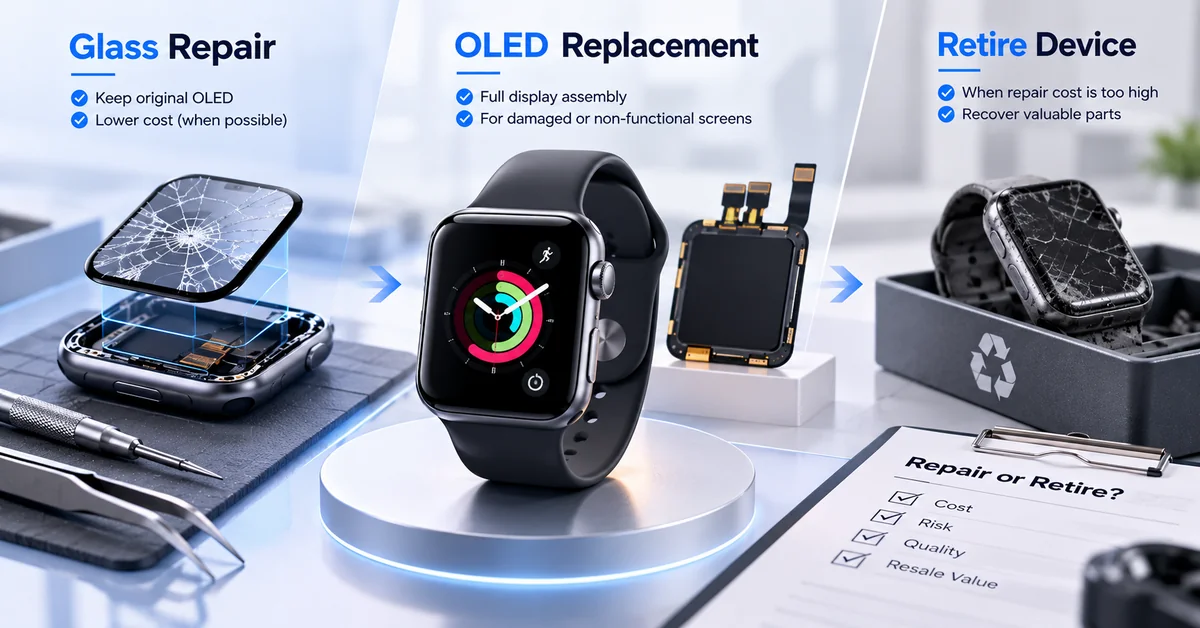

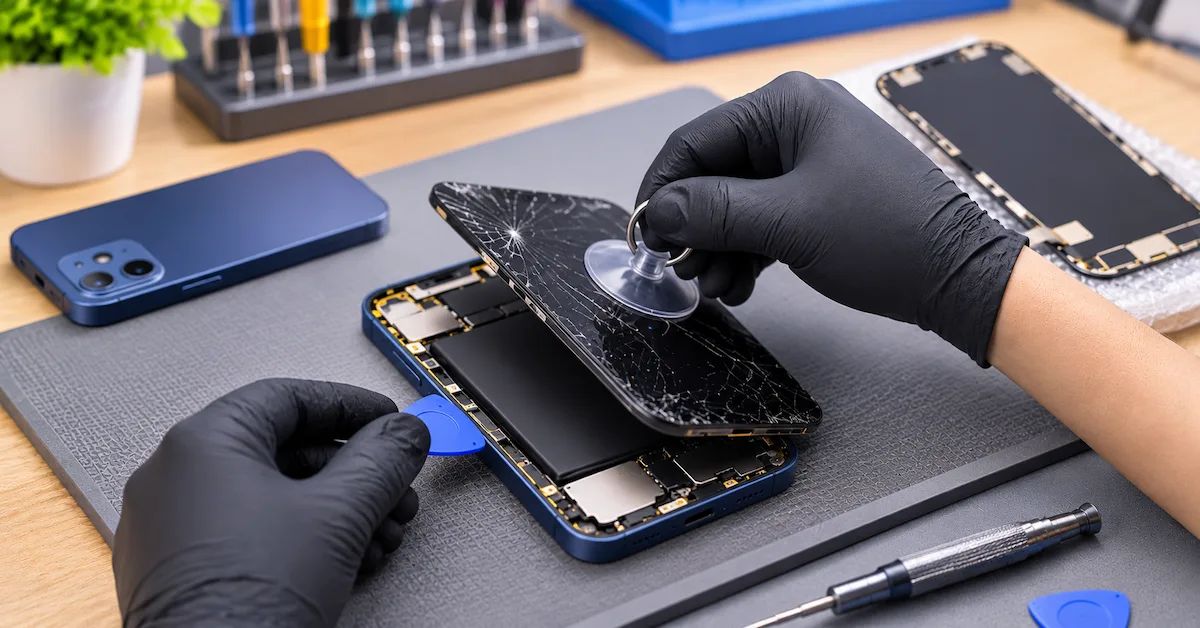
Quick Answer: An iPhone 12 mini screen replacement is appropriate when the display assembly has confirmed damage, such as cracked glass, failed OLED pixels, colored lines, or defective touch input. The original phone uses a 5.4-inch Super Retina XDR OLED display, and its compact assembly requires careful handling of Face ID-related sensors. For professional repair shops, the decision should consider replacement-screen quality, Repair Assistant eligibility, battery condition, labor, and the expected value of the repaired device.
The iPhone 12 mini screen replacement process presents a different commercial challenge from repairing newer or larger smartphones.
Introduced in 2020, the iPhone 12 mini remains relevant to customers who prefer a compact smartphone. However, as devices age, professional repair businesses must decide whether investing in a new display is economically justified.
A cracked display may be the only problem with an otherwise functional phone.
Another device may have a black screen caused by a power fault, an aged battery, or damaged internal components.
For repair technicians, accurate diagnosis prevents unnecessary screen replacements.
For refurbishers and wholesalers, the decision is more complex because display cost, installation labor, battery condition, and resale value must be considered together.
This guide focuses specifically on the iPhone 12 mini's compact construction, sensitive front-sensor components, screen replacement decisions, and commercial refurbishment requirements.
It also explains when battery replacement should be evaluated separately.
1. What Should You Know Before Replacing an iPhone 12 Mini Screen?
The original iPhone 12 mini display uses OLED technology.
This means its image characteristics differ from those of traditional LCD screens.
Before ordering replacement parts, repair businesses should understand the specifications of the original display.
Original iPhone 12 mini display specifications
| Specification | Original Apple specification |
|---|---|
| Device | iPhone 12 mini |
| Display technology | Super Retina XDR OLED |
| Display size | 5.4 inches |
| Resolution | 2340 × 1080 pixels |
| Pixel density | 476 ppi |
| HDR | Supported |
| True Tone | Supported |
| Wide color | P3 |
| Haptic Touch | Supported |
| Typical contrast ratio | 2,000,000:1 |
| Typical maximum brightness | 625 nits |
| Peak HDR brightness | 1,200 nits |
| Screen protection | Ceramic Shield front |
| Original refresh-rate class | 60Hz |
These values describe the original display, not every aftermarket replacement assembly.
Apple provides the specifications in its iPhone 12 mini Technical Specifications.
Why the compact screen matters
The iPhone 12 mini has a smaller enclosure than the standard iPhone 12.
Its display and surrounding components must fit within that compact construction.
Repair technicians should therefore pay particular attention to opening clearance, internal connectors, sensor assemblies, and display alignment.
A replacement screen should be selected using the exact phone model and approved assembly reference.
Do not assume that an iPhone 12 or iPhone 13 mini screen is compatible with an iPhone 12 mini.
The 13 mini also uses a 5.4-inch display, but similar dimensions do not establish assembly interchangeability.
2. How Do You Know Whether the Screen Actually Needs Replacement?
Not every display-related symptom requires a new screen.
Professional repair shops should distinguish physical screen damage from software, charging, battery, and other hardware faults.
Common iPhone 12 mini screen problems
| Symptom | Possible cause | Recommended action |
|---|---|---|
| Cracked front glass | Physical impact damage | Assess display assembly and repair feasibility |
| Vertical colored lines | OLED panel or display electronics damage | Evaluate replacement |
| Black screen | Display, power, battery, software, or board problem | Diagnose before ordering |
| Touchscreen not responding | Touch layer, connector, or software issue | Perform relevant functional checks |
| Ghost touch | Touch subsystem or related fault | Investigate and document |
| Abnormal color | Display damage, calibration, or replacement quality | Compare against reference |
| Display flickering | Panel electronics, software, or power issue | Controlled troubleshooting |
| Screen lifting | Adhesive, enclosure, or possible battery swelling | Investigate safety before repair |
When replacement is likely necessary
Replacement becomes a reasonable option when the screen assembly has confirmed physical or functional damage that cannot be corrected through appropriate non-invasive troubleshooting.
Examples include severe glass damage, persistent panel defects, and confirmed touch failure.
When the screen may not be responsible
If the phone has a black display and does not appear to start, the battery or power system may need investigation.
Likewise, a phone that shuts down unexpectedly may have a battery-related problem rather than a defective OLED panel.
Repair rule: Confirm the failed subsystem before purchasing the replacement component.
3. Why Is iPhone 12 Mini Screen Replacement Technically Difficult?
The iPhone 12 mini combines a compact OLED assembly with sensitive components around the top of the display.
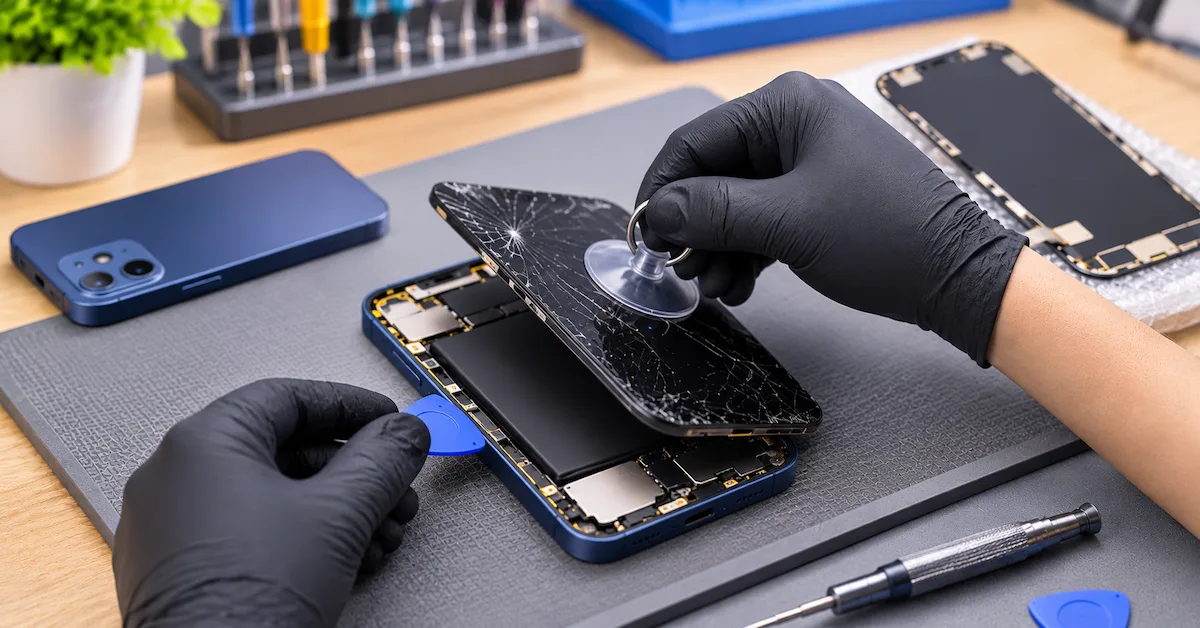
The repair requires controlled disassembly, careful component handling, and appropriate reassembly.
Compact construction
The phone's limited internal space can make cable handling and component access more demanding.
Improper opening techniques may damage display connectors, nearby components, or the original screen assembly.
Strong display adhesive
The display is secured to the enclosure using adhesive.
Opening the device disturbs this seal.
A replacement adhesive may be required during reassembly, but applying new adhesive does not automatically restore the original factory water-resistance rating.
Sensitive sensor assembly
The display's upper assembly is associated with the phone's earpiece and important sensors.
Damage to these parts may create additional repair requirements.
Difficult repair classification
iFixit classifies its iPhone 12 mini screen replacement procedure as difficult and identifies approximately 2–3 hours for the guided repair.
This is a guide-level reference, not a guaranteed labor time for professional repair businesses.
The exact time depends on technician experience, device condition, tooling, and repair procedure.
For detailed model-specific technical instructions, consult Apple's iPhone 12 mini Repair Manual and the relevant approved service procedure.
4. How Can Technicians Protect Face ID During Screen Replacement?
Face ID protection is one of the most important requirements when servicing this model.
The iPhone 12 mini uses the TrueDepth camera system for facial recognition.
In typical independent screen-assembly replacement procedures, the original earpiece and related sensor assembly requires special handling.
Why the original sensor assembly matters
The repair guidance published by iFixit explains that the earpiece speaker and sensor assembly attached to the display is associated with the individual device.
The assembly includes a flood illuminator associated with Face ID.
Improper handling or damage can cause Face ID to stop functioning.
Recommended professional precautions
Before repair:
-
Verify whether Face ID already works.
-
Record any existing biometric or camera problems.
-
Confirm the replacement display's supplied components.
-
Use the correct model-specific repair procedure.
During repair:
-
Protect sensitive flex cables and connectors.
-
Follow appropriate procedures for retaining or transferring necessary original components.
-
Avoid excessive force or uncontrolled heat.
-
Stop if components appear damaged or unsafe to handle.
After repair:
-
Confirm Face ID operation.
-
Check the front camera.
-
Verify proximity and ambient-light-related functions.
-
Record any remaining problems separately.
For further technical reference, see the iFixit iPhone 12 mini Screen Replacement Guide.
Does replacing the screen automatically disable Face ID?
No.
A successful display replacement does not inherently mean Face ID must stop working.
However, damage to associated components, incorrect repair procedures, or unresolved calibration issues can affect the final result.
For professional repair businesses, Face ID should be a mandatory before-and-after inspection item.
5. Which Replacement Screen Type Should You Choose?
The iPhone 12 mini originally uses OLED.
Replacement parts offered in the repair market may differ in technology, origin, construction, and quality.
Replacement screen comparison
| Screen type | Main advantage | Main limitation | Purchasing consideration |
|---|---|---|---|
| New genuine Apple display | Original-design component | Requires suitable sourcing and repair process | Verify genuine part and service eligibility |
| Refurbished original OLED | May retain original OLED panel | Quality depends on refurbishment workmanship | Confirm panel condition and replaced components |
| Aftermarket soft OLED | Flexible OLED-based construction | Performance varies by supplier | Test optical and mechanical quality |
| Aftermarket hard OLED | Alternative OLED construction | Requires durability and fit validation | Verify suitability for the target repair grade |
| Aftermarket LCD | May have lower initial cost | Different display characteristics from original OLED | Disclose limitations and validate compatibility |
Is soft OLED always better?
Not automatically.
Soft OLED describes a particular flexible display construction.
However, the overall quality of a replacement depends on multiple factors, including panel performance, touch behavior, assembly quality, and supplier consistency.
A label such as "Premium Soft OLED" is not evidence of performance by itself.
Should you use an LCD replacement?
An LCD alternative may appear financially attractive because of its purchase price.
However, it is not the original display technology.
Potential differences may include contrast, black-level performance, thickness, viewing characteristics, and energy consumption.
For refurbished devices marketed as maintaining the original OLED display experience, such differences must be considered.
Recommended screen selection rule
For high-grade refurbishment, prioritize replacement displays that meet the promised finished-device standard.
For lower-priced repair channels, evaluate alternative configurations only after confirming technical compatibility and accurately communicating material differences.
The best screen is not necessarily the most expensive option.
It is the one that satisfies the required quality and commercial criteria.
6. What Happens to True Tone After iPhone 12 Mini Screen Replacement?
True Tone adjusts display color characteristics in response to the surrounding lighting environment.
Whether it functions correctly after replacement depends on the installed part, software, and repair process.
Why True Tone may be affected
Apple explains that nongenuine replacement displays may experience display-related limitations.
Possible effects include inaccurate color behavior, reduced brightness, touch issues, or True Tone not working correctly.
These are possible issues, not proof that every aftermarket display will behave in the same way.
What should repair businesses verify?
Check the following separately:
Feature availability: Is the True Tone setting present?
Functional behavior: Does the display respond appropriately to changing lighting conditions?
Repair status: Has the applicable calibration or repair-completion process been performed?
Why software version matters
Some older iOS versions handled replacement displays differently from current supported versions.
Apple's Repair Assistant can help complete eligible display repairs when the relevant part, device, and software requirements are met.
Therefore, a supplier's blanket claim that a replacement screen will always preserve True Tone should be treated cautiously.
B2B purchasing recommendation
Before approving bulk replacement screens, test representative samples on the intended iPhone 12 mini software configurations.
Record the actual True Tone behavior rather than relying on an unsupported marketing statement.
7. Does iPhone 12 Mini Support Repair Assistant?
Yes. Apple includes eligible iPhone 12-family display repairs within its current Repair Assistant support framework.
Repair Assistant is designed to install applicable calibration data and complete supported repairs.
However, its operation depends on the replacement part and service requirements.
Supported repair conditions
Apple's published guidance includes requirements such as:
-
A supported device
-
An eligible replacement component
-
Current supported iOS software
-
Internet access through Wi-Fi
-
Battery charge above 20%
-
Completion of the applicable repair process
How to access Repair Assistant
On a supported repair:
-
Open Settings.
-
Select General.
-
Open About.
-
Open Parts and Service History.
-
Select Restart & Finish Repair when available.
-
Follow the onscreen instructions.
Not every installed part will qualify for the same calibration process.
For official requirements, refer to Apple's Repair Assistant guidance.
Important difference from newer iPhones
Apple's supported reuse of genuine parts from another device of the same model applies to iPhone 15 and later under specified conditions.
That newer-device policy should not automatically be extended to iPhone 12 mini.
Repair businesses must verify whether a particular component and service process is eligible.
Does Repair Assistant make an aftermarket screen genuine?
No.
Software calibration and component authenticity are separate matters.
A replacement must not be described as a genuine Apple part simply because the device starts successfully or supports selected display functions.
8. What Does Parts and Service History Show After Replacement?
On supported iOS versions, the iPhone 12 mini can display information about previous relevant repairs.
The available information can be found under:
Settings → General → About → Parts and Service History
The section generally appears when the device has applicable recorded repair information.
Common repair status information
| Status | General interpretation | Recommended action |
|---|---|---|
| Genuine | Genuine Apple component and applicable completed process | Document and verify functionality |
| Unknown | Component cannot be verified as expected, or another listed condition applies | Record and investigate |
| Finish Repair | Eligible repair completion remains outstanding | Follow supported completion process |
The exact wording and available statuses depend on the device and software.
Does Unknown mean the screen is defective?
Not necessarily.
Apple explains that Unknown can appear under several circumstances, including a nongenuine component or a component that cannot be verified or is not functioning as expected.
The message should be recorded accurately.
It should not be treated as a complete electrical diagnosis.
Why this matters for refurbished phones
Repair history can influence customer expectations and resale disclosures.
A refurbishment company should distinguish:
-
Actual screen functionality
-
Component origin
-
Available repair-status information
-
Customer disclosure requirements
A device can be tested for image and touch performance independently of how its replacement part is described by the operating system.
9. What Is the Professional iPhone 12 Mini Screen Replacement Workflow?
A controlled repair process is more useful than an improvised parts swap.
The following describes a professional workflow at a high level.
It does not replace Apple's detailed repair manual.
Stage 1: Confirm device identity and fault
Verify that the phone is an iPhone 12 mini.
Record the original display symptoms, battery condition, and relevant service history.
Check whether Face ID, cameras, charging, and other functions operate before the repair.
Stage 2: Prepare the device and workstation
Arrange appropriate repair tools, safety equipment, and approved replacement components.
Protect customer data according to the repair agreement.
Inspect the phone for battery swelling, deformation, or other signs of damage.
If the battery is unsafe, stop normal repair work.
Stage 3: Open the device using the correct procedure
A qualified technician should follow the applicable model-specific opening instructions.
Opening the display can damage the original seal.
Avoid uncontrolled force or heat, especially near the battery and sensitive internal components.
Stage 4: Protect and inspect the sensor assembly
Identify the components that must remain with the original device or be handled according to an approved repair process.
Pay particular attention to the earpiece and Face ID-related sensor assembly.
Stage 5: Install and verify the replacement assembly
Confirm that the replacement matches the approved iPhone 12 mini configuration.
Follow the appropriate procedure for internal connections, required components, and reassembly.
Stage 6: Complete eligible calibration
Where supported, use the applicable Apple repair-completion process.
Record what the system actually displays.
Stage 7: Perform final quality inspection
Check the completed device before returning it to the customer or approving it for resale.
A phone that powers on has not automatically passed the entire repair.
10. What Should Be Tested After Screen Replacement?
For professional repair shops, final quality control should include the display, supporting functions, and overall phone condition.
Post-repair acceptance checklist
| Inspection item | Required observation |
|---|---|
| Image output | Stable image across the full display |
| OLED pixels | No unacceptable dead areas or persistent lines |
| Brightness | Normal behavior under agreed conditions |
| Color | Acceptable color and uniformity |
| True Tone | Expected availability and operation |
| Touchscreen | Accurate response across the full screen |
| Haptic Touch | Appropriate interaction behavior |
| Face ID | Matches required functional status |
| Front camera | Normal image and camera operation |
| Proximity sensor | Appropriate behavior during calls |
| Ambient light sensor | Appropriate brightness response |
| Earpiece | Normal sound output |
| Charging | Stable charging behavior |
| Battery condition | No unresolved battery or power problem |
| Physical fit | No unacceptable gaps or deformation |
| Repair status | Recorded applicable system messages |
| Final appearance | Meets agreed cosmetic standard |
Why sensor testing matters
A screen can display a perfect image while nearby functions remain defective.
For example, the front camera or proximity sensor may have been affected during repair.
Final acceptance should therefore verify more than image quality.
What about water resistance?
The original iPhone 12 mini was designed with IP68 resistance under Apple's specified laboratory conditions.
However, disassembly disturbs the original sealing arrangement.
A replacement adhesive does not automatically establish restoration of factory-equivalent water resistance.
Repair businesses should avoid unsupported waterproof claims.
11. How Much Does iPhone 12 Mini Screen Replacement Cost?
Repair prices vary by country, provider, screen type, labor, additional damage, and warranty conditions.
A fixed international price would be misleading.
For professional repair businesses, the more useful calculation is the total cost of producing an accepted finished device.
Total repair cost
Total Repair Cost = Display Component + Labor + Adhesives and Consumables + Quality Inspection + Expected Rework and Warranty Cost
For refurbishment projects, acquisition and selling costs should also be included.
Why the cheapest screen may not be the best choice
A lower-priced screen may reduce component spending.
However, additional rework, installation failures, or customer complaints can reduce the actual savings.
Buyers should evaluate the cost per accepted repaired phone, not only the quoted price per screen.
Illustrative cost comparison
The following figures are hypothetical and do not represent current ESC screen prices or actual market quotations.
| Cost category | Option A | Option B |
|---|---|---|
| Replacement display | $22 | $38 |
| Labor | $24 | $24 |
| Consumables and inspection | $8 | $8 |
| Expected rework allowance | $17 | $5 |
| Expected total | $71 | $75 |
Option A has the lower total expected cost in this illustration, but that does not automatically make it acceptable.
If Option A fails the required OLED, touch, or sensor-performance standard, it should not be approved for that repair grade.
Commercial comparison should begin only after technical qualification.
12. Is It Worth Replacing the Screen on an Older iPhone 12 Mini?
This is one of the most important questions for refurbishers and used-device wholesalers.
The iPhone 12 mini was introduced in 2020.
By 2026, individual devices can have several years of wear affecting the battery, enclosure, charging connector, and other components.
A new screen may restore the display but will not eliminate unrelated aging or hardware faults.
When screen repair can make sense
Replacement may be commercially reasonable when:
-
The display is the main confirmed fault.
-
The phone's internal hardware is functional.
-
Battery performance meets the intended resale standard.
-
The enclosure is not severely damaged.
-
The repair can meet the required finished-device grade.
-
The expected contribution remains acceptable.
When screen replacement becomes less attractive
Repair may be a poor commercial choice when:
-
The phone has multiple expensive faults.
-
The battery also requires replacement.
-
Face ID has an unresolved hardware problem.
-
The enclosure is bent or seriously damaged.
-
The repair cannot meet the intended resale standard.
-
Total refurbishment cost exceeds the commercial limit.
Example: Calculate the maximum screen repair budget
Assume a hypothetical refurbishment company estimates:
| Item | Amount |
|---|---|
| Expected resale revenue | $175 |
| Used-device acquisition cost | $60 |
| Other processing and selling costs | $28 |
| Warranty allowance | $10 |
| Required contribution | $35 |
| Maximum screen repair budget | $42 |
The calculation is:
$175 − $60 − $28 − $10 − $35 = $42
Under these assumptions, a screen repair costing $60 would not meet the target contribution.
The business would need a lower repair cost, a different purchase price, a higher verified resale value, or another disposition strategy.
This is an illustrative business model, not a measured ESC customer case.
Three purchasing decisions
Repair: The device meets the required technical condition and the repair fits the economic budget.
Hold: The diagnosis or final repair cost is uncertain.
Reject or recover parts: The device is unsafe, uneconomical, or unsuitable for the intended resale category.
For mixed lots, document these decisions separately for each device.
13. How Can Refurbishers Reduce Screen-Related Returns?
Consistent inspection and traceability are essential when repairing multiple used iPhones.
A company should distinguish actual replacement-screen defects from installation errors and pre-existing device faults.
Recommended repair record
| Field | Required information |
|---|---|
| Device model | iPhone 12 mini |
| Device identifier | Internal asset or approved tracking reference |
| Initial screen condition | Physical and functional defects |
| Initial Face ID status | Pass, fail, or untestable |
| Battery condition | Available health and power observations |
| Replacement display | Supplier, SKU, and configuration |
| Repair operator | Technician or workstation |
| Software version | Installed iOS version |
| Calibration | Applicable repair-completion result |
| Final functional test | Approved results |
| Final classification | Accepted, rework, hold, or reject |
| Warranty record | Relevant later complaints |
Why separate defect categories?
Not every failed repair should be recorded as a defective display.
A useful classification system distinguishes:
-
Display manufacturing defect
-
Installation damage
-
Sensor-related fault
-
Incomplete eligible calibration
-
Existing phone hardware problem
-
Battery or power-system problem
-
Unresolved customer complaint
This information can help identify which issues require supplier corrective action and which require changes to repair procedures.
14. What Should B2B Buyers Check Before Ordering iPhone 12 Mini Screens?
If a repair company sources display assemblies from a third-party screen supplier, it should qualify the exact product rather than relying on generic descriptions.
Screen supplier qualification checklist
| Evaluation item | What to verify |
|---|---|
| Compatible model | Exact iPhone 12 mini application |
| Display type | OLED or explicitly disclosed alternative |
| Assembly configuration | Included display components |
| Mechanical dimensions | Approved fit and connector arrangement |
| Optical quality | Image, brightness, color and uniformity |
| Touch function | Full-area response |
| Sensor considerations | Required original component handling |
| Repair software | Expected status under specified iOS versions |
| Sample approval | Representative installed-device testing |
| Quality records | Documented inspection results |
| Lot identification | Supplier SKU and production revision |
| Packaging | Physical protection and accurate labels |
| Warranty | Written terms and failure-handling process |
| Commercial conditions | Price, MOQ, lead time and shipment terms |
How should sample approval work?
First, verify the exact display assembly and its stated specifications.
Next, test representative samples using the intended repair procedure.
Record the results of image quality, touch input, relevant sensors, and post-repair system behavior.
Approve the sample only when it meets the buyer's written criteria.
Subsequent orders should be compared with that approved configuration.
Important: ESC's currently verified public product range focuses on replacement batteries and charging products. A dedicated iPhone 12 mini replacement-screen assembly has not been confirmed in its catalog.
The screen supplier qualification guidance here is informational and should not be interpreted as a claim that ESC sells iPhone displays.
15. When Should iPhone 12 Mini Battery Replacement Be Considered?
An older iPhone 12 mini may have both a damaged screen and reduced battery capacity.
These are separate technical problems requiring separate repair decisions.
If the existing battery meets the required performance standard, replacing it solely because the display is being opened may create unnecessary costs.
However, if the battery is confirmed to be degraded or defective, the business should include battery replacement in the complete refurbishment quotation.
Relevant ESC iPhone 12 mini battery
ESC publishes a model-specific 2227mAh diagnosable iPhone 12 mini replacement battery.
Published battery specifications
| Specification | ESC product information |
|---|---|
| Compatible device | iPhone 12 mini |
| Battery reference | A2471 |
| Rated capacity | 2227mAh |
| Rated energy | 8.57Wh |
| Published voltage range | 3.81–3.85V |
| Battery chemistry | Lithium-ion polymer |
| Product type | Diagnosable replacement battery |
| Published warranty | 12 months |
| Listed MOQ | 20 pieces |
| Published delivery time | 3–7 working days |
These are supplier-published values and commercial terms.
Buyers should verify the exact configuration, actual performance, warranty, MOQ, delivery schedule, and documentation before placing an order.
What does diagnosable mean?
ESC positions this product as supporting selected battery-information and recognition functions.
Actual iOS behavior should be evaluated using the intended repair workflow.
A third-party diagnostic or recognition feature does not make the battery a genuine Apple component.
Likewise, a displayed battery-health percentage does not independently establish actual measured capacity.
Related technical guidance
For more information, read ESC's iPhone 12 mini battery replacement and wholesale sourcing guide.
This related article focuses on the battery itself, while the current guide focuses on screen replacement and complete refurbishment economics.
16. How Should Repair Businesses Plan Screen and Battery Inventory?
Professional refurbishment companies should base replacement inventory on confirmed repair demand.
A batch of 100 used iPhone 12 mini devices does not automatically require 100 screens or 100 batteries.
Example repair-demand segmentation
| Device condition | Screen requirement | Battery requirement |
|---|---|---|
| Functional screen, healthy battery | None | None |
| Cracked screen, healthy battery | Screen assessment | None |
| Functional screen, degraded battery | None | Battery assessment |
| Damaged screen, degraded battery | Screen assessment | Battery assessment |
| Black screen, uncertain power state | Diagnostic hold | Diagnostic hold |
| Unsafe battery or enclosure | Safety hold | Safety assessment |
Why separate SKUs?
Screen assemblies and replacement batteries have different specifications, suppliers, inspection requirements, and failure modes.
For B2B operations, maintain independent records for display and battery components.
This makes inventory planning more accurate and helps prevent an unrelated battery complaint from being classified as a screen defect.
ESC battery procurement
ESC supplies mobile phone replacement batteries for professional repair centers, refurbishment companies, wholesalers, distributors, and suitable private-label projects.
Buyers can explore the ESC mobile phone battery range.
For a mixed-model repair program, contact ESC with the exact devices, replacement battery references, approved quality requirements, quantities, and target delivery market.
17. What Should an iPhone 12 Mini Refurbishment RFQ Include?
For battery-related sourcing projects, a detailed RFQ helps ensure the quotation matches the actual intended application.
Recommended RFQ checklist
| Requirement | Buyer information |
|---|---|
| Buyer type | Repair chain, refurbisher, distributor or wholesaler |
| Device model | iPhone 12 mini |
| Required component | Confirmed replacement battery type |
| Battery reference | A2471 |
| Capacity requirement | Approved 2227mAh configuration or specified alternative |
| Quantity | Sample and expected bulk volume |
| Technical acceptance | Capacity, voltage, fit and functional requirements |
| Device software | Relevant iOS version and test conditions |
| Packaging | Standard or private-label requirements |
| Documentation | Applicable product and transportation documents |
| Delivery market | Country or region |
| Commercial terms | MOQ, pricing, lead time and warranty |
B2B Purchasing CTA
If your refurbishment operation identifies iPhone 12 mini devices requiring battery replacement, contact ESC to discuss compatible batteries, samples, electrical specifications, inspection requirements, and wholesale quantities.
For screen assemblies, qualify an appropriate display-parts supplier separately unless ESC confirms a specific screen offering.
Frequently Asked Questions
1. How much does iPhone 12 mini screen replacement cost?
The price depends on the replacement display type, repair provider, labor, location, additional device damage, and applicable warranty. For refurbishment businesses, calculate the total qualified repair cost rather than relying on the screen component price alone.
2. What screen does the iPhone 12 mini originally use?
The original iPhone 12 mini uses a 5.4-inch Super Retina XDR OLED display with 2340 × 1080 resolution at 476 ppi. It supports True Tone, HDR, wide color (P3), and Haptic Touch. Replacement displays should be evaluated against the required original-device performance.
3. Can an iPhone 12 screen fit an iPhone 12 mini?
No interchangeability should be assumed. The standard iPhone 12 uses a larger 6.1-inch display, while the mini uses a 5.4-inch assembly. Professional buyers should verify the exact replacement-screen application before ordering.
4. Can I use an iPhone 13 mini screen on an iPhone 12 mini?
Similar display size does not establish compatibility. The two generations have different device designs and component arrangements. A supplier must substantiate any proposed compatibility using actual assembly specifications and validated device testing.
5. Will Face ID work after iPhone 12 mini screen replacement?
Face ID may remain functional when the repair is completed correctly and the relevant components are preserved or serviced through the appropriate process. Damage to sensitive sensor hardware or unresolved repair issues may affect Face ID. Test it before and after the repair.
6. Can True Tone be restored after iPhone 12 mini screen replacement?
True Tone behavior depends on the replacement part, installed iOS version, and applicable repair process. Apple's Repair Assistant supports eligible display repairs on the iPhone 12 family. However, this does not guarantee that every aftermarket screen can be calibrated as a genuine Apple display.
7. Is OLED better than LCD for iPhone 12 mini replacement?
OLED is the original display technology and is the appropriate reference when maintaining the original display experience. An LCD alternative may have a lower initial price, but its optical and power characteristics can differ. Buyers should validate the finished-device result before approving an alternative.
8. Why is my iPhone 12 mini screen black after replacement?
Possible explanations include display damage, an installation issue, an internal connection problem, software behavior, or an unrelated power fault. A technician should distinguish a display-only failure from a phone that is not starting before replacing further components.
9. Is it worth replacing an iPhone 12 mini screen in 2026?
It depends on the device's condition, intended use, available replacement parts, total repair cost, and expected resale value. A phone with only display damage may be viable, while a device with multiple major faults may be uneconomical to repair.
10. Does ESC supply iPhone 12 mini replacement screens and batteries?
ESC has a verified 2227mAh diagnosable replacement battery for iPhone 12 mini and supports professional battery sourcing. A dedicated iPhone 12 mini replacement-screen product has not been verified in its current public catalog. Buyers should confirm any additional repair-part availability directly.
Conclusion
iPhone 12 mini screen replacement should be approached as both a technical repair decision and a commercial refurbishment evaluation.
The original 5.4-inch OLED display, compact enclosure, sensitive Face ID-related components, and applicable repair-calibration requirements create important considerations for technicians.
A successful repair requires more than installing a screen that produces an image.
Professional repair businesses should confirm the original fault, protect relevant sensors, select a compatible display configuration, complete applicable repair procedures, and perform structured final inspection.
For wholesalers and refurbishers, the decision should also account for total component and labor costs, battery condition, warranty exposure, and expected resale value.
Some devices will justify screen replacement. Others may be better classified for additional diagnosis or rejected when the repair cannot meet the required technical and commercial standards.
A consistent inspection and purchasing framework helps avoid unnecessary repairs and supports more reliable used-phone grading.
When an iPhone 12 mini also has a confirmed battery-related problem, ESC provides a 2227mAh iPhone 12 mini replacement battery for professional repair and B2B purchasing applications.
Repair chains, refurbished-phone businesses, wholesalers, and distributors can contact ESC to discuss compatible batteries, sample approval, quality-control requirements, OEM packaging, and bulk orders.
By separating screen defects from battery problems and evaluating each repair against clear acceptance criteria, businesses can make more informed sourcing decisions, control refurbishment costs, and deliver more consistent finished-device quality.