
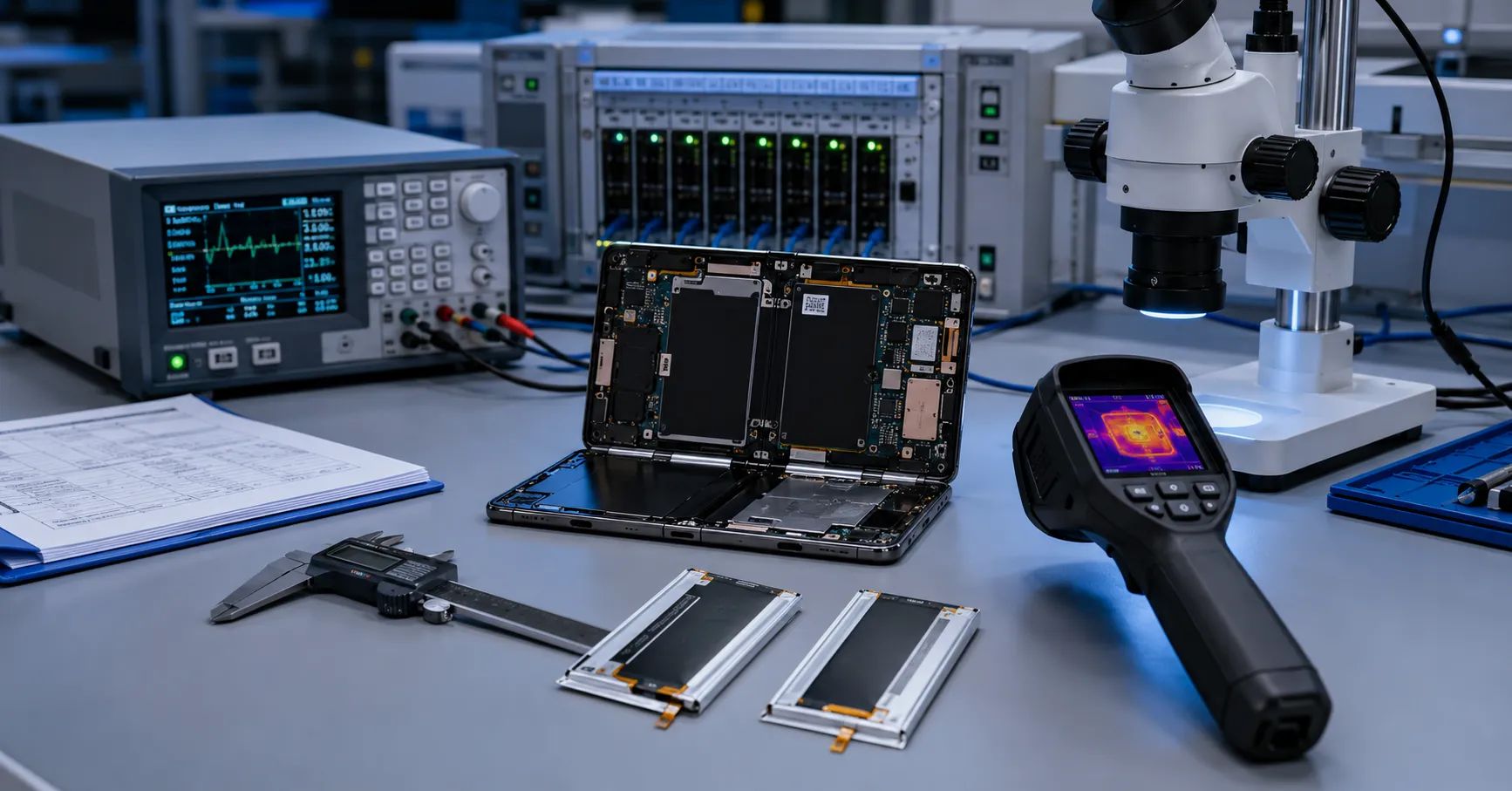
Silicon-carbon anode technology is increasingly discussed as a way to place more battery capacity inside thin smartphones. For a foldable device, however, a higher printed capacity does not prove that a replacement pack is mechanically compatible, thermally controlled, repairable or suitable for mass production.
A professional foldable phone silicon-carbon battery project must validate the complete pack inside the exact device version. Buyers should examine chemistry claims together with battery geometry, thickness distribution, dual-cavity architecture, flex routing, connector alignment, adhesive removal, charging, temperature, cycle behavior and batch consistency.
This guide is intended for battery brands, foldable-device repair chains, refurbishment facilities, mobile-parts wholesalers and private-label buyers. Acceptance limits must be established from verified devices, approved reference samples and documented test methods. ESC should not apply one capacity, thickness, temperature or cycle-life limit to every foldable phone.
Understand Why Foldable Devices Need a Separate Method
A conventional bar-style smartphone normally provides one relatively continuous battery cavity. A foldable device may distribute energy across two narrow body sections connected by cables and controlled around a hinge, display stack and multiple structural layers.
This architecture creates additional variables:
- two battery modules may have different shapes, capacities or locations;
- the modules may experience different thermal conditions;
- flex cables must cross or route near mechanically active areas;
- the hinge and foldable display require protected clearance;
- the closed device may place stricter limits on local thickness;
- adhesive removal may occur close to fragile display components;
- enclosure distortion can affect folding, sealing and display behavior;
- regional or production revisions may alter the internal arrangement.
A battery that powers on the phone can still create long-term pressure, heat concentration or serviceability problems. Foldable products therefore need model-specific installation and environmental validation.
Separate Chemistry Claims From Finished-Pack Evidence
“Silicon-carbon” generally describes the use of silicon-containing material in the anode system. It does not identify one universal formulation, silicon percentage, cell construction, electrolyte, cycle life or expansion characteristic.
Two suppliers may use the same commercial term for materially different cells. Buyers should request a controlled specification showing the exact pack model, rated voltage, rated capacity, Watt-hours, dimensions, mass, cell source where disclosure is approved, protection design and test conditions.
Do not assume that silicon-carbon automatically means:
- longer installed runtime;
- faster charging;
- lower temperature;
- better cycle life;
- less swelling;
- safer operation;
- compatibility with every device using a similar connector.
Each claim needs evidence from the proposed finished pack. A cell-level data sheet cannot replace testing of the protection board, flex, connector, adhesive and installed device.
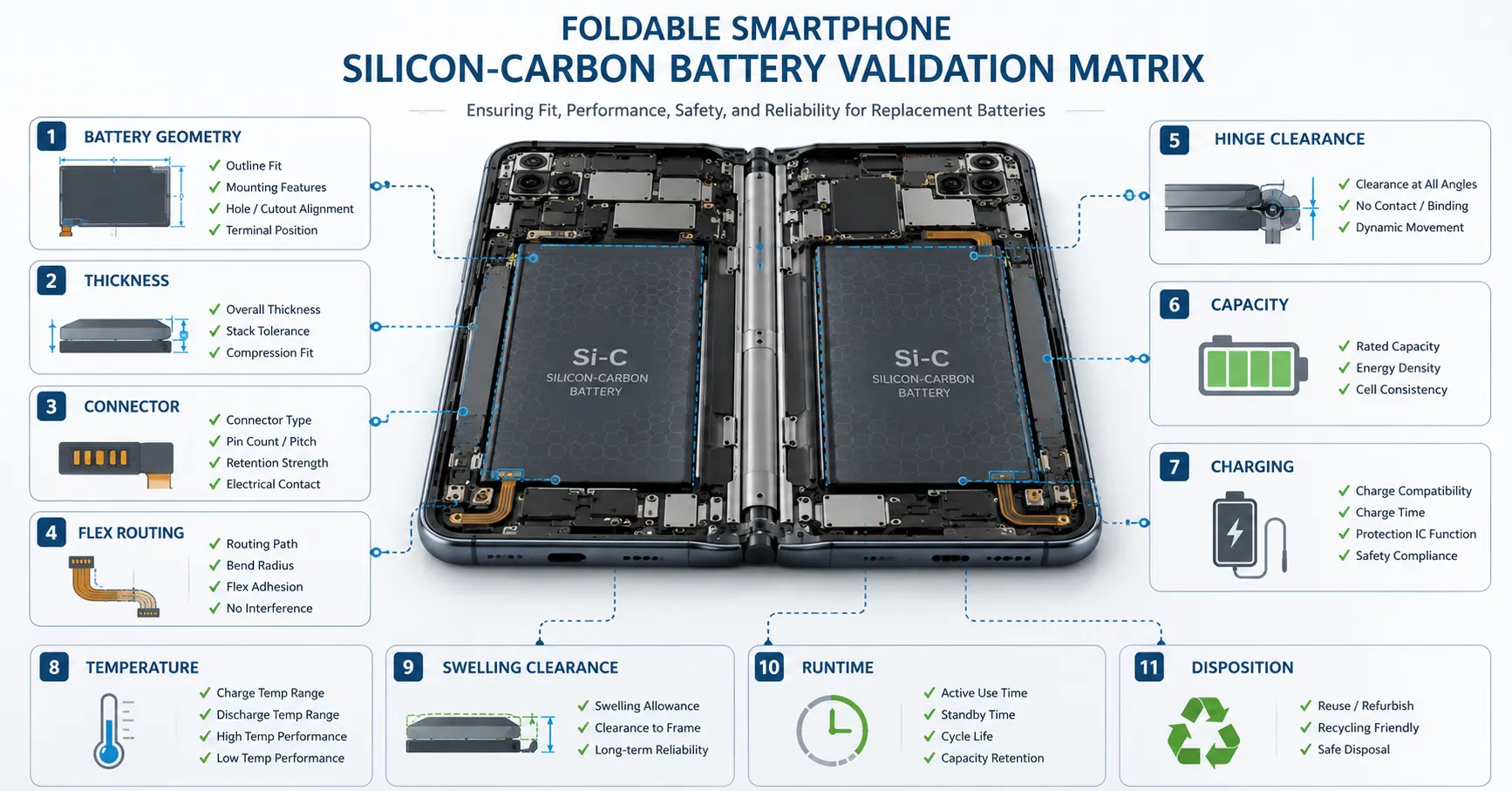
Build a Foldable-Specific Validation Matrix
| Validation area | Required evidence | Key release question |
|---|---|---|
| Device identity | Model, region, hardware revision, production date and photographs | Were all claimed variants verified? |
| Battery identity | Pack model, module identity, revision, batch and specification | Can every tested sample be traced? |
| Mechanical fit | Length, width, thickness map, corners, adhesive and clearances | Does installation avoid pressure and distortion? |
| Flexible interface | Connector, pinout, flex route, bend radius and strain relief | Does normal folding avoid cable stress? |
| Electrical performance | Voltage, capacity, resistance, protection and load behavior | Does the pack remain stable throughout its operating range? |
| Thermal behavior | Charging, camera, network, load and recovery temperatures | Are local hot spots controlled? |
| Repairability | Removal method, tools, time, damage and consumables | Can trained technicians repeat the process? |
| Production control | Golden sample, BOM, pilot data and change approvals | Will production match the approved samples? |
Confirm Every Device and Regional Version
Record the full commercial model, region, storage configuration, hardware revision and production reference. Photograph the exterior and internal battery arrangement before altering the device.
Do not approve several foldable models from a family based on one installation. A standard foldable, Ultra version, flip model or later production revision may use different battery modules, connectors, flex cables and enclosure dimensions.
Maintain at least one unmodified control device. It provides a reference for folding force, enclosure gaps, charging, temperature, runtime and software behavior.
Map Both Battery Cavities
Measure the usable envelope of each battery cavity rather than copying only the original battery’s maximum length and width. Record ribs, screw locations, connector height, cable channels, thermal materials, camera clearance and the relationship with the hinge.
Use a thickness map across several points. Pouch cells are not perfectly rigid blocks, and the thickest location may not be at the center. Include the cell, protection components, flex layers, insulation and adhesive in the installed thickness assessment.
Define a safe clearance rather than designing a sample to touch surrounding components. Manufacturing tolerance, state of charge, temperature and aging can change the pack envelope.
Inspect the Dual-Battery Architecture
Where the phone uses two modules, document their rated capacities, voltages, electrical relationship and control method. Do not assume that visually similar modules are interchangeable or that an imbalance can be corrected through labeling.
Compare module voltage and resistance before assembly. Investigate abnormal differences rather than pairing samples until a favorable combination appears. The pack design should control how the system monitors and protects both sections.
Record which module is located near the processor, camera, charging circuit and display driver. Different heat exposure may produce different aging patterns and should influence the test plan.
Validate Flex Routing Through Repeated Folding
The battery itself may remain stationary while its connecting flex operates close to moving structures. Inspect the designed bend radius, cable slack, protective layers, adhesive locations and possible contact with the hinge or enclosure.
Perform repeated open-and-close operation under an approved method. Inspect for:
- creasing or whitening of the flex material;
- connector movement;
- adhesive lifting;
- abrasion against edges or fasteners;
- intermittent battery detection;
- changes in voltage or resistance;
- new enclosure sounds or folding resistance.
Folding tests should not be described as device-lifetime certification unless they follow an approved complete-device standard. Their purpose in incoming validation is to identify installation and interface risks.
Control Adhesive and Removal Risk
A replacement pack must be installed securely and remain serviceable. Adhesive strength, coverage, thickness and pull-tab design should be approved for the device cavity and expected thermal conditions.
Too little retention may allow movement. Excessive adhesion can increase the risk of bending, puncturing or overheating the cell during later service. Aggressive heat or uncontrolled solvent use can also damage the foldable display, sealing materials or neighboring electronics.
Create a written removal method identifying tools, temperature where authorized, solvent restrictions, pulling direction, technician protection and damaged-battery response. Record time, adhesive breakage and any damage across several operators.
Measure Capacity Under Controlled Conditions
Verify each module and the complete pack using approved equipment and documented charge, rest, discharge and cutoff conditions. Record both ampere-hours and Watt-hours.
A printed high-capacity foldable phone battery claim should not be approved from label values alone. Compare measured capacity with pack mass, dimensions, voltage curve, temperature and repeatability.
ESC’s published phone battery capacity-testing principles can support method design, but foldable models require their own fixtures and limits.
Run Installed Runtime Tests
Bench capacity and installed runtime are different measurements. Device runtime is affected by the display, processor, radios, software, temperature and folding use.
Freeze brightness, refresh behavior, connectivity, applications, audio level and ambient temperature. Create separate stages for standby, video, browsing, camera, voice call and controlled load.
Where the device has internal and external displays, test them separately. Record which screen is active, brightness, refresh settings and folding state. Do not merge the results into one generic endurance claim.
Evaluate Charging and Current Distribution
Use a known-good charger and cable appropriate for the device. Control starting state of charge, ambient temperature, screen state and network activity.
Record input voltage, current, power, device percentage and temperature at defined intervals. Investigate charging interruption, percentage jumps, unexpected tapering, module imbalance and abnormal heat.
A charging pause may be caused by software optimization or temperature management rather than a defective cell. Repeat the test under the approved method and compare with the original battery.
Create a Fold-State Thermal Map
Thermal behavior should be checked with the phone open and closed. Closing the device changes the external surface area and may place two warm sections close together.
Map temperature near both battery modules, processor, charging circuit, hinge and display. Use the same measurement locations for original and replacement packs.
Include charging, camera, network transmission, sustained load, standby and recovery. Stop the test if a sample shows swelling, leakage, odor, damaged insulation or uncontrolled heat.
Define Swelling Clearance Without Making Absolute Claims
All lithium-ion systems require attention to dimensional stability and aging. A tight cavity does not eliminate expansion; it increases the importance of design margin and process control.
Review cell construction, formation data, storage behavior, cycle testing, high-temperature exposure and thickness change. Acceptance criteria must identify temperature, state of charge, duration and measurement method.
Do not advertise “zero swelling.” Risk depends on chemistry, manufacturing, charging, storage, protection, installation and operating conditions.
Test Cycle Behavior at Pack Level
Cycle-life claims must define charge rate, discharge rate, voltage limits, temperature, rest periods and end-of-life criterion. A cycle number without these conditions is not comparable.
Track capacity, resistance, thickness, temperature and voltage behavior throughout the program. Test representative samples from the proposed production process rather than specially selected laboratory units.
If the two modules age differently, investigate thermal position, current distribution and manufacturing consistency. The complete pack should remain stable throughout the approved evaluation window.
Validate Repair and Software Behavior
After installation, record battery detection, charging, Battery Health information where available, service history, warning messages and diagnostic results. Save the exact software build and screenshots.
Do not promise that a third-party pack will display a particular brand-defined status unless it has been observed under named conditions. Software behavior can change after an update, restart or repair workflow.
Separate the physical battery result from system messaging. A status screen does not replace capacity, thermal, fit and runtime testing.
Approve Production-Representative Samples
A concept sample may use temporary flex routing or hand-selected cells. It should not approve mass production. The pilot lot must use the intended cell, protection board, connector, insulation, adhesive, tooling and assembly process.
Review individual results and distributions for:
- voltage and resistance;
- capacity and Watt-hours;
- length, width and thickness map;
- connector and flex position;
- charging and runtime;
- thermal behavior;
- installation and removal repeatability.
Retain the approved golden samples and raw data. Link them to the specification, BOM, drawings and inspection limits.
Control Supplier and Material Changes
Require written approval before changing the cell source, silicon-containing material system, electrolyte, protection component, connector, flex, adhesive, insulation, tooling or production location.
A change that preserves printed capacity may still affect thickness, resistance, heat, cycle behavior or repairability. Repeat the affected tests before accepting the revised product.
Incoming inspection should compare repeat orders with the approved configuration. ESC’s mobile phone battery incoming inspection guide provides a general framework for batch identity, sampling and disposition.
Use a Staged Commercial Release Gate
- Confirm every claimed device version.
- Measure both original battery modules and cavities.
- Approve connector, flex, adhesive and insulation designs.
- Verify capacity, resistance and protection behavior.
- Complete installed charging, runtime and thermal tests.
- Evaluate open and closed operating states.
- Validate removal and multi-operator installation.
- Approve a production-representative pilot lot.
- Freeze the golden sample, specification and BOM.
- Establish incoming inspection and change control.
Frequently Asked Questions
Is silicon-carbon automatically better for a foldable phone?
No. It may support a useful capacity or thickness design, but finished-pack performance depends on the complete chemistry, geometry, protection, thermal environment and manufacturing process.
Can one battery fit several foldable models?
Only if model-level evidence confirms the cavity, connector, flex, voltage, protection and software behavior for every claimed version.
Is a larger mAh value enough to approve a sample?
No. Buyers must verify capacity, Watt-hours, thickness, temperature, runtime, power delivery and production consistency.
Why test the phone in both open and closed states?
Folding state changes display use, external surface exposure and the thermal relationship between the device sections.
Should removal be included in sample approval?
Yes. A battery that installs successfully but creates unreasonable damage or safety risk during later service is not a complete repair solution.
Approve the System, Not the Chemistry Label
A reliable foldable phone silicon-carbon battery program connects chemistry evidence with exact device geometry, flex behavior, thermal mapping, capacity, runtime, repairability and production control.
Send ESC your target foldable models, sample quantity, sales markets and validation requirements. ESC can discuss model-level samples and inspection planning. Capacity, cycle life, compatibility, MOQ and lead time must be confirmed for the specific battery and project.
External Source References
- European Union — Regulation EU 2023/1670 on Smartphone Ecodesign Requirements
- European Commission — Guidelines on Removability and Replaceability of Portable Batteries