
The EU’s repair framework should not be reduced to the statement that every battery seller must repair every phone. Different rules govern consumer remedies, post-guarantee repair obligations, smartphone ecodesign, spare-parts availability, battery replaceability, software access and commercial warranties.
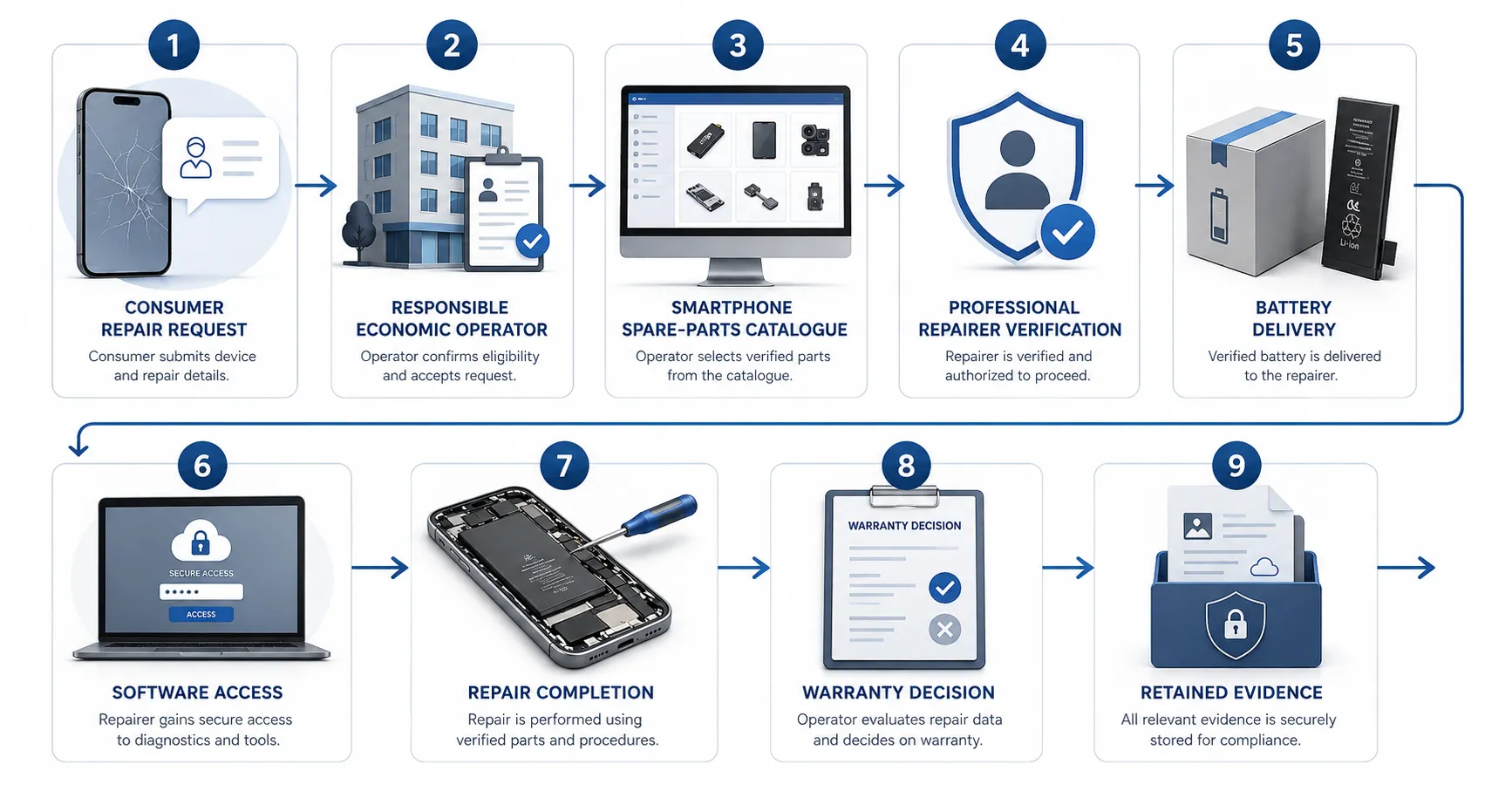
A practical EU phone battery right to repair program begins by identifying the product, placement date, responsible economic operator, consumer location, warranty status and requested remedy. The business must then route the case under the applicable EU and national rules instead of assigning every obligation automatically to the battery factory or repair shop.
This checklist is intended for smartphone brands, importers, authorised representatives, distributors, professional repairers and replacement-battery suppliers. It supports operational preparation but is not legal advice. Each responsible business should obtain current guidance for the Member States in which it sells or repairs products.
Understand the 31 July 2026 Milestone
Directive (EU) 2024/1799 on common rules promoting the repair of goods entered into force in 2024. According to the European Commission’s repair directive overview, Member States must transpose the directive and apply the relevant national provisions from 31 July 2026.
A directive normally requires national implementation. Businesses should therefore check the law and enforcement arrangements in each target Member State rather than treating the directive as an identical standalone procedure in every country.
The Commission explains that manufacturers of products covered by EU reparability requirements and listed in the directive’s scope, including smartphones, may have an obligation to repair within a reasonable time and for a reasonable price. The detailed application depends on the product-specific rules and national implementation.
Separate the Three Legal and Operational Layers
| Layer | Main question | Operational owner |
|---|---|---|
| Consumer remedy and legal guarantee | Is the seller responsible for bringing non-conforming goods into conformity? | Seller and consumer-service team under applicable law |
| Post-guarantee repair framework | Does the responsible manufacturer have a repair obligation for this covered product? | Manufacturer or relevant responsible entity |
| Smartphone ecodesign | Are batteries, information, tools and software access available as required? | Manufacturer, importer or authorised representative, depending on role |
| Commercial warranty | What additional promise was voluntarily made? | Named warrantor under the warranty terms |
| Battery supply contract | Did a replacement battery meet the agreed specification? | Battery supplier and B2B buyer under their contract |
These layers interact but should not be merged. A phone can be outside a commercial warranty while still being subject to a paid repair framework. A battery can satisfy a B2B purchase specification without determining the seller’s consumer-law obligations.
Map Every Economic Operator and Contractual Role
Create a responsibility map for the smartphone manufacturer, EU importer, authorised representative, distributor, seller, repair provider and battery supplier. Record legal entity names, markets, contact channels and decision authority.
The party placing a private-label smartphone on the EU market may have obligations that differ from those of a component supplier producing batteries to an agreed specification. Contracts can allocate evidence, logistics and indemnity responsibilities, but they cannot simply erase mandatory obligations imposed by law.
Do not publish a generic statement such as “the factory handles all EU warranty claims” unless the legal and contractual structure actually supports it.
Confirm Whether the Smartphone Rules Apply
Commission Regulation (EU) 2023/1670 establishes ecodesign requirements for smartphones and related products. Its scope, definitions, exclusions, placement date and transition conditions should be reviewed for the actual device.
The EUR-Lex summary of Regulation 2023/1670 describes requirements covering durability, disassembly, repair, spare-parts delivery and software support.
Keep a product-scope record containing:
- device model and product category;
- date first placed on the EU market;
- date the model ceased being placed on the market;
- responsible manufacturer, importer or authorised representative;
- Member States and sales channels;
- technical file and conformity-assessment references;
- spare-parts catalogue and ordering process;
- repair information and software-access process.
Build a Smartphone Spare-Parts Catalogue
Regulation 2023/1670 includes batteries among the spare parts to be made available for covered smartphones. It also addresses parts relevant to foldable devices, such as hinge assemblies and mechanical display-folding mechanisms.
The catalogue should identify the exact phone model, regional version, battery part number, voltage, capacity, connector, compatible hardware revision, required fasteners, adhesive, insulation and removal consumables.
A vague listing such as “battery for Model X series” can create incorrect orders and unsafe installations. Provide photographs or controlled diagrams where permitted, but avoid exposing restricted information unnecessarily.
The public ordering route and the professional-repairer route should be clear. Record which parts are available to end users and which are restricted to verified professional repairers under the applicable conditions.
Control Spare-Parts Availability Periods
The smartphone ecodesign rules include long-term availability requirements linked to the end of placing the model on the market. The EUR-Lex summary describes availability of critical parts until seven years after end of sales for the model, with delivery-time requirements for relevant parts.
To manage that obligation, record:
- the verified end-of-market date for each model;
- the calculated support end date;
- forecast repair demand;
- battery shelf-life and storage conditions;
- replenishment and last-time-buy decisions;
- superseding part numbers;
- approved alternatives and compatibility evidence;
- shortage escalation and customer communication.
Holding excessive lithium-ion inventory for many years can create aging and storage risks. A support plan should combine demand forecasting, controlled replenishment, periodic inspection and traceable production rather than relying only on one large final purchase.
Verify Delivery-Time Requirements
Regulation 2023/1670 contains requirements concerning maximum delivery time for spare parts. The business should identify the applicable deadline, start event, destination scope and any phase-in periods from the current consolidated legal text.
Track order date, repairer verification, payment, dispatch, delivery and exception reason. Do not treat internal dispatch time as the complete delivery metric if the rule concerns availability to the recipient.
Create alerts for stockout, customs delay, incorrect address and disputed professional status. Repeated exceptions should lead to corrective action rather than manual case closure.
Create a Fair Professional-Repairer Verification Process
Some repair information or parts may be limited to professional repairers where the regulation permits. Verification criteria should be objective, documented and non-discriminatory.
Record the repairer’s legal identity, contact details, relevant competence or registration evidence, market and approval status. Avoid collecting unrelated personal or commercially sensitive information.
Provide a reason and review route when access is refused. A process that is technically available but practically impossible, selectively delayed or priced to block access may create compliance risk.
Provide Necessary Repair Information
A battery listing alone does not complete the repair system. Professional repairers may need disassembly steps, fastener information, adhesive-removal instructions, safety warnings, diagnostic procedures and completion steps.
Information should identify required tools, safe state of charge, personal protection, damaged-battery handling and the steps needed to restore the intended function. Version-control every document and retain the date it was made available.
Translations must be reviewed for the target market. Incorrect terminology for polarity, heat, solvent or damaged-cell handling can create a material safety risk.
Control Software and Firmware Access
The European Commission’s guidance on portable-battery removability and replaceability discusses interaction between the Batteries Regulation and smartphone ecodesign rules. It states that professional repairers should receive non-discriminatory access to software, firmware or similar means needed for the full functionality of serialised spare parts.
The guidance also explains that software may support correct communication and safety, but should not impede replacement with a compatible battery. A notification can provide information without disabling functionality or degrading the user experience.
Operational records should include:
- supported device and battery combinations;
- required software or account process;
- access eligibility and cost;
- system availability and response time;
- repair completion result;
- error message and root-cause category;
- software version and date;
- escalation and corrective action.
Do not describe every warning message as illegal or every calibration process as prohibited. Legal review must consider its purpose, effect, access conditions and the applicable product rules.
Distinguish Repair From Replacement
A repair request may be resolved by replacing a battery, connector, display or another module, but the consumer-law decision and technical procedure are separate.
Use a diagnostic intake process to record symptoms, device condition, battery status, charging behavior, incident history, liquid exposure and previous repairs. Confirm whether battery replacement is likely to restore conformity before committing parts.
If another defect causes abnormal drain or charging failure, replacing a good battery can increase cost without resolving the case.
Build a Phone Battery Warranty Checklist
A warranty team should distinguish at least four possible bases:
- the consumer’s mandatory legal rights against the seller;
- a post-guarantee repair obligation under applicable rules;
- a voluntary commercial warranty offered by a named party;
- a B2B component warranty under the battery supply contract.
For every claim, record the purchase date, seller, consumer location, product model, serial reference, warranty wording, failure description, diagnostic result and proposed remedy.
Do not reject a consumer claim solely because a third-party repair or battery is present. Determine causation and apply the governing law and warranty terms. Equally, do not charge every unrelated device failure to the replacement-battery supplier without technical evidence.
Define Reasonable Repair Pricing
The Commission describes covered repair obligations as requiring repair within a reasonable time and for a reasonable price. The assessment should be reviewed under national implementation and the circumstances of the case.
Create a transparent price structure covering diagnosis, battery, consumables, labour, shipping, tax and any refundable inspection fee. Avoid hidden charges that make the formal repair option practically unusable.
Record how prices are approved and updated. A B2B battery purchase price is only one component of the consumer repair price.
Manage Battery Storage for Long-Term Support
Long availability periods require a storage program. Record model, batch, production date, receipt date, voltage, inspection status and storage location.
Use controlled temperature, humidity, state of charge, physical protection and periodic inspection. Quarantine swollen, leaking, damaged, deeply discharged or undocumented batteries.
ESC’s mobile phone battery storage guidance provides a general warehouse framework. Specific storage windows and reinspection criteria require approval for the battery model.
Connect Incoming Inspection to Repair Outcomes
Spare batteries must remain traceable from supplier lot to repair order. Incoming inspection should verify labels, documents, voltage, dimensions, connector, flex, physical condition and selected functional samples.
Use the mobile phone battery incoming inspection process as a starting point. Add model-specific acceptance limits and software checks.
When a repair fails, compare the returned battery with retained incoming data. This helps distinguish batch defects, storage aging, installation damage, phone faults and software issues.
Control Returned and Removed Batteries
A replaced battery becomes part of a separate reverse-logistics and waste-management process. Record whether it is returned for analysis, held for evidence, recycled or otherwise managed under applicable rules.
Do not place swollen, leaking or mechanically damaged batteries into ordinary return packaging. Use trained personnel, appropriate containment and qualified logistics providers.
Customer data and device identifiers must also be protected when photographs, diagnostics or repair records are retained.
Build a Repair Evidence File
Each case should connect:
- consumer or B2B request;
- device and market identity;
- applicable remedy or repair basis;
- diagnostic evidence;
- quoted price and acceptance;
- battery part and batch;
- repairer and work instruction version;
- software or calibration result;
- final functional tests;
- return, recycling or failure-analysis disposition;
- completion date and customer communication.
Aggregate records by model, battery batch, failure code, repair centre and outcome. Trend data can identify recurring compatibility, training, storage or supplier issues.
Audit Public Claims and Customer Communications
Review websites, packaging, manuals, warranty cards and repair portals. Ensure that availability periods, prices, geographic scope and access requirements are accurate.
Avoid absolute statements such as “all repairs are free,” “any battery can be installed” or “third-party repair always voids the warranty.” Communications should state conditions and preserve mandatory consumer rights.
Translate repair and warranty information consistently across Member States, while accounting for national legal differences.
Use a 2026 Readiness Gate
- Map the legal entities and EU markets.
- Identify covered smartphone models and placement dates.
- Review national implementation from 31 July 2026.
- Separate legal guarantee, repair obligation and commercial warranty workflows.
- Publish accurate spare-parts catalogues and ordering routes.
- Verify professional repairers objectively.
- Provide repair instructions and necessary software access.
- Control battery inventory, storage and delivery time.
- Connect every battery batch to repair and warranty evidence.
- Audit pricing, claims, refusals and customer communications.
Frequently Asked Questions
Does the EU repair directive make every battery repair free?
No. Legal-guarantee remedies, post-guarantee repair obligations and commercial warranties are different. Pricing and responsibility depend on the applicable rule and case.
Must every battery supplier repair the finished smartphone?
No. Responsibility depends on the economic operator’s legal and contractual role. A component supplier may provide parts and evidence without being the finished-device manufacturer or consumer seller.
How long must smartphone batteries remain available?
Regulation 2023/1670 includes long-term spare-parts requirements tied to the end of placing the model on the market. Confirm the exact scope and dates from the current legal text.
Can software be used after battery replacement?
Software may support communication, calibration and safety, but applicable EU guidance states that it should not impede replacement with a compatible battery.
Can a claim be rejected because another repairer opened the phone?
Do not use an automatic rule. Review causation, the applicable law, warranty terms and technical evidence for the actual failure.
Turn Repair Rights Into an Auditable Process
A compliant EU phone battery right to repair workflow connects product scope, economic-operator responsibility, spare-parts availability, repair information, software access, pricing, warranty decisions and traceable battery evidence.
Send ESC your target phone models, EU markets, battery specifications, order plan and documentation requirements. ESC can support project-specific sample, specification and batch-record preparation. Legal scope, consumer remedies, conformity and market responsibilities must be approved by the responsible economic operator and qualified EU advisers.
External Source References
- European Commission — Directive on Repair of Goods
- European Union — Directive EU 2024/1799 on Common Rules Promoting the Repair of Goods
- European Union — Regulation EU 2023/1670 on Smartphone Ecodesign Requirements
- European Commission — Guidelines on Removability and Replaceability of Portable Batteries