
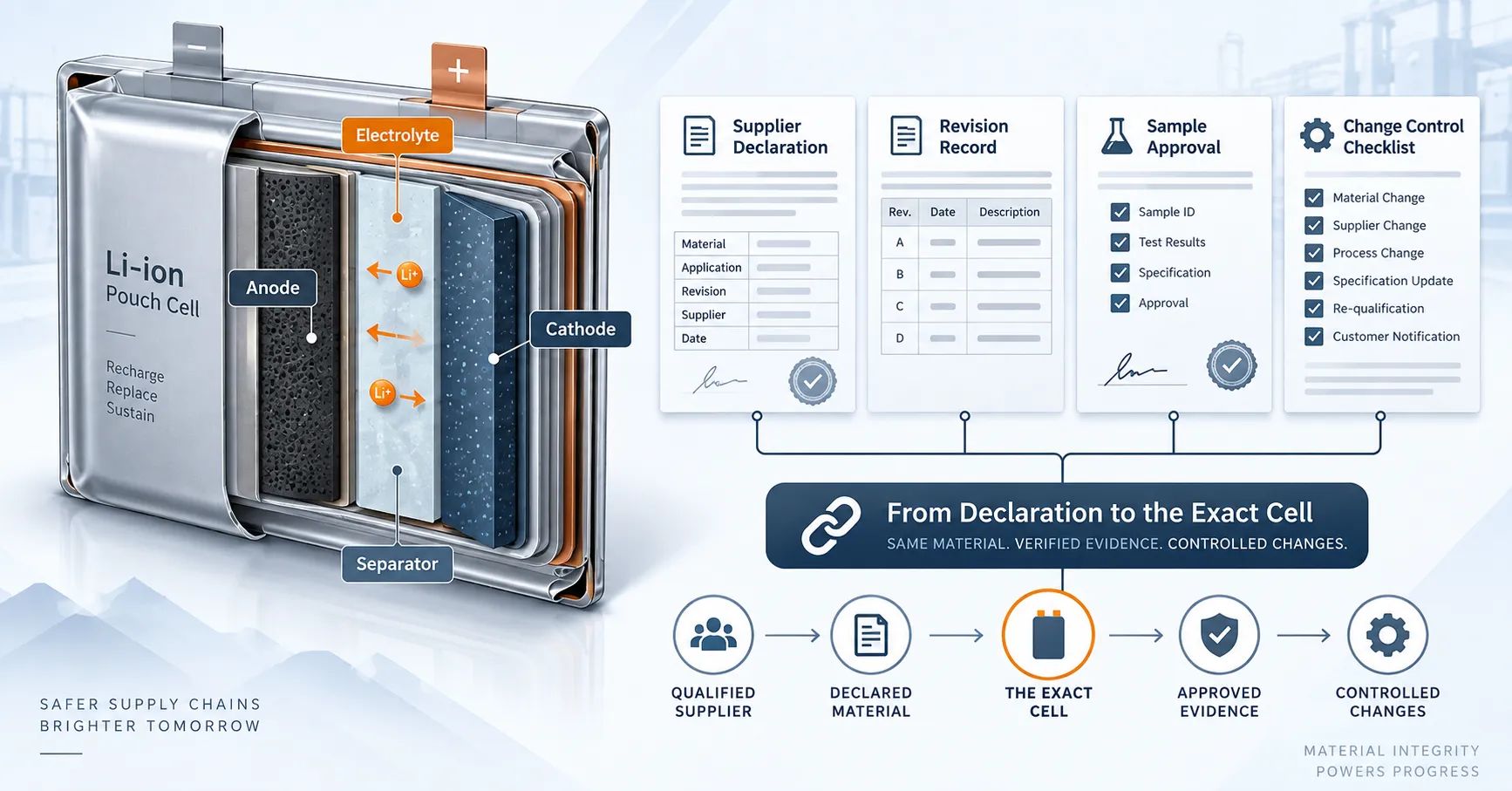
What is battery electrolyte? It is the ion-conducting medium inside a cell that allows charged ions to move between the electrodes during charging and discharging. Electrons travel through the external circuit while ions move inside the cell. For a replacement-battery buyer, that basic definition is only the starting point: the commercial question is whether the declared electrolyte system is appropriate for the exact electrodes, separator, voltage window, manufacturing process and operating conditions of the offered cell.
A supplier statement such as “premium electrolyte,” “polymer electrolyte” or “high-safety formula” is not a complete specification. Buyers need a controlled material declaration, traceability to the cell design, applicable performance and safety evidence, and a written process for notifying and validating changes. The purpose is not to obtain a proprietary chemical recipe. It is to obtain enough verified information to manage product risk and prevent an unapproved material change from entering mass production.
Start With the Electrolyte's Function
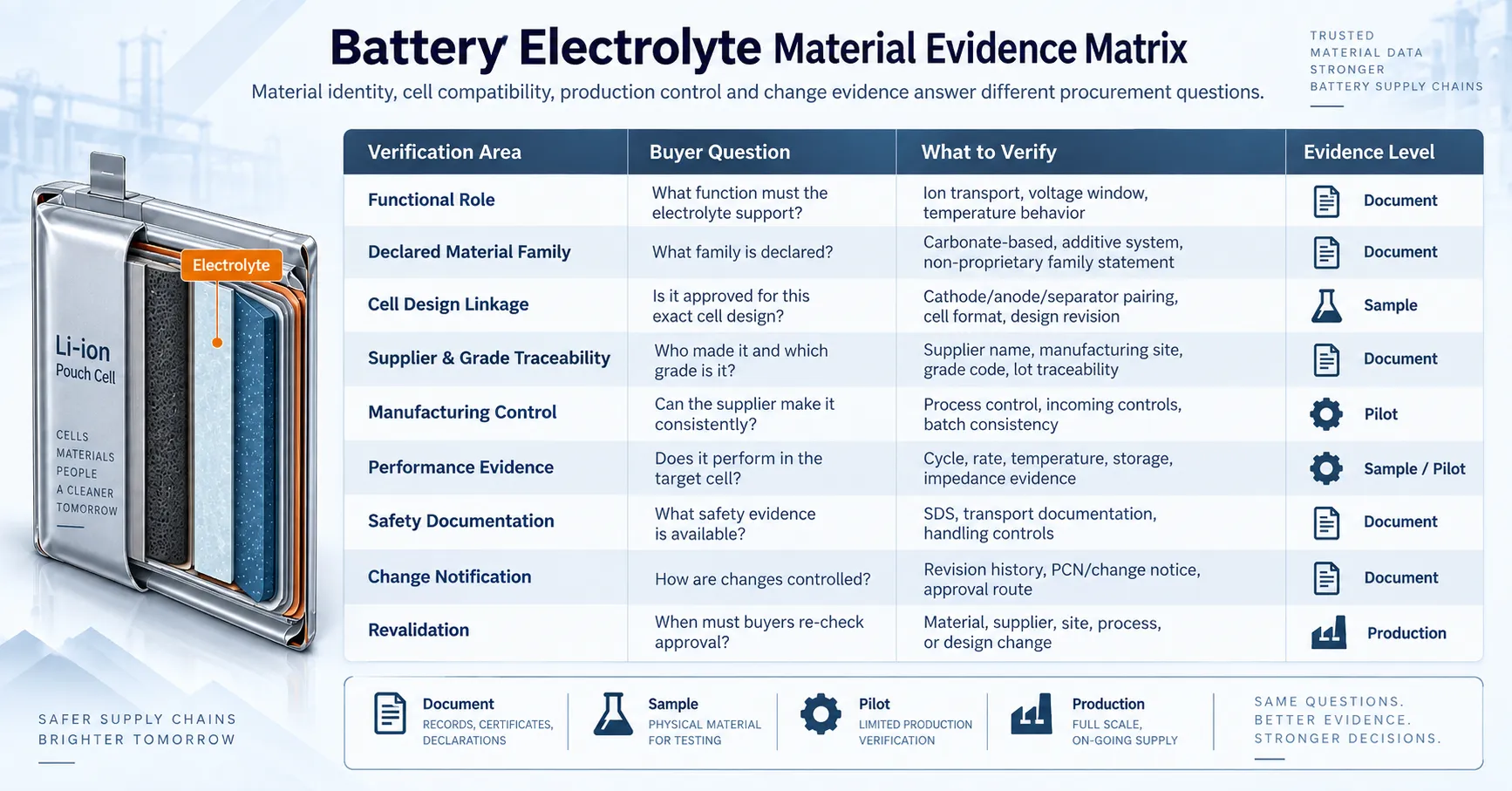
The U.S. Department of Energy explains that a battery has an anode and cathode separated by an electrolyte, with ions moving through the electrolyte while electrons move through the external circuit. Its battery fundamentals overview provides a useful functional definition without implying that one electrolyte suits every cell.
In rechargeable lithium-ion cells, electrolyte behavior affects ion transport and the interfaces that form between the electrolyte and electrode surfaces. It works as part of a system. Changing the solvent family, salt, additive package, concentration, moisture control or manufacturing condition can interact with the electrodes, separator and formation process. A buyer should therefore avoid ranking battery electrolytes from an isolated ingredient list.
| Question | What the answer establishes | What it does not establish |
|---|---|---|
| What is the declared electrolyte family? | A controlled material category for the approved cell | The complete proprietary formulation or finished-cell performance |
| Who supplies it and under which grade? | Source and grade traceability where disclosure is permitted | That all lots meet the cell maker's process controls |
| Which cell design uses it? | Linkage to electrodes, separator, rated conditions and revision | Compatibility with another cell or replacement battery |
| What evidence supports it? | Results under stated sample, method and conditions | A universal claim outside those conditions |
| How are changes controlled? | Notification, risk review and revalidation obligations | That a notified change is automatically acceptable |
Do Not Confuse Electrolyte, Separator and Electrode
The electrolyte carries ions. The separator keeps the electrodes physically apart while permitting ionic movement. The electrodes store and release lithium through electrochemical reactions. These components influence each other, but they have different functions and failure modes.
The DOE's Battery Basics appendix notes that electrolyte may be liquid, polymer, gel or ceramic in different battery systems. Those general categories should not be used to infer the construction of a particular replacement-battery cell. “LiPo” in market language often refers to a pouch-format rechargeable lithium-ion battery and does not, by itself, disclose the exact electrolyte, separator, cathode, anode or additive system.
This article supports the LiPo-versus-lithium-ion topic cluster by going deeper into evidence control. It does not repeat the broader comparison of cell chemistry, enclosure and form factor. Buyers should use the electrolyte page when reviewing a supplier declaration or change, and the broader pillar page when deciding how terminology and construction relate to the application.
Request a Useful Material Declaration
A battery electrolyte material declaration should be detailed enough to maintain the approved design while respecting legitimate confidentiality. The correct disclosure level depends on the project, applicable law, supplier relationship and risk. A buyer does not automatically need exact additive percentages, but “electrolyte” alone is too vague for change control.
- Cell manufacturer and exact cell designation.
- Electrolyte supplier or approved-source status, where disclosure is contractually available.
- Controlled material family, grade or internal specification code.
- Applicable material and cell specification revisions.
- Restricted-substance or market declarations required for the target product and jurisdiction.
- Lot or batch relationship needed for investigation.
- Storage, handling and shelf-life controls relevant to the cell manufacturer's process.
- Change-notification categories and approval route.
Ask the supplier to distinguish a declaration, a safety data document, a compliance statement and a test report. They answer different questions. A safety data sheet supports hazard communication for the material in its stated scope; it does not prove capacity, cycle life, swelling performance or compatibility of the finished phone battery. A restricted-substance declaration does not prove that the electrolyte works with the selected electrodes.
Connect the Declaration to the Exact Cell
The same broad lithium ion battery electrolyte label may cover systems with different materials and performance boundaries. Approval must link the electrolyte declaration to the exact cell model, electrode system, separator, nominal and maximum operating conditions, formation process and production revision. Do not transfer evidence between cells merely because their capacity, dimensions or packaging look similar.
For a finished replacement battery, also retain the link from cell lot to pack SKU, protection circuit, flex, connector and assembly lot. The published mobile phone battery incoming-inspection guide explains how identity and traceability fit into receiving control. IQC cannot directly identify a confidential electrolyte formulation, so it must verify documents, cell identity, approved-source records and performance indicators rather than pretending a visual inspection proves chemistry.
Capacity claims must be verified for the specific battery model and test method. The iPhone battery capacity-testing guide shows why temperature, current, cutoff and rest conditions matter. Capacity is a system result and cannot isolate electrolyte quality, but a controlled trend may reveal that a changed cell no longer matches its approved baseline.
Evaluate Claims as Testable Statements
Translate every marketing phrase into an observable requirement. “Better low-temperature electrolyte” should become a model-specific test plan with defined conditioning, current, cutoff, sample count and reference. “Long-life formula” should identify the cycling method, temperature, endpoints and comparison. “Safer electrolyte” must state the test, cell construction and evidence scope rather than implying zero risk.
| Supplier claim | Buyer clarification | Required evidence boundary |
|---|---|---|
| High conductivity | At which temperature, concentration and method? | Material data plus relevance to the exact cell |
| Wide temperature performance | Which charge and discharge conditions? | Cell-level results with separate operating limits |
| Long cycle life | Which protocol and remaining-capacity endpoint? | Traceable cell design, sample count and test conditions |
| Low swelling | Under which storage, cycling and mechanical conditions? | Defined measurement method and cell construction |
| Safer formulation | Safer against which stated test or failure mechanism? | Applicable evidence without an absolute guarantee |
Do not use a single material property as a finished-product acceptance criterion without engineering justification. Conductivity, viscosity, flash point, moisture or impurity data can be important within a supplier's process, but the buyer must know how the value connects to the cell design and whether it is a purchasing specification, process-control item or confidential supplier control.
Control Moisture, Contamination and Process Evidence
Electrolyte performance depends on manufacturing control as well as formulation. Material receipt, storage, environment, dosing, sealing and formation can affect the finished cell. Replacement-battery buyers do not need to prescribe a cell manufacturer's proprietary process, but they should ask how critical parameters are defined, monitored and released.
Useful audit evidence can include approved work instructions, equipment identification, calibration status, environmental control records, incoming-material release, batch traceability, deviation handling and final cell test linkage. Ask which records can be reviewed during qualification and which can be provided when a field complaint requires investigation.
Do not accept “100% tested” without the test name, stage, equipment, limit and record-retention scope. Likewise, a certificate for the material supplier does not demonstrate that the cell factory stored, dispensed and integrated the material correctly.
Define Electrolyte Change Validation Before Approval
Electrolyte change validation should begin with notification before the changed material reaches production for the buyer. The agreement should name changes that require disclosure: supplier, manufacturing site, material grade, solvent or salt family, additive system, concentration range, specification, process, storage condition or other changes identified by the cell maker's risk assessment.
- Describe the change: identify affected cell models, old and new revisions, reason, date and proposed first lot.
- Assess risk: review interactions with electrodes, separator, formation, charging, discharge, storage and target environment.
- Define evidence: select material, cell and finished-battery tests based on the risk rather than using one universal list.
- Compare samples: test changed and approved-control cells under matched conditions and retain individual results.
- Confirm pilot production: verify that normal manufacturing reproduces engineering-sample performance.
- Approve or hold: document deviations, owners, decision, effective lot and any conditional limits.
- Monitor production: trend incoming, production and field evidence by revision and lot.
The mobile phone battery sampling-plan guide helps define lot selection after the change-risk questions are settled. One passing sample cannot approve a material change for every production lot. One failed sample also cannot establish a defect rate without a defined population and investigation.
Choose Tests From the Risk, Not From a Generic Checklist
The validation plan may include applicable capacity, energy, resistance, charge and discharge behavior, temperature response, storage, cycle, swelling, leakage screening and protection interaction. Exact methods and limits must come from the approved cell and pack specifications. Do not copy values from a different chemistry, cell size or supplier.
Use representative finished batteries when the material change could affect device-level behavior. A cell result does not verify flex, connector, protection circuit or installation. Conversely, a phone runtime result alone cannot identify electrolyte as the root cause. Build an evidence chain from material declaration to cell test, finished pack, device sample and production lot.
Any abusive, fault-injection or safety testing must be conducted by a qualified laboratory with an approved plan, suitable facilities and emergency controls. Procurement teams should not request informal puncture, heating, overcharge or short-circuit demonstrations.
Preserve Transport and Safety Documentation Scope
Lithium cells and batteries are subject to transport requirements that apply to defined designs and shipment configurations. PHMSA states that lithium cells and batteries offered for transport must have passed the applicable UN Manual of Tests and Criteria subsection 38.3 design tests, and that required test summaries must be made available upon request. See its lithium-battery transport guidance.
An electrolyte or process change may require an engineering and compliance review of whether the tested design remains applicable. Do not assume that an existing test summary covers the changed cell. Certification availability must also be confirmed for the specific battery model and target market. Engage qualified compliance and logistics personnel for the actual shipment.
Build Electrolyte Controls Into the RFQ
A useful RFQ should request the exact cell model, electrolyte declaration level, material specification or controlled code, approved source status, cell-performance evidence, restricted-substance documents required by the market, sample quantity, change-notification rules, record-retention period and failure-analysis support. Separate mandatory disclosures from information that may remain under confidentiality.
Commercial terms should reflect the evidence burden. MOQ depends on the selected model and customization scope. Lead time depends on model, customization, validation and order quantity. Warranty depends on the specific product and agreement. Do not promise that one electrolyte feature eliminates swelling, degradation or safety risk.
Route Field Evidence Without Guessing the Root Cause
When a complaint occurs, record battery SKU, cell and pack lot, production revision, storage and service history, device model, symptom, charging conditions and test evidence. Compare whether the pattern follows a cell revision, pack assembly, device, installer or environment. The mobile phone battery warranty-claims guide supports consistent disposition.
Electrolyte should be named as the root cause only when evidence supports it. Fast drain, shutdown, swelling, heat or charging behavior can involve the cell, protection electronics, assembly, installation or device. Preserve an inconclusive status when the returned sample or traceability cannot isolate the cause.
Frequently Asked Questions
Is battery electrolyte the same as battery acid?
No. “Battery acid” usually refers to the sulfuric-acid electrolyte in lead-acid batteries. Rechargeable lithium-ion cells use different electrolyte systems. Always identify the battery chemistry and specific design.
Should a supplier disclose the complete electrolyte recipe?
Not automatically. Buyers need enough controlled information for approval, compliance and change management. Exact proprietary composition may require confidentiality arrangements or remain controlled by the cell maker.
Can an SDS prove that a phone battery is high quality?
No. It supports hazard communication within its scope. It does not prove capacity, cycle life, swelling performance, device compatibility or production consistency.
Does a polymer electrolyte mean the battery cannot leak?
No absolute conclusion follows from the label. Evaluate the actual cell construction, materials, sealing, manufacturing controls and applicable test evidence.
When should an electrolyte change trigger revalidation?
Use the approved change agreement and engineering risk assessment. Source, grade, formulation, process or storage changes that could affect the cell should be reviewed before production use.
Verify the Evidence Chain
Electrolyte enables ion transport, but buyers approve a complete cell and replacement-battery system. The defensible path connects the declaration to the exact cell, links material and process controls to test evidence, and requires notification plus risk-based revalidation before changes enter production.
For an ESCCharge replacement-battery discussion, send the target device models, requested cell or pack configuration, market, material-document requirements, order quantity and change-control expectations. Capacity, compatibility, certification availability, MOQ, lead time and warranty must be confirmed for the selected model, method and agreement.
External Source References
- U.S. Department of Energy — DOE Explains Batteries — accessed September 7, 2026.
- U.S. Department of Energy — Battery Basics Appendix — 2023.
- PHMSA — Transporting Lithium Batteries — accessed September 7, 2026.