
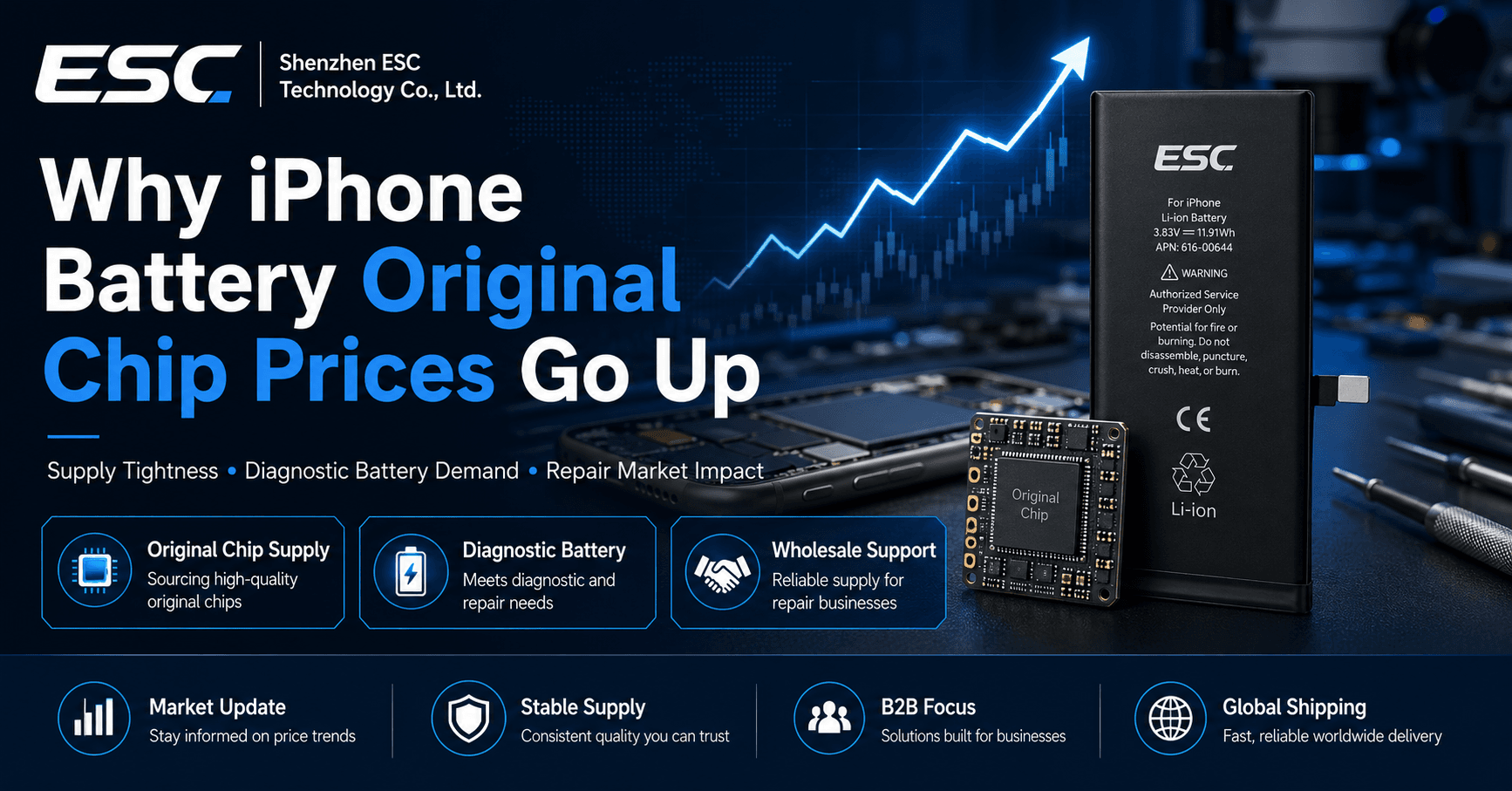
For many repair shops and phone parts wholesalers, the most uncomfortable question this year is simple: why do iPhone battery original chips prices go up when the battery looks almost the same from the outside?
The answer is not only “material cost.” For iPhone diagnostic batteries, no pop-up batteries and battery health display batteries, the chip is part of the repair experience. It affects how the phone identifies the battery, how battery information is displayed, and how much confidence the customer has after repair. When original-chip resources become limited, the whole price structure changes.
ESC supplies iPhone replacement batteries, diagnostic-compatible batteries, no pop-up battery options and original-chip battery solutions for professional repair shops, refurbishment facilities, wholesalers and private label customers. When chip supply changes, we prefer to explain the reason clearly instead of hiding behind a vague “price adjustment” notice.
Original Chips Are Not Just Small Components
In the iPhone repair battery market, “original chips” usually refers to limited original-grade battery identification, fuel gauge, battery data or BMS-related chip resources used in selected repair battery solutions. Different suppliers may use slightly different wording, so buyers should always confirm the exact structure before placing an order.
For normal replacement batteries, buyers mainly care about capacity, voltage, size and safety protection. For diagnostic-ready iPhone batteries, the situation is more complex. The battery-related chip or original data structure may affect post-repair behavior, battery health display, no pop-up performance or compatibility expectations.
Battery management ICs are not decoration. STMicroelectronics explains that battery management solutions require voltage, current and temperature measurements to determine state of charge and battery pack status. Texas Instruments also explains that battery gauges help provide accurate state-of-charge and state-of-health information in battery-powered devices.
That is why the chip side of an iPhone repair battery matters. It is not a cheap label. It is part of how the battery communicates, protects and supports the repair result.
Apple’s Repair System Makes Battery Identification More Visible
The second reason is Apple’s repair visibility. Apple states that users can check Parts and Service History on supported iPhone models after repair. Depending on the part and repair condition, users may see information such as Genuine, Unknown Part or Used. Apple also explains that Self Service Repair gives experienced users access to genuine Apple parts, tools and repair manuals for eligible models.
This changes customer behavior.
In the past, many customers only checked whether the phone powered on and whether the battery lasted longer. Now, they may also check battery health, service history and repair messages. For repair shops and refurbished phone sellers, this creates pressure.
A battery that works electrically may still create a commercial problem if the customer sees confusing information after installation. That is why demand for diagnostic-compatible batteries, show battery health batteries and no pop-up battery solutions has increased.
When more buyers chase the same limited original-chip resources, prices move up. This is basic supply and demand, but inside a very specialized repair supply chain.
The Semiconductor Market Is Also Pushing Costs Higher
The original-chip price increase is not happening in isolation. The broader semiconductor market is under pressure.
Gartner forecasted that global semiconductor revenue would exceed US$1.3 trillion in 2026, with memory revenue expected to increase sharply amid “memflation.” Reuters also reported that AI infrastructure demand has driven memory chip price increases and is affecting cost expectations for smartphones and PCs.
Even though iPhone battery original chips are not the same as AI memory chips, the broader electronics supply chain is connected. When chipmakers, distributors and procurement teams face uncertainty, component pricing becomes more sensitive. Mature-node, analog, power-management and identification-related components can also become harder to source when demand shifts quickly across consumer electronics, automotive, industrial and AI infrastructure markets.
For battery buyers, the lesson is direct: do not assume electronic components will stay cheap just because the battery shell looks unchanged.
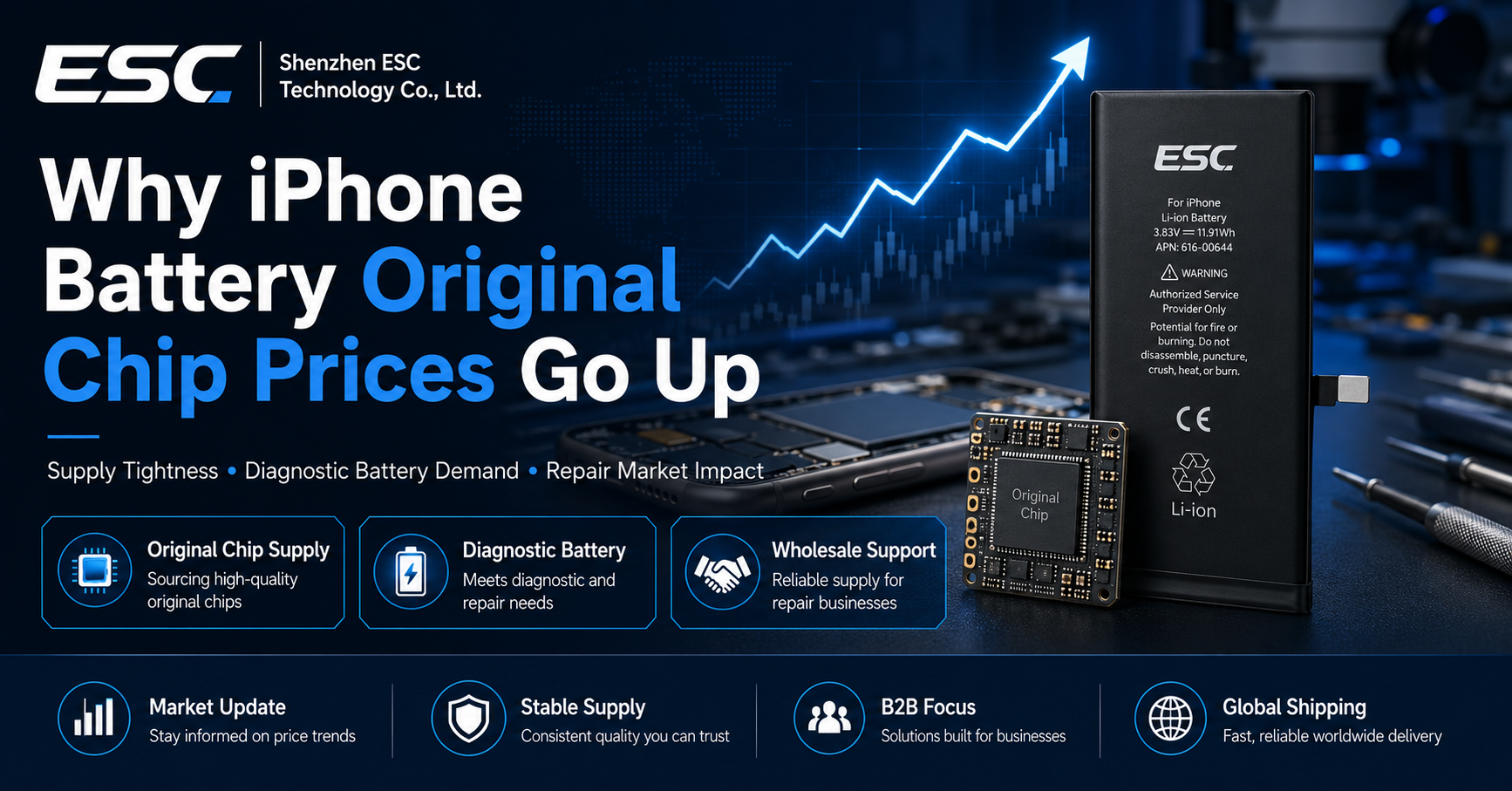
Why Diagnostic Batteries Are More Affected Than Normal Batteries
Not every iPhone replacement battery is affected in the same way.
A standard original capacity iPhone battery mainly depends on cell cost, protection board cost, flex cable cost, labor and packaging. A diagnostic-ready or original-chip battery depends more heavily on chip availability, matching process, testing time and model-specific compatibility.
That is why diagnostic batteries usually react faster to original-chip price increases.
| Battery Type | Price Sensitivity | Main Cost Driver |
|---|---|---|
| Normal replacement battery | Medium | Cell, PCB, flex, labor |
| High capacity battery | Medium to high | Higher-density cell, testing |
| Diagnostic battery | High | Original-chip resources, testing, compatibility |
| No pop-up battery | High | Chip solution and model matching |
| Battery health display battery | High | Data behavior, chip structure, installation reliability |
For repair shops, this means the cheapest battery is not always the best business choice. A low-cost battery can still work, but it may not support the repair experience your customer expects.
Four Reasons Original Chip Prices Go Up
1. Limited Recoverable Chip Supply
Some original-chip battery solutions depend on limited original chip resources. These resources cannot always be scaled like a normal aftermarket PCB. When more repair markets demand diagnostic-ready batteries, the supply becomes tight.
2. Higher Demand from Newer iPhone Models
Newer iPhone models usually create stronger demand for no pop-up, battery health display and diagnostic-compatible solutions. Repair shops and refurbished phone sellers want cleaner post-repair behavior because the resale value of newer devices is higher.
3. More Testing and Matching Work
Original-chip batteries require more careful model matching, installation testing and batch checking. The supplier is not only selling a battery. The supplier is also absorbing a higher testing burden.
4. Procurement Uncertainty in Electronics Supply Chains
When the semiconductor market becomes volatile, component suppliers protect stock, raise quotes or shorten quote validity. This affects battery pack factories, repair parts suppliers and wholesalers.
What This Means for Repair Shops
For repair shops, price increase is not only a cost problem. It is a service positioning problem.
If your shop sells only basic battery replacement, normal original capacity batteries may still be suitable. But if your shop offers premium iPhone repair, diagnostic-ready batteries may be necessary for selected models.
The better strategy is to divide your battery line:
- Standard repair: original capacity iPhone batteries
- Upgrade repair: high capacity iPhone batteries
- Premium repair: diagnostic-compatible or no pop-up batteries
- Refurbished phone resale: battery health display or original-chip options
This allows you to explain price differences to customers instead of fighting only on low price.
A customer who only wants the cheapest repair gets a standard battery. A customer who wants better post-repair confidence can choose a premium battery. That is how repair shops protect margin without sounding unreasonable.
What This Means for Wholesalers and Distributors
For wholesalers, original-chip price movement can create inventory risk. If you wait too long, the same models may become more expensive or harder to source. If you stock blindly, you may trap cash in slow-moving SKUs.
The professional approach is to classify models by demand:
- Fast-moving repair models
- Premium diagnostic models
- Refurbishment models
- High-risk shortage models
- Private label retail models
Do not stock every model equally. Focus on the models your customers actually repeat.
For iPhone 13, iPhone 14, iPhone 15 and iPhone 16 series, diagnostic-compatible demand is usually more sensitive because the device resale value is higher and buyers care more about repair information.
A Practical Case: Explaining Price Increases to Repair Customers
A repair distributor may receive complaints after sending a price update to repair shop customers. The old explanation is usually weak: “Raw material cost increased.”
That is not enough. Repair buyers are not stupid. They need to understand what changed.
A better explanation is:
“The price increase mainly affects original-chip and diagnostic-compatible iPhone battery models. These batteries require more limited chip resources, model matching and post-installation testing than normal replacement batteries. Standard original capacity batteries are still available, but diagnostic-ready versions now have shorter quote validity and longer lead time.”
This explanation is more professional. It separates normal batteries from original-chip batteries. It also gives customers a choice instead of only telling them the price is higher.
How ESC Helps Buyers During Original Chip Price Changes
ESC supports B2B customers with clearer battery version planning instead of forcing every buyer into one product line.
We can help customers choose from:
- Normal original capacity iPhone batteries
- High capacity iPhone batteries
- Diagnostic-compatible batteries
- No pop-up battery options
- Battery health display batteries
- Original-chip battery solutions for selected models
- OEM and private label packaging
- Mixed-model wholesale orders
For repair shops, we can help divide models by standard repair and premium repair.
For wholesalers, we can help identify which models are worth stocking earlier.
For refurbishment facilities, we can help match battery versions with device grades so premium phones do not use the wrong battery level.
How Buyers Should Prepare
The worst response to a chip price increase is panic buying without structure. The second-worst response is doing nothing.
A better procurement plan includes:
- Confirm which models require original-chip or diagnostic-ready versions.
- Separate standard batteries from premium repair batteries.
- Test samples before bulk order.
- Lock price and delivery time for fast-moving models.
- Avoid overstocking slow-moving models.
- Use OEM packaging only for stable SKUs.
- Explain battery version differences clearly to your customers.
- Keep a backup plan for normal replacement batteries.
For B2B buyers, the goal is not to avoid all price increases. That is impossible. The real goal is to avoid being surprised by them.
FAQ About iPhone Battery Original Chip Price Increase
Why do iPhone battery original chip prices go up?
Prices go up because original-chip resources are limited, demand for diagnostic-compatible batteries is increasing, newer iPhone repair requires more careful post-repair behavior, and broader semiconductor supply chains are facing cost pressure.
Are all iPhone batteries affected by original chip price increases?
No. Normal original capacity batteries are usually less affected. Diagnostic batteries, no pop-up batteries and battery health display batteries are more sensitive because they depend more on chip solution, model matching and testing.
Does ESC supply genuine Apple batteries?
No. ESC supplies aftermarket iPhone replacement batteries for professional repair, refurbishment, wholesale and private label markets. We do not describe aftermarket products as Apple genuine batteries.
Why are diagnostic batteries more expensive than normal batteries?
Diagnostic batteries require more specialized chip solutions, stricter model matching and additional testing. Their value is not only battery capacity, but also better post-repair customer confidence.
Should repair shops stock batteries before prices rise further?
Repair shops should stock fast-moving models and premium diagnostic models according to real demand. Do not overstock slow-moving models only because of price fear.
Can ESC provide OEM packaging?
Yes. ESC supports logo labels, retail boxes, barcode labels, warranty cards, manuals and outer cartons for private label battery projects.
How long are battery prices valid?
Price validity depends on model, chip stock and market movement. For original-chip and diagnostic battery models, quote validity may be shorter during supply changes.
Work with ESC
ESC supplies iPhone replacement batteries, diagnostic-compatible batteries, no pop-up battery options, battery health display batteries and original-chip battery solutions for professional repair and wholesale buyers.
If your business is affected by iPhone battery original chip price increases, ESC can help you confirm model demand, test samples, separate standard and premium battery lines, and prepare a more stable wholesale purchasing plan.
Explore more products from our iPhone Replacement Battery category.
For diagnostic-ready batteries and private label packaging, visit our iPhone Decode Battery or OEM Battery Packaging service page and send us your model list for quotation.