
A previously installed iPhone battery may power on another device, but that single result does not establish condition, remaining life, safe removal, software status, or suitability for resale. For a professional repair chain or refurbishment facility, reuse is a controlled disposition decision rather than a shortcut around purchasing a new replacement part.
A reliable used iPhone battery reuse program begins with source identity and ends with a documented release, quarantine, recycling, or investigation decision. Between those points, the buyer must control removal damage, charge condition, physical dimensions, open-circuit voltage, resistance, capacity, device behavior, system messages, and traceability.
This guide is intended for refurbishment facilities, repair chains, parts wholesalers, asset-recovery businesses, recyclers, and warranty teams. It does not recommend reusing every recovered battery. Batteries installed with adhesive can be damaged during removal, and any battery with swelling, puncture, deformation, leakage, abnormal heat, unknown incident history, or compromised insulation should be isolated rather than placed into an ordinary reuse workflow.
Why Used Batteries Need a Separate Control Plan
New replacement batteries and recovered batteries do not begin with the same evidence. A new battery should have a controlled model, production batch, storage history, specification, and supplier release. A recovered battery may have an unknown number of cycles, charging habits, thermal events, impacts, repairs, storage periods, or previous warning messages.
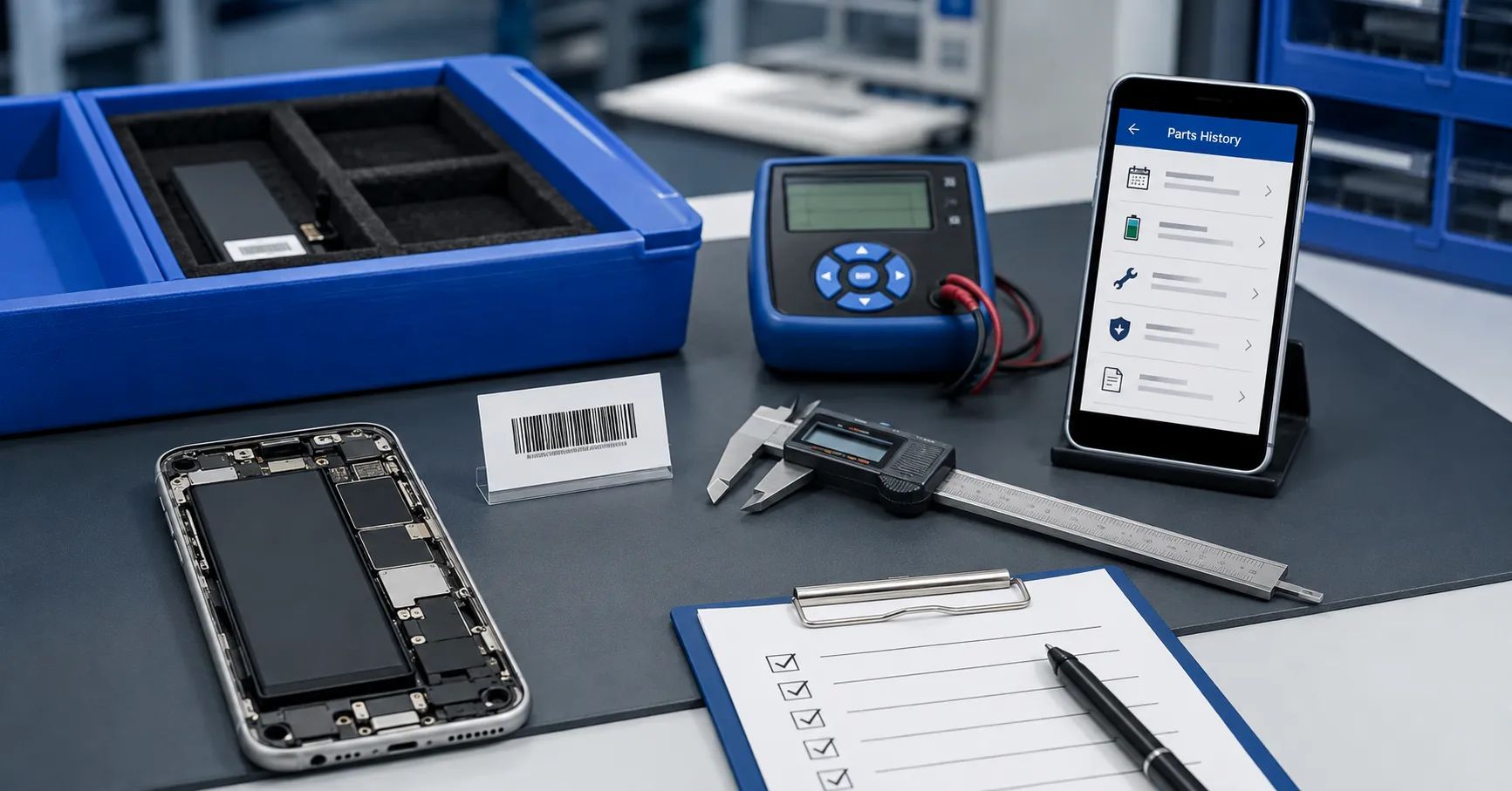
Apple distinguishes new, used, unknown, and unfinished repair states in Parts and Service History. Its official Parts and Service History guidance explains that a Used message can appear when a supported genuine part was previously installed in another iPhone. That software description does not replace a physical and electrical evaluation of the recovered battery.
A B2B program should answer four questions before any test begins:
- Where did the battery come from, and can the source device be identified?
- Was it removed without mechanical, electrical, or thermal damage?
- Does the battery meet the organization’s approved model-level limits?
- Is the intended reuse lawful, technically supported, and commercially appropriate for the target market?
Define Which Batteries Are Not Eligible
A fast exclusion gate prevents technicians from spending time on unsuitable units. Reject from the normal reuse stream any battery showing:
- visible swelling or loss of flatness;
- puncture, cut, crease, dent, crushed edge, or torn pouch;
- damaged insulation, exposed conductor, or contaminated connector;
- evidence of liquid contact, corrosion, overheating, or burning odor;
- unexplained low voltage or unstable voltage recovery;
- unknown removal method or missing source-device record;
- involvement in a safety incident, recall, or severe device impact;
- label alteration that prevents model or source identification.
Do not flatten a swollen battery, repair pouch damage with tape, or charge an abnormal unit to see whether it recovers. Place suspect batteries in the approved quarantine area and follow the organization’s hazardous-battery handling and disposal procedure.
Control Adhesive Removal as a Safety-Critical Process
Removal can turn a usable battery into a damaged battery. Apple’s Parts Support for iPhone guidance recommends installing new batteries when the battery is adhesively installed, noting that used cells can be damaged during adhesive removal and that damage can contribute to overheating, swelling, venting, leaking, or a thermal event.
For any organization evaluating recovered parts, that warning should become an operational control. Record:
- source-device model and condition;
- battery charge condition before disassembly;
- approved tools and removal sequence;
- whether heat, solvent, or force was used;
- adhesive-tab condition and breakage;
- technician identity and removal time;
- photographs before removal, immediately after removal, and after rest;
- any bending, surface mark, odor, heat, or dimensional change.
A battery should not pass merely because pouch damage is difficult to see. Define a post-removal rest and reinspection period so delayed deformation, voltage change, odor, or heat can be detected before electrical testing.
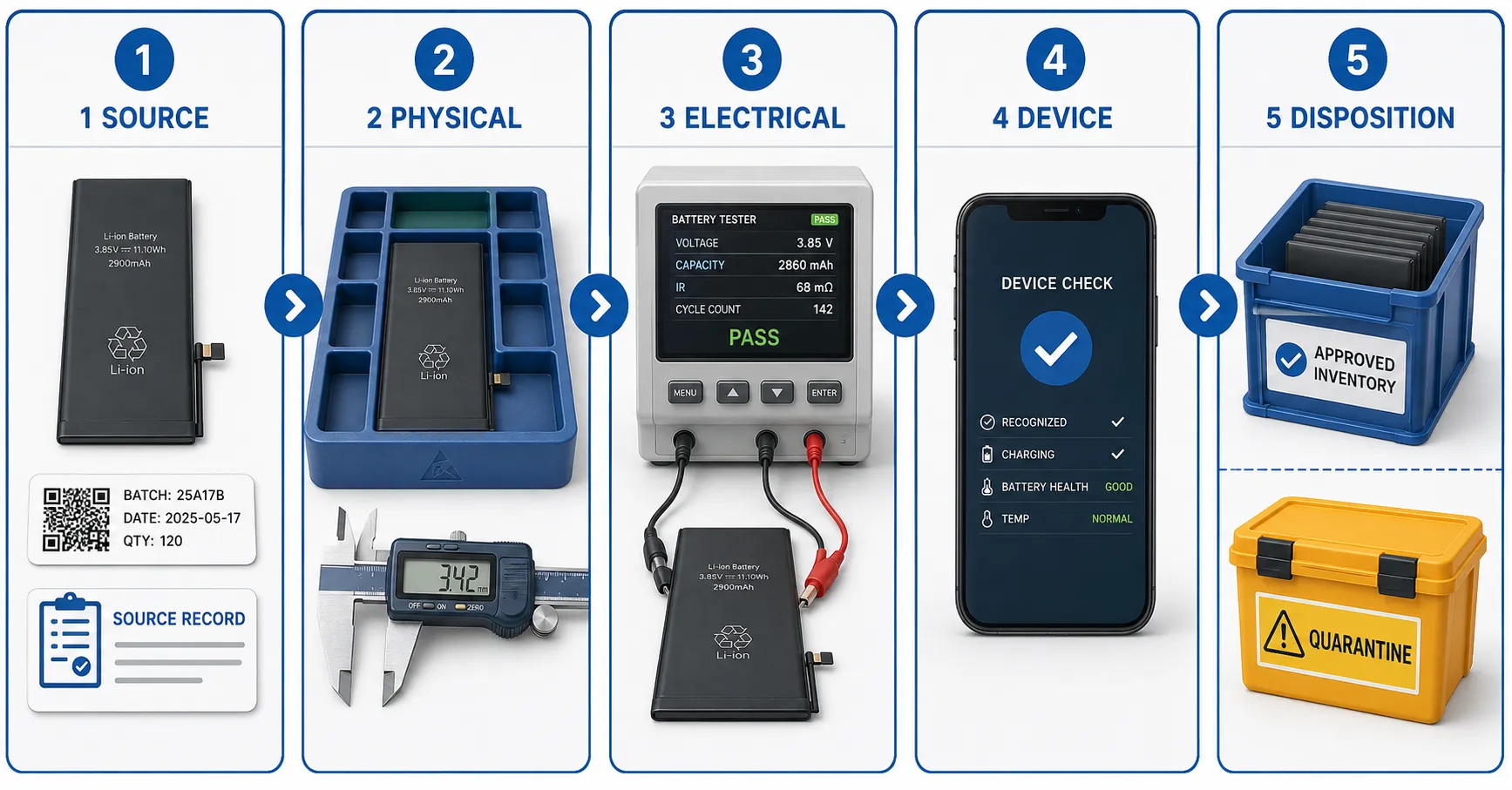
Build a Five-Gate Used-Battery Intake Process
| Gate | Decision question | Minimum evidence | Possible disposition |
|---|---|---|---|
| Source gate | Can the battery and source device be traced? | Device model, work order, serial reference, removal date, reason for recovery | Accept for inspection or quarantine |
| Physical gate | Was it removed without observable damage? | Photographs, dimensions, flatness, connector, insulation, odor and temperature check | Proceed or recycle under approved procedure |
| Electrical gate | Does it fall within model-level screening limits? | OCV, resistance, capacity, voltage curve and temperature | Proceed, retest or investigate |
| Device gate | Does it operate correctly in a controlled device? | Installation, charge, runtime, shutdown, message and diagnostic record | Conditional pass or reject |
| Disposition gate | Is the intended use approved and traceable? | Grade, destination, label, warranty, approver and retained records | Release, internal use, quarantine or recycling |
Create a Chain-of-Custody Record
Recovered batteries should not enter an anonymous mixed bin. Assign a unique intake ID and connect it to the source work order. The record should include source device, battery markings, removal reason, removal technician, date, photographs, initial condition, tests, disposition, destination, and approver.
Keep batteries physically separated by status: awaiting inspection, testing, conditional hold, approved for a defined use, failure analysis, and recycling. A barcode or QR identifier can reduce transcription errors, but the digital record must remain linked to the physical battery after labels or protective packaging are applied.
Traceability also supports warranty analysis. ESC’s mobile phone battery warranty claims guide provides a broader framework for connecting evidence, device diagnosis, batch information, and final resolution.
Standardize Physical Inspection and Dimensions
Measure length, width, and thickness at defined points with a controlled method. Record battery temperature and charge condition because dimensions can vary with condition. Compare the result with the approved reference, not with a different capacity or device model.
Inspect the connector housing, flex cable, insulation, protection-board region, pull-tab area, pouch edges, label, and adhesive residue. Adhesive removal should not leave sharp contamination or create a new compression point during reinstallation. If cleaning is permitted, define the material and method; technicians should not improvise with aggressive solvents.
After measurement, place the battery on a verified flat surface and inspect for rocking, twist, or uneven thickness. Any questionable unit should be held for engineering review rather than forced into a phone enclosure.
Run Electrical Screening Under Controlled Conditions
Open-circuit voltage and internal resistance can identify unusual units, but results depend on temperature, state of charge, rest time, equipment, frequency, contact method, and protection circuitry. Compare only batteries of the same approved model under the same conditions.
Record:
- intake ID and battery model;
- conditioning temperature and duration;
- rest time since charge or discharge;
- instrument, range, frequency, and fixture;
- OCV and resistance;
- repeatability or contact-error result;
- operator, date, and disposition.
Use ESC’s mobile phone battery incoming inspection guide as a general lot-control reference. Recovered units require additional source and removal-damage records that new-production incoming inspection does not normally include.
Verify Capacity Without Overcharging an Unknown Battery
Capacity testing should follow an approved risk assessment. A battery with abnormal voltage, heat, deformation, odor, damaged insulation, or uncertain condition should not be charged merely to obtain a number.
For eligible units, use a controlled charge-discharge method with defined current, voltage limit, termination rule, rest period, discharge load, cutoff, temperature, and stop conditions. Retain the voltage, current, capacity, energy, and temperature curves. Compare measured performance with the organization’s model-level reuse grade, not with an unsupported universal percentage.
Capacity is only one dimension. A recovered battery can deliver acceptable ampere-hours while showing increased resistance, temperature, physical change, unstable percentage behavior, or weak peak-load performance. Review the evidence together.
Perform a Controlled Device Validation
iPhone used battery validation should use known-good target devices and a repeatable work order. Record the device model, operating-system version, initial battery state, installation method, network condition, charger, cable, and test sequence.
Check:
- connector fit and enclosure closure without pressure;
- boot, charge recognition, and stable percentage progression;
- Parts and Service History status;
- Battery Health availability and displayed information;
- controlled standby and runtime behavior;
- peak-load stability and shutdown percentage;
- temperature at repeatable locations;
- condition after removal from the test device.
Do not promise a specific system message across all models and software versions. ESC’s published guide to the iPhone Unknown Part issue can support background reading, while the current workflow should record what the tested device actually displays.
Separate Repair Assistant Status From Battery Condition
Apple’s Repair Assistant instructions explain the conditions required to finish supported repairs, including an updated operating system, Wi-Fi, sufficient charge, and—in some cases—part or account status. A failure to complete the process should not automatically be diagnosed as low battery quality.
Create separate failure codes for:
- physical installation failure;
- battery electrical or performance failure;
- device or connector fault;
- software version or network condition;
- unfinished calibration process;
- part lock or unavailable account information;
- unsupported model or part combination.
This prevents software workflow problems from contaminating battery quality statistics and helps technicians route the device to the correct owner.
Define Grades Without Hiding Product History
If an organization permits reuse, the grade must describe measured condition and intended channel without concealing previous installation. Define the minimum evidence for each grade, permitted destination, warranty, labeling, and customer disclosure.
Do not relabel a recovered unit as new. Do not use terms such as “original,” “genuine,” “100% health,” or “like new” unless the wording is accurate, authorized, and supported for the exact part and market. Separate batteries approved for internal testing, training, warranty investigation, or recycling from batteries approved for commercial installation.
Use Batch and Source Trends to Improve Decisions
Individual test results become more useful when grouped by source channel, device model, removal technician, initial complaint, and disposition. Review:
- damage rate by removal method;
- adhesive-tab breakage by device model;
- capacity and resistance distribution by source;
- software completion rate by model and OS version;
- failure rate after a defined observation period;
- percentage sent to reuse, internal use, investigation, or recycling;
- warranty returns connected to the released grade.
If the organization cannot maintain source history and final disposition, it should not run a commercial reuse program. Anonymous inventory makes root-cause analysis, disclosure, and risk containment difficult.
Common Used-Battery Control Failures
- Approving a battery because it powers on one phone.
- Mixing recovered units from different sources without identification.
- Ignoring adhesive-removal damage because the pouch is not visibly punctured.
- Charging abnormal batteries to obtain capacity data.
- Using one resistance or capacity threshold for every model.
- Treating Repair Assistant failure as conclusive battery failure.
- Describing a used part as new or hiding previous installation.
- Releasing batteries without a defined destination and warranty.
- Discarding raw curves, photographs, and source records after approval.
- Returning failed units to the uninspected inventory area.
Frequently Asked Questions
Can a previously installed iPhone battery be reused safely?
That cannot be decided from previous installation alone. Source history, removal method, physical condition, electrical screening, capacity, temperature, device behavior, software status, and intended use must be evaluated. Adhesively installed batteries introduce additional removal-damage concerns.
Does a Used message prove the battery is healthy?
No. It describes part history in supported Apple workflows. It does not prove remaining capacity, resistance, physical integrity, temperature behavior, or suitability for a specific reuse grade.
Should every recovered battery receive a capacity test?
No. Batteries that fail source, physical, voltage, insulation, or safety screening should be quarantined. Charging a suspect battery only to complete a test can increase risk.
Can Repair Assistant validate a third-party battery?
Repair Assistant is an Apple repair-completion workflow for supported devices and parts. Follow Apple’s current documentation for the exact model. Do not present it as a universal quality certificate for third-party batteries.
What is the most important reuse record?
No single field is sufficient. The critical requirement is an unbroken link between source device, removal evidence, battery identity, test results, software status, disposition, destination, and approver.
When should a battery be sent to recycling?
Use the organization’s approved criteria and applicable waste-battery process. Physical damage, swelling, unstable voltage, abnormal heat, unknown incident history, or failure of the defined reuse grade are common reasons not to return a unit to service.
Make Reuse a Controlled Disposition, Not an Assumption
A professional used iPhone battery reuse program must be more conservative than a simple power-on test. The organization should be able to explain where the battery came from, how it was removed, what was measured, what the device displayed, who approved it, where it went, and what warranty applies.
Send ESC your target device models, sourcing channel, test capability, order volume, and traceability requirements. ESC can help plan new replacement-battery samples and model-level quality records. Previously installed batteries should be evaluated under a separate risk, disclosure, and disposition process approved by the responsible repair and compliance teams.
External Source References
- Apple Support — iPhone Parts and Service History, updated 2026
- Apple Support — Parts Support for iPhone, 2026
- Apple Support — Use Repair Assistant to Finish an iPhone or iPad Repair, 2026