
What Should a Phone Battery with NTC Protection Supplier Actually Provide?
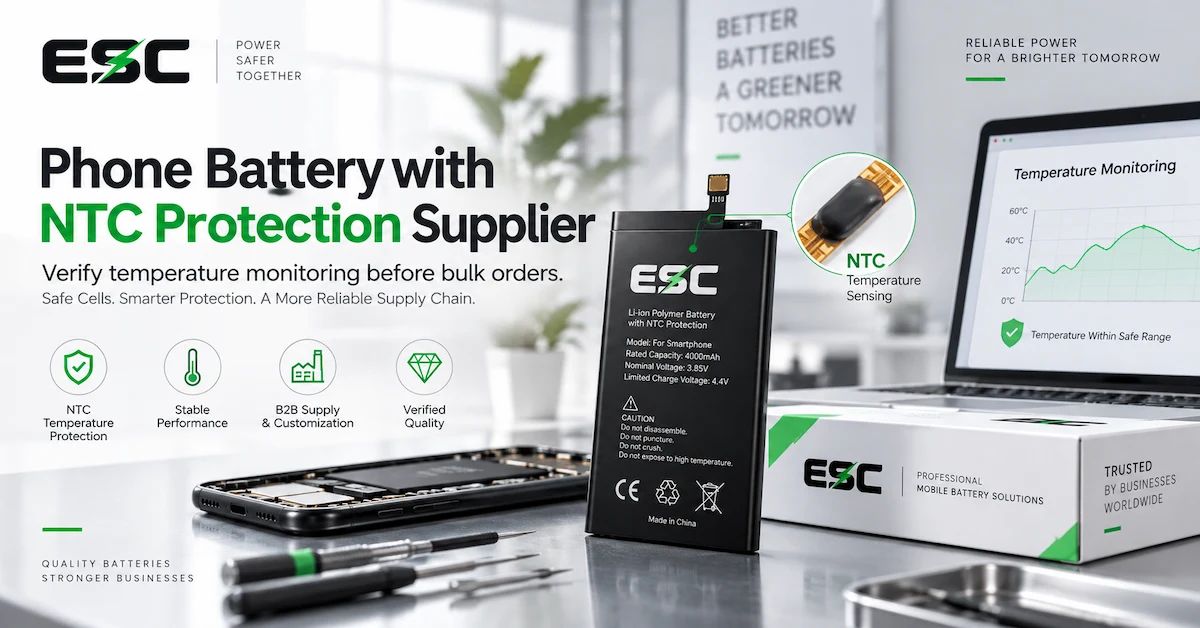
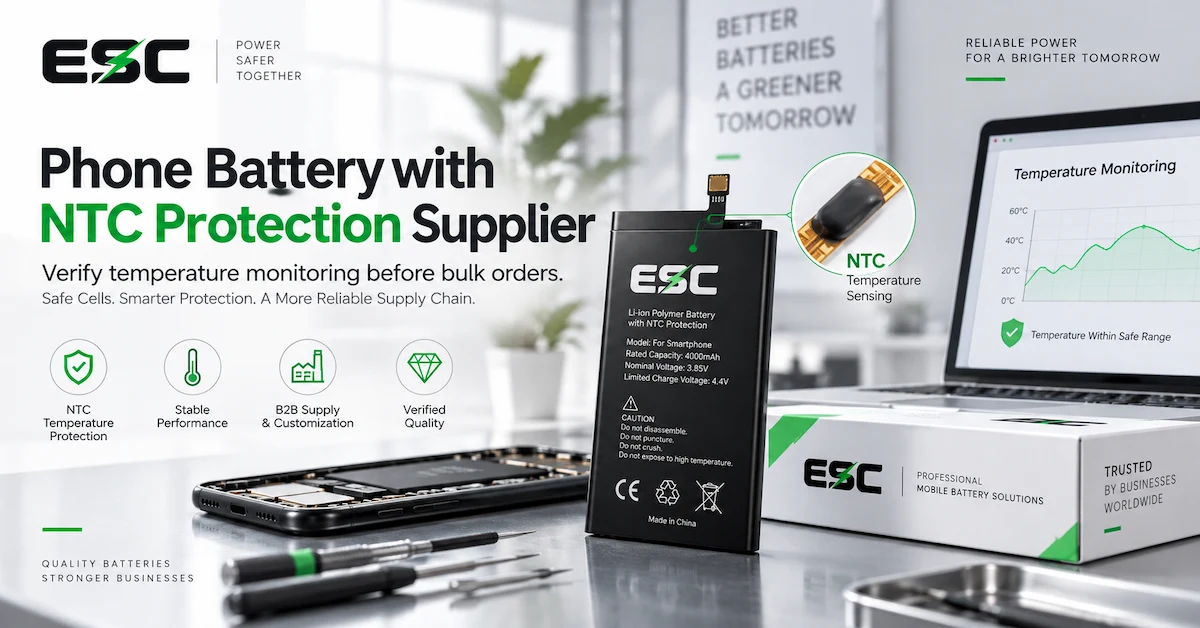
A phone battery with NTC protection supplier should be able to explain how temperature is sensed in the exact battery configuration being sold, rather than relying on a generic “NTC protected” statement. NTC stands for Negative Temperature Coefficient. In a battery temperature-sensing circuit, the resistance of an NTC thermistor changes with temperature, providing a signal that can be interpreted by the phone, protection electronics or other control circuitry depending on the design. The NTC is therefore primarily a temperature-sensing component; the actual response—such as limiting charging, stopping charging or generating an abnormal-temperature condition—depends on the complete hardware and software architecture.
This distinction is important when sourcing replacement batteries. ESC’s mobile phone battery range includes multiple battery formats for repair centers, refurbishers, wholesalers, distributors and private-label programs. The public ESC materials describe protection circuits, quality inspection and thermal behavior, but they do not establish one identical NTC architecture across every phone battery SKU. NTC design should therefore be confirmed at model level rather than assumed across the catalog.
Who Should Pay Special Attention to NTC Temperature Monitoring?
Repair chains need repeatable batteries that behave consistently across many installations. A battery may fit mechanically and charge normally during an initial check, yet still create after-sales problems if the temperature-sensing path is incorrect or incompatible with the device. Refurbishment facilities face similar risks at larger scale because one wrong sensor configuration can affect an entire production batch. Wholesalers and regional distributors need accurate SKU control so one battery configuration is not silently replaced by another, while private-label brands need enough technical evidence to support any “temperature protection” wording printed on the package.
NTC verification is less useful when the basic battery identity is still unclear. The buyer should first confirm the exact phone model, original battery reference where available, capacity, voltage, flex and connector configuration, and whether the supplied product is a complete replacement battery or a cell requiring additional assembly. ESC’s phone battery solutions for distributors emphasizes mixed-model purchasing, product selection and repeat supply for professional buyers, making accurate model-to-specification control especially important.
NTC Protection Is Not the Same as a Complete Battery Protection System
One of the most important sourcing distinctions is between temperature sensing and the complete set of battery protection functions. An NTC thermistor provides information about temperature. Other circuitry may monitor or control overcharge, over-discharge, overcurrent and short-circuit conditions. Depending on the battery and phone architecture, these functions can be handled by different components and control paths.
For example, ESC’s published iPhone X battery page describes PCM protection against overcharge, over-discharge and short circuit and separately lists an operating-temperature range. However, those statements do not identify an NTC component value, sensor location, resistance curve or a particular thermal cutoff strategy. Buyers should therefore avoid converting a general PCM protection claim or operating-temperature range into an unsupported statement that a specific NTC design has been verified.
A supplier should answer three different questions independently:
What senses battery temperature?
This identifies the NTC thermistor or other temperature-sensing method.
Which circuit reads that signal?
This identifies whether the phone, battery electronics or another controller interprets it.
What happens when the defined temperature condition is reached?
This defines the actual protective response.
If these three items cannot be distinguished, “NTC protection” remains a marketing phrase rather than a usable engineering specification.
Build an NTC Specification Before Approving Samples
A serious B2B purchase should convert the temperature-protection claim into measurable fields. The table below is a buyer verification framework. It does not represent universal ESC parameters, because the correct values depend on the battery model and device design.
| NTC specification item | What the supplier should clarify | Why it matters |
|---|---|---|
| Battery identity | Phone model, battery reference, supplier SKU and revision | Prevents one NTC specification being reused for unrelated batteries |
| Sensor type | NTC thermistor or other temperature-sensing element | Confirms what actually performs temperature sensing |
| Nominal resistance | Resistance at a specified reference temperature | Allows the sensing component to be identified |
| Resistance tolerance | Permitted component variation | Helps assess batch consistency |
| Temperature curve | Resistance-versus-temperature relationship or equivalent specification | Determines how the signal changes with temperature |
| Sensor position | Location relative to cell, flex or PCB | Affects how closely sensed temperature follows the battery |
| Connector pin | NTC/temperature pin assignment where applicable | Prevents incorrect wiring or device communication |
| Control path | Device, PCM/BMS or other circuit interpreting the signal | Defines system responsibility |
| Response conditions | Defined temperature-related behavior | Prevents vague “overheat protection” claims |
| Recovery behavior | What happens after temperature returns to an acceptable range | Important for service diagnostics |
| QC method | How the sensor/circuit is verified during production | Connects design intent to mass-production control |
| Change control | Components or revisions requiring reapproval | Protects repeat-order consistency |
Ask for the NTC Curve, Not Just the Word “Thermistor”
A thermistor designation by itself does not tell a repair buyer how the battery will interact with the phone. At minimum, the engineering team should be able to identify the sensor’s nominal resistance at a defined reference temperature and provide a resistance-versus-temperature specification or equivalent technical data. Thermistors also have manufacturing tolerances, so a production design should consider an acceptable range rather than one ideal number.
For B2B sourcing, the objective is not to force the supplier to disclose confidential circuit designs. It is to obtain enough information to determine that the proposed battery was designed for the target device and that the sensor used during production matches the approved configuration.
If your technical team has access to an original battery reference, compare the temperature-sensing behavior as part of sample validation. Do not select a random NTC value simply because it is commonly used in other electronics. The phone may interpret the sensor through a device-specific circuit or calibration.
Sensor Placement Matters as Much as Sensor Specification
Temperature measurement depends on where the sensing element is located. An NTC thermistor positioned close to the cell can respond differently from one located further away on a flex or board. Mechanical contact, insulation, adhesive and local heat sources can also affect what the sensor actually detects.
This is why purchasing teams should avoid comparing NTC-equipped batteries only by the sensor part number. Ask the supplier to freeze the sensor position as part of the approved assembly where it materially affects the design. During incoming inspection or engineering review, compare sample construction with the approved reference.
For repair and refurbishment operations, the battery should also be tested in the actual phone rather than evaluated only on a workbench. Phone enclosure geometry, charging load, processor workload, ambient temperature and installation quality all influence observed battery temperature. A bench result and a device-level result answer different questions.
Connector and Pin Definition Can Make or Break Temperature Detection
A phone battery connector may carry more than positive and negative power connections. Depending on the device, additional contacts can support temperature sensing, identification, communication or other battery-management functions. Similar-looking flex cables therefore should not be treated as electrically interchangeable.
Before ordering, ask the supplier to confirm connector geometry, pin count, orientation and the function of relevant signal lines. This is particularly important for refurbishment factories sourcing multiple closely related phone models. One successful physical installation does not prove that every signal is interpreted correctly by the device.
ESC’s battery compatibility guidance highlights the importance of protection-board matching, connector structure, thermal behavior and system compatibility when evaluating replacement batteries. These factors should remain connected in the sample-approval process rather than being checked independently by different teams.
Finished Batteries and Cell-Only Products Require Different NTC Responsibility
The supply format determines who is responsible for temperature sensing and final system validation. A finished replacement battery can include the cell, flex, protection electronics, connector and associated sensing components. A cell-only product may exclude key parts required for the phone’s complete battery-management system.
ESC sells iPhone battery cells without flex alongside finished replacement battery categories. Buyers purchasing a cell-only solution should therefore not assume that the cell itself contains the complete NTC sensing path or device-interface circuitry. The professional repair or refurbishment process may need to retain, transfer or integrate other components depending on the specific battery architecture.
A useful procurement comparison is:
| Supply format | Temperature-control question | Main buyer responsibility |
|---|---|---|
| Finished replacement battery | What NTC/sensing design is included and validated? | Approve complete battery and device behavior |
| Cell without flex | What temperature-related components are excluded? | Define final flex/BMS/sensor integration |
| Customized finished battery | Does the custom configuration alter sensing or thermal behavior? | Revalidate modified design |
| Private-label standard battery | Is underlying design unchanged from approved product? | Maintain SKU-to-technical-model traceability |
Test NTC Behavior as Part of Sample Validation
A sample should not be approved only because a multimeter shows that the thermistor changes resistance. That confirms only one part of the sensing chain. A stronger validation process separates component verification, device-level recognition and actual thermal response.
First, confirm the approved battery specification and inspect the connector, flex and assembly. Next, verify the temperature-sensing signal using an appropriate technical method. Then install the battery in the intended phone and observe normal charging and discharging under controlled conditions. Record ambient temperature, charger, device state, battery state of charge and software version where relevant.
If engineering validation includes elevated or reduced temperatures, use suitable controlled equipment and an approved safety procedure. Do not create a “temperature protection test” by applying uncontrolled heat, puncturing the battery, bypassing the protection board, shorting terminals or deliberately forcing unsafe charging conditions.
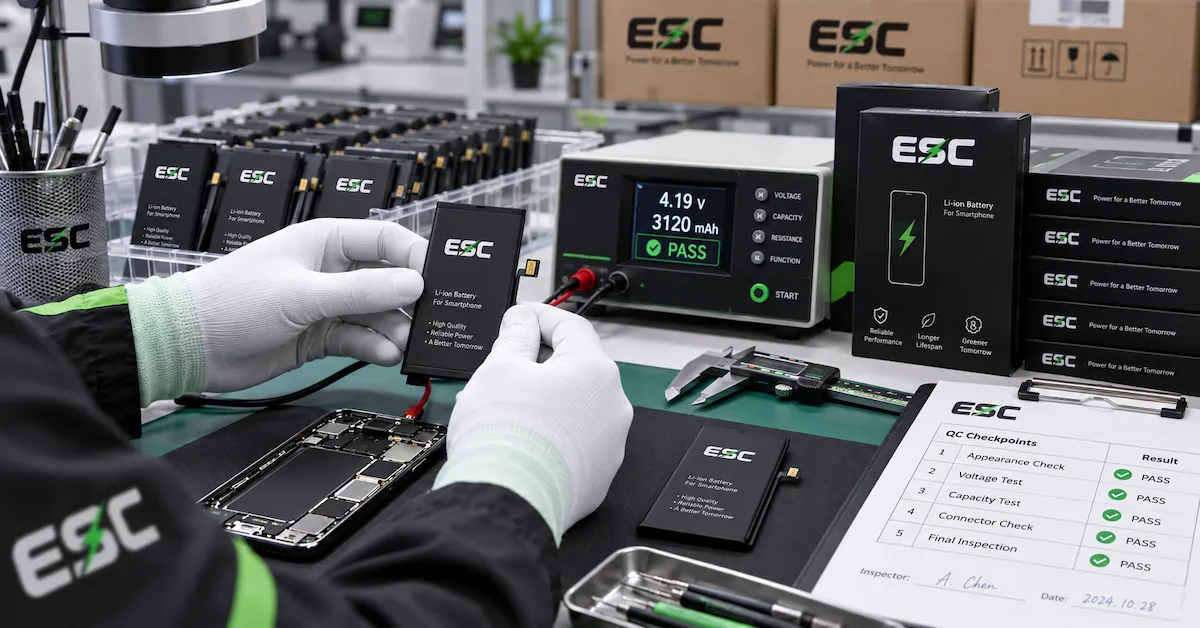
ESC’s phone battery quality control process separates capacity verification, protection-circuit checks, charging/discharging, aging and final inspection. Temperature-sensing verification should similarly be treated as one defined part of the overall battery-approval plan rather than a substitute for all other QC.
Distinguish Normal Temperature Monitoring from Fault Protection
Battery temperature changes normally during charging, device use, storage and environmental exposure. An NTC signal can therefore serve both monitoring and protective-control purposes depending on the system. Buyers should ask the supplier which behavior is expected during normal operation and which behavior represents a fault condition.
For example, the device might accept one resistance range as normal and reject another as abnormal. Another design may use the sensed temperature to adjust charging. The exact response is system-specific and should not be invented from a generic thermistor datasheet.
A phone battery with NTC protection supplier should therefore provide product-level evidence rather than claims such as:
- “NTC prevents all overheating.”
- “Battery cannot swell.”
- “Temperature is always safe.”
- “Charging will never fail.”
- “NTC makes the battery fireproof.”
Those statements go beyond what an NTC sensor alone can establish. Better product communication explains that temperature sensing is one layer within a broader battery, device and charging-control system.
Temperature Performance Should Be Tested as a Curve, Not One Screenshot
A single temperature screenshot provides limited information. For a meaningful comparison, record temperature over time under a repeatable load. Define the test device, initial battery state, charger, workload, ambient temperature, duration and sensor location.
For example, a repair-chain evaluation could compare several samples during the same charging phase and device workload. The objective is not to create a universal safe-temperature limit but to identify abnormal variation and determine whether the approved battery behaves consistently.
ESC’s silicon-carbon phone battery validation guide also emphasizes treating temperature as a curve rather than a single number when qualifying battery samples.This principle is useful for NTC-equipped replacement batteries because both sensor behavior and actual battery heating develop over time.
NTC Verification Should Be Connected to Production Quality Control
A good engineering sample does not guarantee a stable mass-production order. The NTC itself, its mounting method, flex design, connector and associated electronics can all become sources of variation if they are not controlled.
Ask the supplier how these items are managed during production:
- Sensor specification and approved supplier
- Sensor resistance/tolerance verification
- Flex and connector inspection
- NTC pin continuity where applicable
- Installation position
- Electrical function check
- Finished battery charging/discharging test
- Aging
- Final model and label inspection
ESC’s company information describes incoming inspection, cell grading, capacity testing, BMS performance testing, charging/discharging, aging and final shipment inspection as part of its battery-quality workflow. These published process stages provide a starting point for discussing how NTC-related checks could be incorporated for the specific battery being purchased; they should not be interpreted as proof that every model uses an identical NTC test.
Compare Suppliers by Evidence, Not by the Number of Protection Claims
When two suppliers both advertise “temperature protection,” compare what evidence sits behind the phrase.
| Supplier evaluation point | Weak purchasing answer | Stronger purchasing answer |
|---|---|---|
| NTC identity | “Yes, battery has NTC” | Model-specific sensor specification is identified |
| Temperature sensing | “It protects overheating” | Signal path and expected behavior are explained |
| Connector | “Compatible with phone” | Pin/function and approved flex configuration are controlled |
| Sample validation | Battery powers on | Fit, sensing, charging and thermal behavior are recorded |
| QC | “100% tested” | Relevant production checks and acceptance criteria are defined |
| Change control | No stated policy | Sensor/flex/component changes trigger review |
| Private label | Packaging says “NTC Protection” | Claim is approved against underlying technical design |
| Repeat orders | Same model name | Same approved revision is traceable |
This type of comparison aligns with a broader B2B sourcing principle: the cheapest technically undefined battery may cost more after returns, technician troubleshooting and warranty handling are included.
NTC Does Not Replace Other Battery Protection Functions
A thermistor does not eliminate the need to evaluate overcharge, over-discharge, short-circuit or other relevant battery-management functions. Similarly, a strong PCM/BMS design does not eliminate the need to verify the temperature-sensing path where the phone requires one.
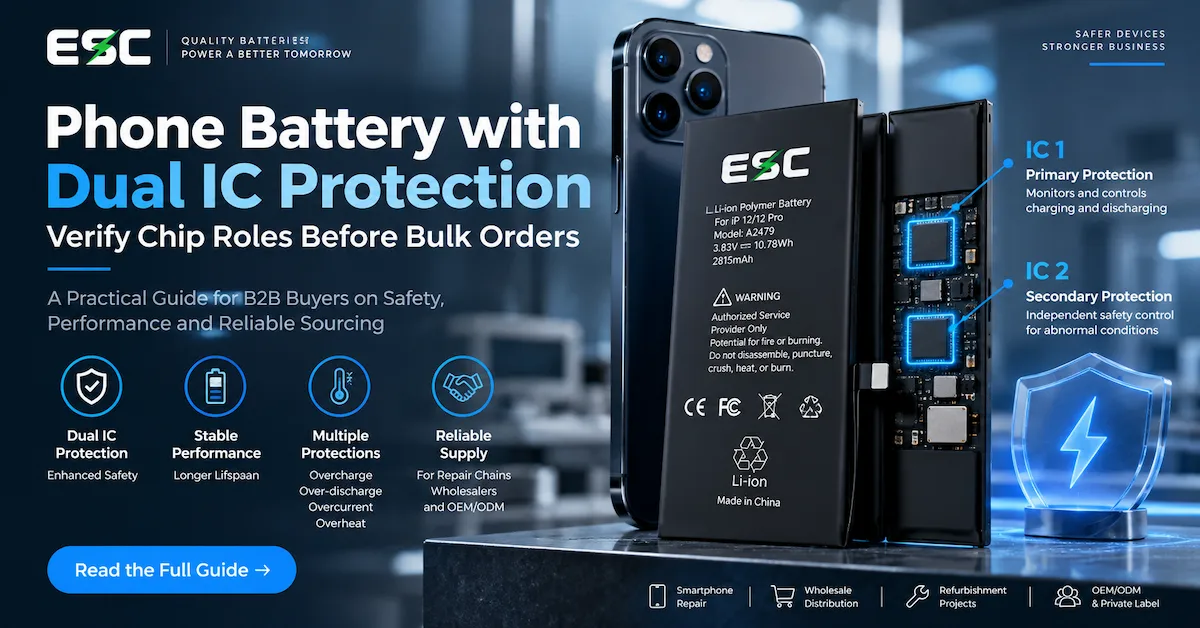
Buyers can read ESC’s dual IC protection battery guide as a related technical topic. That article separates component count from actual circuit function. Apply the same reasoning here: NTC should be evaluated by what it senses, how its signal is used and how the complete battery behaves—not by the presence of the three letters “NTC” in marketing material.
OEM and Private-Label Projects Need Controlled Temperature Claims
Private-label buyers should settle the technical product before finalizing packaging claims. If the retail box will state “NTC Protection,” “Temperature Monitoring” or similar wording, the product-development and quality teams should verify what the underlying battery actually supports.
Keep the buyer SKU linked to the supplier’s technical model, approved sample, sensor specification and packaging revision. If the battery design, NTC component, flex or electronics change later, review whether the claim remains accurate.
ESC supports customized labels and packaging through its customized solution service. For NTC-related products, branding should remain downstream of engineering approval rather than becoming the source of the technical specification.
Certification Documents Do Not Prove the NTC Function
UN38.3, MSDS/SDS and product conformity documents have different purposes. None should automatically be used as proof that a specific NTC sensor, resistance curve or device-level thermal response has been validated.
ESC’s certified mobile phone battery manufacturer guide recommends connecting documents to exact product configurations rather than treating certification logos as universal coverage. The same principle applies to NTC claims. Temperature-sensing evidence belongs in the product specification and relevant test records; shipping and compliance documents should be reviewed for their own intended purposes.
MOQ and Lead Time Depend on Whether the NTC Design Is Standard or Customized
A supplier may already have an approved replacement battery for a particular phone, in which case the NTC configuration should be confirmed against the existing specification. If the buyer asks for a different cell, flex, connector, protection circuit or temperature sensor, the project may require engineering evaluation and sample revalidation before mass production.
For this reason, request commercial terms only after defining whether the project is:
- Existing standard battery
- Existing battery with private-label packaging
- Existing battery with component modification
- Customized battery design
- Cell-only supply requiring buyer-side integration
ESC supports mixed-model purchasing and flexible B2B supply through its mobile phone battery range, but actual MOQ, engineering work and lead time should be confirmed for the selected models and customization scope.
What Should You Send a Phone Battery with NTC Protection Supplier?
A useful RFQ should include the exact device model, original battery reference or photos where available, desired capacity, quantity per SKU, target market and whether you need a complete battery or cell-only configuration. State that NTC temperature monitoring is a required item and request confirmation of sensor specification, connector/pin relationship, relevant temperature-response behavior and production-control method.
Repair chains should also describe the phone models, operating-system versions and installation process used for validation. Refurbishment factories should include expected monthly volume and incoming-inspection requirements. Private-label buyers should provide proposed packaging language so technical claims can be reviewed before printing.
ESC buyers can send these details through the Contact Us page for model-specific review rather than requesting a generic “NTC battery price.”
Frequently Asked Questions
1. What is NTC protection in a phone battery?
NTC refers to a Negative Temperature Coefficient thermistor used for temperature sensing. Its resistance changes as temperature changes. The phone or associated battery-management circuitry can use that signal as part of temperature monitoring and protective-control logic.
2. Does the NTC thermistor itself stop charging?
Not necessarily. The NTC is fundamentally a sensor. The resulting action depends on the complete system reading its signal, which may involve the phone, battery-management electronics or charging-control logic.
3. Does every replacement phone battery use the same NTC value?
No universal value should be assumed. The required sensor specification and temperature-response curve can depend on the target device and battery design. Request model-specific confirmation from the supplier.
4. How can I verify an NTC phone battery sample?
Confirm the battery specification, sensor and connector configuration first. Then perform appropriate electrical and device-level validation using controlled conditions and qualified test methods. Record the battery revision and test conditions.
5. Is working temperature the same as the NTC protection threshold?
No. A published operating-temperature range describes an intended environmental or operating range. It does not by itself identify an NTC resistance value, device threshold or protection response.
6. Can NTC protection prevent every battery overheating problem?
No. Battery temperature is influenced by the cell, charging conditions, device workload, installation, environment and other electronics. NTC temperature sensing is one part of the overall thermal-management and safety system.
7. Does a cell without flex include complete NTC protection?
Do not assume so. Cell-only products may exclude flex, BMS/PCM and other components involved in device temperature sensing. Confirm the exact supplied configuration and responsibility for final integration.
8. Should NTC temperature sensing be checked in every production batch?
The appropriate QC plan should be agreed for the specific product and risk level. Buyers should ask which sensor-related checks are performed during production and how batch consistency is controlled.
9. Can I print “NTC Protection” on my private-label battery packaging?
Only after confirming that the supplied battery includes the relevant design and that the wording accurately describes its function. Packaging claims should remain linked to the approved technical specification.
10. Does ESC provide NTC protection on every phone battery?
The currently reviewed ESC website materials do not establish one universal NTC configuration across all mobile phone battery models. Buyers should request written confirmation for the exact SKU, sensor design and intended device before using NTC as a purchasing or marketing claim.
Conclusion
Choosing a phone battery with NTC protection supplier should begin with a technical question: how is temperature actually sensed and used in the specific battery being purchased? A reliable sourcing process identifies the thermistor specification, sensing path, connector relationship and expected temperature response, then validates those items together with capacity, fit, charging behavior, protection electronics and production consistency. For repair chains, refurbishers, distributors and private-label brands, this model-specific approach is more useful than relying on a generic “NTC protection” label. Review ESC’s mobile phone battery range and contact ESC with your phone models, quantities, target market and NTC requirements to discuss sample validation and an appropriate bulk-order specification.