
What Should a Phone Battery with Dual IC Protection Deliver?
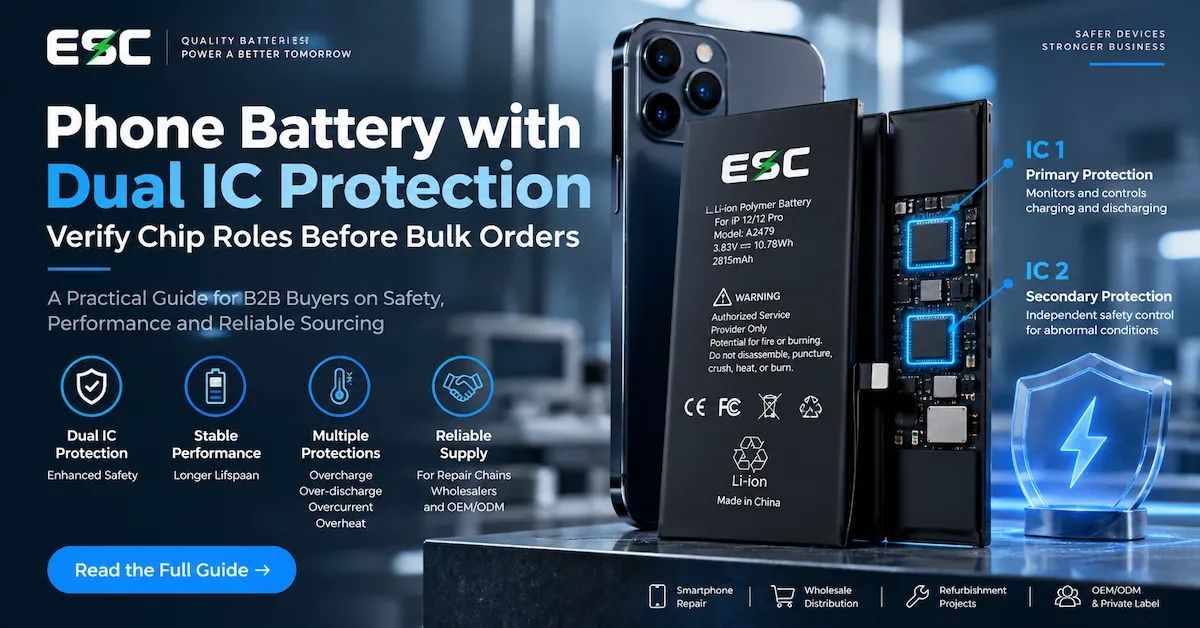
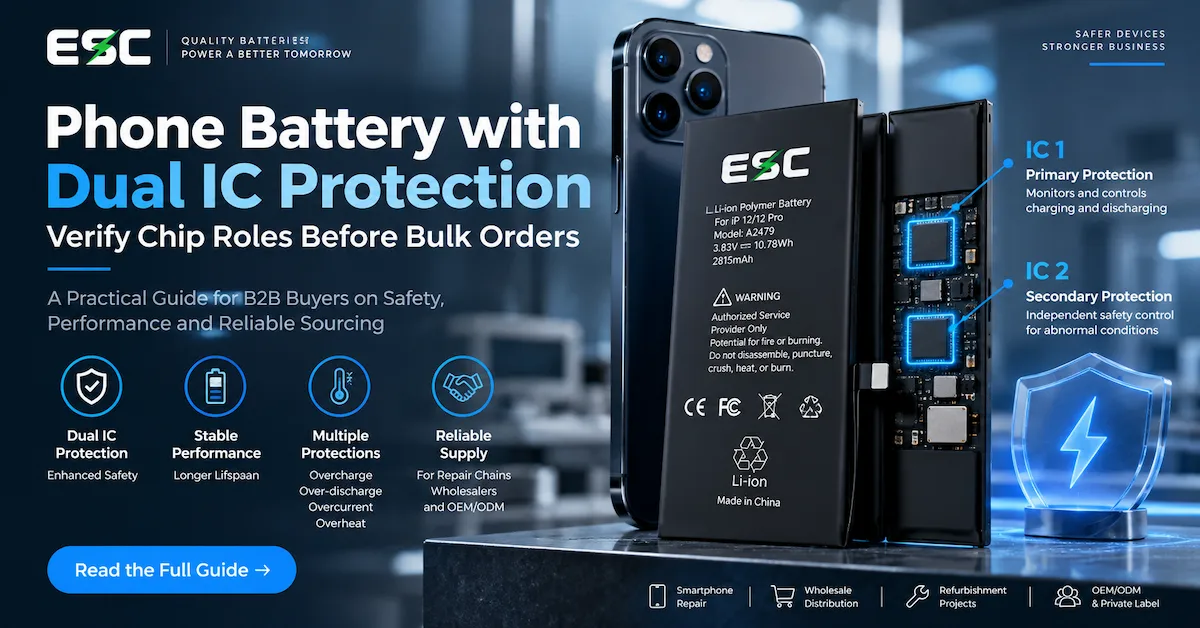
A phone battery with dual IC protection should be evaluated by the functions assigned to each integrated circuit, the faults covered and the way the complete circuit responds. Two visible chips do not, by themselves, establish two independent protection layers. Before purchasing, request a model-specific explanation of the protection architecture, its operating limits and the evidence used to validate it. ESC’s mobile phone battery range provides a starting point for product selection, while its published quality information identifies protection-electronics checks among broader battery inspections. These general capabilities support a technical discussion, but they do not confirm a particular two-chip architecture for every catalog model. The purchasing objective is a correctly specified and verified battery—not simply a package carrying a “dual IC” label.
Who Should Prioritize Protection-Circuit Verification?
For a repair chain, begin with the intended phone models, installation process and acceptance checks used across branches. For a refurbishment facility, define how batteries will be evaluated during repeated device assembly and final inspection. Wholesalers should maintain clear product identifiers so that protection claims remain attached to the correct SKU, while private-label brands should establish evidence requirements before printing those claims on packaging. These are different purchasing situations, but all benefit from a written product specification. ESC discusses model matching, protection-board evaluation, installation fit and batch consistency in its battery sourcing guide for refurbishment businesses. A dual-IC specification is not a reason to accept an unidentified battery, substitute one phone model for another or treat a cell-only product as a ready-to-install assembly.
Identify the Two Components Before Comparing Their Advantages
Start with a simple request: identify each component and describe its function. Distinguish fault detection from current switching, charge measurement and device communication. A protection controller working with a switching device is not the same arrangement as a primary protector working with a secondary fault detector. Likewise, the presence of a fuel-gauge or communication chip does not, by itself, demonstrate independent backup protection. Ask for component references, a functional block diagram and an explanation of the current-interruption path. Where circuit details are confidential, agree on an appropriate technical disclosure process rather than relying on a board photograph. For a phone battery with dual IC protection, the meaningful advantage must come from the verified functions and their coordination; the number of visible packages alone cannot establish that advantage.
Turn “Dual IC Protection” into a Written Specification
A useful specification separates normal operating conditions from fault-detection and recovery conditions. Ask which protection functions are included, what triggers them, how long detection takes and what happens after the fault is removed. Do not use nominal battery voltage as a substitute for the approved charging limit or protection threshold. The following table is a buyer’s specification checklist, not a universal set of electrical limits or a declaration that every ESC battery includes every listed function. Values and acceptance criteria should be supplied for the selected battery design.
| Specification area | Information to request | Purchasing decision it supports |
|---|---|---|
| Battery identity | Device model, battery reference, supplier SKU and revision | Connects the protection description to the ordered product |
| Cell specification | Chemistry, capacity, nominal voltage and approved charging limits | Establishes the electrical requirements of the actual cell |
| First IC | Component identifier and assigned functions | Clarifies its role in the circuit |
| Second IC | Component identifier and assigned functions | Distinguishes backup detection from other electronic functions |
| Overcharge protection | Detection threshold, tolerance, delay and recovery behavior | Evaluates protection against the defined charging fault |
| Over-discharge protection | Detection and release conditions | Defines low-voltage protection behavior |
| Overcurrent and short-circuit response | Applicable conditions, timing and interruption method | Establishes the claimed abnormal-current response |
| Temperature monitoring | Sensor arrangement, responsible controller and response | Prevents assumptions based only on the dual-IC description |
| Normal current capability | Continuous and transient requirements under stated conditions | Supports operation in the target device |
| Standby consumption | Measurement condition and relevant operating modes | Supports storage and standby evaluation |
| Assembly definition | Board, switching devices, flex, connector and insulation | Keeps the complete battery configuration identifiable |
| Validation evidence | Sample revision, test method, results and acceptance criteria | Connects claims to the approved finished product |
What Would Demonstrate Genuine Backup Protection?
Where a supplier claims independent secondary protection, ask which specific fault the secondary stage addresses. Do not assume it duplicates every primary function. Request an explanation of how the fault is detected, which element interrupts the affected current path and what shared components remain involved. A meaningful review also asks what happens in the agreed failure scenario: does the second stage still detect the relevant condition, and can the design take the intended protective action? Have the responsible engineer define suitable validation evidence rather than asking purchasing staff to improvise a demonstration. For a phone battery with dual IC protection, describe the result narrowly—for example, an additional verified protection function—rather than making unsupported claims such as “twice as safe,” “impossible to overcharge” or “zero failure risk.”
Check Electrical Losses Instead of Assuming More Chips Mean Better Performance
Evaluate the complete current path as well as the protection logic. ESC’s phone battery internal-resistance testing guide explains that measurements on a finished battery can include contributions from its protection circuit, connections and flex assembly, and that results depend on the measurement method and conditions. For an illustrative calculation, an additional resistance of 10 milliohms carrying 3 amperes produces a 30-millivolt voltage drop and 90 milliwatts of dissipation, using V = IR and P = I²R. These are arithmetic examples, not ESC measurements or recommended test limits. Ask engineers to assess the actual design for normal current capability, voltage drop, temperature behavior and standby consumption. Adding a protection feature does not remove the need to verify these performance characteristics.
Compare Battery Supply Formats Before Comparing Protection Claims
ESC’s published products illustrate why the supplied configuration must be identified first. The Samsung Galaxy A51 example below is listed as a replacement battery, while the iPhone 12/12 Pro example is explicitly supplied without flex or BMS. The capacities and nominal voltages are supplier-published values, not independently measured results. These products fit different devices and are not substitutes for one another; the comparison concerns purchasing scope, not a ranking of their protection systems.
| Comparison item | Samsung Galaxy A51 replacement battery | iPhone 12/12 Pro battery cell |
|---|---|---|
| Product reference | EB-BA515ABY 4000mAh | 2815mAh cell without flex |
| Published capacity | 4000mAh | 2815mAh |
| Published nominal voltage | 3.83V | 3.83V |
| Supply-format check | Confirm the complete replacement-battery specification and included electronics | Published configuration excludes flex cable and BMS |
| Protection inquiry | Request the protection-board description and applicable test evidence | Define responsibility for the completed assembly’s electronics and validation |
| Dual-IC status | Requires model-specific technical confirmation | The supplied cell does not include a complete dual-IC protection assembly |
| Purchasing priority | Approve fit, electrical behavior and the exact finished configuration | Confirm technical capability and responsibility before choosing a cell-only route |
Do Not Separate Protection Electronics from Cell and Assembly Quality
A protection claim belongs to the finished design, not merely to the name printed on one component. ESC’s OPPO replacement-battery sourcing guide describes the relationship between the cell, protection board, tabs, flex, connector and insulation, and identifies workmanship as a separate purchasing concern. For your order, request control of the cell specification, board revision, critical components, connections and insulating materials. Ask which assembly checks address misalignment, damaged flex, poor connections or inconsistent insulation, and which changes require renewed approval. A supplier offering a phone battery with dual IC protection should be able to connect that description to a reproducible assembly. Do not approve a production substitution solely because the replacement component has a similar package size or general function.
Approve Samples Through Separate Electrical, Functional and Protection Reviews
Use a sample approval plan that distinguishes three questions: does the battery match the agreed specification, does it work correctly in the intended device, and is the claimed protection behavior supported by appropriate evidence? Capacity measurement, physical fit and normal charging observations do not answer every protection question. Equally, protection evidence does not establish runtime or installation compatibility. ESC’s phone battery quality control process identifies capacity checks, protection-circuit checks, charging and discharging, aging and final inspection as distinct activities. Request the relevant method, test coverage and acceptance criteria for your selected model. Protection-trigger testing should be handled by qualified personnel with suitable fixtures and approved procedures. Do not test a safety claim by shorting exposed terminals, bypassing protection electronics or deliberately overcharging a live phone battery.
Keep Device Recognition and Battery Health Claims Separate
Do not approve “dual IC protection,” battery-health display and warning-message behavior as one combined feature. Give each claim its own requirement and validation record. For a repair program, document the device model, software version, battery revision and installation conditions used during evaluation. ESC’s cell-only product information explicitly states that battery recognition and battery-health behavior depend on the associated management components, repair method and device software; the replacement cell alone does not guarantee those results. The same purchasing discipline should apply to a finished battery: a normal status display is not a substitute for protection validation, and a protection description is not proof of device-brand authorization. Record what was actually observed rather than extending one sample result to every supported phone or future software version.
Maintain the Approved Circuit Through Repeat Production
The first approved sample should become a controlled reference for later orders. Record the manufacturer model, buyer SKU, cell specification, board revision, relevant component references and associated test documents. Define which changes require notification and which require new sample evaluation. For larger programs, consider a pilot order to check whether the documented configuration is reproduced under normal production conditions. ESC’s company and service information describes cell grading, capacity testing, BMS inspection, aging and shipment checks; ask how the applicable records will be connected to your order. When purchasing a phone battery with dual IC protection repeatedly, require confirmation of the approved configuration rather than accepting an unchanged sales name as evidence that the electronics remain unchanged.
Private-Label Claims Should Follow Technical Approval
For OEM and private-label projects, settle the battery specification before finalizing promotional claims. A logo, barcode or retail-box change should remain connected to the underlying manufacturer model and approved configuration. ESC describes branding, labeling and packaging support within its mobile phone battery manufacturing guide. When the proposed packaging says “dual IC protection,” ask the technical team to approve that wording against the actual component roles and evidence. Avoid upgrading it to “dual independent protection,” “fireproof” or a quantified safety improvement without specific support. Keep the artwork revision with the product approval record. If the cell or electronics later change, review whether the label, product description and technical documents still describe the supplied battery accurately.
Review Safety Documents Without Confusing Them with Circuit Validation
A dual-IC description does not replace product or shipment documentation, and paperwork does not prove the claimed circuit architecture. ESC’s battery certificates and shipping-documents guide distinguishes product specifications, safety data sheets, UN38.3 information and other documentation by purpose. Maintain the same distinction in your purchasing file: use specifications and appropriate validation records to review the protection design, and request other applicable documents for their intended purposes. When an OEM change affects the underlying battery, ask the responsible technical and compliance parties whether existing evidence remains applicable. A company-level logo or a document for a different configuration should not close an unresolved model-specific question.
Compare Cost, MOQ and Lead Time Against the Same Technical Scope
A quotation for a phone battery with dual IC protection should identify the supplied configuration and the work included in approving it. Separate unit pricing from samples, additional engineering evaluation, testing, custom labels and packaging. Request minimum quantities by model, and ask whether the proposed product is an existing configuration or requires development. For scheduling, distinguish sample preparation, technical approval, component procurement, production, inspection and shipment preparation. Avoid applying a general stock-delivery estimate to a project that still has unresolved circuit requirements. Compare suppliers against the same accepted specification and deliverables. Paying more for an undefined “dual IC” label provides little purchasing value; paying for a documented design, appropriate validation and repeatable production can be evaluated against concrete requirements.
What Should You Send ESC for a Technical Inquiry?
Provide the exact phone models, original battery references where available, required capacity, finished-battery or cell-only scope, quantity per SKU and target market. State that you are evaluating a phone battery with dual IC protection, then specify the information needed: component roles, protection functions, relevant limits, sample-validation scope and production change control. Repair chains should add their installation and device-check requirements; private-label buyers should include packaging and proposed claim wording. Ask for the specification and available evidence to be reviewed before the final quotation is approved. Through the ESC contact page, these details can form a focused product inquiry rather than a general request for “the safest battery at the lowest price.”
Frequently Asked Questions
1. Does dual IC always mean two independent protection circuits?
No. The component count alone does not establish independence. Ask what each device does, which faults it detects and how the complete design interrupts current. A second component serving measurement, switching or communication should not automatically be described as a second independent protector.
2. Is a dual-IC battery always better than a single-IC battery?
Do not rank batteries by IC count alone. Compare the required functions, cell compatibility, operating limits, finished-product validation and manufacturing controls. Select the design that satisfies the actual requirement with supporting evidence rather than assuming that more components guarantee better performance.
3. Can dual IC protection guarantee that a battery will never swell or overheat?
Do not accept that guarantee from the feature name. Review the cell, assembly, operating conditions and applicable safety evidence separately. Protection-related claims should state their verified scope instead of suggesting that the battery is immune to every failure or form of damage.
4. Does dual IC protection increase capacity or runtime?
The term does not establish either result. Request capacity measurements under defined conditions and, where important, runtime evaluation in the target device. Include standby consumption and electrical losses in the assessment rather than inferring performance from the number of chips.
5. Does dual IC protection make a replacement battery charge faster?
Do not derive a charging-speed claim from protection-component count. Define the compatible charging conditions and verify performance in the intended device. Keep normal charging behavior and abnormal-condition protection as separate requirements in the approval plan.
6. Will dual IC protection guarantee normal battery-health display?
No such guarantee follows from the term. Define battery-health display and device recognition as separate functional requirements. Record the device, software and repair conditions used for validation; ESC’s published cell-only guidance makes this dependence explicit.
7. Can a battery cell without BMS be ordered as a complete dual-protected battery?
Not without a separately defined completed assembly. ESC’s cited iPhone 12/12 Pro cell excludes flex and BMS. Buyers needing a finished battery should request that configuration explicitly and clarify responsibility for its protection electronics, integration and validation.
8. How should buyers verify protection without unsafe demonstrations?
Request documented evaluation by qualified personnel using appropriate equipment and approved methods. Link the report to the sample and circuit revision. Buyer-side receiving checks should follow an agreed procedure, not improvised fault tests on live batteries.
9. Do all ESC replacement batteries have the same dual-IC design?
Do not assume catalog-wide coverage. The reviewed ESC materials describe protection functions and multiple supply formats, but they do not establish one identical two-chip architecture across the range. Request written confirmation for each selected model and configuration.
10. What determines MOQ and lead time for a dual-IC battery order?
Request terms for the actual model mix and project scope. Existing products, additional engineering evaluation and private-label packaging involve different approval and production tasks. Confirm the schedule after the battery configuration, quantities and required evidence are defined.
Conclusion
Selecting a phone battery with dual IC protection requires more than recognizing two components on a circuit board. Confirm their roles, identify the faults covered, review how the complete design responds and connect that evidence to the battery being ordered. Then evaluate capacity, installation fit, device behavior, workmanship and production consistency separately. For wholesalers, repair chains and private-label brands, the most useful specification is one that remains clear from sample approval through repeat shipments. Contact ESC with your battery models, quantities and protection requirements to request model-specific clarification, discuss available samples and establish the technical and commercial scope before placing a bulk order.