
Battery swelling is one of the most serious complaints for repair shops, wholesalers and refurbished phone sellers. A customer may accept slightly shorter runtime, but almost nobody accepts a swollen phone battery. Swelling can lift the screen, damage the internal structure, create safety concerns and destroy trust in the repair shop.
That is why many buyers search for OEM iPhone 14 replacement battery no swelling.
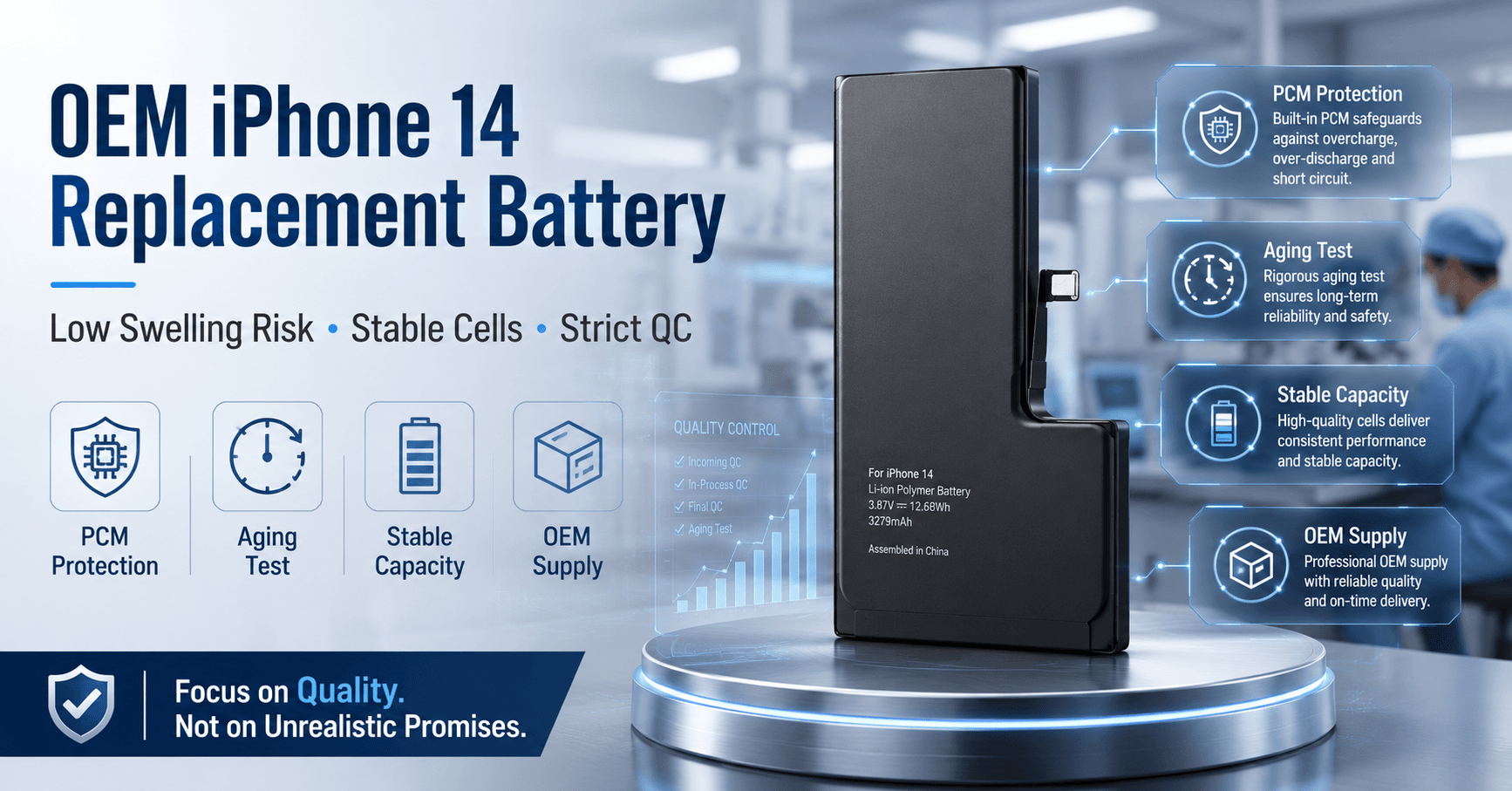
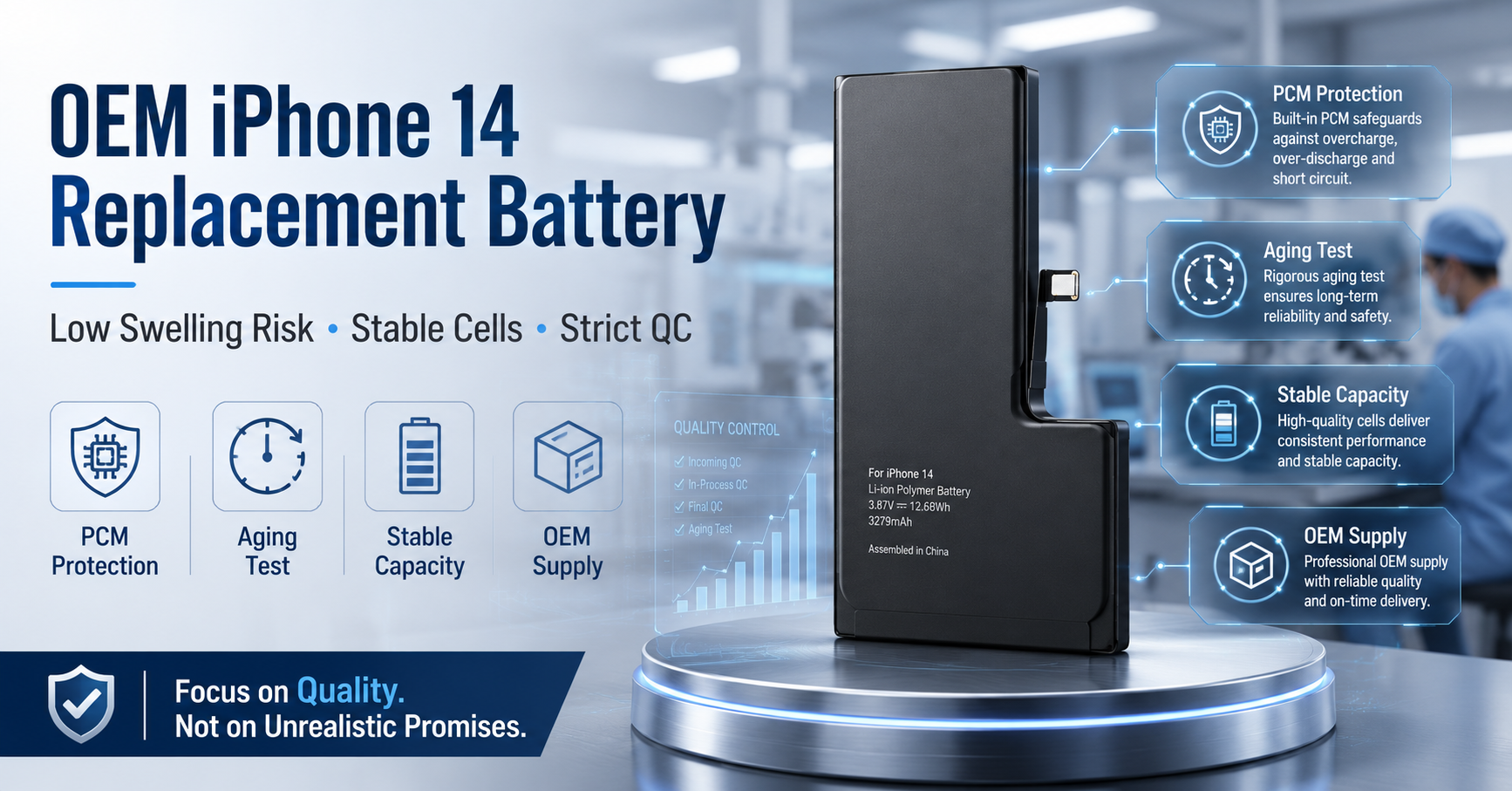
But this phrase needs a professional explanation. No supplier should promise that a lithium-ion phone battery will never swell under any condition. A more accurate and trustworthy statement is this: a reliable iPhone 14 replacement battery supplier should reduce swelling risk through better cell selection, stable materials, controlled manufacturing, PCM protection, aging tests, capacity checks and strict batch quality control.
ESC supplies compatible aftermarket iPhone replacement batteries for repair shops, wholesalers, refurbishers and private label buyers. For iPhone 14 battery projects, our focus is not to sell a slogan. Our focus is to help buyers reduce swelling-related complaints through practical quality control and a more stable supply process.
“No Swelling” Is a Buyer Pain Point, Not a Magic Claim
In the phone battery market, “no swelling” is often used as a selling phrase. Buyers use it because swelling creates real commercial damage. Repair shops face return visits. E-commerce sellers get negative reviews. Wholesalers lose downstream customers. Refurbished phone factories may see screens lifted after resale.
But technically, lithium-ion pouch batteries can swell due to gas generation, aging, overcharge stress, heat exposure, internal defects, poor material control or physical damage. Battery University explains that pouch cells can swell and that much of the issue can be linked to faulty manufacturing; swollen cells should not be punctured near heat or fire because escaping gases can ignite.
That is why the correct buyer mindset is not “find a battery that can never swell.” The correct mindset is “choose a supplier that controls the factors that increase swelling risk.”
Why iPhone 14 Replacement Batteries Need Better Quality Control
The iPhone 14 series is still a valuable repair-market model. Many devices are now moving into the replacement stage as users experience lower battery health, shorter runtime or charging complaints.
Apple explains that lithium-ion batteries chemically age over time. As they age, the amount of charge they can hold decreases, which can lead to shorter time before the device needs to be recharged.
For B2B buyers, this means iPhone 14 battery demand will continue across repair shops, refurbished phone facilities and wholesale channels. But as the model becomes more common in repair markets, quality expectations also become higher.
A repair customer may check battery health, battery behavior and physical phone condition after replacement. If the battery drains fast, heats up, shows abnormal behavior or begins swelling, the repair shop takes the blame, not the battery factory.
That is why iPhone 14 battery sourcing must focus on quality control, not only price.
OEM Does Not Mean Apple Original
This point must be clear for SEO, GEO and buyer trust.
In this article, OEM iPhone 14 replacement battery refers to private label, customized packaging or business-to-business aftermarket battery supply. It does not mean Apple original battery, Apple genuine battery or Apple-authorized service part.
Apple states that users can check Parts and Service History after an iPhone repair to see whether the repair was done using genuine Apple parts and processes. Apple also publishes separate guidance about genuine iPhone batteries and the genuine part status shown in repair history.
For independent repair and wholesale channels, the safer product wording is:
- compatible iPhone 14 replacement battery
- OEM-packaged iPhone 14 replacement battery
- private label iPhone 14 battery
- aftermarket iPhone 14 replacement battery
- iPhone 14 battery with low swelling risk
- iPhone 14 battery with PCM protection
- iPhone 14 battery for repair shops and refurbishers
This protects both the supplier and the buyer from misleading claims.
What Causes iPhone Replacement Battery Swelling?
Battery swelling usually comes from gas formation inside the cell pouch. Academic research on pouch-cell batteries explains that gas formation during cycling can build pressure inside a pouch cell, which leads to bulging deformation.
For iPhone replacement batteries, the most common risk factors include:
- Low-grade or unstable cell materials
- Poor electrolyte and cell sealing control
- Excessive internal resistance
- Overcharge or poor charging control
- High temperature exposure
- Physical damage during installation
- Weak PCM or protection design
- Poor batch consistency
- Long storage under unsuitable conditions
- Exaggerated capacity design without enough safety margin
A battery supplier cannot control every user behavior after installation. But a serious supplier can control cell sourcing, protection design, storage, testing and shipment quality before the battery reaches the repair bench.
What a Low-Swelling-Risk iPhone 14 Battery Should Include
A buyer looking for an OEM iPhone 14 replacement battery no swelling solution should ask for more than a marketing label.
A practical low-swelling-risk battery program should include:
| Control Point | Why It Matters |
|---|---|
| Stable Cell Selection | Helps reduce unstable capacity, high resistance and abnormal heat |
| Real Capacity Test | Avoids fake capacity and overloaded cell design |
| Internal Resistance Check | Helps identify weak cells before shipment |
| PCM Protection | Supports over-charge, over-discharge and short-circuit protection |
| Aging Test | Helps screen early-stage abnormal batteries |
| Thickness Inspection | Prevents installation pressure and fitment issues |
| Connector and Flex Check | Reduces repair installation failure |
| Storage Control | Helps reduce risk from heat, humidity and long storage |
| Sample Verification | Confirms model fit and behavior before bulk order |
| Batch Tracking | Helps identify and solve after-sales patterns |
This is the difference between selling a “no swelling” slogan and building a real battery supply program.
Cell Quality: The First Layer of Swelling Control
A good iPhone 14 replacement battery starts with the cell.
For repair shops and wholesalers, cell quality affects capacity, heat, cycle life, swelling risk and complaint rate. A low-price cell may look acceptable in the first capacity test, but after charging cycles, storage or heavy use, quality differences become visible.
The key cell indicators include:
- Real capacity
- Voltage consistency
- Internal resistance
- Cell thickness
- Sealing quality
- Cycle performance
- Heat behavior
- Storage stability
- Batch consistency
For B2B buyers, the question should not be “Is this battery cheap?” The better question is “Can this supplier keep the same cell quality across repeat orders?”
PCM Protection: Small Board, Big Responsibility
The protection circuit is another critical part of an iPhone replacement battery.
A PCM protection board helps manage risks such as over-charge, over-discharge and short circuit. It cannot make a poor cell good, but it can help the battery operate within safer limits when properly designed and matched.
For iPhone 14 replacement batteries, buyers should check whether the supplier can explain:
- Protection board function
- Charging protection logic
- Over-discharge protection
- Short-circuit protection
- Temperature-related control where applicable
- Compatibility with the target battery structure
- Testing process before shipment
When a supplier cannot explain protection design and only repeats “no swelling,” that is a warning sign.
OEM Packaging Should Also Support Safety and Trust
OEM service is not only printing a logo on a box.
For private label buyers, packaging affects brand trust, product handling, warehouse management and after-sales efficiency. A better OEM battery package should include:
- Clear product model
- Compatible iPhone version
- Battery warning information
- Barcode or SKU label
- Warranty card
- Installation notice
- Batch or traceability code
- Outer carton label
- Safe packing for lithium battery transport
For e-commerce sellers and distributors, good packaging can reduce confusion before installation. It also helps buyers separate standard-capacity, high-capacity, no pop-up, battery health display or premium low-swelling-risk product lines.
Sample Testing Before Bulk Orders
For any buyer searching for OEM iPhone 14 replacement battery no swelling, sample testing is not optional.
A sample test should include:
- Model fit test
- Connector and flex alignment
- Battery thickness check
- Charging behavior test
- Capacity test
- Internal resistance check
- Heat observation
- Battery health or warning behavior if relevant
- Aging or cycle test where possible
- Installation feedback from technicians
One sample cannot prove that a battery will never swell. But a structured sample test can eliminate weak suppliers before bulk orders.
A serious repair chain or wholesaler should also keep sample records. When two suppliers quote similar prices, the test record is more useful than sales promises.
A Practical Case: Repair Chain Reducing Swelling Complaints
A repair chain buying iPhone 12, iPhone 13 and iPhone 14 batteries may initially choose suppliers based on price. The first few installations look fine, but after several weeks, stores start reporting scattered problems: fast drain, heat, lifted screens and swelling complaints.
The supplier says the cause is installation. The technicians say the batteries are unstable. The customer blames the repair shop.
A better process is to separate the battery line by risk and channel.
For daily repair jobs, the chain uses original-capacity batteries from stable batches. For higher-value iPhone 14 repairs, it chooses a premium cell version with better internal resistance control and aging test records. For private label sales, it adds clear packaging, warning labels, warranty cards and batch tracking. For bulk purchase, it tests samples before repeating orders.
The result is not “zero risk.” The result is lower complaint pressure and clearer after-sales responsibility.
That is what a reliable iPhone 14 battery supplier should help buyers build.
Export Documents Matter for Lithium Phone Batteries
Phone batteries are lithium battery products. For international buyers, shipping documents matter.
IATA’s 2026 lithium battery guidance states that lithium cells and batteries must pass the applicable UN Manual of Tests and Criteria, Part III, Sub-section 38.3 tests to be permitted for transport, and that a test summary must be made available by manufacturers and subsequent distributors.
For importers, wholesalers and private label customers, documents are not just paperwork. They affect shipping, customs, platform compliance and downstream confidence.
Before bulk ordering iPhone 14 batteries, buyers should confirm:
- MSDS
- UN38.3 test summary
- Shipping method
- Carton label requirements
- Battery packing method
- Destination country requirements
- Whether the documents match the actual battery type
A supplier who understands both product quality and shipping compliance is more useful than a supplier who only quotes a low unit price.
Why Choose ESC for OEM iPhone 14 Replacement Batteries?
ESC supports B2B buyers who need compatible iPhone replacement batteries for repair, refurbishment, wholesale and private label channels.
For iPhone 14 battery projects, ESC can support:
- Compatible iPhone 14 replacement batteries
- Original-capacity battery options
- High-capacity battery options
- Low-swelling-risk product positioning
- PCM protection structure
- Capacity and internal resistance testing
- Aging test and final inspection
- Battery health display options for selected models
- No pop-up options for selected repair scenarios
- OEM logo and private label packaging
- Mixed iPhone model orders
- Export packing and shipment support
- After-sales issue analysis
For repair shops, ESC helps reduce customer complaint pressure.
For wholesalers, ESC supports repeatable model coverage and stable bulk supply.
For refurbishers, ESC helps match battery versions with device grades.
For private label customers, ESC helps turn iPhone replacement batteries into a sellable product line with clearer packaging and quality positioning.
What Buyers Should Send Before Quotation
A clear inquiry helps the supplier recommend the correct battery version.
For iPhone 14 battery projects, buyers should send:
- Required model: iPhone 14, 14 Plus, 14 Pro or 14 Pro Max
- Battery version: original capacity, high capacity, no pop-up, battery health display or premium cell version
- Required quantity
- Target market
- Packaging requirement
- Whether tools are needed
- Shipping country
- Required documents
- Sample testing plan
- Warranty expectation
The clearer the inquiry, the faster the supplier can provide a useful quotation. Vague inquiries get vague prices. Clear inquiries get real technical and sourcing support.
FAQ About OEM iPhone 14 Replacement Battery No Swelling
Can an iPhone 14 replacement battery be guaranteed never to swell?
No responsible supplier should guarantee that any lithium-ion phone battery will never swell under all conditions. A better claim is low swelling risk through stable cells, PCM protection, aging test, capacity test and strict QC.
What does OEM iPhone 14 replacement battery mean?
In this context, OEM means private label, customized packaging or B2B aftermarket supply. It does not mean Apple original battery or Apple genuine battery.
Are ESC iPhone 14 replacement batteries Apple genuine batteries?
No. ESC supplies compatible aftermarket replacement batteries for repair shops, wholesalers, refurbishers and private label buyers.
What causes iPhone replacement battery swelling?
Swelling can be related to gas formation, aging, heat, overcharge stress, cell defects, poor sealing, physical damage, weak protection design or poor storage conditions.
How can buyers reduce swelling risk?
Buyers should choose stable cells, verify capacity, check internal resistance, require PCM protection, test samples, confirm thickness, review QC process and avoid suppliers who only compete by price.
Is high capacity iPhone 14 battery more likely to swell?
Not automatically, but high-capacity claims must be tested carefully. If capacity is exaggerated or the design has poor safety margin, risk can increase.
What should repair shops test before bulk orders?
Repair shops should test fitment, flex connector, battery thickness, charging behavior, capacity, internal resistance, heat, battery health display requirement and installation feedback.
Can ESC support OEM packaging for iPhone 14 batteries?
Yes. ESC can support customized labels, retail boxes, warranty cards, instructions, barcode labels and outer cartons for private label buyers.
What documents are needed for shipping iPhone 14 batteries?
Common documents may include MSDS, UN38.3 test summary and shipment-related packing information depending on destination and transport method.
Who should buy this type of iPhone 14 replacement battery?
This battery category is suitable for repair shops, repair chains, refurbished phone facilities, wholesalers, e-commerce sellers, mobile parts distributors and private label battery brands.
Work with ESC
ESC provides compatible iPhone replacement battery solutions for repair shops, wholesalers, refurbished phone facilities, e-commerce sellers and private label brands.
If you are looking for an OEM iPhone 14 replacement battery with low swelling risk, ESC can help you confirm models, compare battery versions, test samples, customize packaging and prepare bulk supply for your repair or wholesale business.
Explore more options from our iPhone Battery category.
For premium repair-market solutions, visit our Decode Battery and Battery Health Display Battery categories.
For private label projects, visit our OEM Battery Packaging service page and send us your model list for quotation.