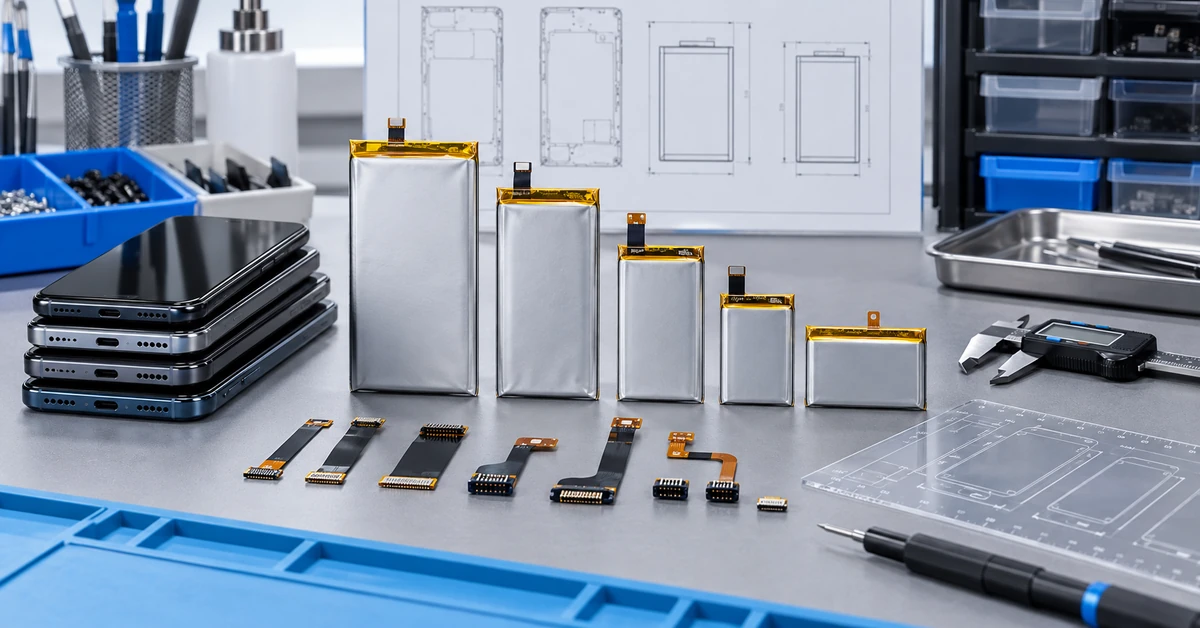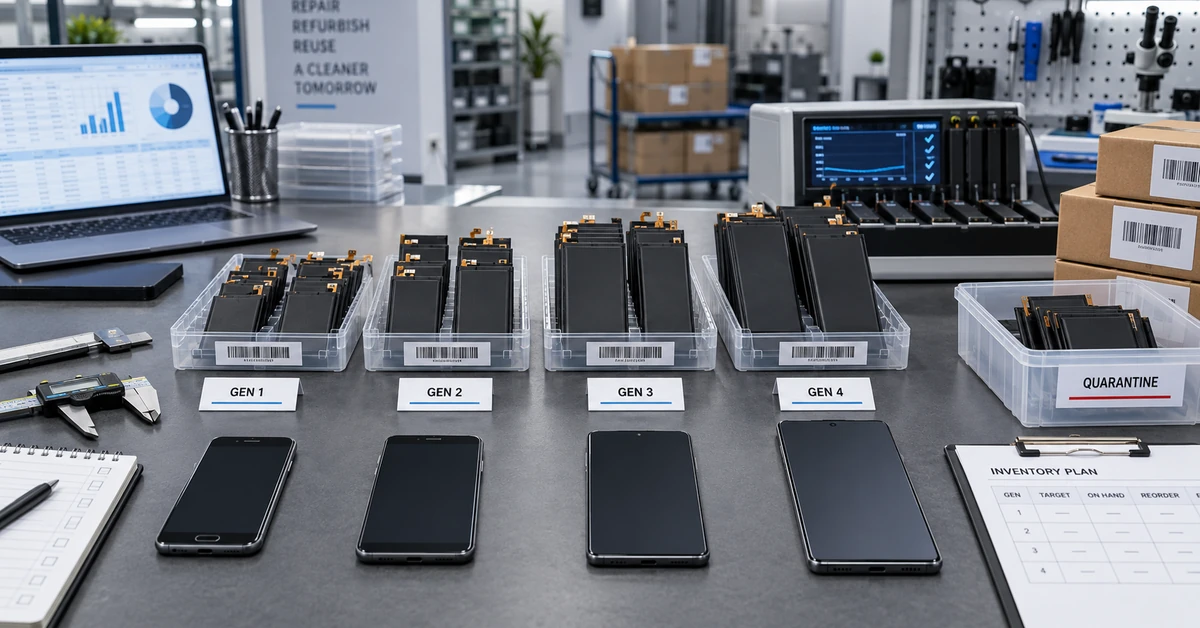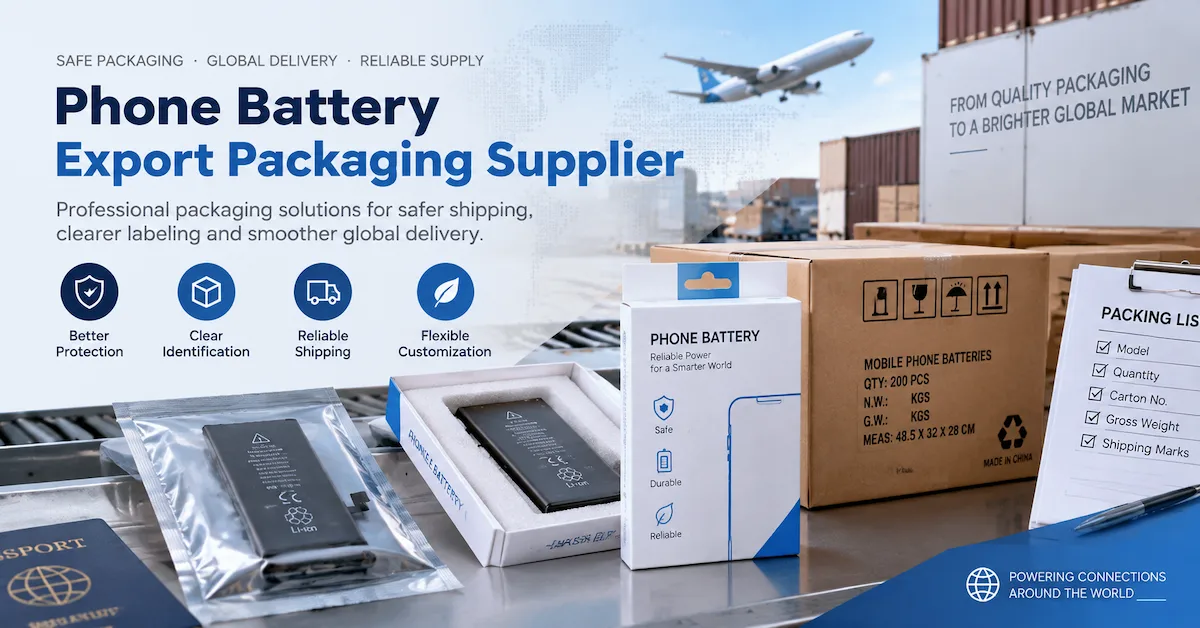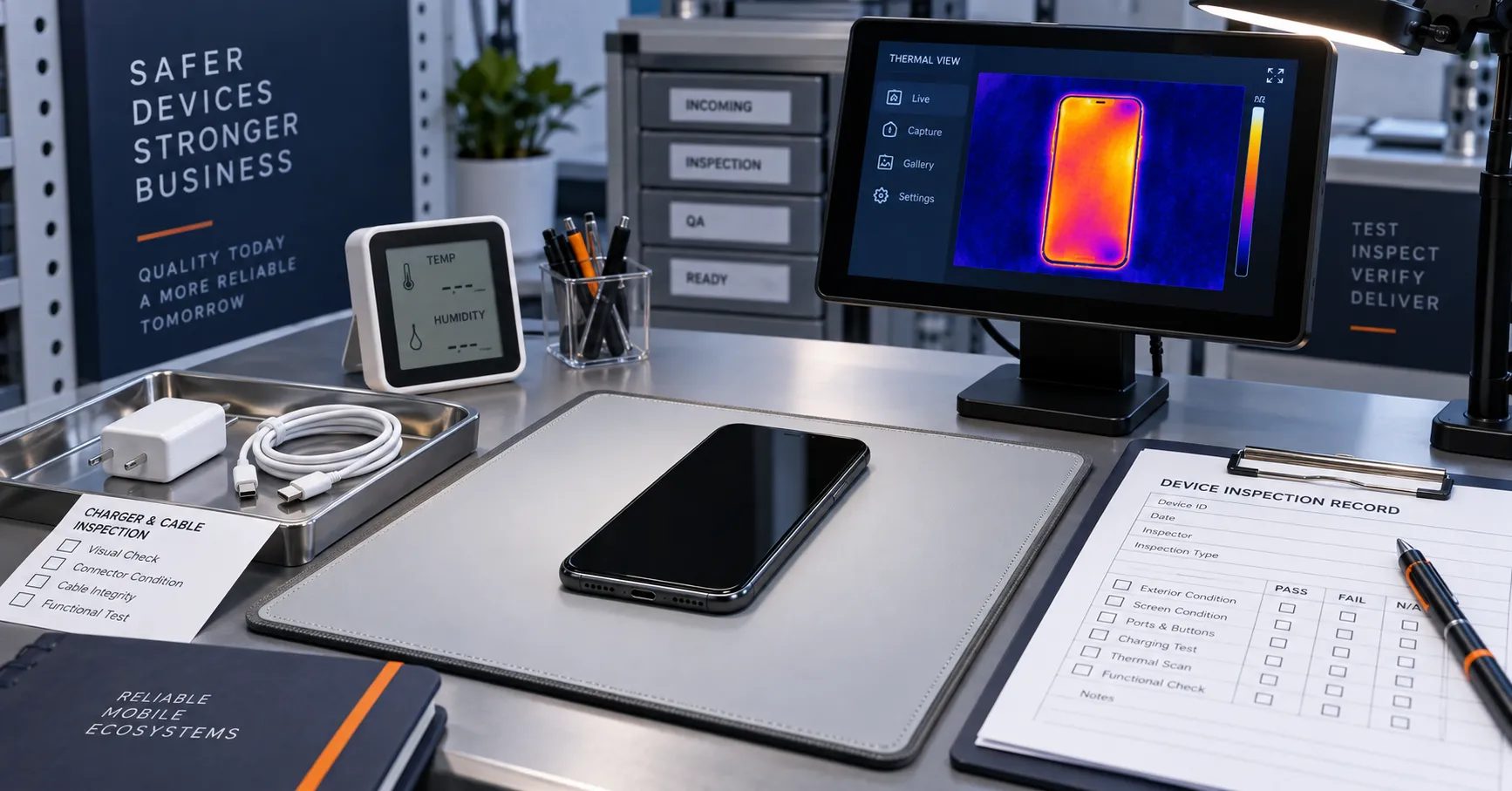

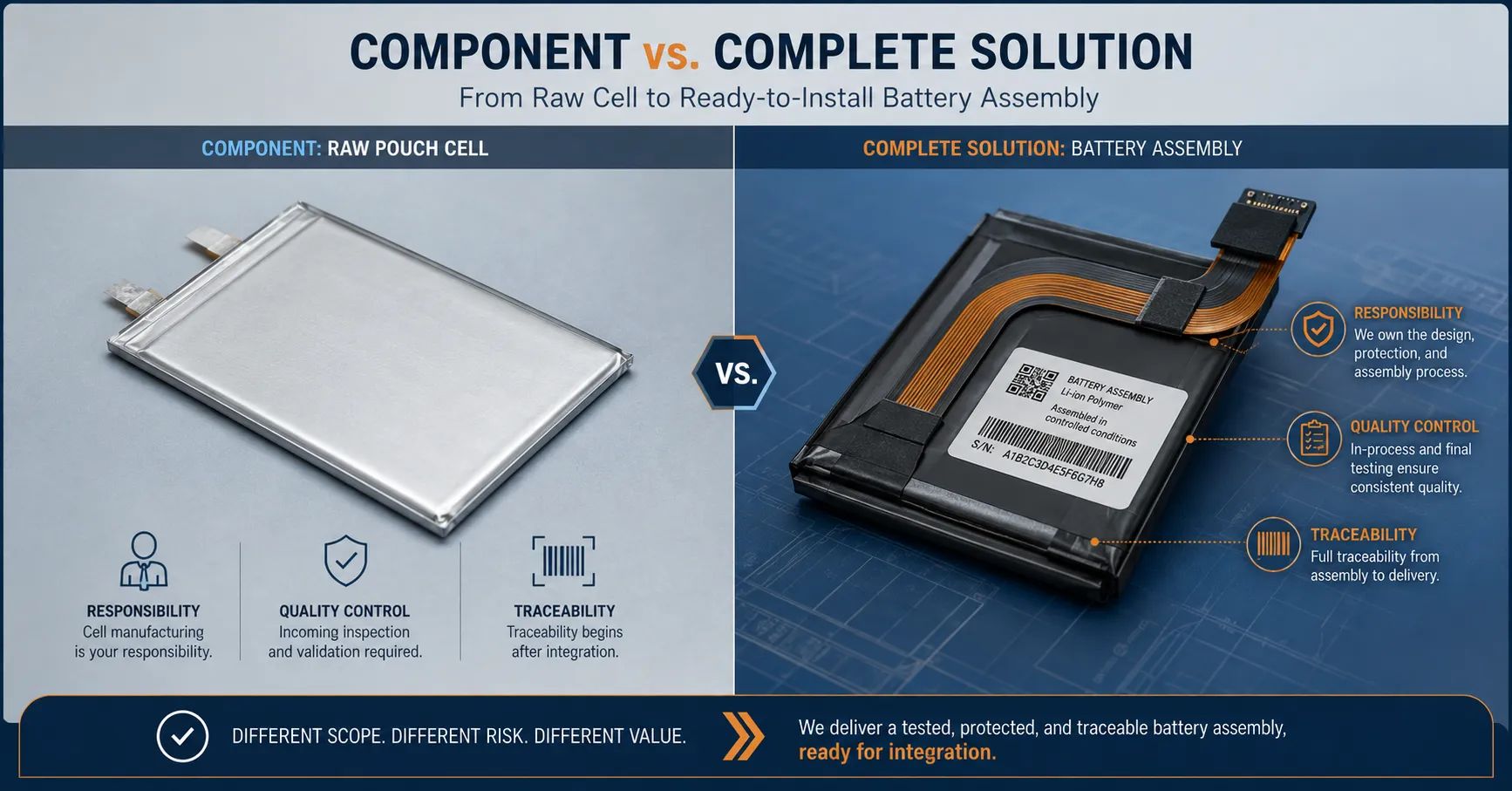
A mobile battery cell is an electrochemical component; a finished phone battery pack is a model-specific assembly intended for integration or installation. The finished scope may include the cell, protection electronics, flex circuit, connector, temperature sensing, insulation, adhesives, identification and final functional evidence. Buyers should choose between them according to who is qualified to design, assemble, validate and warrant those added functions.
The lowest unit quotation does not identify the lower total cost. Buying a bare cell transfers integration work and risk to the buyer or an appointed pack assembler. Buying a finished assembly transfers more deliverables to the supplier, but only if the purchase specification names them. A clear RFQ must define the physical item, responsibility boundary, approved design, test evidence and change-control obligations.
Start With the Delivered Scope
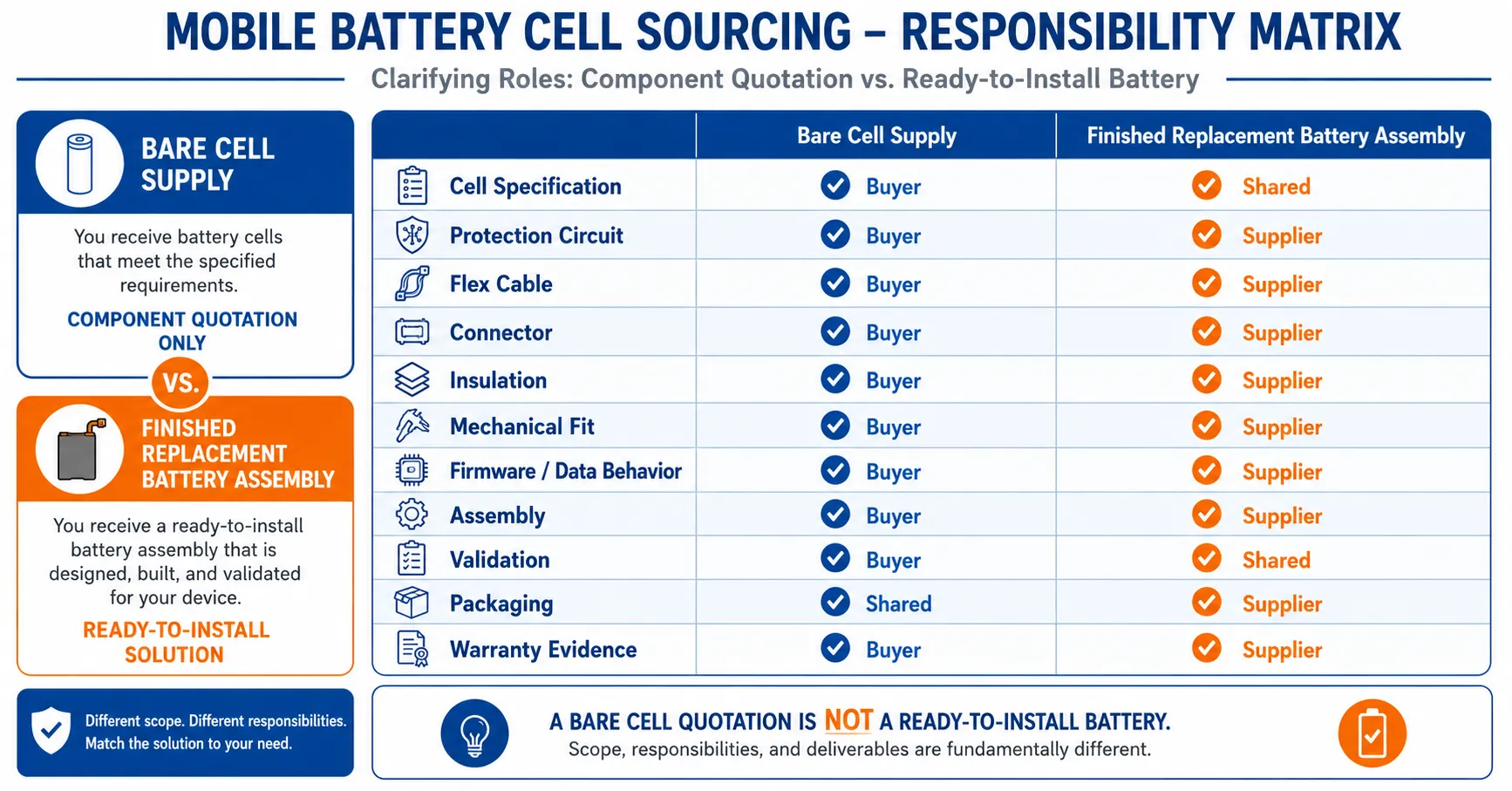
| Scope item | Bare cell purchase | Finished pack purchase | Buyer confirmation |
|---|---|---|---|
| Electrochemical cell | Primary supplied item | One component within the assembly | Cell designation, specification revision and traceability |
| Protection electronics | Normally designed and integrated downstream | Included only when specified | Functions, components, settings and evidence for the exact revision |
| Flex and connector | Normally outside cell scope | Model-specific parts may be included | Pinout, mating interface, routing and mechanical tolerance |
| Insulation and mechanical stack | Downstream responsibility | May be part of the approved assembly | Dimensions, clearances, tape, adhesive and enclosure interaction |
| Final functional validation | Performed after downstream assembly | Should match the defined delivered configuration | Device models, software context, test method and acceptance record |
| Warranty boundary | Often limited to the supplied cell under agreed conditions | Can include the delivered assembly under the agreement | Failure-analysis access, exclusions and remedy process |
The word “battery” is often used loosely in commercial discussions. Require drawings, a bill-of-material scope and photographs of the actual deliverable. A quotation for a cell with tabs should not be compared directly with a ready-to-install assembly that includes electronics, connector, insulation, adhesive and individual packaging.
When a Bare Cell Can Be the Right Purchase
Bare battery cell sourcing can fit a buyer that already controls battery-pack engineering and qualified assembly. This may include a manufacturer integrating cells into its own product, or a specialist refurbishment program with an approved design, equipment, trained operators, process controls and validation capability. The buyer must also have a lawful and supportable route for transport, traceability and field responsibility.
The business advantage is control. The buyer may select a cell against its own mechanical and electrical design, manage component inventory separately, and retain the approved interconnect or protection architecture. This can also support programs in which the downstream assembly is genuinely the buyer's product and the buyer owns design verification.
The tradeoff is that the cell supplier cannot validate work it did not perform. Weld quality, tab forming, flex attachment, connector installation, insulation, adhesive placement, sealing, data behavior and device fit can all affect the completed product. If another party performs those steps, the RFQ and quality agreement must identify that party and allocate incoming inspection, process validation, final release and warranty investigation.
A phone battery cell should therefore be approved as a component against a controlled specification, not as shorthand for a completed repair solution. Capacity claims must be verified for the specific cell and test method. Compatibility with a phone cannot be inferred from capacity, nominal voltage or approximate dimensions alone.
When a Finished Replacement Pack Is the Better Scope
A finished phone battery pack is usually the clearer choice for repair chains, parts wholesalers and refurbishment lines that need an installable SKU and do not own cell-to-pack manufacturing. The defined deliverable can include the model-specific electrical and mechanical interface, final assembly inspection, traceable labels and packaging suited to the agreed channel.
This approach reduces the number of uncontrolled handoffs, but it does not remove buyer verification. The buyer must confirm that the delivered assembly matches the exact device model and approved specification. “Finished” does not automatically mean tested in every target phone, compatible with every software version, certified for every market or guaranteed to display a particular system message.
The published iPhone battery pack manufacturer guide covers broader supplier qualification. This page addresses the earlier decision: whether the RFQ should ask for a component cell or a complete replacement battery assembly, and which evidence must follow that choice.
Protection Electronics Are an Engineering Boundary
Protection electronics monitor defined electrical or temperature-related conditions and control the current path according to the design. They do not turn an unspecified cell into a universal phone battery, and their presence does not prove that components, thresholds, sensing, switching capability or layout are suitable for the application.
For a bare-cell purchase, the buyer or pack integrator normally owns selection and validation of the protection circuit. For a finished-pack purchase, request the approved circuit revision, critical-component control, programmed or configured values where applicable, functional-test coverage and supplier change notification. Do not accept “with PCB” as a complete technical description.
- Define which abnormal conditions are monitored and which switching path responds.
- Confirm the relationship among the cell limits, pack electronics, charger and host device.
- Identify the temperature sensor, placement and interpretation when the design uses one.
- Control protection IC, switching devices and other critical substitutions by revision.
- Require evidence for the offered assembly rather than an unrelated reference board.
Protection validation must be conducted by qualified personnel under a controlled plan. Procurement staff should not request improvised overcharge, short-circuit or deep-discharge demonstrations. Such demonstrations can create hazards and do not replace a documented, applicable validation program.
Flex Cable, Connector and Pinout Determine Integration
The flex is not merely a convenient wire. It can carry power, sensing and communication paths while providing the mechanical route between the cell assembly and the phone. Connector family, contact arrangement, polarity, flex geometry, stiffener, bend area and installed clearance must match the approved design.
A connector that appears to mate can still have an incorrect pinout, height or retention behavior. A flex that works outside the enclosure may be stressed, pinched or displaced after final assembly. Dimensional inspection should therefore connect the battery drawing to the device stack, adhesive position and repair process.
The mobile phone battery incoming-inspection guide provides a wider receiving framework. For this sourcing decision, create different IQC plans: bare cells require cell identity, physical condition and component-level electrical checks; finished packs also require flex, connector, insulation, label, fit and defined functional checks.
Assign Assembly Responsibility Before Sampling
Write a responsibility matrix before ordering samples. Name the party that owns cell approval, protection design, interconnection, welding or joining, insulation, adhesive, connector, software-related behavior, final device validation, packaging, transport documents and field failure analysis. If work is subcontracted, identify how the prime supplier controls and traces it.
| Decision area | Evidence for cell scope | Additional evidence for finished-pack scope |
|---|---|---|
| Identity | Cell model, manufacturer, revision and lot | Pack SKU, complete BOM revision and serial or lot relationship |
| Electrical | Capacity and discharge method; cell limits | Protection functions, connector pinout and pack-level behavior |
| Mechanical | Cell drawing, tabs and tolerances | Overall stack, flex route, connector position, insulation and adhesive |
| Process | Cell production and outgoing controls within disclosed scope | Assembly work instructions, critical process controls and final inspection |
| Application | Input to the buyer's integration validation | Model-specific installation and functional comparison under the agreed plan |
| Change control | Cell material, design or production changes | Cell plus electronics, flex, connector, insulation, adhesive and assembly changes |
Use the published mobile phone battery sampling-plan guide after the scope is frozen. Sampling cannot repair an ambiguous specification. An acceptance plan should name the lot, selection method, test unit, acceptance criteria and action when a result is inconclusive or outside limits.
Compare Total Landed and Qualified Cost
Compare both options at the level of a released, supportable unit. The bare cell price must be combined with protection electronics, flex and connector, insulation, joining, labor, yield loss, equipment, engineering, validation, scrap, packaging, transport preparation and field support. A finished-pack quotation should be checked for which of those items are actually included.
A useful cost model separates:
- purchase price and commercial terms;
- engineering and tooling;
- incoming inspection and assembly conversion cost;
- pilot and ongoing quality-control cost;
- yield, rework and scrap;
- inventory complexity and component obsolescence;
- transport, packaging and documentation;
- warranty handling, diagnosis and replacement labor.
Do not assume the same MOQ, lead time or warranty applies to both scopes. MOQ depends on the selected model and customization scope. Lead time depends on model, customization and order quantity. Warranty depends on the specific product and agreement.
Keep Compliance and Transport Evidence Design-Specific
Transport evidence must match what is offered for shipment. PHMSA explains that lithium cells and batteries offered for transportation must pass the applicable UN Manual of Tests and Criteria subsection 38.3 design tests, and that manufacturers and subsequent distributors must make the required test summary available upon request. See the agency's lithium-battery transport guidance.
The current UNECE Manual of Tests and Criteria publication page provides Revision 8 and Amendment 1 materials addressing lithium cells and batteries. Buyers should verify which design the test summary identifies and whether changes to the cell or completed pack affect applicability. A supplier statement or certificate from another model is not a substitute for model-level traceability.
Certification availability must be confirmed for the exact product and target market. A cell document does not automatically cover a completed pack, and a pack document does not automatically approve every device or shipping configuration. Engage a qualified compliance and logistics specialist for the destination, transport mode and shipment state.
Approve the Sample, Pilot and Production Configuration
- RFQ: state cell or finished-pack scope, drawings, target devices, evidence and responsibility matrix.
- Engineering review: resolve electrical, mechanical, protection, interface and documentation gaps.
- Samples: test the exact revision under a written method with compatible controls.
- Pilot: confirm that production processes reproduce the approved result.
- Mass production: apply incoming and outgoing controls to defined lots.
- Changes: require notice, risk review and revalidation before substitution.
The iPhone battery capacity-testing guide explains why capacity needs a defined method. Capacity is only one release characteristic: the finished assembly must also meet the applicable protection, interface, fit and functional requirements.
Route Field Failures to the Responsible Scope
A field return should preserve device model, pack or cell lot, assembly history, installation record, reported event and comparison evidence. If the buyer assembled the pack, failure analysis must distinguish cell behavior from joining, electronics, flex, connector, insulation and workmanship. If the supplier delivered a finished pack, review the complete delivered assembly against its specification.
The mobile phone battery warranty-claims guide helps structure evidence and disposition. Avoid assigning every fast-drain, charging, shutdown or display complaint to the cell. Retain “inconclusive” when the returned configuration, history or reference control cannot support a root cause.
Frequently Asked Questions
Is a mobile battery cell ready to install in a phone?
Usually no. A cell is a component. Installation requires the approved protection, interconnection, insulation, mechanical interface and complete validation defined for the target product.
Does a protection board make a cell a finished pack?
Not by itself. The delivered pack scope may also require a flex, connector, sensing, insulation, adhesive, label, dimensional control and final functional evidence.
Which option is cheaper for a repair chain?
Compare total qualified cost. A repair chain without controlled pack assembly may add more labor, equipment, yield and warranty exposure than the bare-cell price suggests.
Can a cell test report be used for the completed replacement battery?
Only within its stated scope. Confirm the exact document, design and applicable requirement. Assembly changes may create additional product and transport evidence needs.
What should buyers send in an RFQ?
Provide the requested delivery scope, cell or pack specification, device models, drawings, interface requirements, target market, annual or order quantity, sample plan, packaging, transport and warranty expectations.
Choose the Scope Your Organization Can Control
Buy a bare cell when your organization or qualified partner owns pack design, controlled assembly, full validation and field responsibility. Buy a finished replacement battery when you need the supplier to deliver and document a model-specific assembly. In either case, the contract must make every interface and responsibility visible.
For an ESCCharge project discussion, send the target device models, required cell or finished-pack scope, drawings, expected quantity, market and validation requirements. ESCCharge can review the requested configuration and sampling plan. Compatibility, capacity, certification availability, MOQ, lead time and warranty must be confirmed for the selected model and agreement.
External Source References
- PHMSA — Transporting Lithium Batteries — accessed September 4, 2026.
- UNECE — UN Manual of Tests and Criteria Revision 8 and Amendment 1 — 2023 and 2025.