
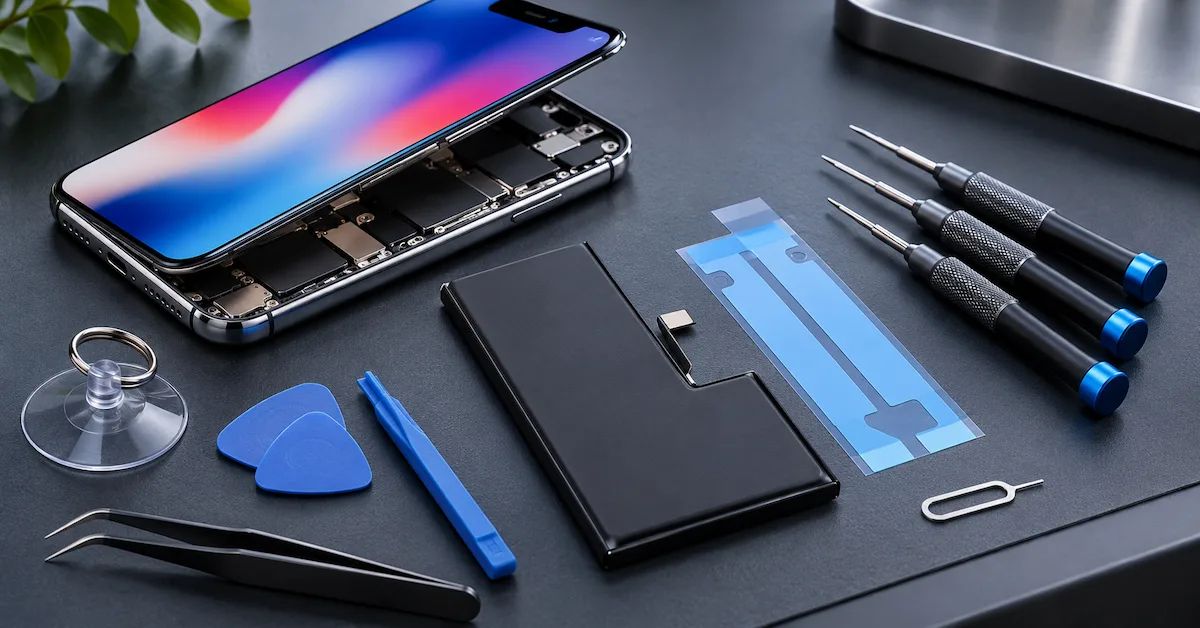
An Apple iPhone X battery replacement kit should combine a compatible replacement battery, appropriate installation consumables, and the tools needed by the intended repair user. For professional B2B buyers, the most important considerations are battery compatibility, verified capacity, component quality, clearly defined kit contents, and supplier consistency.
The iPhone X remains a relevant device in certain repair and refurbishment markets. As batteries age, repair shops and refurbishment businesses may need replacement components to restore acceptable operating performance.
However, not every product advertised as a battery replacement kit contains the same items.
Some suppliers offer only the replacement battery. Others package batteries with adhesive strips, opening tools, screwdrivers, or additional accessories.
A professional buyer should never assume these components are included without an approved bill of materials (BOM).
For wholesalers, repair chains, and private-label businesses, the challenge is to create a product configuration that meets customer expectations while controlling component costs, warranty exposure, and product quality.
ESC supplies aftermarket replacement batteries, including its iPhone X 2716mAh replacement battery, for professional repair and wholesale applications.
This article explains how to select the right battery, evaluate proposed kit contents, compare purchasing configurations, and establish a repeatable B2B sourcing process.
1. What Is an Apple iPhone X Battery Replacement Kit?
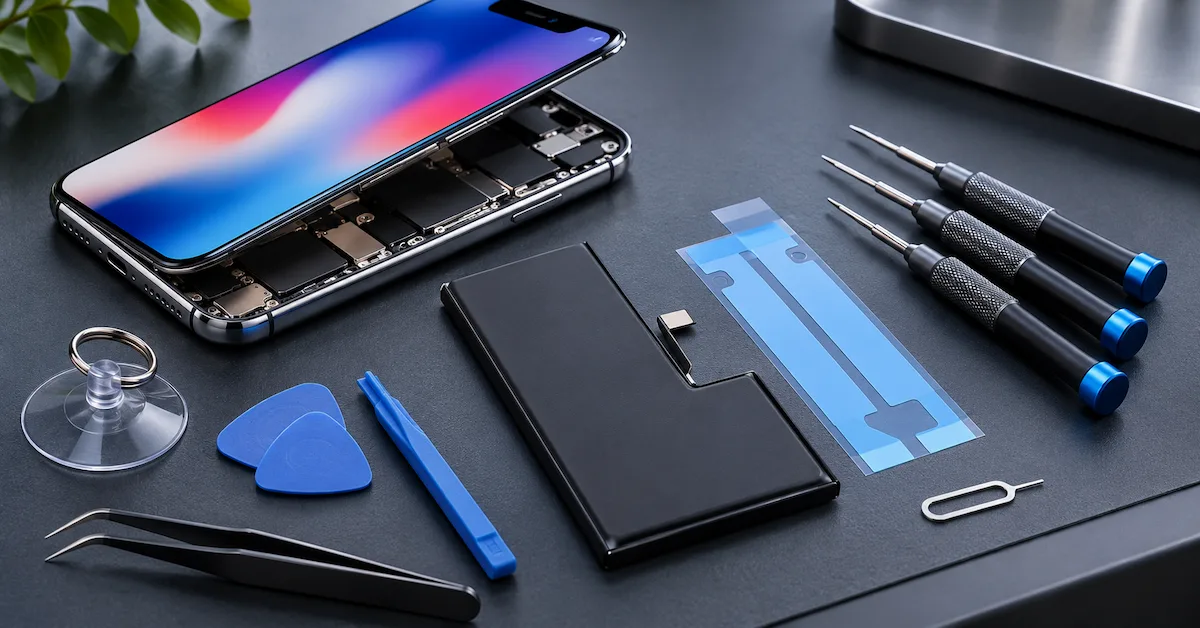
An Apple iPhone X battery replacement kit is a collection of parts and tools intended to support battery replacement in a compatible iPhone X.
Despite the wording, an aftermarket kit should not be represented as an Apple-manufactured or Apple-authorized product unless its origin and authorization have been independently established.
In the replacement-parts market, the term may describe three different configurations.
Battery-only supply: A replacement battery without a complete repair-tool assortment.
Battery with installation consumables: A replacement battery accompanied by specified adhesive or sealing materials.
Complete repair-oriented kit: A battery packaged with designated tools, consumables, instructions, and other components.
These configurations serve different customers.
Professional repair facilities usually maintain reusable tools and may prefer buying batteries in bulk.
An e-commerce business targeting occasional repair customers may want a more comprehensive package.
The correct configuration depends on repair experience, packaging requirements, and the buyer's intended sales channel.
2. What Should a Complete iPhone X Battery Replacement Kit Include?
Before comparing suppliers, establish a detailed kit bill of materials.
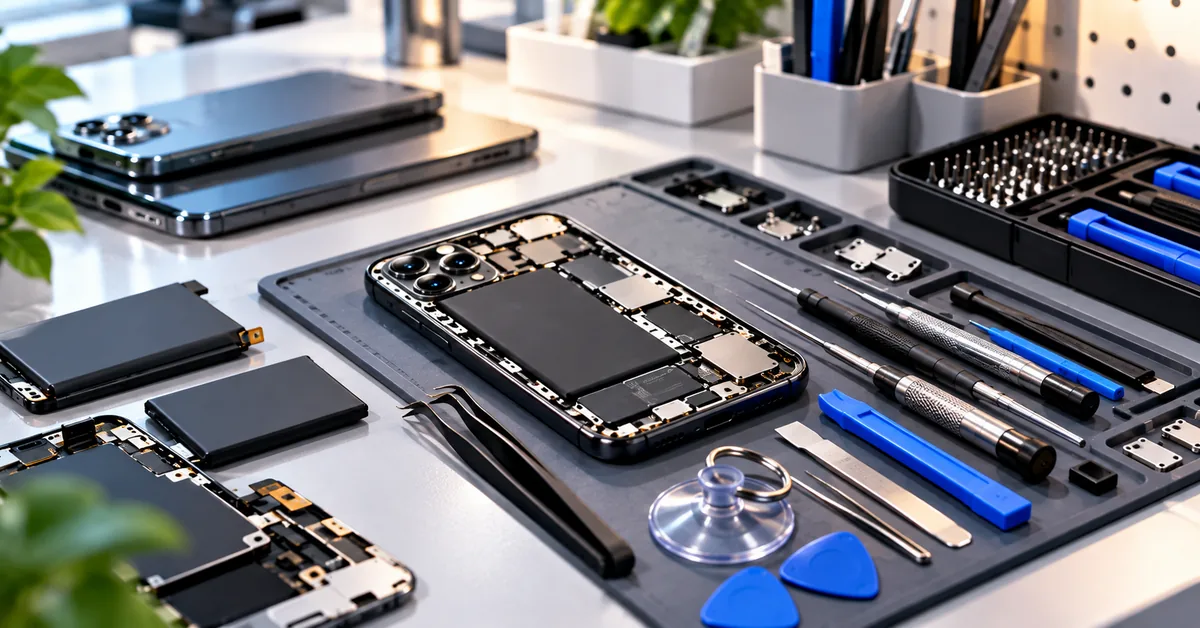
The following table provides a recommended component checklist.
It is not a list of items confirmed to be included with ESC's standard iPhone X battery.
Recommended battery replacement kit contents
| Component | Purpose | Purchasing requirement |
|---|---|---|
| iPhone X replacement battery | Replaces the existing battery | Confirm 2716mAh configuration and compatibility |
| Battery adhesive strips | Secure the replacement assembly | Confirm material and device-specific fit |
| Display sealing adhesive | Supports enclosure reassembly | Verify suitable model-specific material |
| Precision screwdriver bits | Remove compatible device fasteners | Confirm required bit profiles |
| Opening picks | Support controlled device opening | Inspect material and dimensions |
| Suction opening tool | Assists trained technicians | Confirm suitable device application |
| Nonconductive spudger | Supports component handling | Evaluate construction and insulation |
| Precision tweezers | Handle small components | Select appropriate type for each task |
| Screw organizer | Helps prevent fastener mix-ups | Provide organized identification |
| ESD protection | Reduces electrostatic-discharge risks | Use suitable verified workstation equipment |
| Repair instructions | Communicate approved procedures | Require accurate, model-specific guidance |
| Protective packaging | Protects products during distribution | Confirm battery and accessory protection |
Why the component list matters
A customer purchasing a complete repair kit expects to receive all advertised components.
Missing adhesives or unsuitable tools can interrupt repair work, increase support requests, and create dissatisfaction.
For B2B distributors, kit accuracy should be verified against the approved BOM before the product enters inventory.
Each included component should have its own specification or purchasing reference.
This allows the business to replace a defective accessory without creating uncertainty about the battery itself.
Battery-only supply versus complete kits
For repair chains with established workstations, repeatedly buying disposable tools may create unnecessary packaging and inventory costs.
Battery-only purchasing can therefore be commercially appropriate.
However, businesses selling directly to repair customers may find that a clearly specified kit helps simplify the buying process.
The objective is not to include more items. It is to include the right items for the intended user.
3. iPhone X Replacement Battery Technical Specifications
The original iPhone X battery platform is commonly identified with a nominal capacity of approximately 2716mAh.
ESC publishes an aftermarket replacement battery with a 2716mAh capacity and 3.81V nominal voltage.
Its product listing describes a lithium-ion polymer battery designed for professional replacement applications.
ESC iPhone X battery specification reference
| Technical parameter | ESC published specification |
|---|---|
| Product | iPhone X Replacement Battery |
| Device compatibility | iPhone X |
| Compatible device identifiers | A1865, A1901, A1902 |
| Battery type | Li-ion polymer |
| Rated capacity | 2716mAh |
| Nominal voltage | 3.81V |
| Nominal energy | 10.35Wh |
| Battery condition | New aftermarket replacement |
| Intended applications | Professional repair, refurbishment, wholesale |
| Quality-control activities | Capacity, voltage, charging, appearance and safety inspection |
| OEM support | Labels, branding and packaging |
| Standard repair tools included | Not confirmed by the product listing |
| Adhesive and sealing materials included | Must be confirmed for the quoted configuration |
These specifications are based on ESC's published product information and should be reconfirmed against the applicable quotation and approved sample.
How are capacity and energy related?
Battery capacity is expressed in milliampere-hours, while nominal energy is expressed in watt-hours.
The approximate relationship is:
Energy (Wh) = Capacity (Ah) × Nominal Voltage (V)
For the listed battery:
2.716Ah × 3.81V ≈ 10.35Wh
This calculation confirms the relationship between the stated nominal values.
It does not independently verify actual discharge capacity or guarantee a particular operating time.
Why compatibility matters more than capacity alone
The iPhone X, iPhone XR, iPhone XS, and iPhone XS Max are different devices.
Their batteries should not be considered interchangeable merely because their names are similar.
Before ordering, buyers should confirm the exact phone model, battery geometry, connector, flex cable, electrical specification, and approved replacement configuration.
A compatible battery must fit the device without abnormal mechanical pressure.
For additional models, buyers can explore ESC's original-capacity iPhone replacement battery category.
4. Compare Three Kit Configurations Before Purchasing
Professional buyers should select a kit configuration based on customer requirements rather than assuming every sales channel needs the same packaging.
| Configuration | Main contents | Suitable buyer | Main consideration |
|---|---|---|---|
| Battery-only supply | Approved replacement battery | Repair chains and refurbishers | Requires existing tools and consumables |
| Battery and consumables | Battery plus specified adhesive or sealing materials | Professional repair distributors | Verify exactly which consumables are included |
| Complete repair-oriented kit | Battery, tools, consumables, approved instructions | Retail accessory brands and trained repair users | Higher BOM and packaging complexity |
Battery-only supply
This configuration is suitable for repair businesses that already operate standardized repair stations.
It can reduce unnecessary duplication of reusable tools.
However, the facility remains responsible for having suitable installation materials and procedures.
Battery with consumables
A battery and consumables package may simplify parts preparation.
The buyer should verify the specifications and quantities of all included adhesive or sealing components.
The presence of a replacement seal does not automatically restore the phone's original water resistance.
Complete repair-oriented kit
A complete kit can offer convenience to distribution channels serving customers who require a defined tool assortment.
However, adding tools also introduces supplier management, packaging, and quality-control requirements.
Every component should be evaluated independently.
ESC's confirmed offering is the aftermarket battery and related battery customization services. A complete tools-and-consumables package should be discussed as a separate, unconfirmed configuration rather than assumed to be a standard product.
5. Who Should Buy iPhone X Battery Replacement Kits in Bulk?
Different business customers have different purchasing priorities.
Independent repair shops
These businesses need compatible batteries, dependable supply, and manageable replacement costs.
A battery-only configuration may be sufficient when professional equipment is already available.
Multi-location repair chains
Repair chains prioritize consistent battery specifications across locations.
They may also need standardized replacement procedures, centralized inventory, and identifiable production batches.
Smartphone refurbishment companies
Refurbishment companies purchase batteries for devices being prepared for resale.
Their primary concerns include capacity, installation compatibility, production efficiency, and finished-device inspection.
Replacement-parts wholesalers
Wholesalers need clear product descriptions, packaging consistency, and repeat-order availability.
They may distribute both battery-only products and repair-oriented kits.
Private-label accessory brands
Brand owners may require customized labels, barcodes, packaging, and documented product specifications.
For these customers, packaging quality should support accurate product identification rather than conceal the aftermarket origin.
6. Battery Cell Quality, Protection Electronics, and Assembly Workmanship
Battery performance depends on more than the printed capacity.
A complete replacement assembly includes a rechargeable cell and device-specific electrical and mechanical components.
Cell quality
Buyers should ask how suppliers evaluate the actual cell characteristics.
Relevant parameters may include capacity, nominal voltage, internal resistance, dimensions, appearance, and aging behavior.
Different cell batches should be assessed against the same approved product requirements.
Protection electronics
Battery assemblies may incorporate circuitry for monitoring and protection functions.
Buyers should verify which functions apply to the exact quoted configuration.
A general statement about battery protection should not replace model-specific technical evidence.
Flex cable and connector
The connection assembly is especially important during smartphone battery replacement.
Poor alignment, damaged flex cables, or incorrect connectors can lead to installation problems and electrical failures.
The purchasing specification should identify the approved connector configuration and relevant assembly details.
Assembly consistency
For repeated orders, buyers should examine whether the supplier controls the cell selection, connection components, insulation, and final product appearance.
A reliable supplier should be able to explain how product revisions are identified and communicated.
ESC describes capacity, voltage, charging-performance, appearance, and safety inspection for its iPhone X replacement battery.
The detailed acceptance conditions should be confirmed for the actual purchasing order.
7. What Safety Requirements Should a Replacement Kit Address?
Battery replacement involves lithium-ion cells and delicate smartphone components.
It should be performed by trained personnel using an appropriate model-specific procedure.
Professional repair guidance, including iFixit's iPhone X Battery Replacement guide, identifies battery puncture, display damage, and adhesive removal as significant repair considerations.
Battery-related safety precautions
A visibly swollen, leaking, unusually hot, or physically damaged battery should not undergo ordinary charging or repair tests.
Do not puncture, crush, bend, force-remove, or attempt to flatten a suspect battery.
The device should be managed according to an appropriate damaged-battery safety procedure.
Tool suitability
Opening equipment and precision tools should be selected for the exact device and repair task.
Improvised metal tools or excessive force may damage internal components.
A general-purpose toolkit is not proof that the user is qualified to perform battery replacement.
Display and sensor protection
The iPhone X includes delicate display connections and a TrueDepth camera system.
Incorrect handling can create additional damage unrelated to battery performance.
Repair operations should use validated procedures and inspect relevant device functions before and after service.
Water-resistance limitations
Apple originally specified IP67 resistance for the iPhone X under controlled laboratory conditions.
Opening the device may compromise its seals.
Even with replacement adhesive, repair businesses should not guarantee restoration of the original resistance without appropriate evidence.
8. How Should Repair Shops Inspect Replacement Batteries Before Installation?
Incoming quality control reduces the likelihood of unsuitable batteries entering production.
A practical inspection process should be defined before the shipment arrives.
Step 1: Verify product identification
Confirm the supplier SKU, intended device, capacity, nominal voltage, and approved configuration.
Step 2: Inspect packaging and appearance
Check for incorrect labels, damaged packaging, visible deformation, damaged connectors, or other abnormal conditions.
Suspect batteries should be held and handled according to the appropriate safety procedure.
Step 3: Verify electrical specifications
For safe, intact samples, qualified personnel may perform measurements using approved equipment and methods.
Acceptance limits must come from the agreed technical specification.
Step 4: Evaluate representative samples
Samples should be tested for the intended device and repair process.
A passing label or open-circuit voltage reading does not independently establish capacity or installed-device performance.
Step 5: Document results
Inspection records should identify the product configuration, lot, test method, results, and final disposition.
Recommended inspection checklist
| Inspection item | Requirement |
|---|---|
| Product identity | Matches approved SKU |
| Compatible device | Exact iPhone X configuration |
| Appearance | No unacceptable physical damage |
| Capacity | Meets agreed measured specification |
| Voltage | Within approved limits |
| Connector | Correct construction and orientation |
| Flex cable | No visible damage |
| Packaging | Correct labeling and protection |
| Traceability | Identifiable supplier lot |
| Documentation | Appropriate product and transport information |
A shipment should not be released solely because its outer cartons appear correct.
9. Establish a Professional Replacement and Final-Testing Workflow
A consistent repair process supports better quality control across different technicians or branches.
The following is a high-level operational framework, not a disassembly procedure.
Device identification: Confirm the exact phone model and existing condition.
Initial diagnosis: Determine whether the observed symptoms are consistent with battery degradation or another device issue.
Safety screening: Identify damage or other conditions requiring special handling.
Parts verification: Confirm that the battery and required consumables match the approved repair plan.
Professional installation: Use trained technicians and an appropriate model-specific procedure.
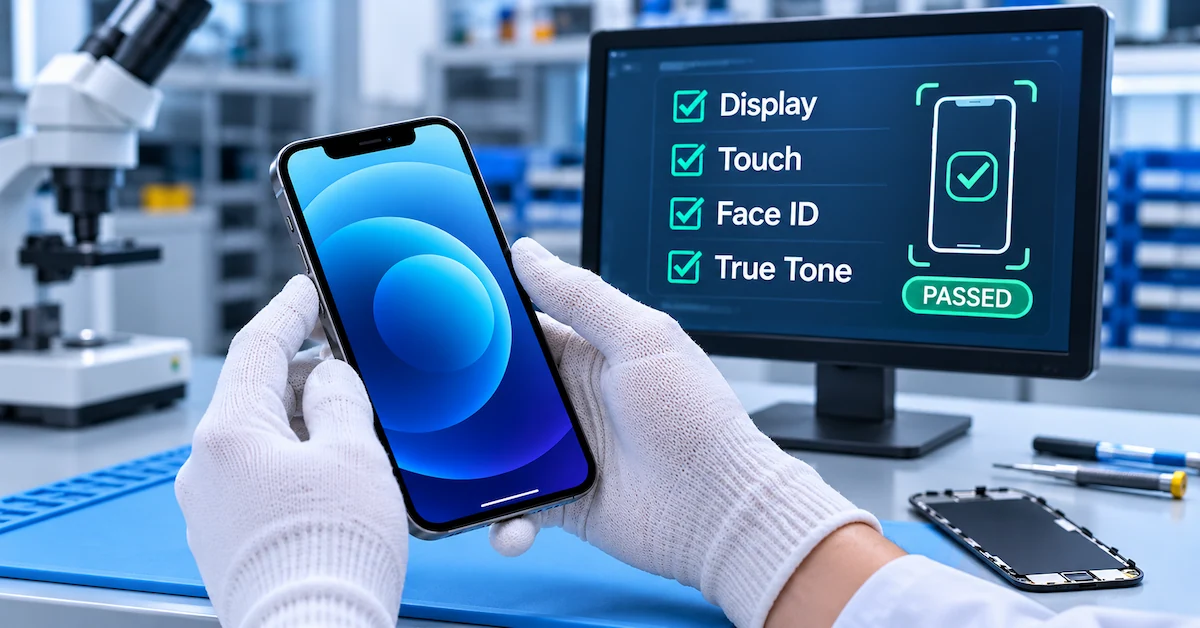
Functional testing: Evaluate device startup, charging, battery information, and relevant device functions.
Final inspection: Confirm the repaired device meets the company's acceptance standard.
Documentation: Record the replacement battery reference, relevant lot information, technician, and final result.
Why final testing matters
A correctly labeled battery may still be unsuitable if the device has existing charging or motherboard faults.
Similarly, installation damage can create problems unrelated to the supplied cell.
Repair records should distinguish confirmed battery failures from device and workmanship issues.
This supports fair supplier evaluation and better warranty management.
10. How Much Should an iPhone X Battery Replacement Kit Cost?
Kit costs depend on the battery configuration, tools, consumables, packaging, inspection requirements, order quantity, and commercial terms.
A battery-only quotation should not be compared directly with a complete repair kit.
Total purchasing cost
A useful calculation is:
Total Kit Cost = Battery + Consumables + Tools + Packaging + Inspection + Freight + Applicable Import Costs
For repair chains, reusable tools may be treated as equipment costs rather than assigned fully to every battery replacement.
Example: comparing two hypothetical purchasing options
Assume a buyer is evaluating the following configurations.
| Cost component | Battery-only option | Complete-kit option |
|---|---|---|
| Replacement battery | $8.00 | $8.00 |
| Adhesives and consumables | Purchased separately | $1.50 |
| Repair tools | Existing workstation | $3.00 |
| Packaging | $0.50 | $1.50 |
| Total illustrative component cost | $8.50 | $14.00 |
These amounts are hypothetical examples, not ESC quotations or verified current market prices.
The comparison illustrates why product contents must be standardized before quotations can be evaluated.
For a professional repair chain, the lower-cost battery-only option may be suitable.
For a business selling individual repair packages, a complete kit may offer additional convenience.
The correct decision depends on actual customer needs and total program cost.
11. Supplier Qualification, MOQ, and Wholesale Delivery
A dependable B2B supplier should provide clear specifications and order terms.
When comparing battery suppliers, procurement teams should assess compatibility, product documentation, sample testing, traceability, warranty handling, and supply continuity.
MOQ and mixed-model orders
ESC states that it supports flexible quantities and mixed-model replacement battery purchasing.
The iPhone X product page lists MOQ as negotiable.
However, the applicable quantity should be confirmed for each quotation.
A customized package containing third-party tools may have different minimum quantities from battery-only supply.
Lead time
ESC's iPhone X product page lists an estimated lead time of 7–15 working days.
Actual availability and delivery arrangements depend on the final order.
Customized labels, packaging development, and additional accessory procurement may affect the schedule.
Documentation and warranty
ESC's product page references CE, MSDS, and UN38.3 documentation and a 12-month warranty.
Buyers should confirm the applicable documents and warranty terms for the exact configuration, destination, and order.
A transport test summary is not equivalent to every applicable product safety certification.
The final commercial agreement should identify the specific coverage and required warranty evidence.
12. OEM and Private-Label Battery Kit Opportunities
Private-label distributors may want to develop a branded battery replacement product line.
ESC supports OEM battery labels, product branding, barcodes, and customized packaging, subject to project requirements.
Recommended private-label specifications
Buyers should define the battery SKU, compatible devices, electrical ratings, packaging contents, warnings, barcode system, product artwork, and lot identification.
If the proposed product includes tools or consumables, those components should appear in the approved BOM.
They should not be added to product listings before supply has been confirmed.
Why packaging consistency matters
An aftermarket battery packaged under a private brand must still accurately identify its product type and compatibility.
Branding should not imply that the battery was manufactured or authorized by Apple.
Product descriptions, labels, and instructions should be reviewed before production.
Multi-model purchasing opportunities
Businesses selling iPhone X replacement batteries may also serve customers repairing other generations.
ESC's mobile phone replacement battery range includes multiple product categories.
Wholesalers can discuss mixed-model purchasing while keeping each device's battery specification and stock identification separate.
13. Prepare a High-Quality B2B Battery Kit RFQ
A professional request for quotation should identify exactly what the buyer wants to purchase.
Instead of requesting only an “Apple iPhone X battery replacement kit,” provide a clear list of required components and performance conditions.
Recommended RFQ checklist
| RFQ field | Information to provide |
|---|---|
| Device | iPhone X |
| Compatible models | A1865, A1901, A1902 |
| Battery capacity | 2716mAh or separately approved alternative |
| Nominal voltage | 3.81V reference |
| Configuration | Battery-only or specified kit |
| Adhesive requirements | Type and quantity, if required |
| Repair tools | Itemized list, if required |
| Packaging | Workshop bulk pack or private-label retail pack |
| Quantity | Initial order and forecast |
| Sample requirements | Required configuration and quantity |
| Quality criteria | Inspection and acceptance requirements |
| Documentation | Destination-specific requirements |
| Delivery | Country and requested shipment terms |
| Warranty | Required conditions and claim procedure |
Request the appropriate product configuration
For battery-only purchasing, buyers can review ESC's iPhone X replacement battery product page.
For private-label packaging or possible additional kit components, buyers should request written confirmation of the actual supply scope.
To discuss pricing, samples, capacity requirements, or wholesale packaging, contact ESC with your detailed product list and expected quantity.
A complete inquiry allows the supplier to evaluate the request without assuming that every accessory is already part of its standard product.
14. Frequently Asked Questions About iPhone X Battery Replacement Kits
1. What is included in an Apple iPhone X battery replacement kit?
Contents vary by supplier. A proposed kit may include a compatible battery, adhesive materials, opening tools, precision screwdrivers, and instructions. ESC's verified iPhone X offering is the replacement battery. Buyers should request an itemized kit list before assuming tools or consumables are included.
2. What battery capacity does the iPhone X use?
The commonly referenced original-capacity configuration is approximately 2716mAh. ESC publishes a 2716mAh aftermarket replacement rated at 3.81V and 10.35Wh. Actual purchasing specifications and tested capacity should be confirmed for the quoted battery.
3. Is an ESC iPhone X replacement battery a genuine Apple battery?
No. ESC describes its product as an aftermarket replacement battery for compatible iPhone X devices. It should not be marketed as a genuine Apple service part or as Apple-authorized without appropriate evidence.
4. Can iPhone X and iPhone XS batteries be used interchangeably?
No interchangeability should be assumed. These devices use different battery configurations. A professional buyer should verify the exact device, electrical specifications, dimensions, connector, and approved assembly before selecting a replacement.
5. Does a complete battery kit need special repair tools?
Professional replacement requires suitable model-specific equipment and trained personnel. Precision drivers, opening tools, and nonconductive handling equipment may be involved. The correct equipment should be established by the approved repair procedure rather than a generic accessory count.
6. Are battery adhesive strips included with every replacement battery?
Not necessarily. Adhesive contents depend on the supplier and product configuration. Buyers should check whether battery adhesive or display sealing materials are included, specified separately, or excluded from the quotation.
7. Can battery replacement restore the iPhone X's original water resistance?
Not automatically. Opening the device can compromise its original seals. Installing replacement adhesive does not prove that the original IP67 performance has been restored. Repair businesses should avoid unsupported water-resistance guarantees.
8. How can wholesalers evaluate replacement battery quality?
Wholesalers should verify compatibility, capacity, voltage, dimensions, connector condition, sample performance, packaging, and lot identification. Ask the supplier for model-specific specifications and relevant testing evidence before approving a bulk purchase.
9. Does ESC support OEM packaging and wholesale battery orders?
ESC publishes OEM battery labeling, branding, private-label packaging, and wholesale supply services. The applicable MOQ, product configuration, lead time, and customization conditions should be confirmed through a written quotation.
10. How do I request an iPhone X battery replacement kit quotation?
Provide the exact phone model, desired battery capacity, quantity, destination, packaging requirements, and a detailed list of requested tools or consumables. Ask ESC to confirm which items it can supply and which specifications and documents apply to the proposed order.
Conclusion
Choosing an Apple iPhone X battery replacement kit requires more than comparing battery prices or selecting the package with the largest number of tools.
For repair shops, refurbishers, and wholesale distributors, the best purchasing strategy starts with a compatible replacement battery, clearly defined kit contents, and an appropriate quality-control process.
The iPhone X battery's electrical specifications, physical construction, connector compatibility, and supplied protection components should be verified before bulk purchasing.
Additional items such as adhesive strips, opening tools, and precision screwdrivers must be specified separately unless their inclusion is confirmed.
For professional repair chains, battery-only purchasing may reduce unnecessary duplication of reusable equipment. For retail and private-label channels, carefully configured kits may offer greater convenience, provided every component meets the approved purchasing requirements.
Reliable supply also depends on supplier qualification, sample testing, controlled packaging, traceability, and clear warranty conditions.
ESC provides aftermarket replacement battery solutions for professional B2B customers, including its iPhone X 2716mAh replacement battery, along with wholesale and OEM packaging services.
Buyers can explore ESC's iPhone replacement battery portfolio and contact ESC with their required configuration, purchasing quantity, packaging specifications, and quality expectations.
By defining the complete bill of materials and approving each component before purchase, businesses can reduce sourcing uncertainty, support more consistent repair operations, and build stronger long-term replacement battery supply programs.