
When repair shops search for an iPhone show genuine battery supplier, they are usually not only asking for a battery that can power on the phone. They want a battery solution that supports a cleaner post-install repair experience, helps technicians reduce warning-message confusion, and gives customers more confidence when they check Battery Health or Parts and Service History after replacement. For Shenzhen ESC, this market demand is not simply about selling replacement batteries. It is about supporting repair shops, refurbishers, wholesalers and private label buyers with a battery program that considers capacity, chip behavior, diagnostic workflow, validation steps, packaging and after-sales support.
Product Pain Points: Why Battery Recognition Matters After Repair
The battery is no longer judged only by runtime.
For many iPhone repair customers, the repair result is judged inside the phone settings.
After replacement, customers may check Battery Health, Parts and Service History, warning messages, maximum capacity, cycle count or battery status.
If the phone shows an unclear message, missing health information or a warning state, the customer may question the battery quality immediately.
For repair shops, this creates communication pressure.
For refurbishers, it creates resale hesitation.
For wholesalers, it creates downstream complaints.
For e-commerce sellers, it creates returns and negative reviews.
For private label buyers, it can damage brand trust.
This is why buyers search for an iPhone show genuine battery supplier. In practical business terms, they want fewer repair disputes, fewer pop-up warnings, more stable display behavior and easier customer handoff after installation.
Working Principle: What the Post-Repair Workflow Is Trying to Solve
The battery installation is only one part of the repair job.
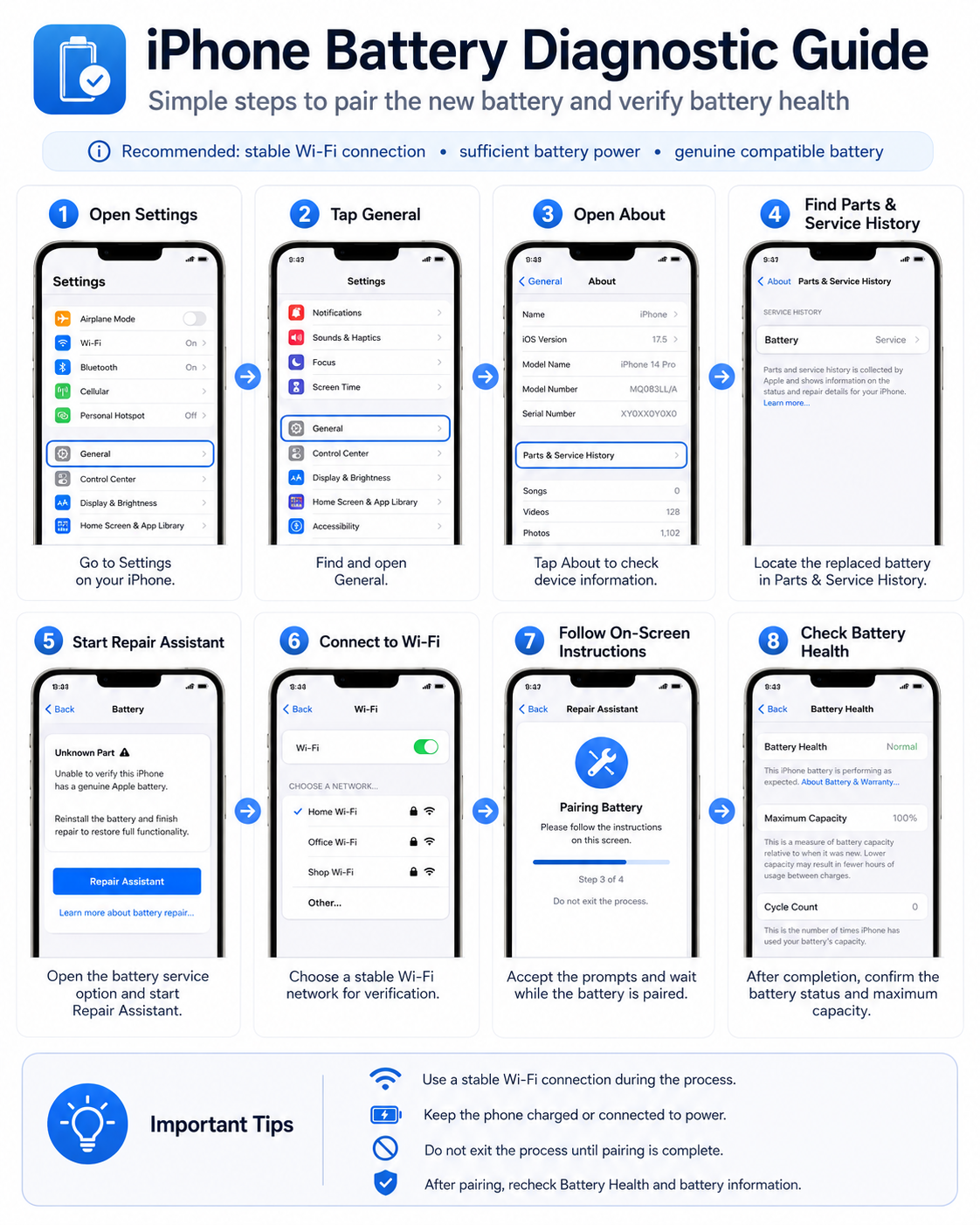
After installation, technicians may need to check the phone’s settings, service history and battery status to confirm whether the replacement result is acceptable for customer delivery.
A professional iPhone replacement battery solution involves several layers.
The cell must deliver stable capacity.
The PCM must support safe charging and discharging.
The flex cable and connector must match the model.
The chip and battery data behavior must be stable.
The phone must complete the expected post-repair workflow under the right conditions.
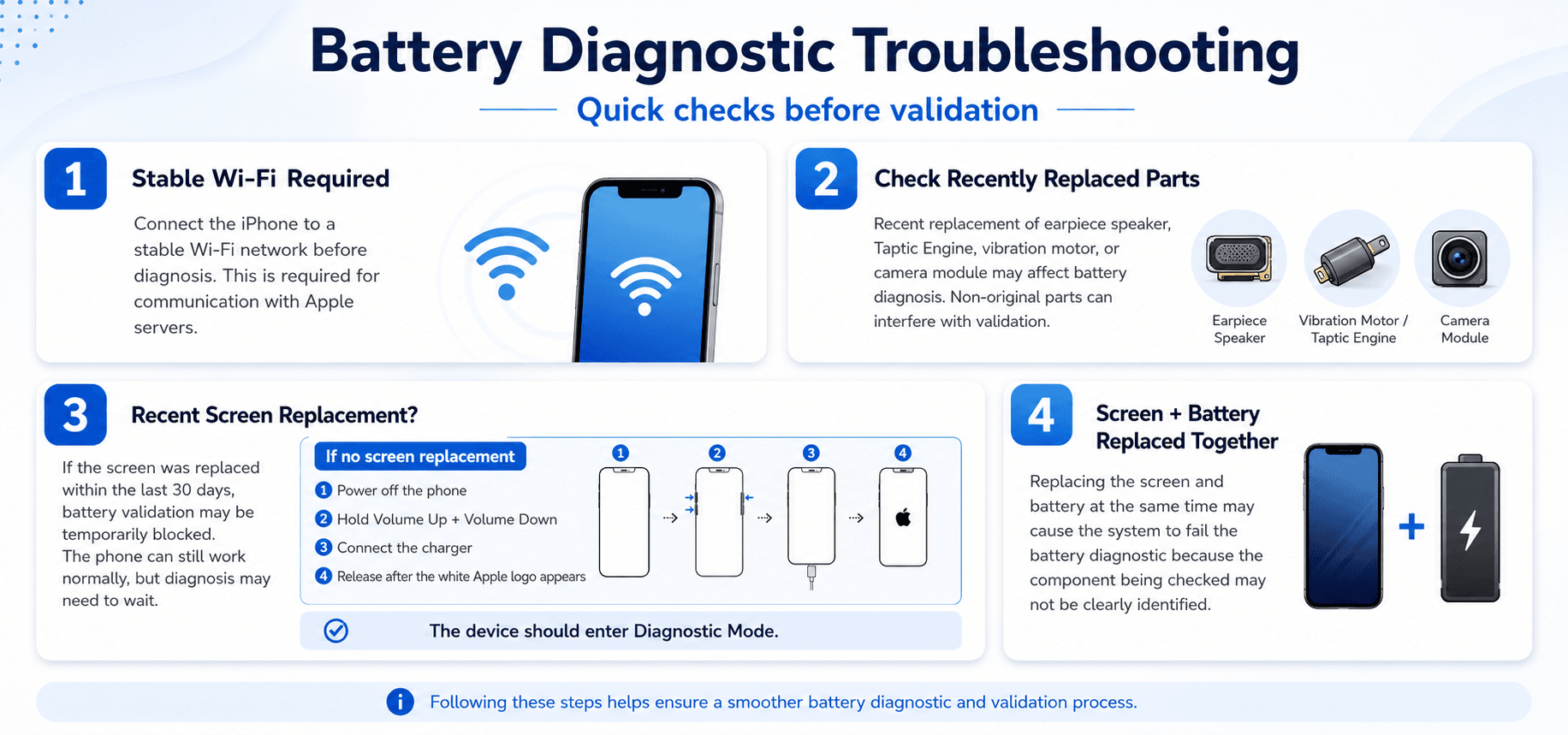
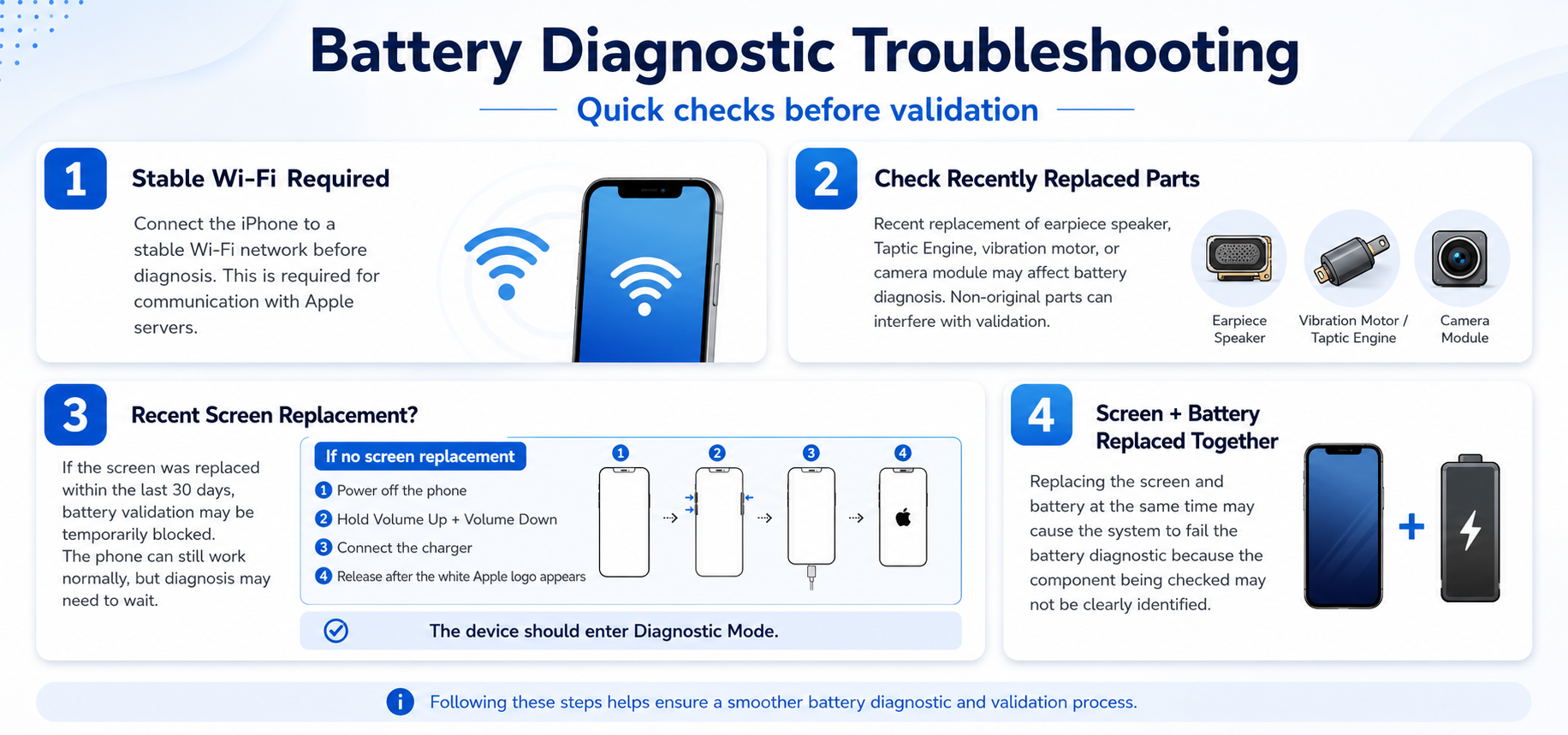
The repair process may also require stable Wi-Fi, sufficient battery charge and correct service steps before validation or status checking can finish properly.
For buyers, this means a supplier is not only selling a cell pack.
A supplier must understand the repair environment.
If the battery physically fits but the phone cannot complete a clean post-install workflow, repair shops still face customer pressure.
That is why Shenzhen ESC positions this category as a diagnostic-compatible iPhone battery solution instead of only a capacity product.
Comparison: Basic Replacement Battery vs Diagnostic-Compatible Battery Solution
A basic replacement battery focuses on restoring power.
It may be suitable for low-cost repair, older models or markets where customers only care about price.
A diagnostic-compatible battery solution focuses on repair confidence.
It is more suitable for repair shops, refurbishers and B2B buyers who care about Battery Health display, stable recognition behavior, no pop-up options and cleaner after-repair communication.
Basic Replacement Battery
Basic power restoration
Lower unit price
Suitable for price-sensitive repair
More customer questions after installation
Higher communication pressure for technicians
Diagnostic-Compatible Battery Solution
Cleaner repair workflow
Better Battery Health communication
Lower warning-message pressure
More suitable for refurbished phones
Higher value for professional repair channels
The difference is not only technical.
It is commercial.
A low-cost battery may help win one order.
A stable diagnostic-compatible solution helps protect repeat business, repair-shop reputation and downstream customer trust.
Solution: How Shenzhen ESC Builds a Better iPhone Battery Program
Shenzhen ESC supports iPhone replacement battery projects from both product and service-workflow perspectives.
The product line can include standard capacity batteries, high capacity batteries, Battery Health display options, no pop-up warning battery solutions, diagnostic-compatible batteries and private label packaging.
For buyers who ask for an iPhone show genuine battery supplier, Shenzhen ESC helps clarify the real requirement first.
Does the buyer need standard repair batteries?
Does the buyer need Battery Health display behavior?
Does the buyer need no pop-up warning support?
Does the buyer need diagnostic workflow instructions?
Does the buyer need private label packaging?
Does the buyer need batteries for refurbishment production?
Does the buyer need mixed-model wholesale cartons?
This matters because not every market needs the same battery category.
Repair shops need stable installation and clean customer explanation.
Refurbishers need batch consistency and resale confidence.
Wholesalers need repeat supply and model labeling.
E-commerce sellers need clear product positioning and lower return risk.
Private label buyers need a full product series with packaging, barcode and warranty language.
Core Product Advantages: What Buyers Should Focus On
The first advantage is stable recognition behavior.
Repair shops need batteries that behave predictably during post-install checking.
The second advantage is Battery Health support.
A clear Battery Health screen helps technicians explain the repair result more confidently.
The third advantage is no pop-up warning option.
For supported models and repair processes, this option helps reduce visible warning-message pressure.
The fourth advantage is low self-discharge control.
Stable standby behavior reduces phantom drain complaints and unnecessary after-sales disputes.
The fifth advantage is chip and data stability.
Battery percentage jumping, unstable health reading or abnormal validation behavior can create customer distrust.
The sixth advantage is clear product tiering.
Shenzhen ESC can help buyers build product levels such as standard series, high capacity series, diagnostic series and private label premium series.
The seventh advantage is repair-friendly documentation.
Technicians need simple instructions, not only a product datasheet.
Application Scenarios: Where This Battery Solution Creates Value
Repair shops use diagnostic-compatible batteries to reduce customer doubt after replacement and complete a cleaner handoff.
Repair chains use standardized battery solutions to keep service quality consistent across multiple stores.
Refurbished phone factories use them before resale to improve Battery Health confidence and reduce batch return risk.
Wholesalers use them to supply professional repair stores that want better customer-facing results.
E-commerce sellers use them to create stronger product listings with clearer benefits and lower return pressure.
Private label buyers use them to build a more advanced iPhone battery product line under their own packaging.
Selection Advice: How Different Buyers Should Choose
Repair shops should choose based on customer sensitivity.
If customers check Battery Health and warning messages after repair, a diagnostic-compatible or no pop-up option is more valuable than a low-cost basic battery.
Repair chains should focus on standardization.
The same battery type, same installation instructions and same after-repair checking process can reduce technician mistakes across locations.
Refurbished phone factories should focus on batch consistency.
They should test several samples from the same batch and check capacity, voltage, internal resistance, charging behavior, Battery Health display, standby behavior and service-history result.
Wholesalers should focus on repeat supply.
They need model coverage, carton labels, clear product tiers and stable after-sales support.
E-commerce sellers should avoid exaggerated claims.
The product page should explain supported models, expected behavior and repair conditions clearly.
Private label buyers should focus on product strategy.
A strong iPhone battery catalog can include standard repair batteries, high capacity batteries, Battery Health display batteries, no pop-up options and diagnostic-compatible premium series.
Before placing bulk orders from any iPhone show genuine battery supplier, buyers should test real devices, confirm supported models, review repair workflow, verify packaging and require clear after-sales handling rules.
Common Mistakes Buyers Should Avoid
Do not buy only because the capacity label looks attractive.
Do not assume one good sample represents the whole batch.
Do not ignore chip behavior and self-discharge performance.
Do not blame every validation failure on the battery.
Do not mix different product tiers without clear labels.
Do not promise customers that an aftermarket battery is an original Apple battery.
Do not skip real-device testing before bulk purchase.
For professional buyers, the safest approach is sample testing under real repair conditions.
Install the battery.
Check the phone behavior.
Review Battery Health.
Observe standby drain.
Confirm service-history behavior.
Then decide whether the battery is only compatible or truly service-friendly.
FAQ
What does buyers mean by iPhone show genuine battery supplier?
Most buyers use this phrase to describe a supplier that can provide iPhone replacement battery solutions with cleaner post-repair display behavior, better Battery Health communication and lower warning-message pressure.
Does this mean the battery is an original Apple battery?
No. Shenzhen ESC replacement batteries should not be described as original Apple batteries. They are aftermarket repair battery solutions designed for professional repair, refurbishment and wholesale channels.
What is an iPhone diagnostic battery supplier?
An iPhone diagnostic battery supplier provides battery solutions that support repair shops during post-install checking, Battery Health review, validation workflow and customer handoff.
What is an iPhone no pop up battery factory?
It refers to a battery factory or supplier that offers no pop-up warning solutions for supported iPhone models and repair methods, helping reduce customer-facing warning messages after replacement.
Why does Wi-Fi or repair sequence matter after battery replacement?
Some post-repair validation or status-checking steps may require the phone to complete communication or setup under proper conditions. If other parts were recently changed or the sequence is not suitable, the battery result may not appear as expected.
What should buyers test before bulk ordering?
Buyers should test capacity, voltage, internal resistance, charging behavior, standby drain, Battery Health result, warning-message behavior, installation fit, packaging and batch consistency.
Is Battery Health display enough to prove battery quality?
No. Battery Health display is useful, but buyers should also test real capacity, discharge behavior, self-discharge, connector fit and long-term stability.
Can Shenzhen ESC support private label iPhone battery projects?
Yes. Shenzhen ESC can support private label iPhone battery projects with battery labels, retail boxes, barcodes, warranty cards, instruction sheets, carton marks and product series planning.
Conclusion
Choosing an iPhone show genuine battery supplier is not only about finding a battery that powers on the phone.
For professional buyers, the real goal is to reduce post-repair friction, improve Battery Health communication, control warning-message pressure and support repeatable repair or refurbishment workflows.
Shenzhen ESC supports repair shops, refurbishers, wholesalers, e-commerce sellers and private label buyers with iPhone replacement battery solutions, including standard capacity, high capacity, diagnostic-compatible batteries, no pop-up options, Battery Health display solutions and OEM packaging support.
Contact Shenzhen ESC to request iPhone diagnostic battery samples, model support, packaging options and wholesale pricing for your repair or refurbishment business.