
When a repair shop or refurbisher searches for an iPhone no pop up battery supplier, the real request is not only about marketing language. Buyers want a replacement battery that can reduce warning-message problems, support a cleaner Battery Health display, and help the phone look more professionally repaired after service. For repair shops, refurbished phone suppliers and parts distributors, this directly affects customer trust, return rate and repeat orders.
What Is an iPhone No Pop Up Battery?
An iPhone no pop up battery is usually a replacement battery designed to reduce or avoid visible battery-related warning prompts after installation.
In repair-market language, “no pop up” usually means the buyer wants fewer customer-facing alerts, cleaner battery information and a smoother handover after repair.
It does not automatically mean the battery is an original Apple battery.
It does not guarantee the same result on every iPhone.
The final display behavior can depend on the iPhone model, iOS version, battery design, installation method, chip programming, device condition and service history.
For B2B buyers, the important point is this:
A no-pop-up battery is not only judged by whether it can power the phone.
It is judged by what the phone shows after the battery is installed.
Why Does the No Pop-Up Issue Matter?
In real repair work, the battery itself is only one part of the customer experience.
A battery can fit the phone, charge normally and still create a problem if the phone shows a warning message, hides Battery Health information or displays an unknown part status.
For end users, this may look like a small message.
For repair businesses, it can become a serious support issue.
⚠️ Customer Doubt
The customer may think the battery is fake, unsafe or poorly installed.
🔁 Return Risk
A simple battery replacement can turn into a return, refund request or warranty dispute.
🛠️ Repair Pressure
Technicians spend extra time explaining battery messages instead of finishing more repairs.
📦 Refurbishment Risk
Refurbished phones with unclear battery status may be harder to grade, resell or export.
⭐ Brand Trust Loss
For private label buyers, one unstable battery line can damage market reputation.
This is why buyers often search for terms such as iPhone diagnostic battery supplier, iPhone Show 100% battery factory or OEM pulled iPhone battery. These searches are all connected to the same business goal: a cleaner post-repair battery experience.
How Can Buyers Understand This Product Category?
Buyers should treat no-pop-up batteries as a service-oriented repair part, not just a standard battery pack.
A good replacement battery should support three things:
1. Electrical Performance
The battery should have stable voltage, realistic capacity, safe charging behavior and reliable discharge performance.
2. Physical Fit
The battery should match the correct iPhone model, connector position, flex cable layout and installation space.
3. Customer-Facing Display Behavior
The phone should show battery information in a way that reduces customer confusion after repair.
This third point is what separates a normal replacement battery from a no-pop-up or diagnostic-style battery solution.
Product Example: iPhone 15 Replacement Battery Data Buyers Should Notice
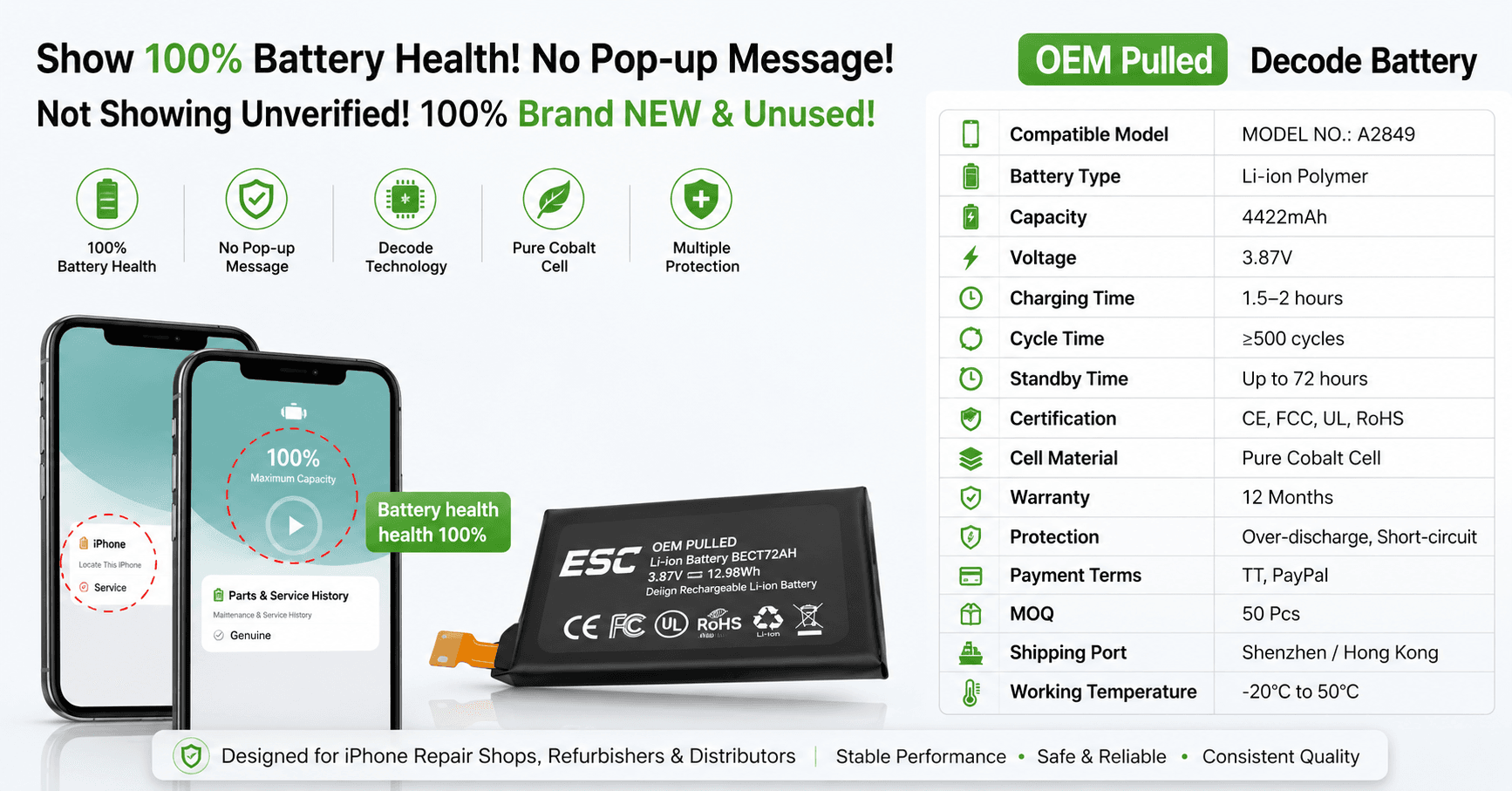
The supplied product information points to an OEM-style replacement lithium-ion battery for iPhone 15, with visible specification data including:
🔋 Battery Type: Li-ion battery
📱 Model Reference: iPhone 15 replacement battery
⚡ Capacity: 3349mAh
🔌 Energy: 12.98Wh
📊 Standard Voltage: 3.876V
🔋 Charge Limit Voltage: 4.48V
These values give buyers a useful starting point for comparison.
However, printed specifications do not fully prove real-world quality.
Actual performance can vary depending on iOS version, phone condition, screen brightness, signal strength, motherboard status, charging habits and battery batch consistency.
What Should Buyers Check Before Ordering?
1. Battery Identity and Label Consistency
A professional battery supplier should provide stable product labeling.
Buyers should check:
Model name
Compatible iPhone version
Capacity
Voltage
Batch number
QR code or tracking code
Packaging label
If labels change from batch to batch, the buyer’s inventory risk increases.
2. iPhone Settings Behavior After Installation
For no-pop-up batteries, the most important test is not only whether the phone turns on.
Buyers should check:
Does Battery Health display?
Does the phone show warning messages?
Does the device report the battery clearly?
Does the phone behave normally after restart?
Does the battery percentage remain stable?
Does the result stay consistent after charging and discharging?
A supplier screenshot is useful, but real-device testing is more important.
3. Protection Board and Safety Design
A replacement smartphone battery should include proper protection design.
Key protection points include:
Over-charge protection
Over-discharge protection
Short-circuit protection
Stable PCM board
Connector reliability
Flex cable quality
For repair shops and refurbishers, safety protection is not an optional selling point. It is a basic requirement for service inventory.
4. Commercial Terms
Buyers should also review the business terms.
Useful checks include:
MOQ
Warranty period
Sample policy
Lead time
Payment terms
After-sales process
Shipping documents
Private label support
If the MOQ is low, such as around 20 pieces, it can be useful for sample testing before larger orders.
How Can Repair Shops Evaluate an iPhone No Pop Up Battery Supplier?
Repair shops should evaluate suppliers based on repair outcomes, not product photos.
Ask What the Phone Will Actually Show
The key question is:
What will the iPhone display after installation?
A serious supplier should explain whether the battery is designed for:
Battery Health display
No pop-up warning behavior
Diagnostic repair process
Show 100% health display
Refurbishment use
General replacement use
If the supplier only talks about capacity but cannot explain post-install behavior, the product may not be suitable for professional repair shops.
Confirm Exact Model Compatibility
A label such as iPhone 15 does not always mean it fits every iPhone 15-family model.
Buyers should confirm:
iPhone 15
iPhone 15 Plus
iPhone 15 Pro
iPhone 15 Pro Max
Connector version
Battery code
iOS behavior
Repair method
Even small model differences can affect fit and display behavior.
Check Packaging and Traceability
Repair shops and distributors need batteries that are easy to manage.
Good packaging should include:
Clear model label
Capacity label
Barcode or QR code
Batch information
Safety marks
Carton labels
Retail packaging option
Traceability helps buyers identify problems quickly if a batch issue occurs.
Do Not Overvalue One Screenshot
A phone showing 100% Battery Health in one image is not enough.
Buyers should test several pieces from the same batch.
A reliable supplier should help buyers verify repeatability, not only show a marketing image.
Common Mistakes Buyers Make
❌ Mistake 1: Assuming every no-pop-up battery behaves the same
Different suppliers use different battery boards, chips, programming methods and assembly quality.
❌ Mistake 2: Buying only based on the Battery Health screenshot
A clean screenshot does not prove long-term stability or batch consistency.
❌ Mistake 3: Ignoring physical build quality
Poor connector quality, weak flex cable alignment or pouch damage can still cause failures.
❌ Mistake 4: Treating “OEM pulled” as a guaranteed original source
The term can mean different things in the market. Buyers should ask for clear explanation.
❌ Mistake 5: Skipping compliance document review
If the supplier claims CE, FCC, RoHS, MSDS, UN38.3, PSE, KC, IEC62133 or TISI, buyers should request supporting documents.
❌ Mistake 6: Moving to bulk orders too quickly
One good sample is not a supply chain. Buyers should test several units before scaling.
How Can Refurbishers Use This Battery Type?
For refurbishers, the value of a no-pop-up iPhone battery is not only repair convenience.
It affects resale quality.
A refurbished iPhone with cleaner battery information is easier to grade, explain and sell.
Refurbishers should test:
Battery Health display
Standby drain
Charging behavior
Fast-drain complaints
Service-history display
Battery percentage stability
Performance after restart
Batch consistency
For resale channels, battery presentation can directly affect buyer confidence.

How Can Distributors Choose the Right Supplier?
Distributors need consistency more than one-time performance.
A good supplier should support:
Stable repeat orders
Consistent packaging
Clear model classification
Mixed-model shipment
Batch labels
Low MOQ trial order
Fast replenishment
Warranty handling
Private label options
Distributors should choose suppliers that can support long-term repair-store demand, not only short-term price competition.
Practical Buyer Checklist
✅ Confirm exact iPhone model compatibility
✅ Check printed capacity and voltage
✅ Test Battery Health display after installation
✅ Check if warning messages appear
✅ Test several samples from the same batch
✅ Review connector and flex cable quality
✅ Check charging and discharge performance
✅ Ask for safety and transport documents
✅ Review packaging and batch labeling
✅ Confirm warranty and claim process
✅ Avoid relying only on supplier screenshots
✅ Start with sample order before bulk purchase
FAQ
What is an iPhone no pop up battery supplier?
An iPhone no pop up battery supplier provides replacement batteries designed to reduce or avoid visible battery-related warning prompts after installation, depending on model, iOS version, battery design and repair method.
Is a no-pop-up battery the same as an original Apple battery?
No. A no-pop-up battery should not automatically be described as an original Apple battery. It is usually an aftermarket or service-oriented replacement battery solution.
Will a no-pop-up battery work on every iPhone?
No. Results can vary by iPhone model, software version, device condition and installation process. Buyers should test the battery on their target models before bulk ordering.
What does “Show 100% Battery Health” mean?
It means the battery is marketed to display 100% Battery Health after installation under certain conditions. Buyers should verify this through real-device testing.
Is 3349mAh enough for iPhone 15 replacement?
3349mAh is the printed capacity in the supplied data. Whether it meets buyer requirements depends on actual tested capacity, runtime performance and batch consistency.
What is the biggest risk when buying no-pop-up batteries?
The biggest risk is assuming the display result is guaranteed on every device. Buyers should always test samples before placing larger orders.
Should repair shops stock no-pop-up batteries?
Yes, if their customers care about Battery Health, warning messages and clean repair presentation. Standard batteries may still be useful for price-sensitive customers.
What documents should buyers request?
Depending on the market, buyers may request CE, FCC, RoHS, MSDS, UN38.3, PSE, KC, IEC62133, TISI or other relevant documents.
Summary
An iPhone no pop up battery supplier helps repair shops, refurbishers and distributors solve a practical business problem: reducing customer-facing warning messages after battery replacement.
The value of this product category is not only capacity.
It includes battery health display, service-screen behavior, physical fit, protection board quality, batch consistency, packaging and supplier support.
For buyers, the safest sourcing method is clear:
Start with samples.
Test on real iPhones.
Check Battery Health.
Watch for warning messages.
Review battery labels and documents.
Confirm after-sales support.
Then decide whether the battery line is stable enough for daily repair, refurbishment or wholesale distribution.
A good no-pop-up battery program should help repair shops move faster, reduce customer doubts and lower return pressure.