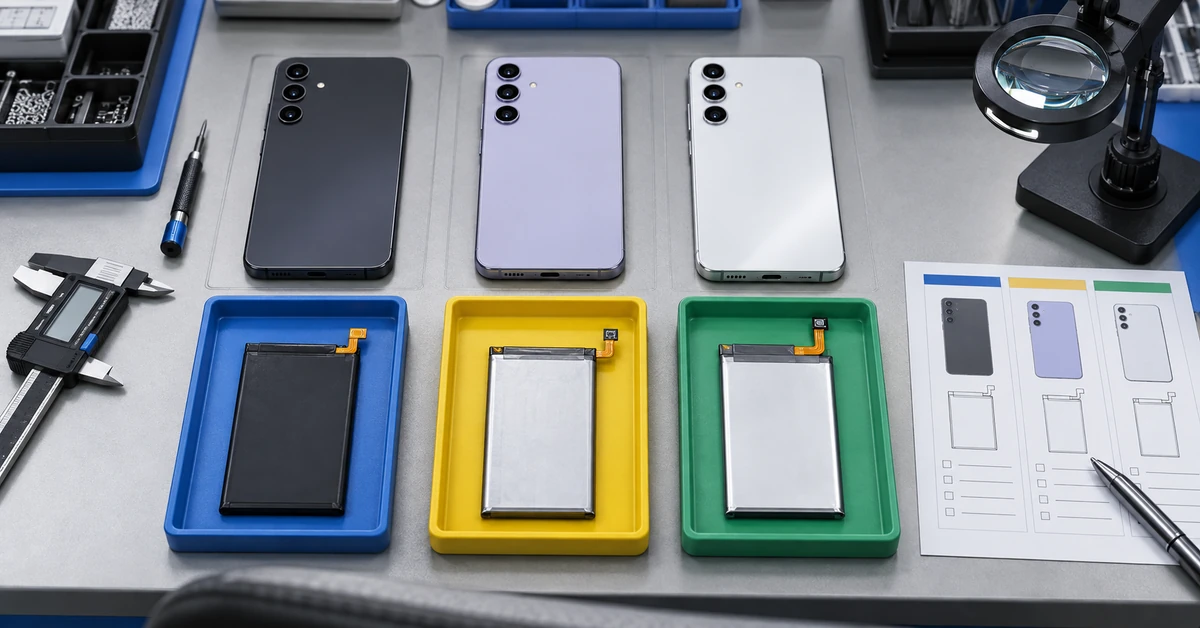

The practical conclusion is simple: an iPhone Duo battery and a Xiaomi 18 Fold battery must be treated as separate engineered assemblies, not as interchangeable packs that can be compared by one headline number. For repair chains, refurbishers and replacement-battery buyers, the useful iPhone Duo vs Xiaomi 18 Fold battery comparison is about verified model identity, architecture evidence, geometry, cell control, connector design, device behavior and lot traceability.
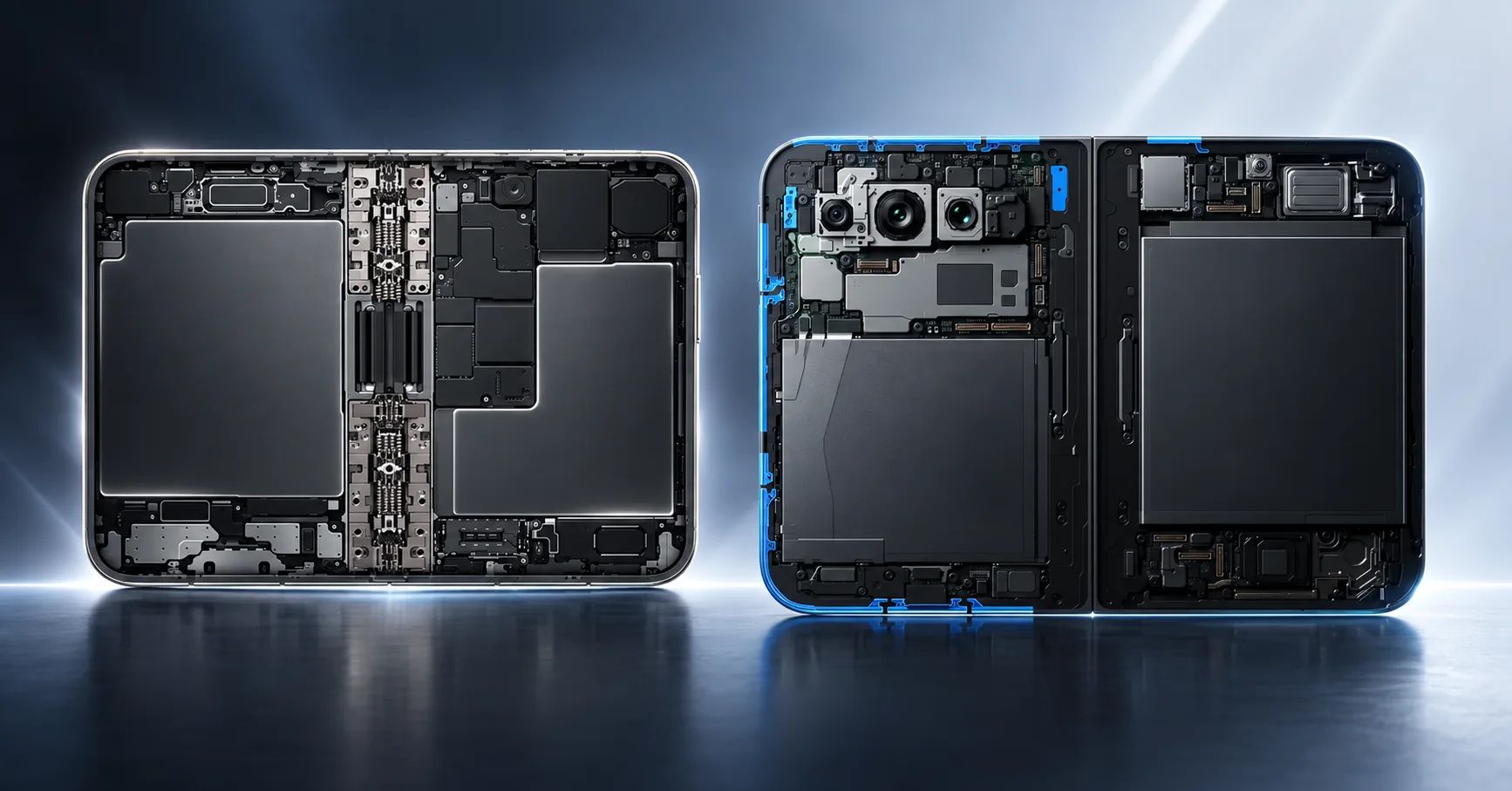
Apple identifies iPhone Duo as its first foldable iPhone and describes a dual-battery arrangement. Xiaomi's official Chinese storefront identifies Xiaomi 18 Fold as a current product, but the accessible official page does not provide a complete replacement-battery drawing, cell arrangement or service-part specification. Model identity is therefore confirmed, while detailed replacement-battery claims still require a controlled reference unit and engineering evidence.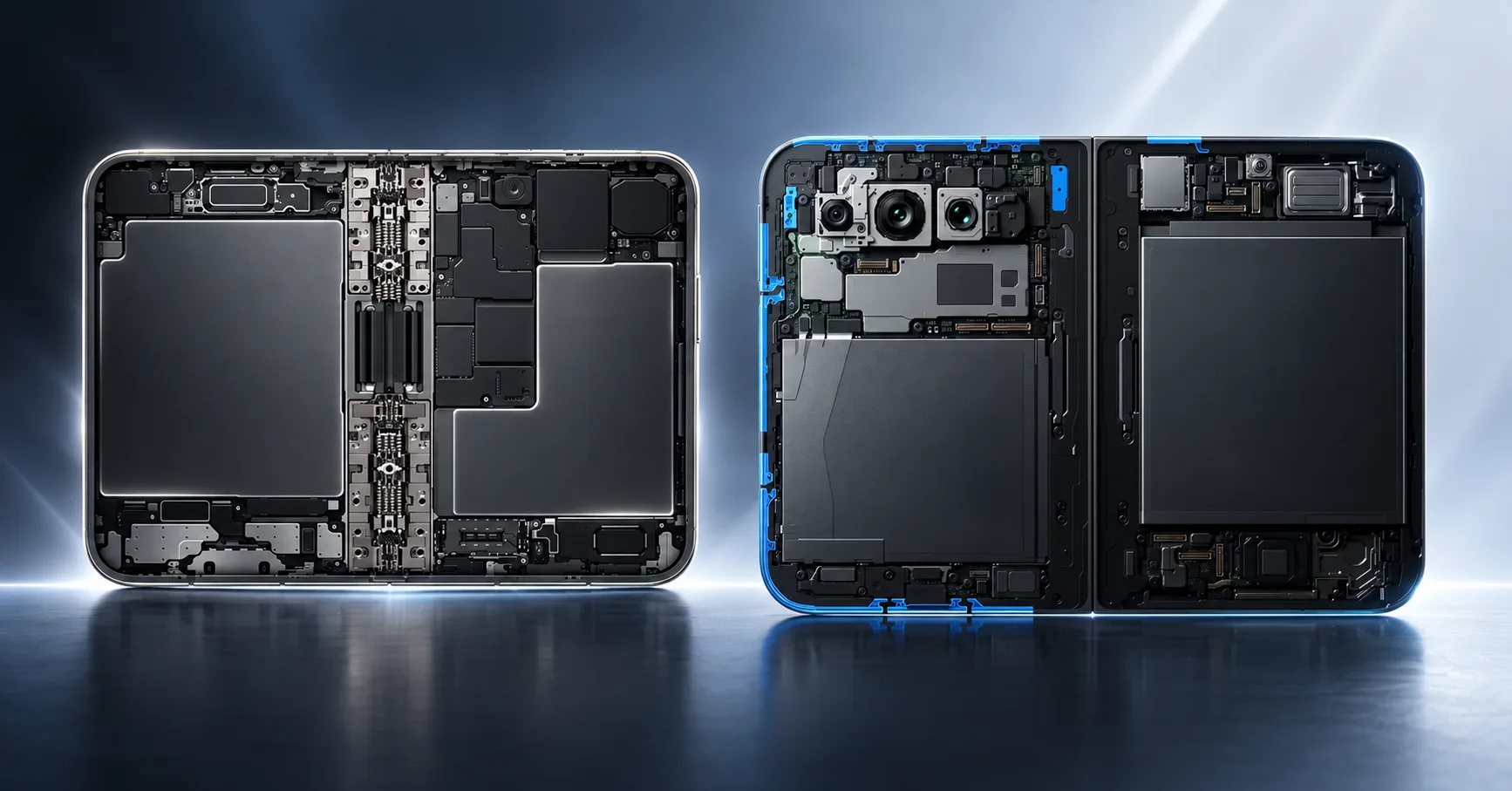
What the Official Specifications Actually Establish
Apple's official iPhone Duo overview says the device uses a dual-battery system. Apple also lists up to 31 hours of video playback on the inner display and up to 44 hours on the outer display. These are device-level runtime claims under Apple's test conditions, not replacement-pack capacity or acceptance specifications.
“Dual-battery system. All-day power.” — Apple, iPhone Duo overview
Xiaomi's official Xiaomi 18 Fold product page and official specifications entry establish the model name. Because the accessible specification text does not expose a battery capacity, cell configuration, connector drawing or service-part number, this article does not fill those gaps with reseller data, leaks or specifications from previous Xiaomi foldables.
“Xiaomi 18 Fold.” — Xiaomi official product page
This evidence gap is itself commercially important. A buyer should not turn an older MIX Fold specification into a Xiaomi 18 Fold purchasing requirement. Runtime, nominal capacity and replacement assembly identity answer different questions, and none substitutes for inspection of a controlled reference unit.
Compare Battery Architecture Before Capacity
| Decision field | iPhone Duo | Xiaomi 18 Fold | B2B purchasing implication |
|---|---|---|---|
| Official architecture signal | Dual-battery system | Foldable model identity confirmed; battery architecture not established by the accessible official text | Build separate drawings, BOMs and approval records. |
| Official energy statement | Runtime figures on Apple's page; no cited mAh value | No battery capacity used in this draft without an accessible official specification | Do not turn missing or unlike claims into a ranking. |
| Mechanical risk | Two cell locations, foldable chassis and routing constraints | Exact battery envelope must be measured from a controlled reference | Verify outline, thickness, tabs, flex path and adhesive zones. |
| Electrical risk | Paired-cell behavior and device communication must be checked | Pack protection, connector and device behavior must be checked | Approve the completed assembly, not a loose cell description. |
| Catalog control | Dedicated iPhone Duo SKU branch | Dedicated Xiaomi 18 Fold SKU branch | No shared compatibility claim without engineering evidence. |
A dual battery system creates more than a second pouch cell. The finished assembly may include separate flex paths, joining structures, protection and monitoring functions, adhesive geometry and sequence-sensitive installation features. Buyers should request a complete assembly definition rather than assume two cells with the same printed rating form an acceptable pair.
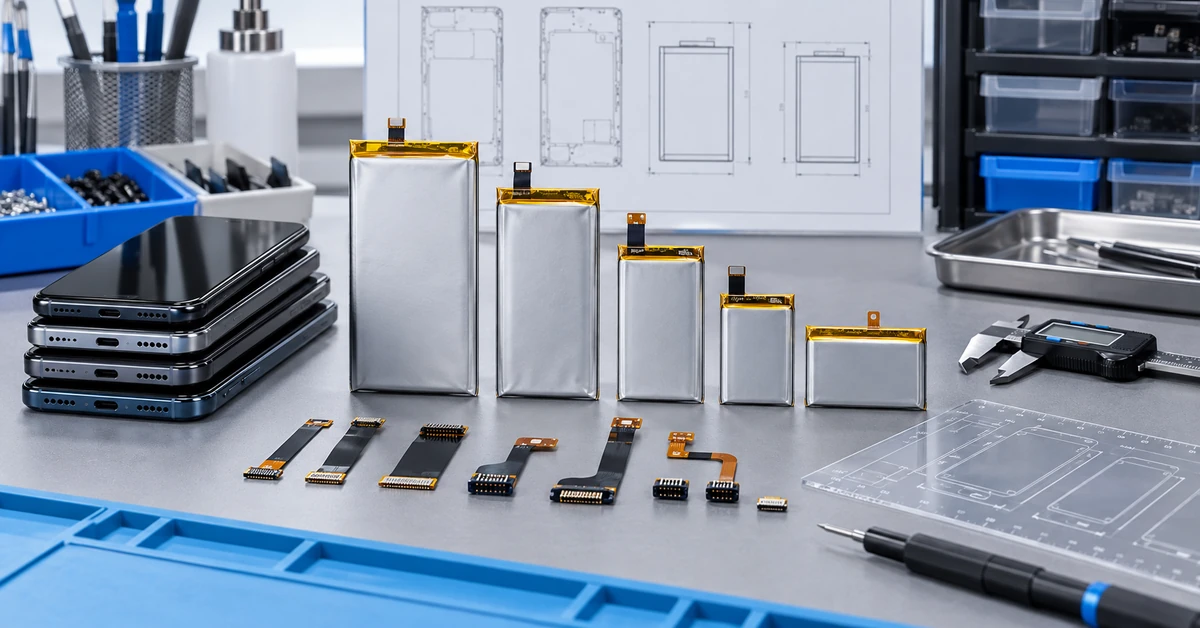
The unknown Xiaomi assembly geometry creates a strict evidence requirement. Small changes in a step, corner radius, local thickness or tab exit can affect seating pressure and nearby components. A candidate Xiaomi 18 Fold replacement battery should therefore be checked against a controlled reference and an agreed drawing at multiple points, not classified from photos or an older MIX Fold battery.
Why Capacity Cannot Decide the Better Replacement
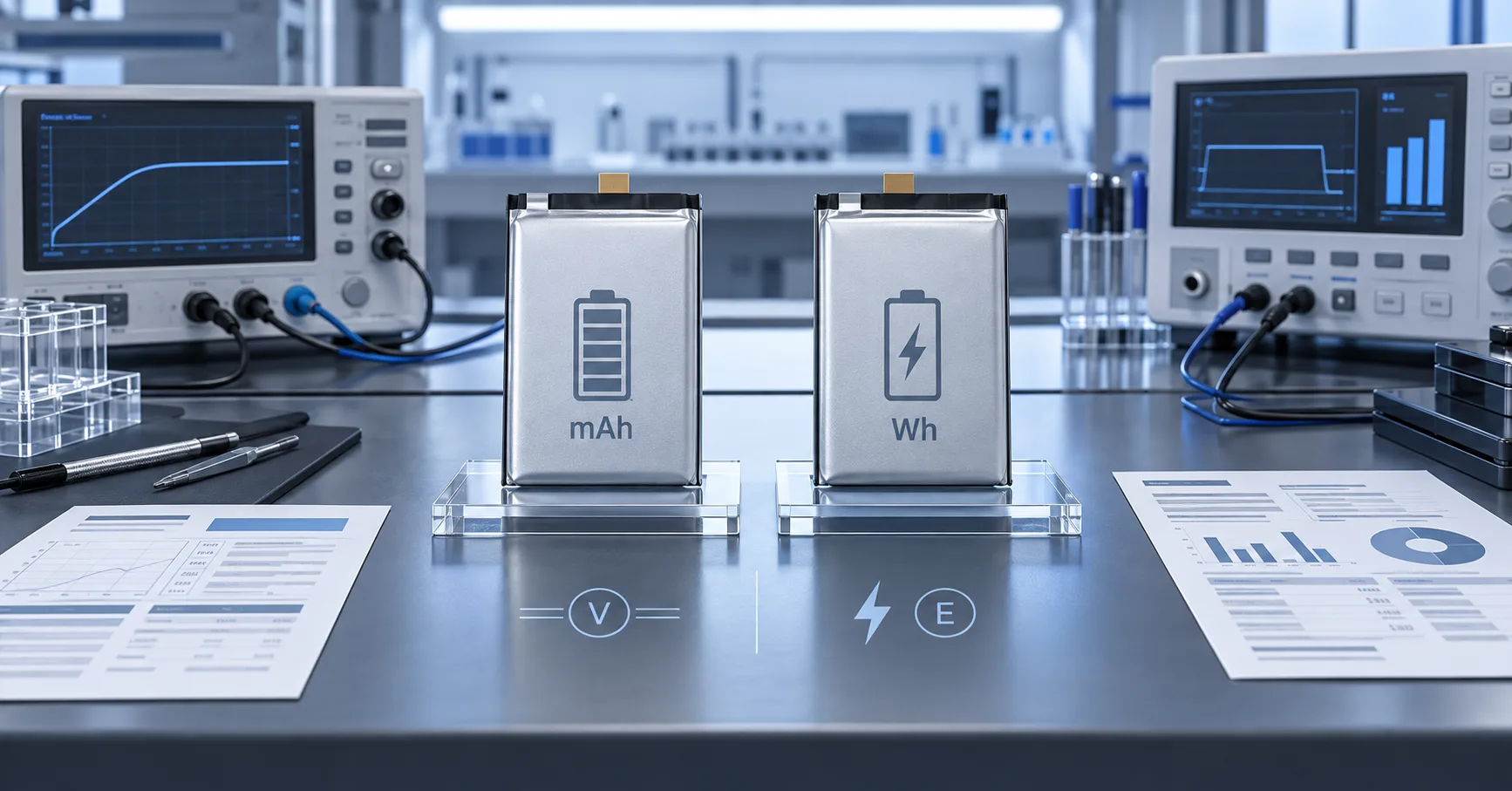
mAh is an electrical-charge value. Runtime depends on usable energy, voltage behavior, display state, radio activity, processor load, thermal control, software and cutoff behavior. Apple's inner-display and outer-display playback figures illustrate how one device can produce different runtime results depending on operating state. Until an official Xiaomi 18 Fold battery figure and its definition can be verified, no numerical capacity comparison should be published.
For replacement sourcing, buyers should distinguish label capacity, rated or minimum capacity, typical capacity and measured discharge results. The mobile phone battery incoming-inspection guide explains why a receiving decision should use a defined method and acceptance rule rather than visual label comparison alone.
Ask the supplier to identify the test temperature, charge procedure, rest time, discharge current, cutoff voltage, sample count and reporting unit. For paired cells, preserve results for each element and for the completed assembly where technically applicable. Do not accept “same capacity” as proof of geometry, pairing, firmware behavior or service life.
Build a Foldable-Battery Validation Matrix
Effective foldable phone battery validation starts with a matrix linking each device branch to evidence, samples, results and an approval decision. Use at least the following layers.
1. Identity and Reference Control
- Record the full device model, market variant, storage configuration if mechanically relevant and software version used for testing.
- Photograph the controlled reference assembly, connector orientation, flex routing and printed markings.
- Assign an internal sample ID so measurements cannot be separated from the physical unit.
- Keep iPhone Duo and Xiaomi 18 Fold records in different folders and SKU branches.
Xiaomi's support guidance states that phones sold through Mi Store are not intended for user battery replacement. That reinforces the need for qualified repair procedures rather than consumer DIY instructions.
“Phones sold in Mi Store do not support users to replace the battery by themselves.” — Xiaomi Support, mobile-phone battery replacement guidance
2. Mechanical Inspection
Measure the complete installed envelope at agreed datum points. Check maximum thickness as well as local thickness, stepped regions, corner geometry, connector position, flex length, bend direction, adhesive clearance and pull-tab access. Inspect the battery while flat and after the device has been assembled through the defined repair process. A cover that closes does not prove that local pressure is acceptable.
3. Electrical and Pairing Checks
Confirm polarity, connector keying, open-circuit voltage and protection behavior using approved procedures. For an iPhone Duo replacement battery, define how the two cells or subassemblies are paired and identified. Record imbalance limits only after engineering review; do not invent a universal threshold. The candidate must be assessed as the configuration actually supplied and installed.
For teams handling iPhone service behavior, the iPhone battery calibration and reset guide separates genuine electrical problems from misleading software assumptions. A device boot or a displayed percentage is an initial observation, not complete approval.
4. Functional and Thermal Verification
Run controlled charge, discharge, standby and representative workload checks. Observe both folded and unfolded use when these states change screen load or thermal distribution. Record ambient temperature, charger, cable, device state and measurement location. Compare candidates against a controlled reference under the same method rather than against an uncited online number.
Stop and quarantine any sample showing deformation, abnormal odor, leakage, unstable voltage, unexpected heating or installation pressure. The purpose of the trial is to expose risk before scale-up, not to force every sample through a complete cycle.
5. Repair-Process Verification
Validate the whole repair sequence: opening, adhesive removal, disconnection, cleaning, placement, flex routing, reconnection, closure and post-repair checks. Foldable devices concentrate value and mechanical complexity around the hinge and two display structures. A technically acceptable pack can still fail in the field if its adhesive, flex position or installation sequence is uncontrolled.
Move From Samples to a Controlled Production Lot
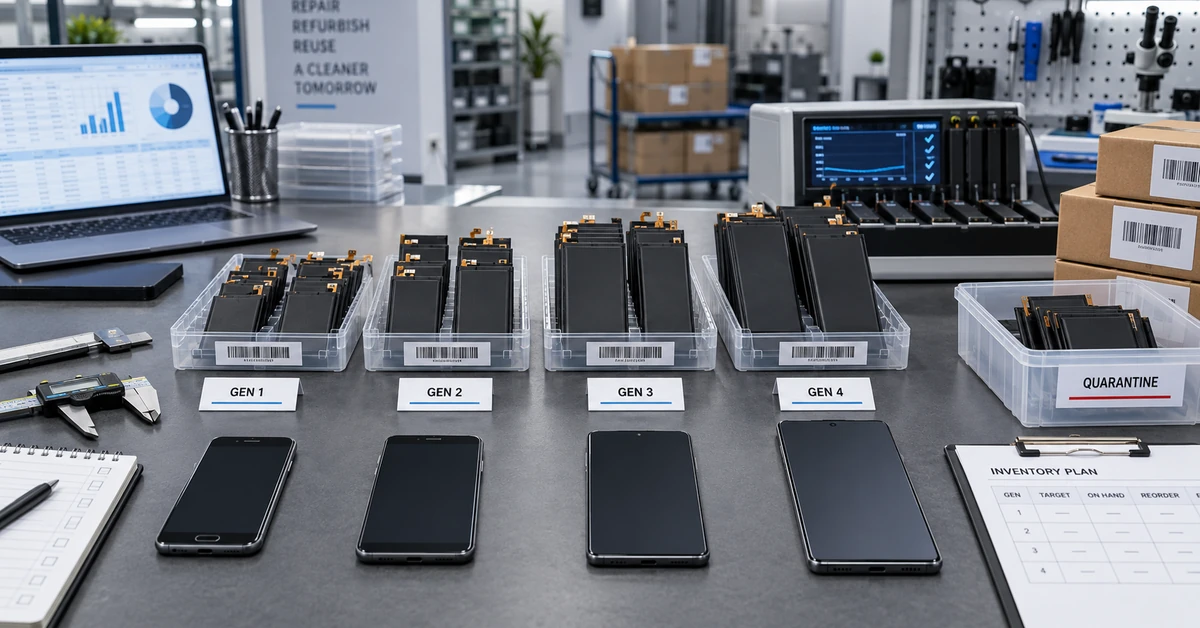
A golden sample is useful only when it is tied to drawings, materials, process controls and traceability. Build the pilot order from the same defined configuration intended for production. The mobile phone battery sampling-plan guide provides a framework for deciding sample size and escalation based on lot risk rather than checking a convenient handful.
At incoming inspection, verify model label, packaging identity, appearance, dimensions and electrical characteristics according to the approved control plan. Retain photos and results by lot. If a connector, flex, protection board, cell source, adhesive or label changes, require documented review before treating the revision as equivalent.
Keep warranty feedback model-specific. Mixing both foldables into one defect bucket can hide whether a problem belongs to the cell, paired assembly, connector, installation process, device state or one production lot. The goal is traceable correction, not a generic “foldable battery” failure rate.
What to Put in the RFQ
Send a structured request rather than asking only for “Duo battery” or “Xiaomi Fold battery.” Include:
- exact device and market variant;
- required finished assembly, not only a requested cell capacity;
- reference images and approved measurement points;
- connector, flex, protection and adhesive requirements;
- capacity terminology and test method requested;
- sample quantity and device-level test plan;
- label, packaging, traceability and target-market requirements;
- change-notification expectations and pilot-lot acceptance process.
Buyers developing an Apple-focused catalog can use the iPhone battery supplier guide for broader supplier-screening questions. For the Xiaomi side, the Xiaomi replacement-battery sourcing guide covers model mapping and wholesale controls. Neither page replaces engineering approval for these specific foldable devices.
Frequently Asked Questions
Does Xiaomi 18 Fold have a larger battery than iPhone Duo?
The cited official materials do not provide directly comparable capacity figures. Apple's page provides runtime figures and identifies a dual-battery system without publishing a matching mAh value; the accessible Xiaomi 18 Fold page does not expose a battery capacity used by this draft. A defensible comparison requires verified equivalent units and test conditions.
Can two battery cells with matching voltage and capacity be used for iPhone Duo?
No compatibility conclusion can be made from those two fields. Geometry, cell pairing, tabs, flex, connector, protection functions, device communication, installation and controlled testing all matter. Use an approved completed assembly.
Can one foldable-phone replacement battery fit both devices?
No such claim is supported by the official sources cited here. The products use different device architectures and must have separate model-level validation. Never create a shared SKU merely because both are book-style foldables.
What is the first sample-approval test?
Start with identity and non-energized mechanical inspection against a controlled reference. If the candidate fails model identity, outline, thickness, connector or flex checks, do not proceed to device testing.
Does this guide confirm that ESCCharge already supplies either replacement?
No. This article provides a procurement and validation framework. Availability, final compatibility, specifications, documentation and commercial terms must be confirmed for the exact project and approved sample.
Approve the Assembly, Not the Headline Number
The correct iPhone Duo vs Xiaomi 18 Fold battery decision is not which unsupported headline looks larger. It is whether each model-specific assembly has documented identity, fit, electrical behavior, repair-process compatibility, thermal performance and lot control. Keep the SKUs separate, test under comparable conditions and require change control after approval.
For a model-specific sourcing review, send ESCCharge the exact device variant, reference battery information, target market, expected order quantity and required validation documents. The project team can then confirm whether a candidate configuration and sampling plan are available; no compatibility or supply claim should be assumed before that review.
External Source References
- Apple — iPhone Duo overview — 2026.
- Apple — iPhone Duo Technical Specifications — 2026.
- Xiaomi — Xiaomi 18 Fold official product page — 2026.
- Xiaomi — Xiaomi 18 Fold official specifications entry — 2026.
- Xiaomi Support — How to replace the battery of mobile phone? — accessed 2026.