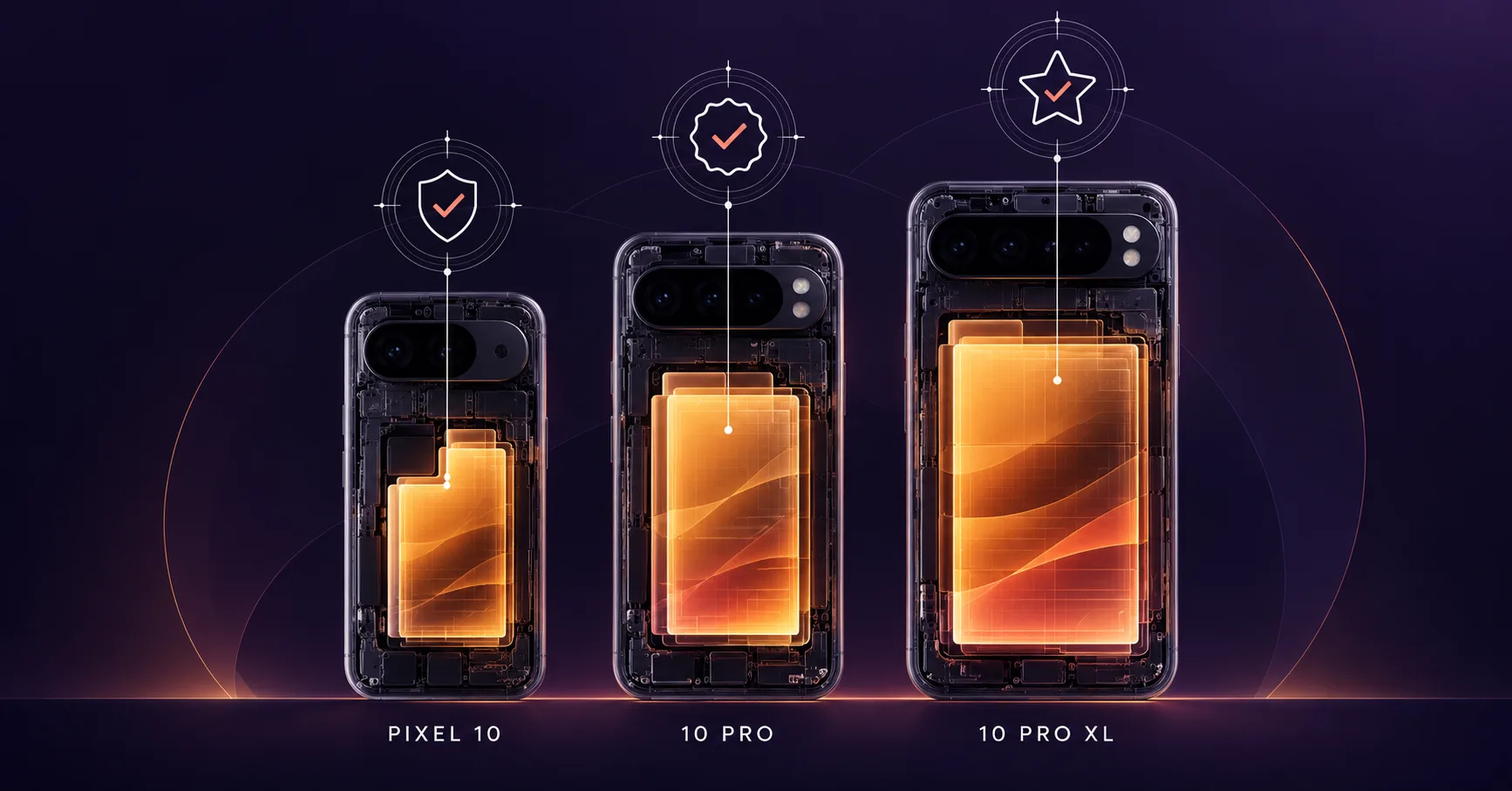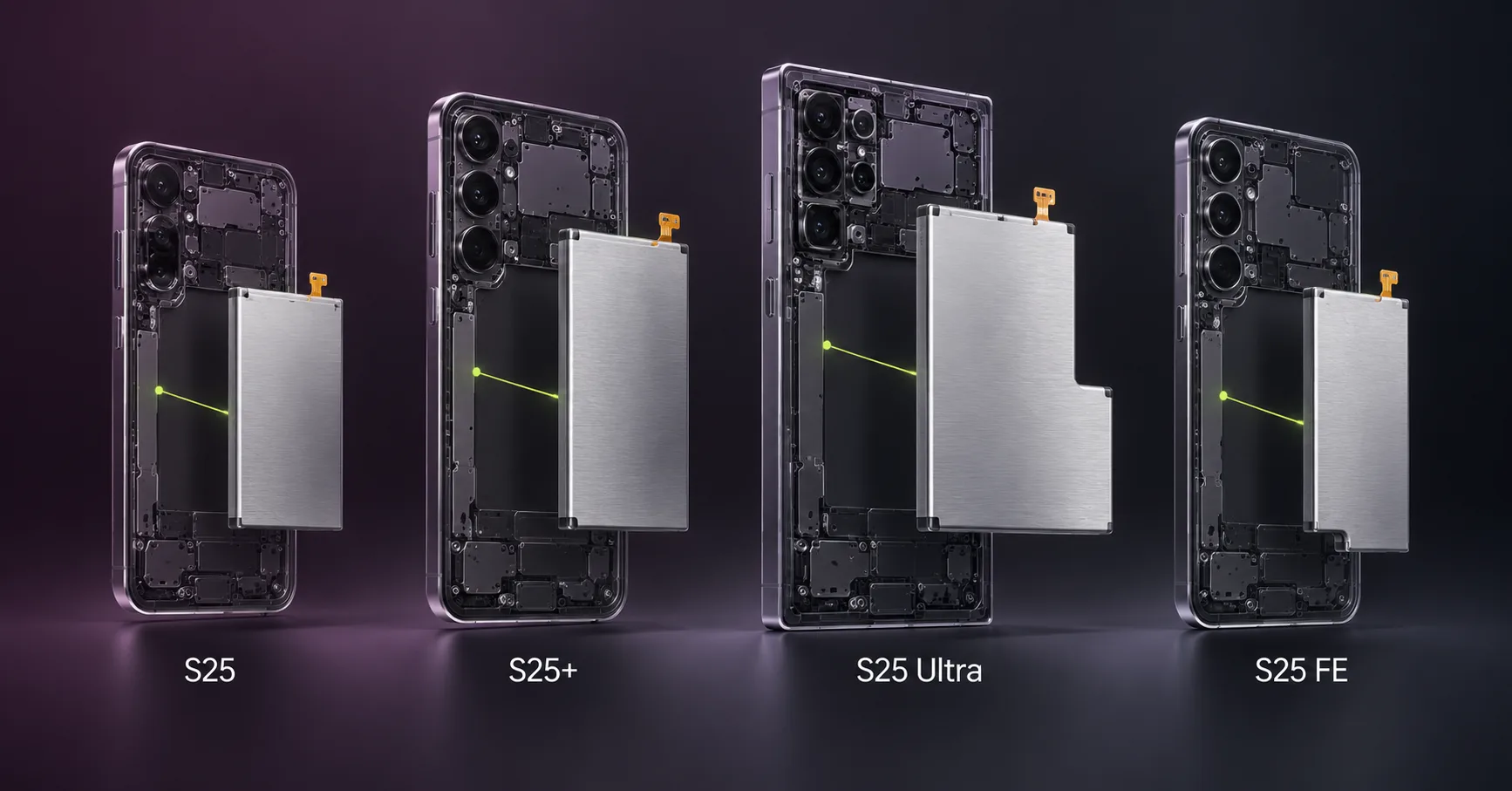

A larger printed mAh value does not automatically deliver a better replacement battery. More active material can affect pack thickness, weight, heat, voltage behavior, enclosure pressure and the difficulty of later removal.
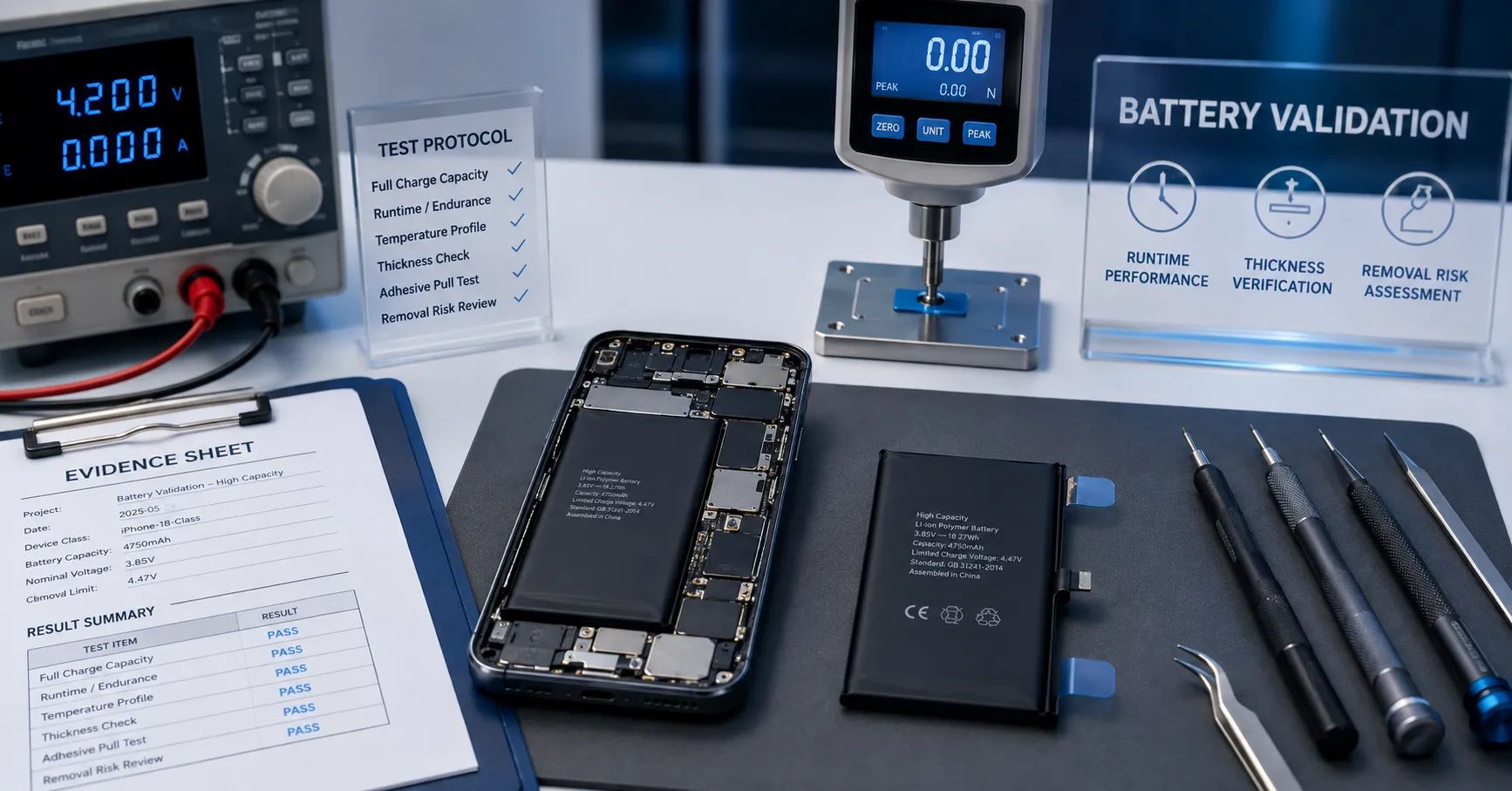
A professional iPhone 18 high-capacity battery program should verify rated and measured energy, installed runtime, thickness distribution, temperature, adhesive behavior and removal damage across devices, batches and operators.
Apple has not published final iPhone 18 battery specifications. All dimensions and capacity targets therefore remain provisional until commercial devices and official service information are available.
Verify Capacity Before Claiming an Upgrade
Record rated capacity, typical capacity where applicable, nominal voltage and Watt-hours. Measure production-representative samples using controlled charging, rest, discharge, cutoff and temperature conditions.
Compare the full voltage curve and usable energy rather than one label number. A pack can display a higher mAh value yet deliver little runtime benefit if cutoff, resistance, software estimation or temperature reduces usable energy.
Keep individual results and batch distributions. A favorable average can hide low-capacity or high-resistance outliers.
Balance Runtime With Thickness and Pressure
Map thickness across the complete pouch, protection area, flex and adhesive. Confirm clearance to the display, enclosure, charging coil and nearby components under defined state of charge and temperature.
Do not force the enclosure closed. Pressure marks, raised edges or changed gaps are rejection evidence even when the phone boots normally.
Run controlled standby, video, network, camera and sustained-load tests so additional measured energy can be connected to useful device runtime.
Define the Removal Scenario
Identify the exact device, hardware revision, battery, adhesive, enclosure condition and intended repairer. End-user replacement and professional workshop replacement can have different permitted tools and skills.
Define whether the test concerns production assembly, first service, aged service or removal after environmental exposure. Fresh adhesive does not represent a phone used for years.
Record every consumable and protective step, including replacement fasteners, sealing materials and insulation.
Build a Removal Validation Matrix
| Variable | Levels | Evidence |
|---|---|---|
| Adhesive | Supplier, revision, age and storage | Lot and specification |
| Environment | Temperature, humidity and conditioning | Recorded exposure |
| Pull method | Angle, speed, direction and tool | Force curve and video |
| Operator | Trained generalist and specialist | Time and deviations |
| Outcome | Clean removal, tab break, residue or damage | Photographs and code |
| Reassembly | Cleaning, new adhesive and sealing | Fit and function result |
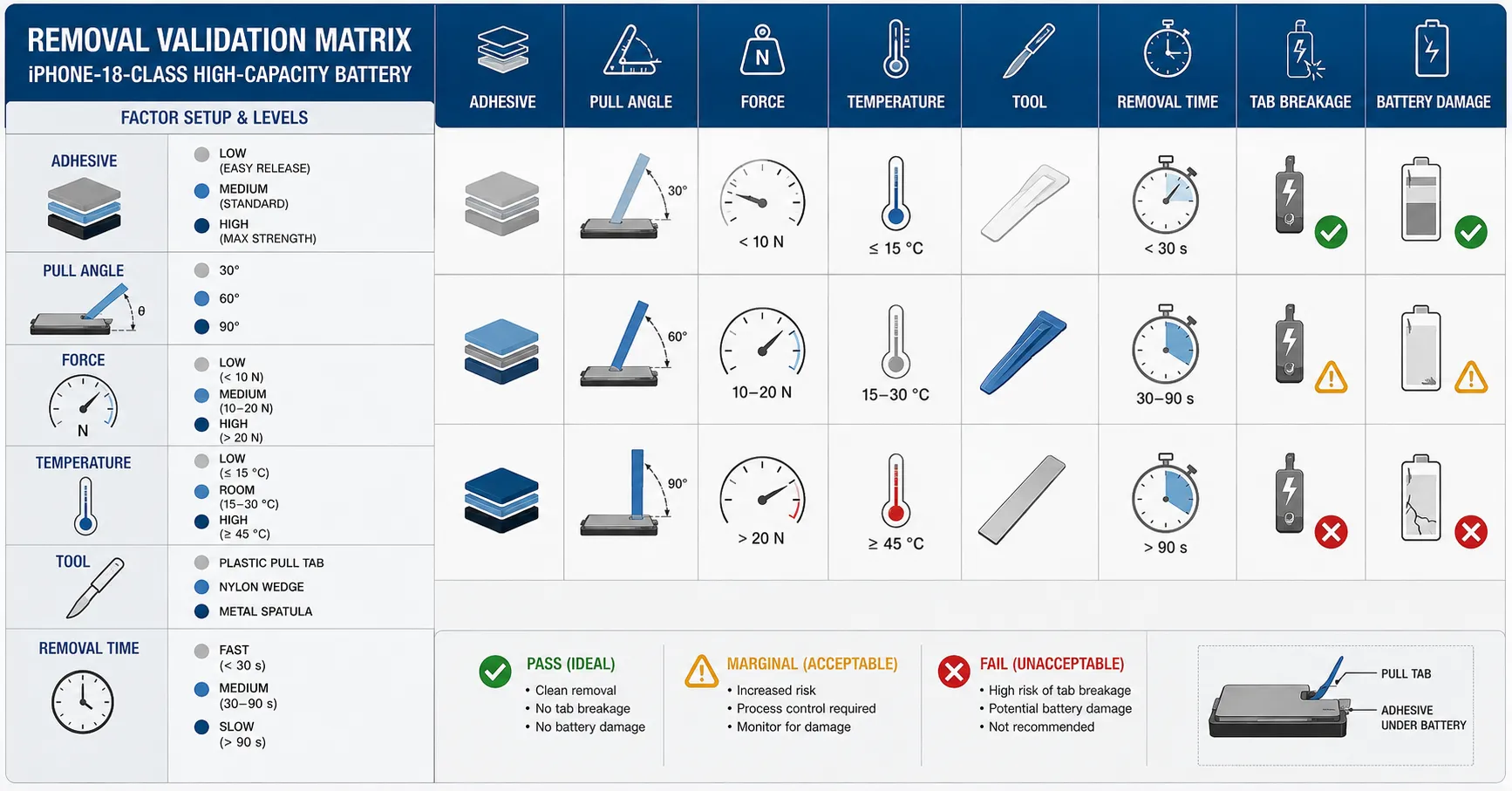
Specify the Adhesive
Record material, dimensions, thickness, carrier, liner, pull-tab geometry, supplier lot and approved storage. Similar-looking strips can behave differently during aging and removal.
Check adhesion to the battery surface and device substrate. Surface treatment, contamination and assembly pressure influence retention.
Require change approval before modifying supplier, formulation, dimensions, liner or application process.
Measure Installation Consistency
Removal quality begins during installation. Verify adhesive position, pressure, dwell time, alignment and trapped folds. Misplaced strips can become inaccessible or attach to unintended components.
Use fixtures where needed and inspect multiple operators. Record rework rather than hiding corrected units.
Confirm that the battery remains secure during drop, vibration and thermal use without excessive removal force.
Control Conditioning and Aging
Test fresh samples and samples conditioned to represent storage and use. Define temperature, humidity, duration and battery state of charge.
Environmental acceleration must be technically justified; severe exposure is not automatically equivalent to field aging. Keep baseline and conditioned groups.
Inspect thickness, adhesive migration, liner behavior and residue after conditioning.
Measure Pull Force Correctly
Use a repeatable fixture or force gauge where practical. Control pull angle, speed, direction and tab grip. Force values from different geometries are not directly comparable.
Record the complete force curve, maximum force, elongation and failure location. A low average can hide sudden peaks that break the tab.
Do not turn one force number into a universal acceptance limit. Establish model-specific ranges from approved samples and successful repairs.
Evaluate Tab Breakage
Classify whether the tab tears at the grip, separates from the adhesive, snaps after elongation or becomes inaccessible. Each mechanism needs a different corrective action.
Record breakage rate by adhesive lot, device cavity, operator and conditioning group. Inspect cut edges and alignment.
Define a safe secondary method before testing. Technicians should not improvise with metal tools near a charged pouch cell.
Control Heat and Solvents
If heat is allowed, define equipment, location, maximum condition, time and monitoring. Uncontrolled heat can affect the cell, display, seals and nearby components.
If a solvent is allowed, document chemical identity, volume, application point, ventilation, compatibility and residue removal. “Use alcohol” is not a sufficient work instruction.
EU guidance on removability and replaceability should be reviewed for restrictions concerning tools, heat and solvents in the actual product category.
Protect the Battery During Removal
Record bending, denting, puncture, edge damage, flex strain and insulation damage. Stop if swelling, leakage, odor or abnormal temperature appears.
Use a defined state of charge for destructive-risk testing and trained personnel with containment. Never reuse a cell damaged during removal.
Apple’s parts-support guidance warns that used battery cells can be damaged during adhesive removal, creating overheating, swelling, venting, leakage or thermal-event risk. The principle supports conservative handling for all pouch cells.
Protect the Device
Inspect display, back cover, charging coil, cameras, cables, frame and seals. Removal success is not acceptable if it damages a high-value assembly.
Measure enclosure flatness and gaps after reassembly. Run charging, camera, radio and touch functions.
For foldable phones, add hinge, flexible display and dual-cavity checks.
Measure Technician Repeatability
Use several trained operators. Record removal time, tab breaks, tool changes, deviations and damage. One expert demonstration can hide a process unsuitable for normal service networks.
Compare generalist and specialist outcomes when the applicable requirement distinguishes them. Improve fixtures and instructions before blaming individuals.
Video selected trials and version-control training materials.
Validate Reassembly
Removal is only half of the repair. Define cleaning, new adhesive, positioning, connector seating, enclosure closure and sealing steps.
Verify battery movement, pressure, charging, runtime and temperature after repair. Where water or dust protection claims apply, follow the approved restoration and verification method.
Do not promise restoration of an original protection rating without appropriate process and evidence.
Connect Results to EU Evidence
Regulation (EU) 2023/1670 includes smartphone disassembly and battery-replacement requirements. The Batteries Regulation and Commission guidance also address portable-battery removability and compatible replacement.
Maintain product scope, placement date, replacement steps, tools, time, operator competence and damage outcomes. Show which legal pathway and exception the design uses.
Do not assume one repairability score proves compliance with every battery requirement.
Audit Supplier and Production Changes
Incoming inspection should verify adhesive identity, dimensions, liner, battery surface and storage. Retain approved samples.
Repeat relevant tests after changes to adhesive, battery coating, cavity material, assembly pressure, enclosure or work instruction.
Link field repair failures to production lots and operators. ESC’s incoming inspection guide supports batch traceability.
Avoid Common Errors
- Testing only fresh adhesive.
- Using one expert operator.
- Ignoring pull angle and speed.
- Keeping only average force.
- Allowing undocumented heat or solvent.
- Counting removal as successful despite device damage.
- Reusing bent cells.
- Ignoring reassembly and sealing.
- Changing adhesive without approval.
- Claiming universal EU compliance from one test.
Define Failure and Damage Codes
Use standardized outcomes such as clean removal, high force, early tab break, inaccessible tab, adhesive residue, cell deformation, flex damage, enclosure damage and display damage.
Define severity and disposition before testing. A cosmetic residue and a bent pouch cell should not share the same failure code.
Require photographs and reviewer approval for serious events. Preserve damaged samples safely for investigation when appropriate.
Analyze Distributions Instead of Averages
Review individual pull curves, removal times and failure modes. A normal average can hide a small group with extreme force or repeated tab breakage.
Compare adhesive lots, cavity positions, conditioning groups and operators. Two distinct populations may indicate mixed material or assembly conditions.
Set warning and rejection rules using approved samples, repeatability and repair risk. Do not copy a force limit from another phone.
Test Storage and Logistics Effects
Adhesive and battery surfaces may experience warehouse heat, cold, humidity and long storage before assembly or service. Verify shelf life and packaging protection.
Condition materials within justified logistics scenarios and inspect liner release, dimensional stability and adhesion. Record whether material was stored after opening.
Quarantine expired, contaminated or untraceable adhesive. Do not extend shelf life from appearance alone.
Design Safe Secondary Removal
When the intended pull process fails, technicians need a validated fallback. Identify permitted non-metal tools, protective shields, access direction and battery state.
Measure the additional time and damage rate. If the fallback is needed frequently, correct the primary design rather than treating secondary removal as normal.
Prohibit puncturing, uncontrolled prying, bending and direct heating of the battery. Include escalation for swollen or damaged cells.
Audit Repair Documentation
Give technicians model-specific photographs or diagrams, tool lists, pulling direction, heat or solvent limits, stop conditions and reassembly steps. Generic instructions may be unsafe when cavities differ.
Test the instruction with people who did not write it. Record misunderstandings and revise ambiguous language.
Control translations and document versions. A repair network should be able to identify which instruction applied to every completed job.
Connect Removal Performance to Commercial Cost
Track labour time, consumables, broken tabs, damaged parts, repeat repairs and unusable returned batteries. The cheapest adhesive at assembly may create a more expensive service process.
Use the data when selecting materials and negotiating warranty responsibility. Separate adhesive defects, installation errors and technician deviations.
Do not sacrifice secure retention merely to reduce service time. Approval must balance use-phase stability with safe removal.
Add a controlled iPhone 18 battery removal risk review to the supplier approval file. It should identify the adhesive lot, device cavity, conditioning, operator, pull method and outcome for every sample.
Compare pilot and mass-production data. A hand-built sample may receive more careful surface cleaning and positioning than a normal production unit. Audit application fixtures, pressure and liner removal at the intended production rate.
When field technicians report frequent breaks, collect the removed adhesive, battery lot, phone production date and work-instruction version. Reproduce the combination before changing the material.
Include accessibility in the review. A tab that has acceptable mechanical strength but cannot be gripped after opening the device does not provide a practical removal process.
Define how partially removed batteries are stabilized and transported inside the workshop. A loose charged cell should not remain connected or be placed with conductive tools.
Review packaging of replacement adhesive and batteries so the technician receives the correct consumables together. Missing fasteners, shields or seals can prevent complete reassembly even when removal succeeds.
Create an Approval Gate
- Confirm product scope and repair scenario.
- Freeze adhesive and surfaces.
- Validate installation.
- Condition fresh and aged groups.
- Measure pull force and breakage.
- Approve secondary removal.
- Inspect battery and device damage.
- Test multiple operators.
- Validate reassembly and function.
- Freeze evidence and change control.
Frequently Asked Questions
Is lower adhesive force always better?
No. Retention during use and safe removal must both pass.
Can heat be used?
Only when the approved process and applicable rules permit it, with controlled equipment and conditions.
What if the pull tab breaks?
Use a validated secondary method and record the failure mechanism. Do not improvise near the cell.
Must removal restore water resistance?
Review the product claim and applicable rules; restoration requires appropriate materials, process and verification.
How many operators should test?
Use enough operators and samples to evaluate realistic process variation and risk.
Validate the Entire Repair, Not One Successful Pull
Reliable iPhone 18 high-capacity battery connects retention, aging, pull behavior, technician repeatability, cell safety, device protection and reassembly.
Send ESC your target models, adhesive design, repair market and test requirements. ESC can support sample and batch planning. Final legal and technical limits require project-specific approval.
External Source References
- European Union — Regulation EU 2023/1670
- European Commission — Battery Removability and Replaceability Guidelines
- Apple Support — Parts Support for iPhone