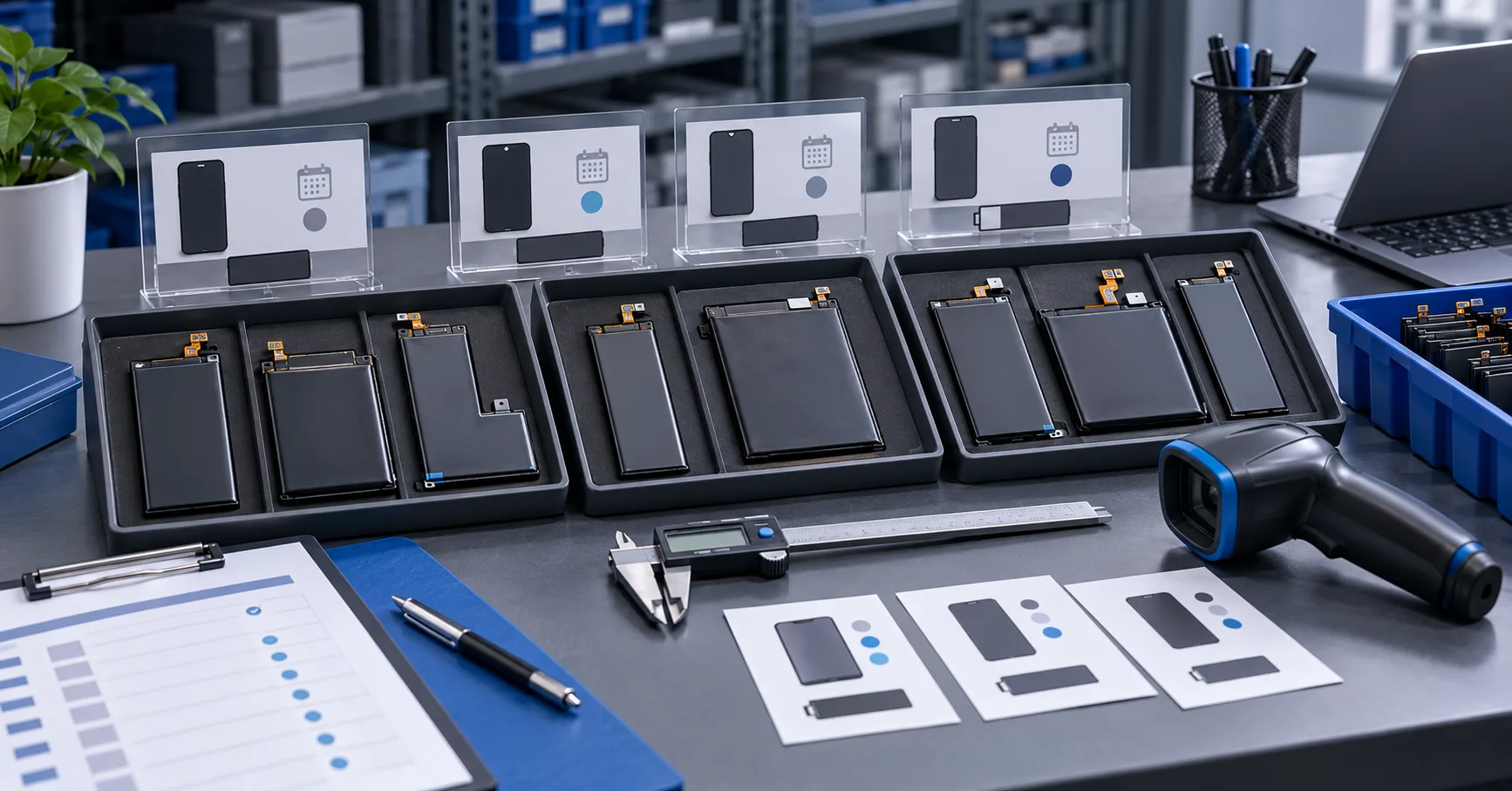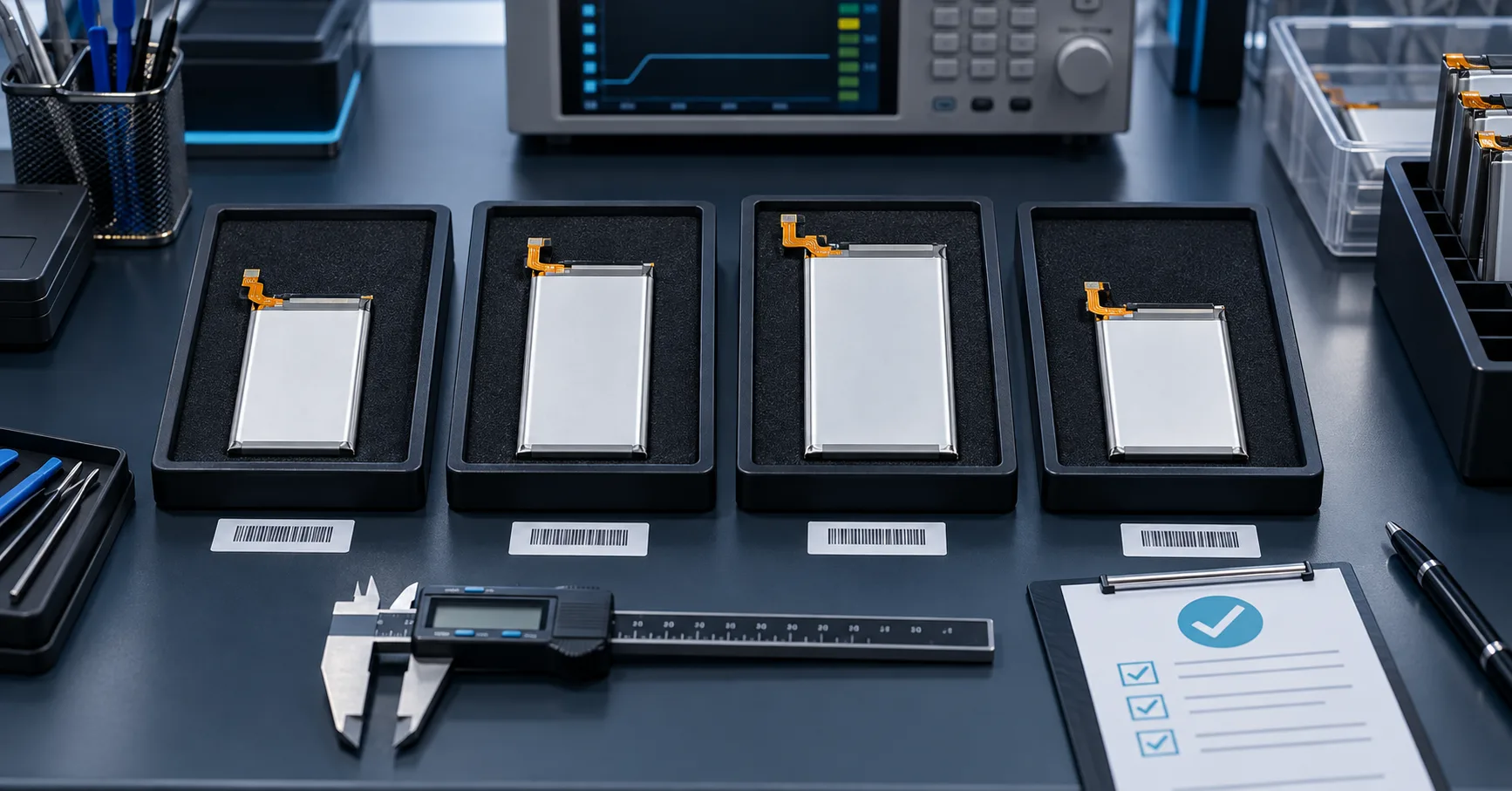

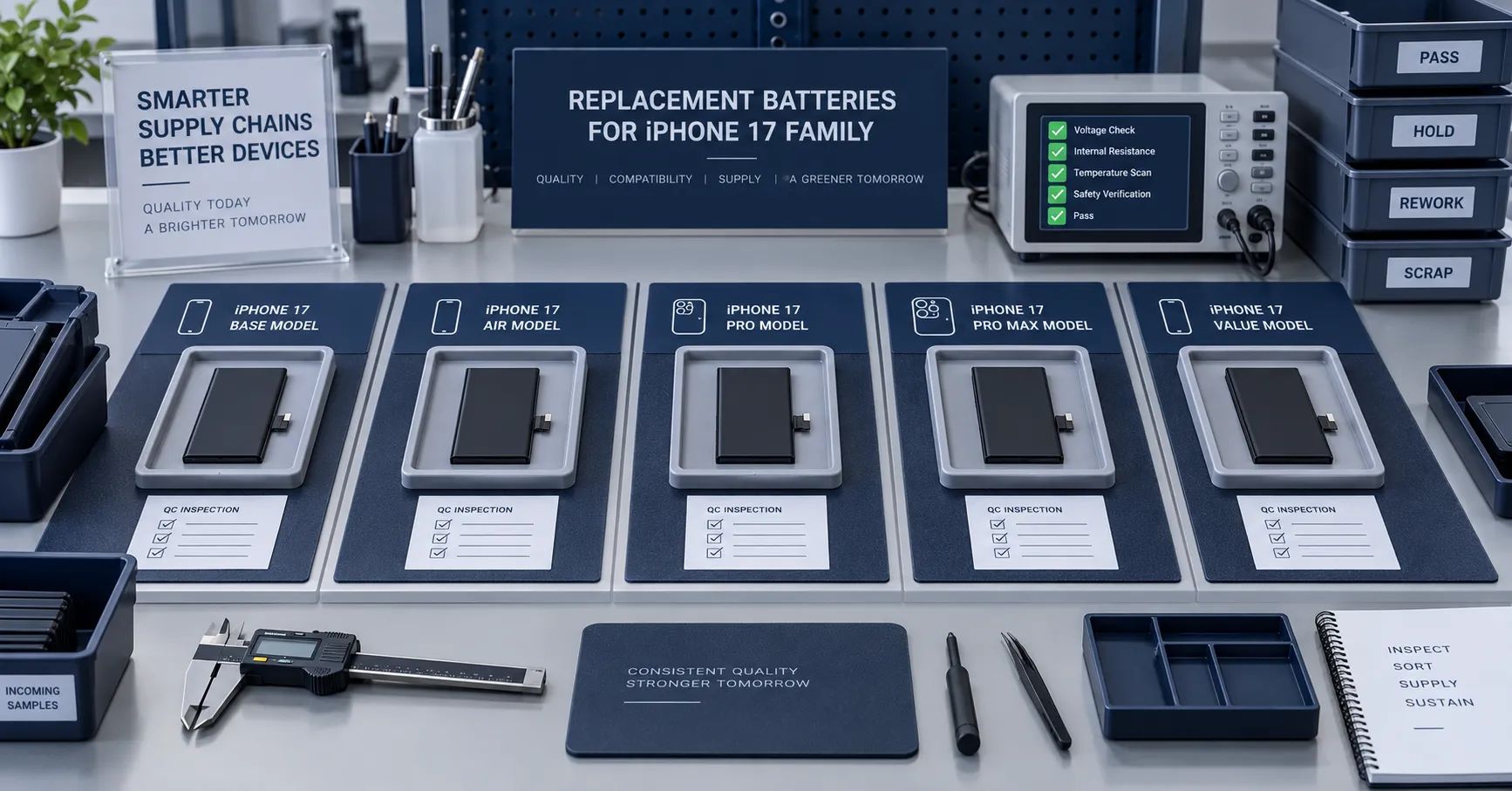
iPhone 17 series replacement batteries should be sourced and approved as five separate device programs, not as one interchangeable family. Apple identifies iPhone 17, iPhone Air, iPhone 17 Pro and iPhone 17 Pro Max as distinct 2025 devices, while iPhone 17e was introduced in 2026. A repair chain or wholesaler should therefore connect every approved battery to an exact phone model, regional A-number, sample revision and production lot.
This page owns the series-level purchasing decision: how many SKUs are required, what evidence should distinguish them and how a buyer moves from samples to repeat orders. Buyers looking only for a single iphone 17 pro max battery replacement source can also review ESCCharge's existing iPhone 17 Pro Max battery manufacturer guide. System messages such as Genuine, Used or Unknown require a separate software-aware validation path and are not promised here.
Separate the Five Approval Lanes
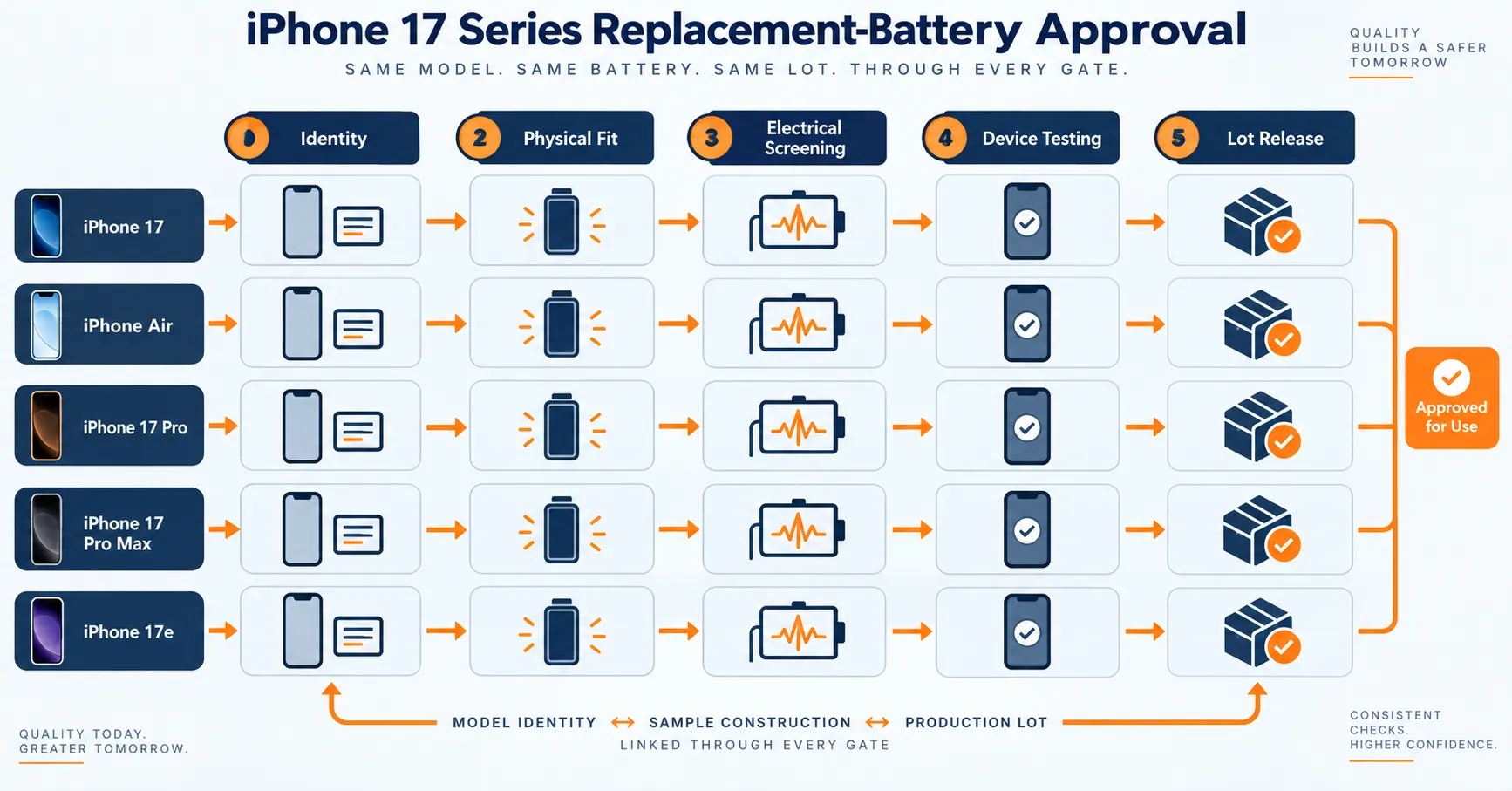
Apple's current Identify your iPhone model page lists multiple regional model numbers for each device. Record the phone's marketing name and A-number before selecting a part. Region can affect the device configuration, so a label that says only “iPhone 17 series” is not enough evidence for inventory or installation control.
| Device lane | Year introduced | Examples of official model identifiers | Buyer control |
|---|---|---|---|
| iPhone 17 | 2025 | A3258, A3519, A3520, A3521 | Dedicated sample, drawing and test record |
| iPhone Air | 2025 | A3260, A3516, A3517, A3518 | Never map approval from the base or Pro models |
| iPhone 17 Pro | 2025 | A3256, A3522, A3523, A3524 | Separate connector, flex and fit evidence |
| iPhone 17 Pro Max | 2025 | A3257, A3525, A3526, A3527 | Independent Pro Max approval and stock code |
| iPhone 17e | 2026 | A3575, A3634, A3635 | New-model approval; do not inherit 2025 results |
The model numbers above identify devices, not replacement batteries. They help prevent receiving, labeling and picking errors, but they do not prove that one battery construction fits every regional version. The buyer still needs supplier drawings, sample inspection and controlled installation evidence for the exact supply proposal.
Define Compatibility as Testable Evidence
iPhone 17 battery compatibility is not a single yes-or-no label. For B2B approval, it is a chain of evidence covering identity, geometry, electrical interface, protection behavior, device function and repeatability. Each conclusion should state the tested sample code, phone identifier, operating-system build, test conditions and result.
| Evidence layer | What to verify | Common release risk |
|---|---|---|
| Identity | Supplier part number, target model, drawing revision, label and cell lot | One label used across different constructions |
| Mechanical | Pouch outline, thickness, flex path, connector location, insulation and adhesive area | Pressure, pinched flex or difficult closure |
| Electrical | Polarity, connector condition, agreed voltage screening and protection-board revision | Wrong interface or unexplained distribution |
| Device behavior | Boot, charge, discharge, restart, shutdown and temperature observations | Passing one short boot test |
| Production | Pilot-lot consistency, traceability and controlled changes | Bulk construction differs from the sample |
A supplier statement such as “compatible with iPhone 17” should be converted into an evidence request. Ask which exact model and regional devices were used, how many samples were evaluated, which revision passed, what acceptance method was applied and whether the shipped lot preserves the approved construction.
Screen Samples Before They Enter a Phone
Begin with shipping condition and traceability. Photograph the received packaging and each label. Quarantine packs with crushing, puncture, moisture exposure, swelling, damaged insulation, deformed connectors or uncertain identity. Do not bend, probe, compress or install a questionable lithium-ion pack.
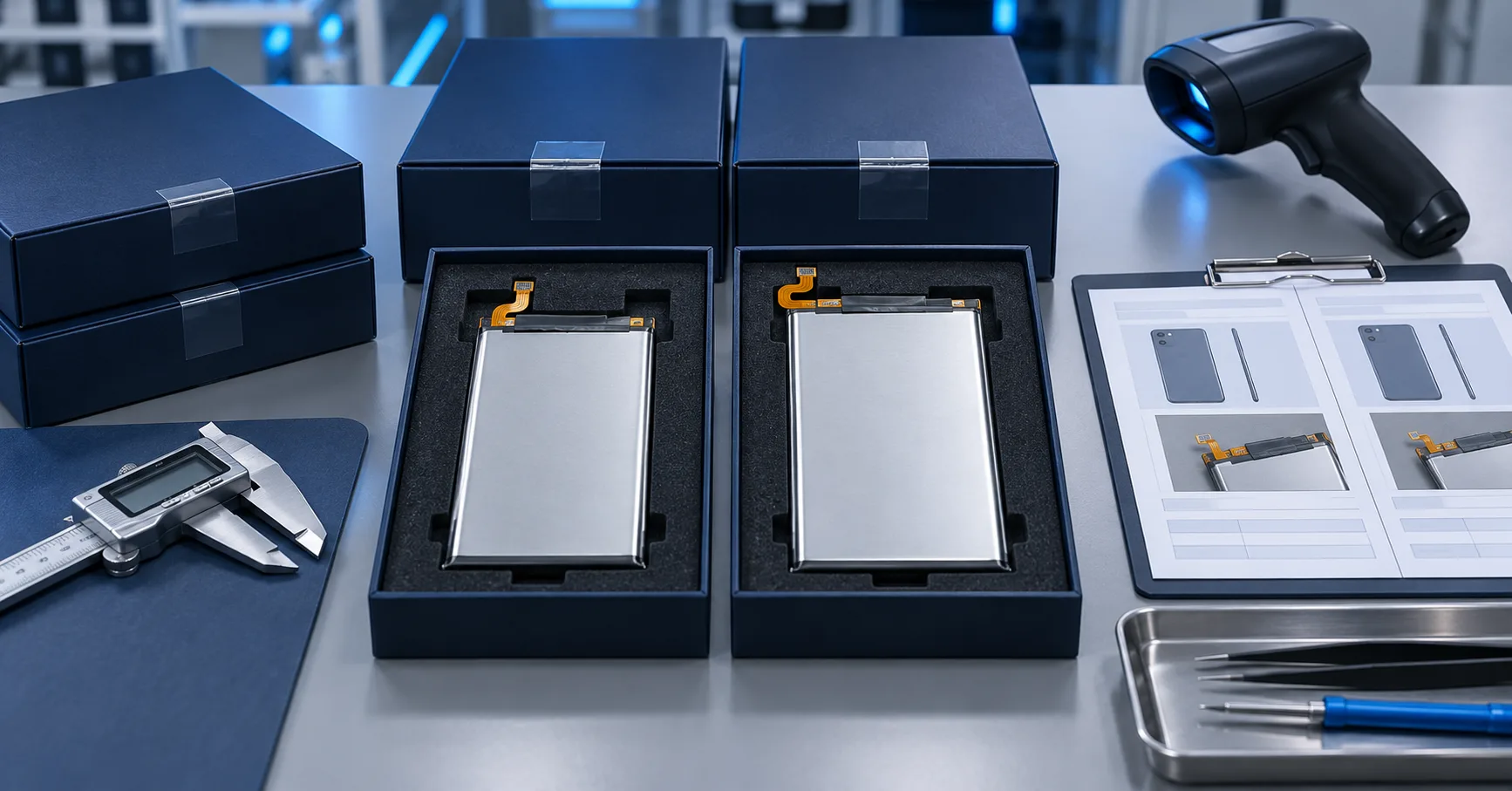
Inspect dimensions at defined points using suitable tools and a written method. Check the pouch perimeter, thickness distribution, tab area, flex routing, connector orientation, insulation and adhesive location against the approved reference. Retain individual readings instead of reporting only an average, because a local high point or shifted flex can create installation risk even when the overall dimensions appear acceptable.
Electrical screening should use buyer-approved limits and safe equipment. Record polarity, connector condition and open-circuit voltage without turning a generic industry value into a universal acceptance limit. The correct limit depends on the proposed battery design, storage state, test method and supplier specification.
Control Installation and Device Testing
Apple publishes model-specific repair documentation. The iPhone 17 Repair Manual and iPhone 17 Pro Repair Manual both include battery safety, battery procedures and battery-related troubleshooting sections. Trained personnel should use the applicable official documentation, appropriate tools and a controlled workspace rather than treating a similar-looking model as procedural authority.
Use test phones with recorded pre-test condition. Photograph the sample routing before closure. Confirm that the connector seats normally, the flex is not trapped and the pack stays flat without forcing the device together. A phone that boots is only the start of the test, not final approval.
Record wired charging, wireless charging where applicable, controlled discharge, unexpected restarts, shutdowns and observable temperature behavior. Keep charger, cable, ambient condition, starting charge state, software build, test duration and device workload consistent when comparing samples. If an event occurs, preserve the raw record and classify it before assigning the cause to the battery.
Validate Capacity, Runtime and System Observations Separately
A capacity printed on a label is a specification claim. Buyers can use controlled charge-discharge measurement, incoming screening and device-runtime comparison for different purposes. The published iPhone battery capacity testing guide explains how to prepare a repeatable bulk-order test plan. Report individual values and dispersion, including invalid or interrupted runs, rather than presenting only the best sample.
Runtime is influenced by screen settings, connectivity, applications, background activity, software and the condition of the test phone. Hold those variables as stable as practical. Compare like with like, and do not convert one favorable runtime into a universal performance promise.
Parts and Service History, Repair Assistant results and battery-health displays are separate observation fields. A physical fit or successful charge does not guarantee a particular Apple system message. An aftermarket supplier should not describe a third-party replacement as Apple genuine or Apple-authorized, and the buyer should document exactly what was observed rather than relying on terms such as “no warning” or “fully decoded” without a defined device and software condition.
Approve a Pilot Lot Before Bulk Release
A passed sample does not automatically release production. Freeze the relevant drawing, label, cell reference, protection-board revision, flex, connector, insulation, adhesive and agreed test method. Then use a pilot lot to test whether the production process reproduces the approved result.
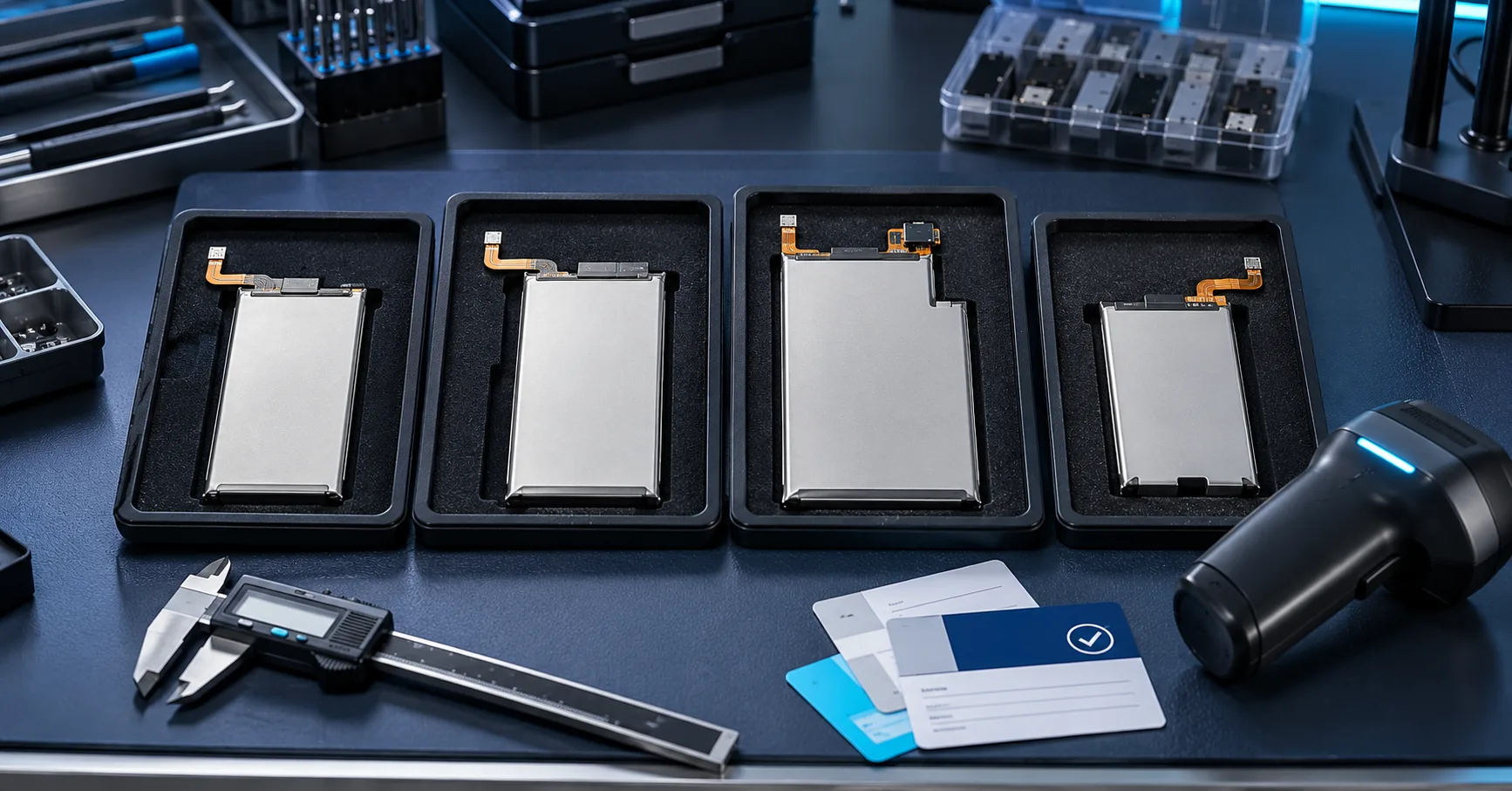
Build a model-stratified mobile phone battery sampling plan. Do not combine all five device lanes into one pool that could hide a weak or mislabeled SKU. Sampling quantity and acceptance limits should reflect order size, failure severity, process history and the buyer's own risk policy.
At receiving, the mobile phone battery incoming-inspection guide can support a consistent IQC structure. Keep the inspection record connected to the purchase order, carton, lot, model code and disposition. Mixed labels, unexplained voltage distribution, dimensional drift, installation interference, charging faults, abnormal heating or repeated runtime spread should trigger containment and investigation.
Plan the SKU Mix Without Overbuying
An iphone 17 replacement battery assortment should follow installed device demand, repair intake and sell-through data rather than equal quantities for every model. Newer or lower-volume lanes may justify small approval and replenishment batches until local demand becomes visible. Fast-moving models may need deeper stock, but only after the lot-control process is stable.
Track inventory by exact model, supplier part code, revision and lot. Use barcode or equivalent controls to reduce picking errors. Separate standard, premium or diagnostic-oriented commercial versions when they have different constructions or claims. Packaging must not imply that aftermarket products are Apple original parts.
When evaluating an iphone 17 battery supplier, compare qualified cost rather than unit price alone. Include sample work, incoming inspection, installation rework, returns, warranty handling, slow-moving stock and the cost of an uncontrolled material change. A cheaper unit can become the more expensive program if evidence and repeatability are weak.
Prepare a Decision-Ready RFQ
For a replacement battery for iphone 17 pro or any other lane, the RFQ should identify the exact target device and market. Include forecast by model, order quantity, sample quantity, required drawings, label and packaging needs, acceptance methods, traceability format, change-notification expectations and destination country.
- List each device and regional A-number used for approval.
- Request a unique supplier part code and revision for every construction.
- Define which measurements and device tests must appear in the sample report.
- State whether accessories, adhesives or packaging are included in the deliverable.
- Ask which product-specific transport and compliance documents are available.
- Confirm how deviations, substitutions, complaints and repeat orders will be controlled.
ESCCharge can discuss a model-separated sampling and sourcing plan after reviewing these inputs. Capacity, certifications, MOQ, lead time, warranty, diagnostic behavior and performance limits must be confirmed for the proposed product, target market and order rather than assumed from a general series label.
Frequently Asked Questions
Can one battery cover iPhone 17 and iPhone 17 Pro?
Do not assume so. Keep separate drawings, samples, installation results and stock codes unless documented evidence for the exact proposal proves otherwise.
Does iPhone Air belong in the same battery SKU?
No shared SKU should be inferred from the release year. Apple identifies iPhone Air as a distinct model, so buyers need its own approval lane.
Can 2025 test results approve an iPhone 17e battery?
No. Apple lists iPhone 17e as a 2026 model with its own A-numbers. It requires a new identity, fit and functional validation record.
Is a higher stated capacity automatically better?
No. Capacity must be evaluated together with fit, temperature behavior, repeatability and the agreed measurement method.
When should a battery be revalidated?
Use risk-based revalidation after changes to the cell, protection board, flex, connector, dimensions, insulation, adhesive, label or manufacturing process, and after unexplained field failures.
What is the minimum evidence for bulk release?
At minimum, preserve exact model identity, approved sample and revision, inspection and device-test records, pilot-lot evidence, traceability, acceptance decision and authorized change controls.