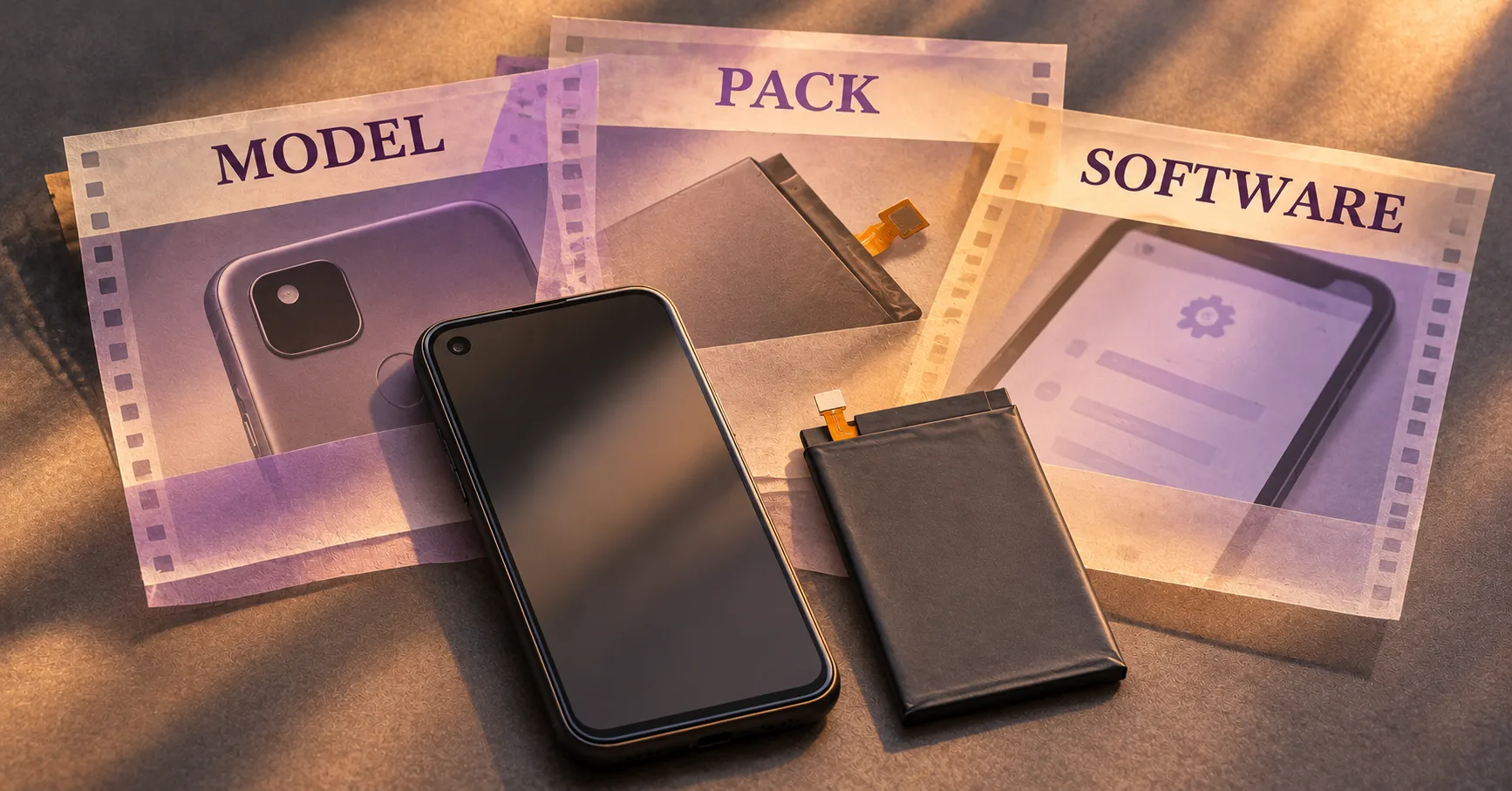

Quick answer: an iPhone 16e battery replacement program should use a dedicated assembly specification and installed-device approval record. Confirm the exact phone, battery reference, dimensions, flex, connector, adhesive system and software observations before ordering in volume. Approval from an iPhone 16 or another similar-looking device should not be transferred without evidence.
For repair chains, refurbishment facilities and wholesalers, the important purchasing question is whether a repeat production lot will reproduce the approved repair result. That requires more than a matching product title, a printed capacity or a successful first boot. This guide connects the official device and service references to sample testing, kit definition and lot release.
Give iPhone 16e Its Own Compatibility Record
Apple identifies the iPhone 16e as a 2025 model. Its official iPhone model-identification list includes A3212, A3408, A3410 and A3409 for different markets. Record the identifier from the target device along with its sales region and software build.
These regional identifiers define the scope of the validation program. They do not, by themselves, establish either different batteries or universal compatibility. If a supplier proposes one assembly across several variants, require an application list and supporting drawings, references and representative installed tests. Record which variants were physically tested and which were assessed through documented engineering equivalence.
Maintain a buyer SKU linked to the supplier SKU, drawing revision, label revision and approved device applications. Sales staff and warehouse operators should see “16e” explicitly on the picking record. A shortened “16-series” description creates avoidable ambiguity when standard, Plus, Pro and Pro Max batteries are stored nearby.
Separate Official Device Performance From Pack Specifications
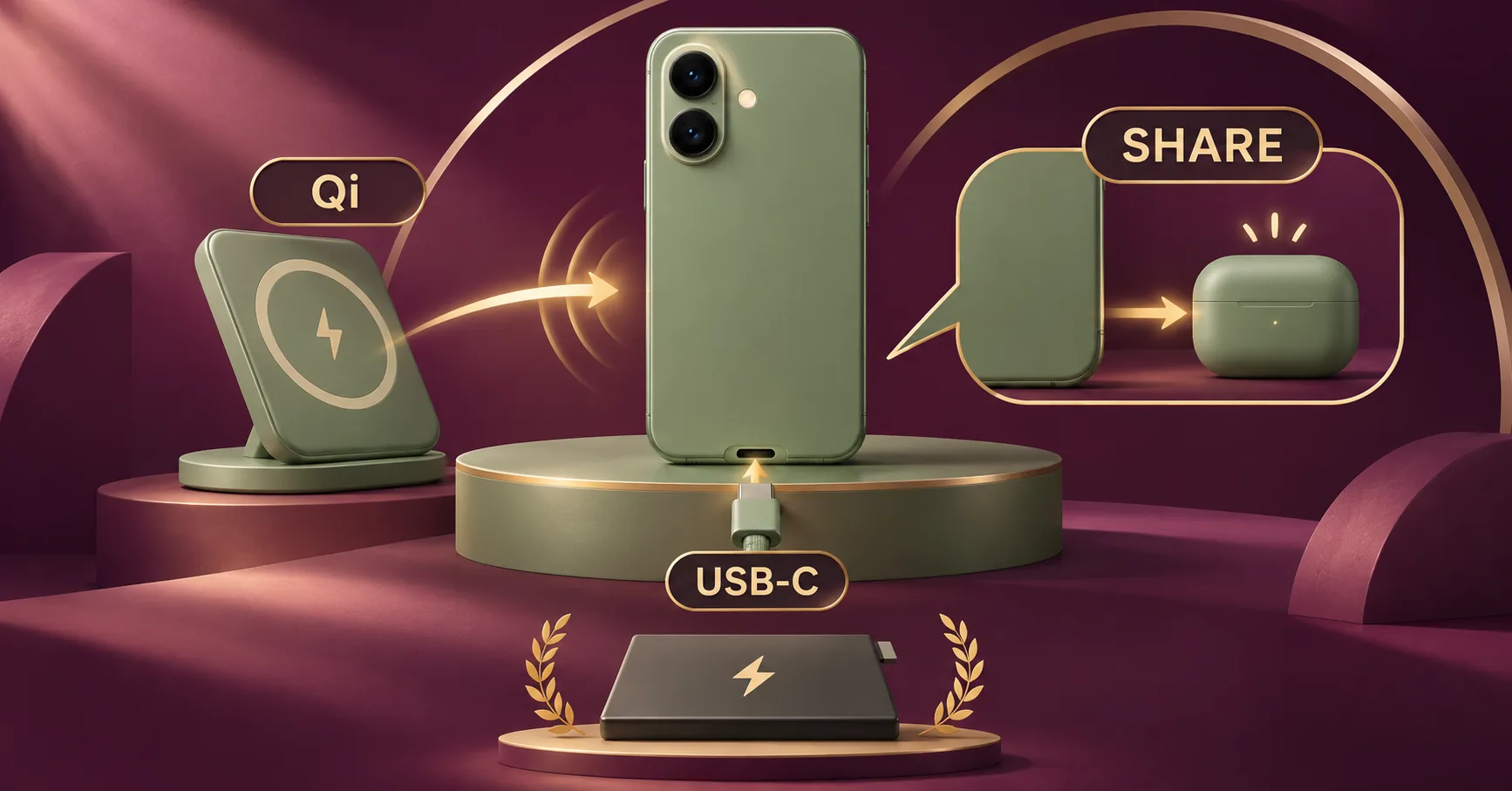
Apple's iPhone 16e technical specifications list up to 26 hours of video playback, 21 hours of streamed video and 90 hours of audio playback. They also describe charging to up to 50% in 30 minutes with a 20W or higher adapter and USB-C cable under Apple's test conditions, plus Qi wireless charging.
Apple qualifies battery life with the statement, “Battery life and charge cycles vary by use and settings.” These figures describe the finished phone. They cannot be converted into a guaranteed runtime or capacity result for an offered replacement assembly.
| Reference | What it helps establish | Additional purchasing evidence |
|---|---|---|
| Official device runtime | Platform-level performance context | Controlled comparison in the buyer's workload |
| Official charging description | Supported device charging context | Specified charger, cable, starting state and temperature |
| Supplier capacity label | The supplier's declared battery rating | Rating definition and measured sample report |
| Service part reference | Identification of a particular service item | Origin, construction, fit and delivery-scope evidence |
A question about iPhone 16e battery capacity should therefore lead to the offered pack's specification. Request rated capacity, any separately declared typical capacity, nominal voltage, watt-hours and the measurement method. The cited consumer specification page does not publish a replacement-pack mAh acceptance limit. Establish that limit from approved model-specific evidence rather than repeating an unsupported marketplace number.
Define the Battery Kit and Adhesive Scope
Apple's iPhone 16e orderable-parts directory identifies battery kit 661-49432. It lists one battery, one battery cap and one screw tray. The same directory lists back glass adhesive separately as 923-12052. This is a useful starting point for distinguishing the battery service item from enclosure consumables.
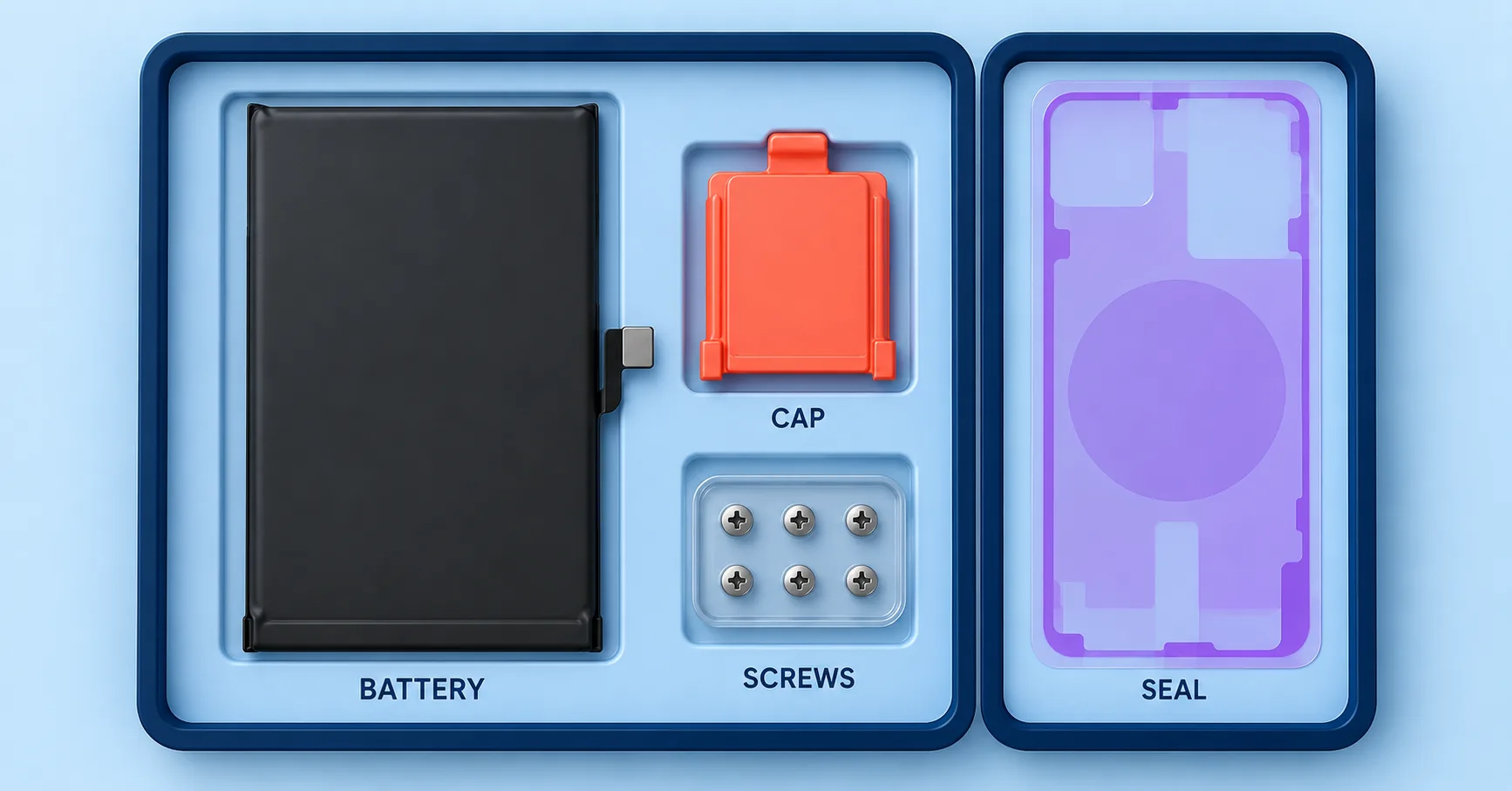
A reference number does not establish that an independently offered product is an Apple service kit. Specify the actual product identity and origin separately. Never describe a third-party pack as genuine Apple merely because a quotation includes an Apple cross-reference.
For every iPhone 16e replacement battery quotation, define what arrives: finished assembly, protection board, flex, connector, battery adhesive, release liners, protective cap, screws, back-cover adhesive and packaging. Mark each item included, excluded or separately ordered. A lower unit price may reflect a narrower kit rather than a more efficient supply offer.
Approve Adhesive and Retention as Part of the Assembly
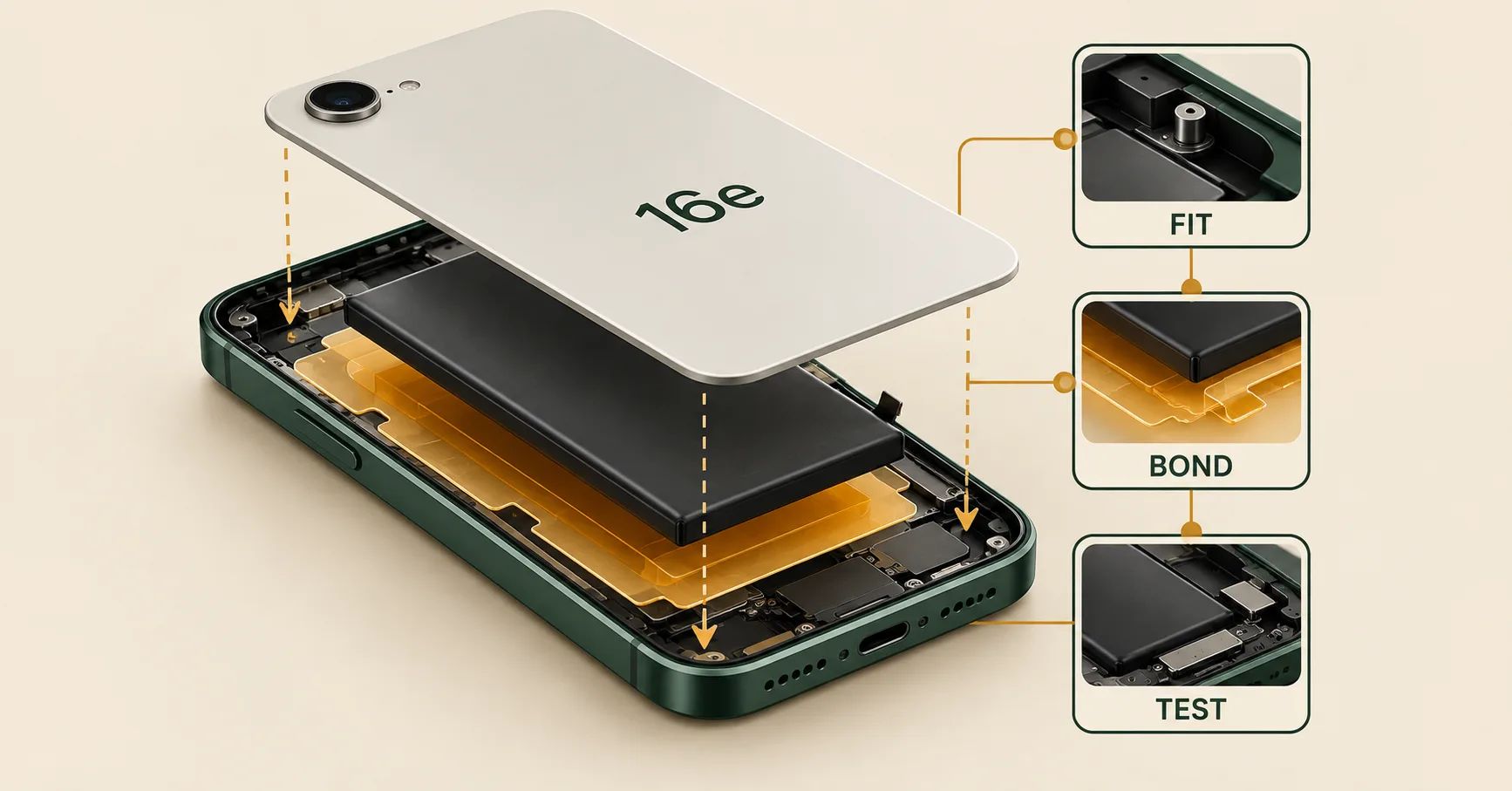
The Apple battery procedure for iPhone 16 and iPhone 16e documents electrical adhesive debonding and a controlled reassembly process. This matters commercially because the adhesive system affects repair tools, technician training, installation quality and future removal.
A shared procedure title is not a cross-model battery approval. Evaluate the offered 16e assembly in its own enclosure. If its adhesive system differs from the official service configuration, require supplier-specific installation and removal instructions and have the repair engineering team assess them before purchase.
The approval record should identify surface preparation, adhesive location, liner handling, storage conditions, applicable shelf life, pressing method and retention checks. Use the adhesive supplier's instructions for the actual material. Do not transfer an expiry rule for one official consumable to a different aftermarket adhesive.
Apple's procedure gives a clear stopping point: “If you can't remove the battery, stop the repair.” Trained technicians should follow the current model-specific manual. This sourcing guide does not replace that procedure or authorize improvised battery handling.
Use Five Approval Layers Before Bulk Purchasing
The offered iPhone 16e battery should pass five connected layers of review. Each answers a different question, and a pass in one layer cannot resolve missing evidence in another.
| Layer | Evidence to retain | Reason to hold approval |
|---|---|---|
| Identity | Device application, supplier code, construction and revision | Conflicting labels or unclear product origin |
| Mechanical | Outline, local thickness, flex route, connector and installed clearance | Forced alignment, pressure or enclosure lift |
| Electrical | Voltage, sensing, protection configuration and capacity report | Unexplained deviation or incomplete test method |
| Installation | Adhesive specification, work instruction and retention result | Loose assembly or uncontrolled bonding process |
| Device behavior | Boot, charging, discharge, restart and software observations | Repeatable functional fault or undocumented status |
Measure the finished assembly under agreed conditions. Define whether the measurement includes labels, protective layers and adhesive. Compare multiple thickness locations where necessary, since one average thickness can miss a raised board or local interference.
Retain the approved sample with its drawing and test record. Identify which changes require review, including cell source, protection components, flex, connector, adhesive, label and assembly process. ESCCharge's iPhone battery supplier guide provides the broader supplier-screening framework around this model-specific approval.
Test Charging and Runtime Under Controlled Conditions
For a valid comparison, use reference devices with documented condition and software. Hold the charger, cable, starting state of charge, ambient temperature, screen settings, network conditions and workload consistent. Record charge progression, temperature at defined locations, interruptions and endpoint behavior.
Test wired charging and Qi charging separately when both are part of the intended service promise. A wireless charging issue may involve coil alignment, enclosure assembly, accessories, temperature or the device itself. Record the setup before assigning the fault to the battery.
Laboratory capacity testing needs its own protocol: equipment, conditioning, temperature, rest time, charge method, discharge current or load, cutoff and invalid-run handling. Report individual results and variation. Installed runtime then checks how the assembly performs within the phone; it does not replace the capacity measurement.
Do not set universal voltage, temperature or capacity tolerances from this article. The purchasing specification should contain limits approved for the actual cell, protection design and finished assembly. Stop testing visibly damaged, swollen or abnormally hot units and follow the facility's established handling process.
Record Repair Completion and Parts Status Separately
Apple recommends Repair Assistant after battery reassembly in its model-specific procedure. Its Repair Assistant guidance explains that the tool installs calibration data to finish supported repairs. Applicable requirements include current software, Wi-Fi and more than 20% charge.
That workflow does not guarantee a particular result for every third-party assembly. Record the exact device, software build, replacement configuration, completion result, battery-health display and any message observed. Keep those observations separate from measured capacity and electrical performance.
Apple's Parts and Service History explanation distinguishes Genuine, Used and Unknown messages. An Unknown result can have several causes, including a nongenuine part, malfunction, incomplete verification or modification. A buyer should evaluate the actual message and evidence rather than accepting an unconditional “no warning” promise.
The existing iPhone battery calibration guide explains the difference between system reporting and physical battery performance. This page uses that distinction only to define the 16e acceptance record.
Release a Pilot Lot and Protect Repeat Orders
After sample approval, evaluate a pilot from normal production. Select units across the lot, retain packaging and date codes, and compare results against the approved construction. Keep invalid tests visible so a high interruption rate cannot disappear inside a favorable average.
Use the mobile phone battery sampling-plan guide to define sample selection, defect classes and escalation. The incoming-inspection guide supports subsequent shipment checks for identity, appearance, dimensions, electrical screening and sampled installation.
For repeat orders, preserve the battery revision and adhesive configuration in the purchase order. Keep warehouse bins separate from other iPhone 16 variants. Returns should identify the device, battery lot, installation date, symptom, software, charger, observations and disposition so repeated issues can be investigated by lot or process.
Send a Complete RFQ for the 16e Program
A quotation for a battery for iPhone 16e should state:
- target device identifiers, markets and forecast quantities;
- supplier assembly code, revision, drawing and product-origin description;
- rated and typical capacity definitions, voltage, energy and test method;
- cell, protection, sensing, flex and connector scope;
- battery adhesive, liners, cap, screws and enclosure consumables included;
- installation instructions, removal method and retention evidence;
- sample plan, software observations, pilot and recurring lot checks;
- packaging, traceability, change notification and warranty evidence;
- documents required for the exact configuration and destination.
Confirm MOQ, lead time, warranty and documentation for the project. These depend on the model, construction, customization, order quantity, destination and agreement.
Frequently Asked Questions
Can an iPhone 16 battery be approved automatically for iPhone 16e?
No. Treat the 16e application independently. A shared repair procedure or family name does not establish identical assembly geometry, interfaces or installed behavior.
What does service reference 661-49432 identify?
Apple lists it as the 16e battery kit reference. It is useful for identifying the service item, but its appearance in a supplier listing does not prove that the offered product is an Apple kit.
Does a longer advertised runtime prove higher replacement capacity?
No. Runtime depends on device and workload conditions. Require a defined capacity test and a separate controlled device comparison.
Should battery and back-cover adhesive be included in one quotation?
They can be quoted together, but list them separately in the delivery scope. Confirm material identity, instructions and applicable shelf life for each consumable.
Can a displayed health percentage replace sample testing?
No. Record it as a software observation alongside physical, electrical, capacity, charging and installation evidence.
Build the Purchase Around the Approved Repair Result
A repeatable 16e program connects device identity, assembly construction, kit contents, adhesive performance and installed testing to each production lot. Clear records make quotations comparable and give repair teams a reliable basis for release and warranty decisions.
Request an iPhone 16e sourcing review: send ESCCharge your target device identifiers, battery references, markets, quantities, kit contents and acceptance tests. The team can review the requirements and propose a sampling path. Final specifications, supported applications, commercial terms and documents remain subject to project confirmation.
External Source References
- Apple Support — Identify Your iPhone Model — accessed October 22, 2026.
- Apple Support — iPhone 16e Technical Specifications — accessed October 22, 2026.
- Apple Support — iPhone 16e Internal View and Orderable Parts — accessed October 22, 2026.
- Apple Support — iPhone 16 and iPhone 16e Battery Procedure — accessed October 22, 2026.
- Apple Support — Use Repair Assistant to Finish a Repair — accessed October 22, 2026.
- Apple Support — iPhone Parts and Service History — accessed October 22, 2026.