
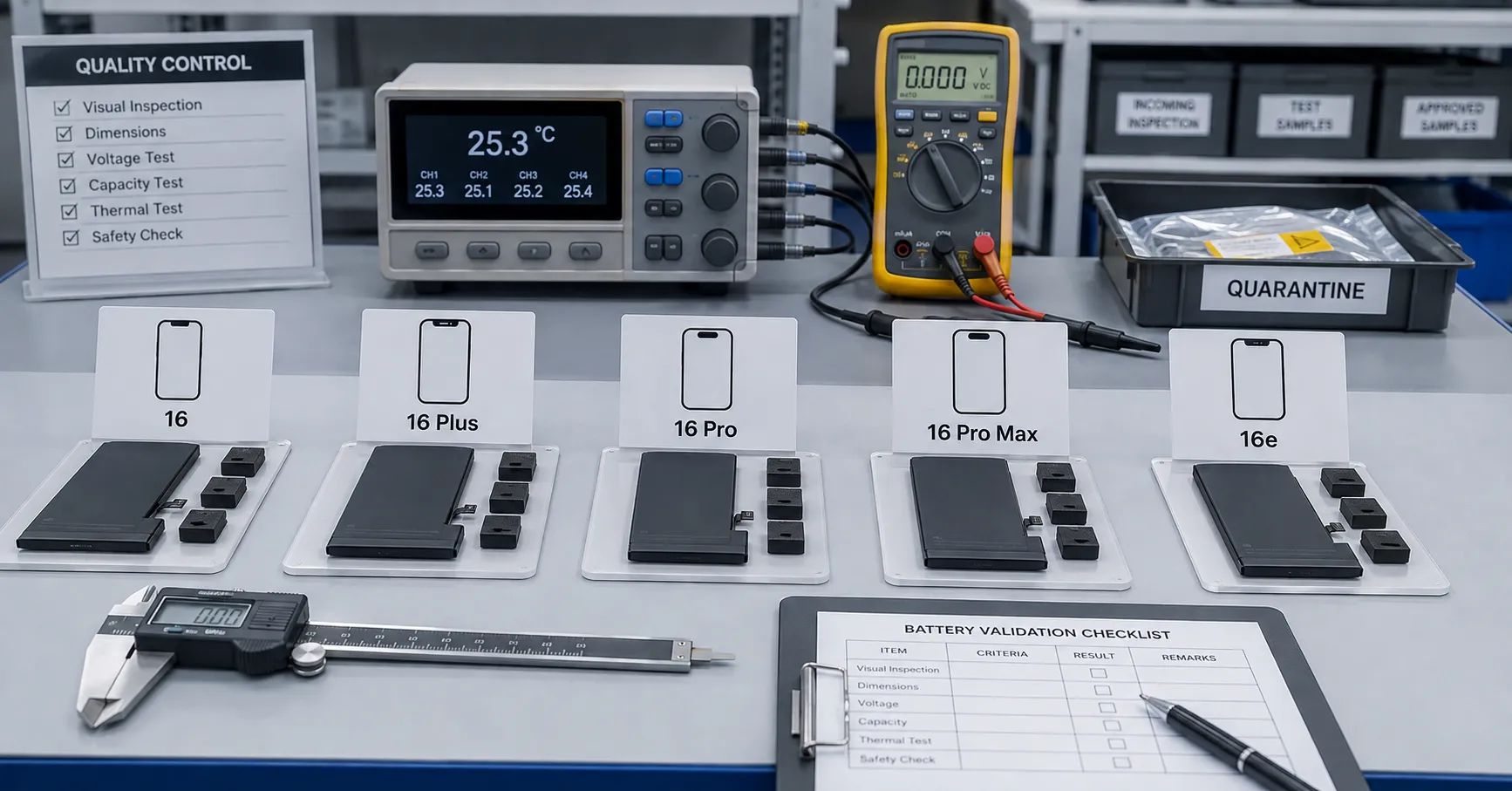
An iPhone 16 replacement battery should be approved by exact device identity, not by the words “iPhone 16 series.” Repair chains and wholesalers need separate records for iPhone 16, 16 Plus, 16 Pro, 16 Pro Max and 16e. A sample passes only when its mechanical fit, flex and connector geometry, electrical behavior, charging, usable capacity, temperature and repeatability all meet an agreed specification. One successful installation is evidence for that sample and device combination; it is not a compatibility guarantee for every model or future production lot.
This checklist deliberately focuses on physical and electrical qualification. Parts and Service History messages, Repair Assistant outcomes and claims such as Genuine, Used or Unknown require a separate software-aware validation plan. Buyers should never infer those outcomes from a capacity label or a supplier's product name.
Start With Exact Device Identity
Apple's official iPhone model-identification page lists different model numbers for regional versions of each device. Record the marketing name, A-number, storage device identifier, sales region, operating-system build and test-device history before opening a sample. Do not group two phones merely because both have a similar display size.
| Approval lane | Minimum identity evidence | Release boundary |
|---|---|---|
| iPhone 16 | Device name, A-number and region | Only the verified device variants |
| iPhone 16 Plus | Separate device and sample record | Never inherited from the base model |
| iPhone 16 Pro | Separate fit and electrical results | Not interchangeable with Pro Max |
| iPhone 16 Pro Max | Dedicated sample code and fixture | Largest-model approval only |
| iPhone 16e | Independent 2025 model record | Do not map from iPhone 16 |
Assign a buyer-controlled sample ID to every unit. Link it to the supplier code, label photo, received date and device used. This prevents a later “passed sample” claim from being attached to a different construction.
Build the Validation Matrix Before Testing
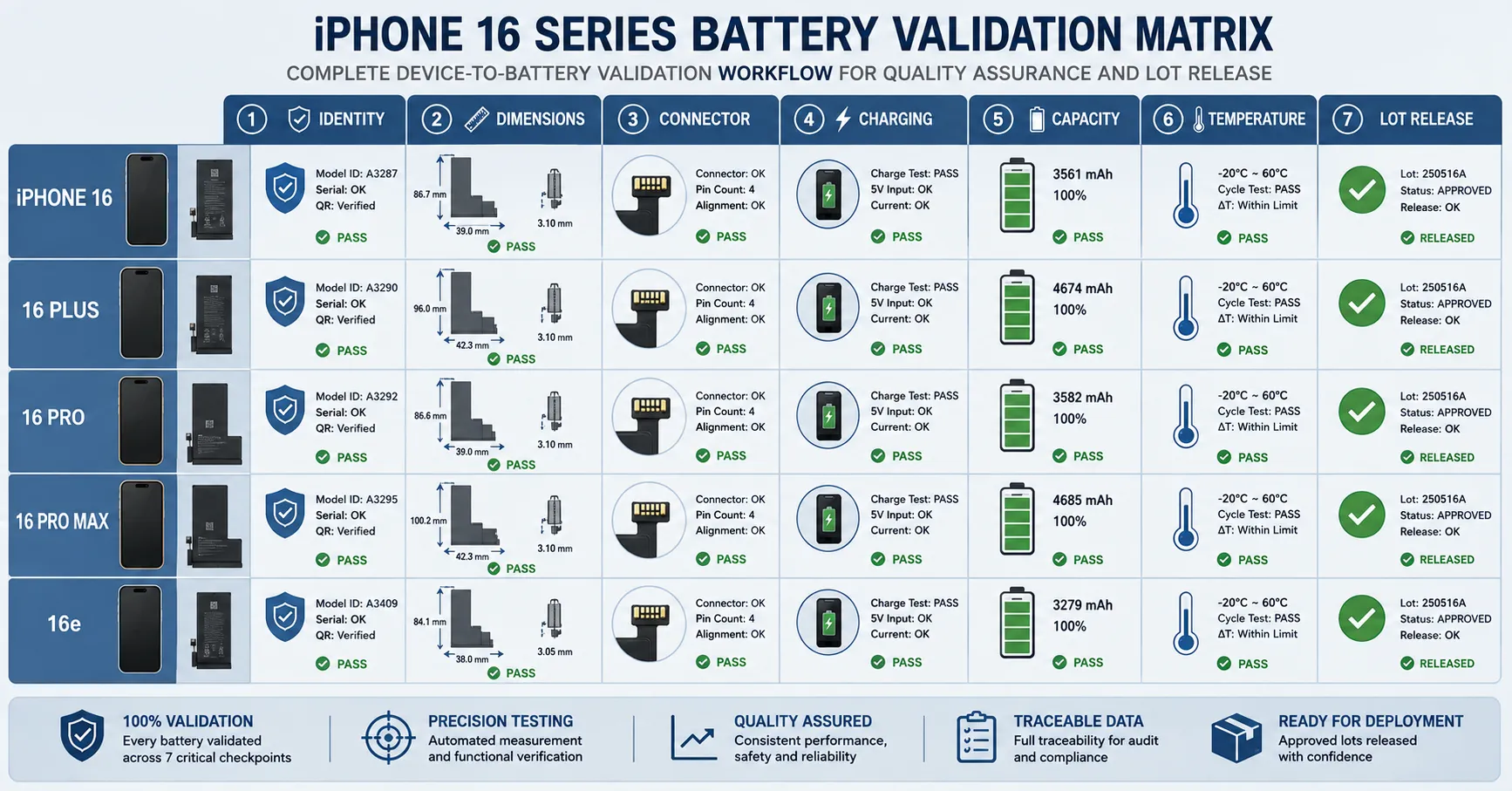
The matrix should define the test method, equipment, environment, sample quantity, acceptance limit and disposition before results are known. Include a known device baseline where practical. An iPhone 16 battery sample should move through four gates: document review, bench inspection, controlled installation and functional testing. Failed or ambiguous units remain quarantined until the cause is understood.
- Identity gate: supplier part code, target device, drawing revision, cell lot, protection-board revision and label are traceable.
- Mechanical gate: pouch outline, thickness, flex route, connector position, adhesive area and clearance match the approved reference.
- Electrical gate: polarity, open-circuit voltage and connector condition are checked using an agreed safe method.
- Device gate: boot, wired and wireless charging, discharge behavior, restart and shutdown observations are recorded under controlled conditions.
Inspect Before Installation
Check packaging for compression, puncture, moisture and label mismatch. Under suitable lighting, inspect the pouch, edge seals, tabs, flex, connector, insulation and adhesive. Measure only at defined points with tools that cannot damage the cell. Averages can hide a thick edge or a displaced flex, so retain individual results and photographs.
Do not bend, probe or force a questionable pack into a phone. Apple's iPhone 16 Repair Manual includes battery safety and a model-specific battery procedure. Repair teams should use the applicable official manual, trained operators and appropriate tools. A tight fit, lifted display or compressed flex is a failure even when the phone powers on.
Control Installation and Functional Checks
Use documented test phones with known pre-test behavior. Photograph the installed routing before closing the device. Confirm that the connector seats without unusual force, the flex is not pinched and the battery remains flat. After reassembly, check boot, charging recognition, USB-C charging, wireless charging where relevant, basic phone functions and unexpected restarts.
Record charger, cable, ambient temperature, starting state of charge, operating-system build and test duration. Compare candidate samples with the approved reference under the same conditions. Temperature should be measured at defined locations and intervals. A single surface reading cannot prove cell safety, but unusual heating or a repeatable difference is a reason to stop and investigate.
Validate Capacity and Runtime Without Marketing Assumptions
A printed capacity is a claim, not an acceptance result. Agree whether the buyer needs incoming screening, controlled charge-discharge measurement, device runtime comparison or all three. Use calibrated equipment, stable temperature and a written charge/discharge method. Report individual values, dispersion and any invalid runs rather than only the best result.
Device runtime depends on network, display, applications, software activity and test-phone condition. Standardize these variables and compare like with like. Capacity, runtime and thickness form a linked decision: a higher label value has no purchasing value if fit, heat or repeatability deteriorates.
Move From Samples to a Pilot Lot
Sample approval should freeze the relevant bill-of-materials information, drawings, label, flex, connector and test method. The first pilot lot then confirms whether production reproduces the approved result. Use a documented mobile phone battery sampling plan and apply model-level inspection rather than mixing the five variants into one sample pool.
Incoming control should include identity, appearance, key dimensions, electrical screening and traceability. The mobile phone battery incoming-inspection guide can support the general IQC structure. Set escalation rules for mixed labels, dimensional drift, abnormal voltage distribution, installation damage, heat, charging faults or unexplained runtime spread.
Use a Clear Release Decision
Release by model and production lot. A useful iPhone 16 battery validation record states Pass, Conditional Pass, Hold or Reject; lists deviations; identifies the approving person; and attaches raw data. Conditional approval needs a defined quantity, market and corrective action. Supplier substitutions must trigger change notification and the appropriate level of revalidation.
For an RFQ, send the exact target models and regions, forecast mix, required label and packaging, sample quantity, test plan, acceptance limits and traceability expectations. ESCCharge can then discuss a model-separated sampling and validation plan. Specifications, certifications, MOQ, lead time, warranty and performance limits remain subject to confirmation for the proposed product and order.
Frequently Asked Questions
Can one approved sample cover all iPhone 16 models?
No. Approval should remain tied to the exact device, battery construction and revision tested.
Is a successful boot enough for approval?
No. Boot is only one observation. Fit, charging, capacity, temperature, runtime and repeated results also matter.
Should buyers accept the capacity printed on the label?
Treat it as a specification claim and verify it with an agreed method and representative samples.
When should revalidation occur?
Revalidate after material, cell, protection-board, flex, connector, factory-process or label changes that can affect the approved result.