
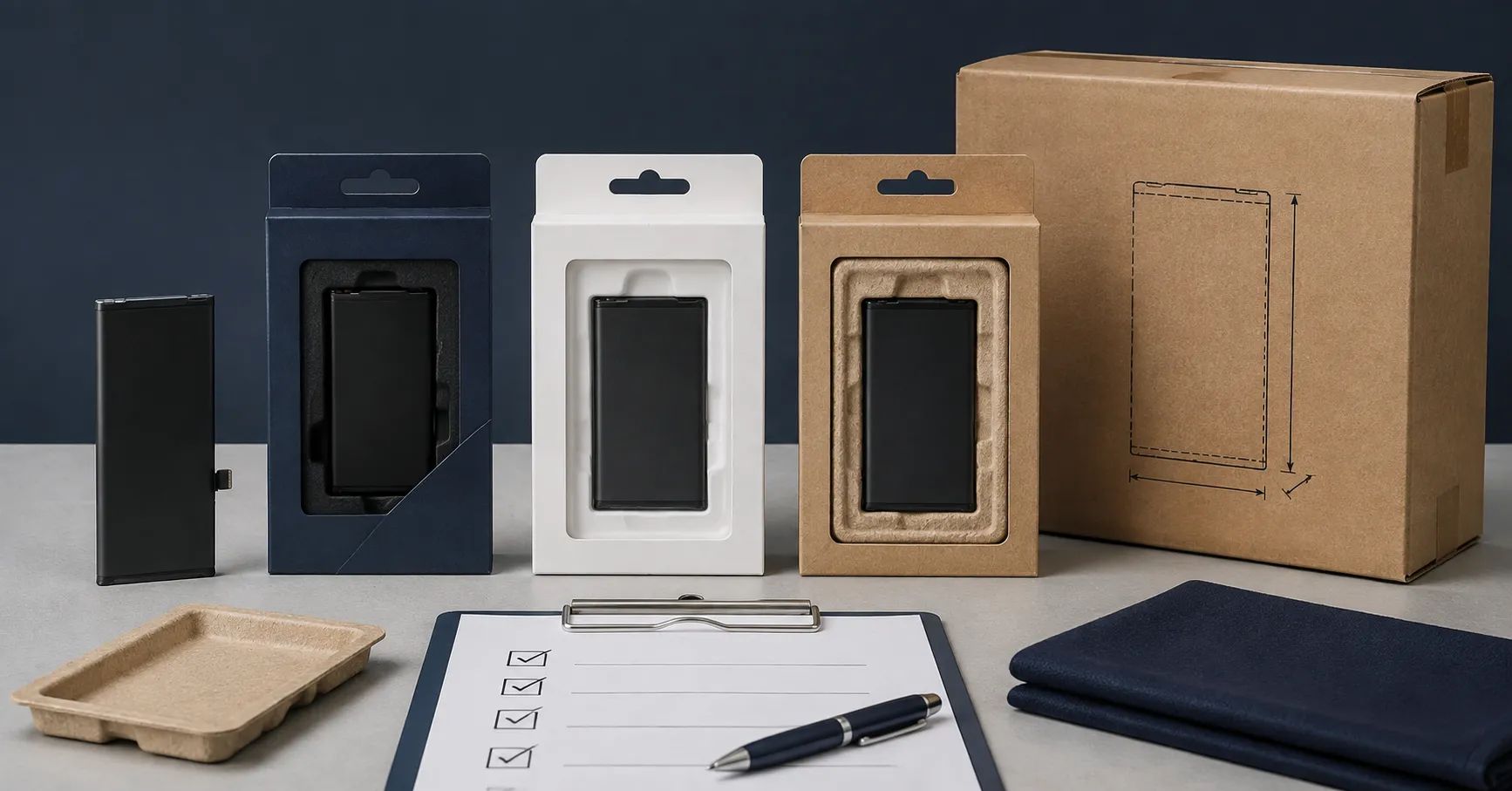
For a replacement phone battery, less packaging is not automatically better packaging. A carton that is too large wastes material and freight space. A tray that is removed too early may allow a connector, flex cable or battery terminal to move during transport. The commercial objective is to reduce excess packaging for replacement phone batteries while preserving safety, identification, product condition and practical handling for distributors, repair chains and end users.
The EU Packaging and Packaging Waste Regulation, Regulation (EU) 2025/40, applies from 12 August 2026. It establishes a lifecycle framework for packaging and packaging waste. Its packaging-minimisation requirement has a specific future milestone: from 1 January 2030, manufacturers and importers must ensure that packaging placed on the market is reduced to the minimum weight and volume necessary for its function. For battery exporters, that means the right action now is not a rushed redesign. It is a controlled programme that can explain the function of every layer, remove material that has no justified role, and validate every safety-related change.
This article is a practical sourcing and design guide, not legal advice. It should be used alongside market-specific EPR checks, dangerous-goods requirements, carrier rules and the separate product obligations that may apply to batteries. A package can be efficient and still fail transport requirements; a safe battery shipment can also contain unjustified decorative material. Both questions need their own evidence.
Why replacement battery packaging needs a different approach
Phone battery packaging sits between two competing risks. The first is excess: oversized retail boxes, duplicate inserts, decorative sleeves, unnecessary foam, heavy multi-layer construction and empty space that increases shipping volume. The second is insufficient protection: terminal contact, connector damage, tab bending, puncture, compression, moisture exposure, misidentification or uncontrolled movement in an outer carton.
The correct review starts with the battery itself. A small rectangular cell with recessed contacts may need a different solution from a battery with exposed flex cables, a fragile connector, a shaped housing or separate insulation requirements. The logistics route also changes the answer. A master carton going from factory to a repair-parts distributor is not exposed to the same handling as a single unit sent through an e-commerce parcel network.
Do not classify all internal packaging as waste before examining its actual purpose. An insulating terminal protector, a restraint that prevents connector damage or a divider that stops units rubbing together can be necessary. A second decorative sleeve that repeats the same branding as the printed retail box usually needs stronger justification. The question should be simple: what failure, handling need or legal information requirement would occur if this component were removed or reduced?
Use the PPWR minimisation principle as a design test
Article 10 of PPWR requires packaging minimisation from 1 January 2030. The package must have weight and volume reduced to the minimum necessary to ensure functionality. The regulation also identifies packaging characteristics aimed only at increasing perceived volume, such as false bottoms, double walls and unnecessary layers, as a problem area. Its Annex IV framework is useful now because it links reduction decisions to real performance criteria: product protection, manufacturing, logistics, functionality, information, hygiene and safety, and legal requirements.
That makes EU PPWR packaging minimisation a structured engineering exercise rather than a graphic-design trend. The goal is not to choose a smaller box in isolation. The goal is to reduce material after documenting the point at which further reduction would compromise a necessary function.
For each package family, create a one-page function map. List the sales box, any sleeve, inner tray, insulating component, label, leaflet, tamper feature, grouped carton, divider, void fill and transport carton. Next to each item, record:
- Its material, weight and supplier.
- Its direct function: protection, identification, handling, tamper evidence, transport restraint or required information.
- The failure mode if it is removed or made lighter.
- The evidence that supports keeping it: a drawing, shipping test, drop test, customer instruction, risk assessment or regulatory requirement.
- The person who approves a material, size or artwork change.
If a component has no function, or the same function is already performed by another component, it is an immediate redesign candidate. If it has a function but no evidence, it becomes a validation candidate. This distinction protects the business from arbitrary cost cutting and from unsupported environmental claims.
Map packaging layers before making changes
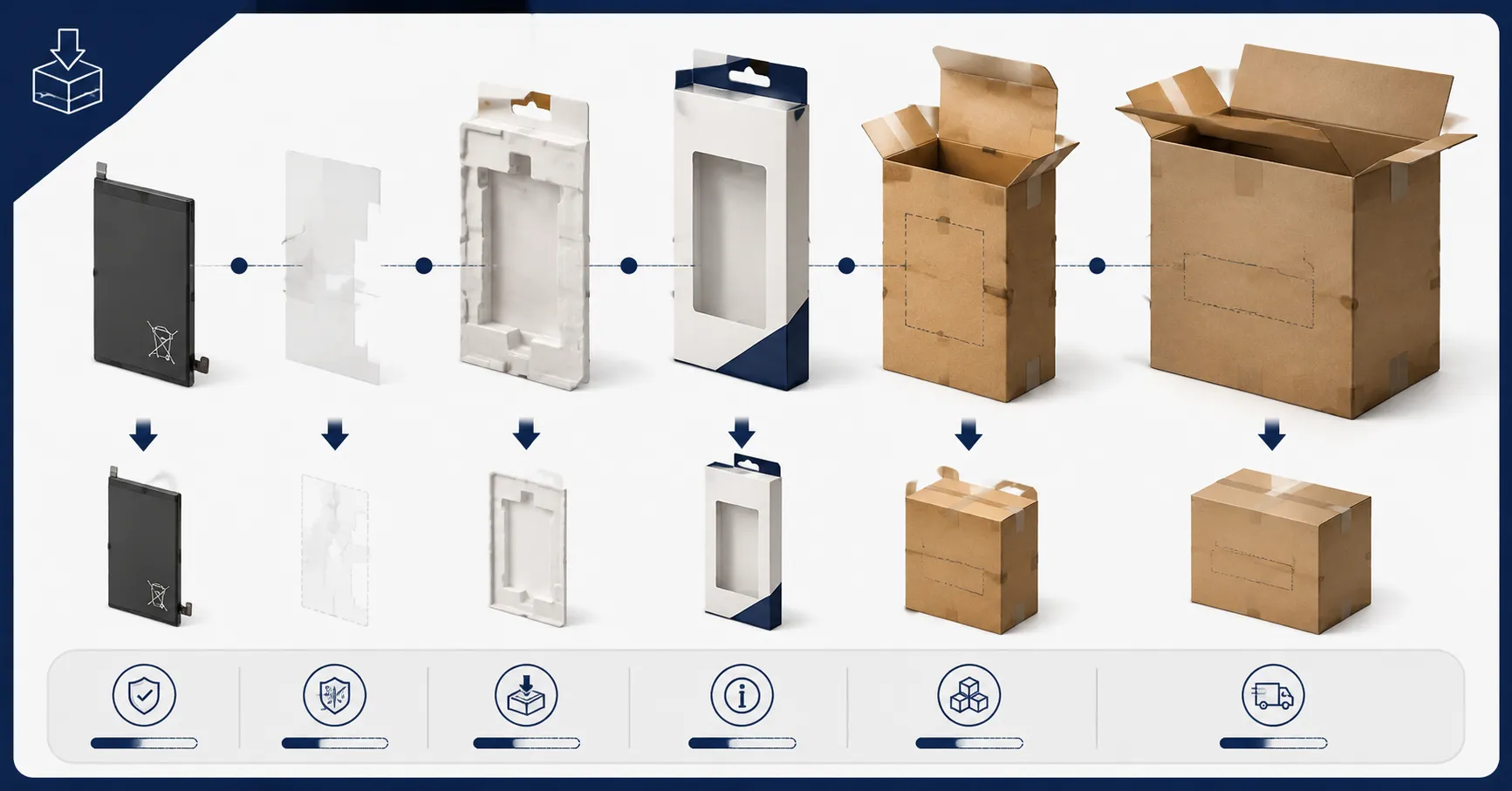
A useful review separates packaging by layer rather than describing the complete pack as “one box.” For a typical replacement phone battery, the packaging system may include a printed sales carton, a paper or plastic inner tray, a terminal cap or insulating cover, a model-identification label, a folded installation note, sealing tape, a grouped carton, dividers, outer shipping carton and pallet wrap.
The sales carton communicates the SKU and can protect the product during normal handling. The inner structure controls movement inside that carton. Protective terminal components can reduce electrical or mechanical risk. Grouped and transport packaging protects the sales units during warehouse handling, stacking and delivery. These layers should be evaluated separately because a reduction in one layer may require a small adjustment elsewhere.
For example, removing an inner tray may let the retail carton become smaller, but it may also increase movement. A fitted paperboard insert could perform the same retention function with less plastic. Replacing a rigid tray with a loose paper wrap might reduce material weight but introduce connector damage or misidentification. A decision should never be based on material mass alone; product returns, repair damage, repacking labour and failed deliveries also have environmental and commercial costs.
Find excess material with a three-question audit
Run a physical audit using production samples, not only packaging drawings. Weigh every component and photograph the assembled package before and after opening. Then ask three questions.
1. Does the component protect the product or the user?
Protection includes more than preventing visible breakage. Check terminal isolation, restraint of flexible tabs, connector clearance, crush resistance, moisture protection where relevant and prevention of contact between units. If a component supports a dangerous-goods or carrier requirement, record that link clearly. It should not be removed through a general sustainability initiative without the appropriate specialist review.
2. Does it provide required or genuinely useful information?
Product identity, compatible model information, lot traceability, handling notices and instructions may be necessary for safe and efficient repair work. However, the same message should not appear in three different paper inserts unless each instance serves a different user or legal purpose. Consolidate repeated information where permitted and ensure the remaining information is still legible, accessible and controlled by the current artwork revision.
3. Does it exist only for presentation or perceived size?
This is where excess packaging is often found. A large empty cavity, a false bottom, a thick decorative collar, duplicate printed sleeves or an oversized master carton can make a low-value accessory look more substantial but add no protection. Removing such features is usually less risky than changing battery restraints or terminal protection. Start there before considering safety-critical components.
Right-size cartons using evidence, not assumptions
Battery packaging right-sizing starts with measuring the actual product envelope and the protective clearance needed for that specific route. Record battery length, width, height, connector projection, cable bend radius and any location where pressure could cause damage. Then record the internal dimensions of the existing retail box and outer carton.
Calculate the empty volume, but do not treat every empty millimetre as waste. Some clearance may be necessary for insertion, removal, retention, shock absorption, dimensional variation or required leaflets. The key is to determine whether the clearance is deliberate and tested. If the carton is large because it was inherited from an older battery family, it may be reducible. If it has been enlarged for a universal design, compare the logistics savings from a tailored carton against the cost and inventory complexity of another box size.
Use a simple comparison sheet for each proposal:
| Design option | Material and volume effect | Protection risk | Evidence needed before release |
|---|---|---|---|
| Smaller retail carton | Lower board use and cube volume | Reduced connector clearance | Fit check, compression and drop test |
| Remove decorative sleeve | Lower paper and print use | Loss of branding surface only | Artwork and customer approval |
| Paper insert replacing plastic tray | Potential material simplification | Retention performance may change | Transit, vibration and opening tests |
| Fewer box sizes across SKUs | Lower inventory complexity | More void space for smaller batteries | SKU-by-SKU fit and packing review |
Protect lithium batteries while reducing packaging
A responsible redesign must preserve the conditions required for safe handling and shipping. That means involving the team responsible for dangerous-goods compliance before changing insulation, terminal covers, inner restraints or master-carton configuration. A lightweight material can be acceptable only if it maintains the necessary resistance, separation and containment in the actual shipment configuration.
Use a change-control meeting whenever a proposal affects the battery’s position or protection. Include a packaging engineer, quality representative, logistics or dangerous-goods specialist and the customer’s product team where relevant. Review the product’s ability to move, rotate, contact other units or experience compression. Check whether a reduction changes the number of units per carton, pallet height, stack load, label placement or the ability to identify mixed SKUs.
For an export order, battery safety evidence and packaging-minimisation evidence should sit in connected but separate files. One file may cover the battery’s transport classification, instructions and applicable test information. The other should show why the packaging design uses a particular amount of board, tray material, tape or void fill. Combining the files is useful for a release decision; treating one as proof of the other is not.
Validate the redesigned package before mass production
Never release a reduced design from a computer drawing alone. Build representative samples using the intended production materials, printing, adhesives and forming process. Test a realistic selection of the smallest, largest and most sensitive batteries in the family. Include the models with the longest flex cables, the most exposed connectors and the tightest dimensional tolerances.
A practical validation programme may include:
- Assembly and removal checks to ensure the unit fits without forcing or abrasion.
- Vibration checks to detect internal movement and contact damage.
- Compression checks for expected warehouse and stacked-carton loads.
- Drop or impact checks aligned with the company’s real distribution conditions.
- Opening tests with repair technicians or warehouse staff to confirm safe, repeatable handling.
- Artwork and traceability checks after the new box dimensions or print areas are confirmed.
- Return-route checks if customer returns use the original retail package.
Define pass and fail criteria before testing. “Looks okay” is not a sufficient result. Record movement, damage, box deformation, label scuffing, opening time, incorrect SKU selection risk and any failure of terminal protection. If a proposed reduction fails, retain the result. It documents why a minimum package is not always the smallest package.
Improve materials without making unsupported claims
Material substitution can support a lower-impact design, but it should follow function and evidence. A paper-based insert may be easier to separate from a paperboard box than a bonded multi-material structure. A lighter material may cut weight but create a higher breakage rate. A recycled-content claim may depend on material category, sourcing method, calculation rules and future PPWR timelines. Confirm the available evidence before placing a statement on the box, catalogue or marketplace listing.
Claims such as “fully recyclable,” “plastic-free,” “eco packaging” or a stated recycled-content percentage should be reviewed against the exact packaging component and destination market. Do not apply a claim about the carton to a whole pack if it includes a separate plastic tray, coating or protective sleeve. Do not state that a package is compliant merely because it uses recycled paper. The buyer needs a precise description of what changed, what evidence exists and which components remain necessary.
Set supplier controls that prevent packaging creep
Excess packaging can return after the first redesign. A supplier may change board thickness, add a plastic bag for convenience, substitute a tray, increase carton dimensions or add a promotional insert without the customer recognising the compliance impact. Prevent this with a controlled packaging specification.
The specification should include a component list, approved material descriptions, dimensions, tolerances, weights, artwork revision, sample photographs and a no-change clause. Require written notification and approval before a supplier changes material, adhesive, coating, inner support, carton layout, label location or package weight. When a change is approved, update the BOM, test evidence, artwork matrix and customer communication record.
This is also useful for purchasing. Buyers can request packaging data during quotation, compare supplier proposals on a consistent basis and avoid accepting a low unit price that later produces higher freight costs or damage rates. A good specification turns packaging reduction into a repeatable sourcing standard rather than a one-time cost project.
A practical 60-day reduction workflow
Week 1–2: choose the five highest-volume replacement battery packaging families. Gather physical samples, BOMs, box weights, outer-carton data, return reasons and shipment-damage records.
Week 3–4: conduct the three-question component audit. Identify decorative, duplicate or oversized elements first. Separate safety-critical items from candidates for immediate removal or simplification.
Week 5–6: create one to three reduction concepts per family. Estimate material, freight-cube and labour effects. Ask the logistics and dangerous-goods teams to review risks before samples are made.
Week 7–8: test the most suitable concept, issue a controlled specification and gain customer approval. Add the finished evidence to the packaging file. Monitor the first production lots for transit damage, customer feedback and packing-line issues.
The best result is not necessarily the lightest package. It is the lightest and simplest package that keeps the battery safe, identifiable and usable across its real supply chain. That is the standard procurement teams should use when comparing suppliers and approving packaging changes.
FAQ
Does PPWR require all replacement phone battery packaging to be reduced immediately?
PPWR applies from 12 August 2026, but packaging-minimisation requirements in Article 10 have a 1 January 2030 application point. Exporters should prepare now, track applicable transition measures and avoid describing future requirements as though they already apply in full.
Can we remove a battery terminal protector to use less material?
Not without confirming that removal does not create a safety, transport or handling risk. Terminal protection can perform a necessary function that must be assessed separately from general packaging reduction.
Is an oversized master carton always non-compliant?
Not automatically. It may be justified by product protection, pallet configuration, mixed-SKU handling or compression resistance. The business should document the reason and investigate whether a smaller, equally protective alternative is feasible.
Can a recycled paper box be described as fully recyclable?
Only if the claim is accurate for the relevant packaging unit and market. Consider coatings, labels, inserts, adhesives and local collection or sorting conditions. Avoid broad claims that are not supported by evidence.
Who should approve a packaging-reduction change?
At minimum, packaging, quality and logistics teams should approve it. For EU-bound batteries, include the importer or brand owner responsible for the market, plus the person responsible for dangerous-goods compliance where the change affects product protection.
Planning a lower-material replacement battery pack for EU customers? Send ESCCharge your current packaging photos, component list, battery dimensions, destination markets and shipping configuration. We can help structure a supplier comparison and sample-validation checklist for your procurement review.
External Source References
- European Parliament and Council — Regulation (EU) 2025/40 on packaging and packaging waste — 2025.
- European Commission — Packaging and Packaging Waste Regulation FAQ — 2026.
- European Commission — Packaging waste policy and PPWR overview — accessed 2026.