
Start With Two Separate Battery Applications
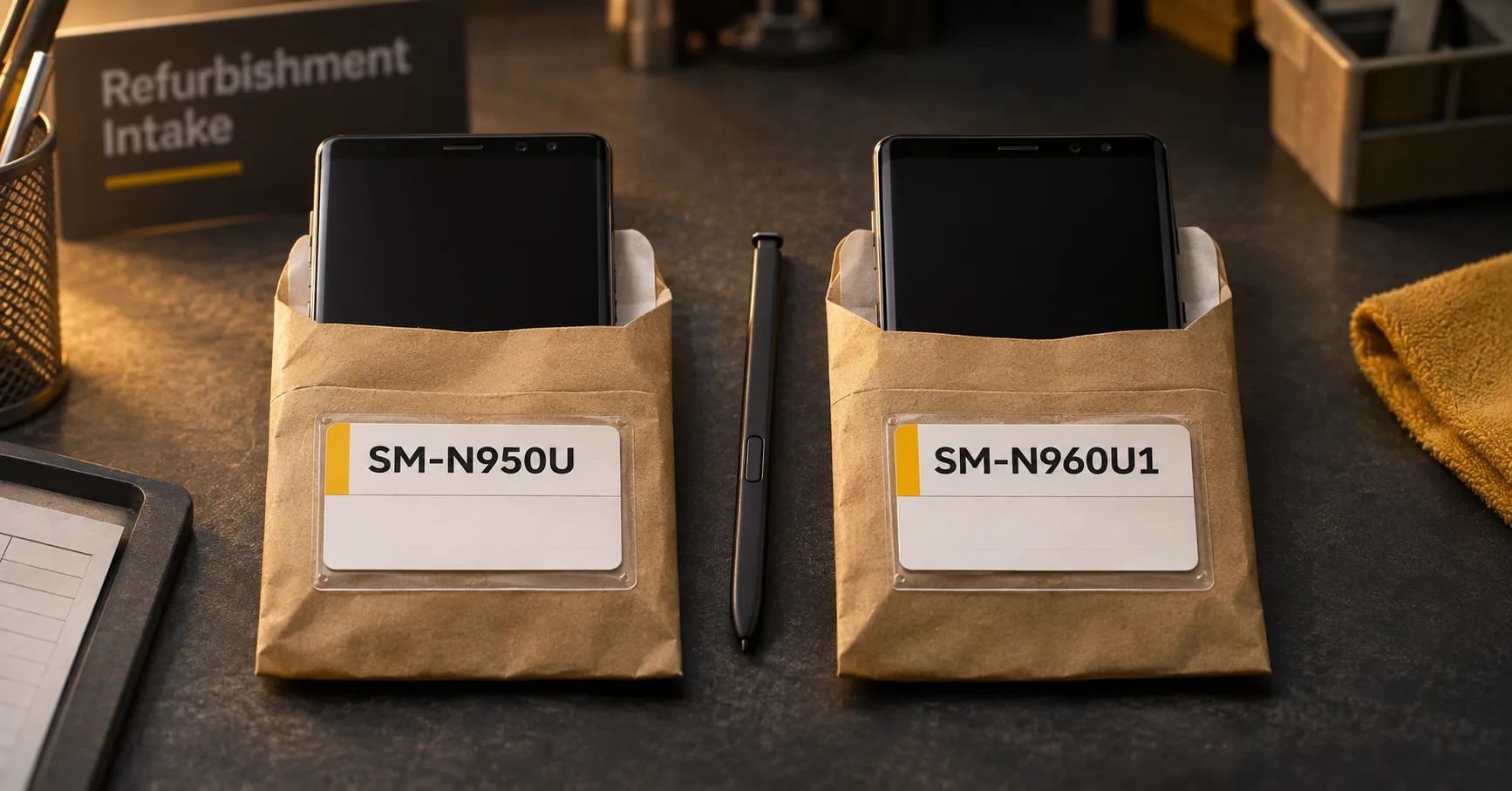
A Galaxy Note 8 battery replacement order should specify the full handset code and the approved finished assembly. Apply the same rule to a Galaxy Note 9 battery replacement order. Keep both applications separate in the catalog and the warehouse. When the repair queue includes both models, the work order should determine which part can be picked, even if the cartons look alike.
Samsung Business publishes separate support records for the Note8 SM-N950U and Note9 SM-N960U1. These are examples of US variants. Record the complete code for each device in the target repair population and ask the supplier to confirm its application list. A code copied from a listing describes the seller’s claim and should be checked against the actual handset. Samsung Business — Galaxy Note8 SM-N950U support and Samsung Business — Galaxy Note9 SM-N960U1 support.
| Device | Example US handset code | Samsung published capacity | Buying control |
|---|---|---|---|
| Galaxy Note8 | SM-N950U | 3,300 mAh | Match the Note8 handset and approved assembly revision |
| Galaxy Note9 | SM-N960U1 | 4,000 mAh | Match the Note9 handset and approved assembly revision |
Samsung Business lists 3300 mAh
for the Note8 and 4,000 mAh
for the Note9 in its respective datasheets. The Galaxy Note8 battery capacity and Galaxy Note9 battery capacity differ by 700 mAh in those references. Use each published figure for the original device and require a separate capacity declaration and test method for the replacement assembly. Samsung Business — Galaxy Note8 datasheet and Samsung Business — Galaxy Note9 datasheet.
Turn the Listing Into a Purchase Specification
Keep three identifiers on the order line: the handset code, your internal SKU and the supplier’s finished-pack reference with its revision. Record which handset variants the supplier claims to support. Separate phone and tablet catalog records when incoming enquiries say only “Note 8” or “Note 8.0.” Ask for a full device code before quoting.
Request a controlled drawing or an approved reference sample. Compare outline, thickness, flex length and routing, connector orientation, insulation, and adhesive scope. Capture the unit label and carton markings at approval so receiving can compare the delivered revision with the approved build. Specify whether the quote includes adhesive or supplies it separately. Compare the total cost of a complete repair set when two suppliers offer different pack contents. ESCCharge Samsung replacement battery sourcing guide.
For the installed evaluation, have a trained technician record seating, closure, startup, charging and stable operation under an agreed workload. Record the device code and test configuration. Compare runtime results on the same device model under consistent brightness, radio conditions and workload. Use a separate agreed discharge method to assess the supplier’s capacity claim.
Screen Stock Age Before You Commit

For legacy battery stock, request the assembly date, date-code key, lot quantities and available storage records with the quote. Ask what the printed date represents. It could refer to cell manufacture, pack assembly or packaging. A recent carton label leaves the underlying assembly age unresolved when the supplier cannot link it to a production record.
Set your maximum acceptable age and retest interval in the purchase specification with engineering and quality input. Use the agreed pack requirements, expected time to sell and known storage conditions. When a shipment contains several date codes, keep the groups separate until their records and inspection results support release. The warehouse can issue the oldest eligible stock first while keeping held or overdue lots unavailable for picking. ESCCharge mobile phone battery storage guide.
| Receiving finding | Disposition |
|---|---|
| Model, revision and date code match the order | Proceed to the agreed receiving and sample checks |
| Date code is missing or unreadable | Hold the affected group and request traceable records |
| Mixed revisions or lots share one carton | Separate and reconcile each group before sampling |
| Sample capacity or installed behaviour falls outside agreed criteria | Hold the affected lot and investigate with the supplier |
Record inspection results by part, revision and lot. Keep visual condition, resting voltage, measured capacity and installed behaviour in separate fields. A resting voltage reading serves as a screen. Measured capacity requires its own controlled test and acceptance criteria. Escalate suspected damage through the facility’s battery handling procedure. ESCCharge mobile phone battery sampling plan.
Agree on Sample Coverage Before the Shipment Arrives
Ask for the carton breakdown by device application, assembly revision and supplier lot before setting the sampling plan. For example, a mixed order may contain one Note8 lot and two Note9 lots produced on different dates. Treat those as three receiving groups. Select units across cartons within each group according to the agreed plan and log the units used for installed checks or bench tests. A passing sample from the newer Note9 lot clears only the group it represents.
Give the warehouse a release record it can act on. Include the approved handset codes, the quantity received, the quantity held, the reason for any hold and the person authorized to release it. Apply the same identifiers to any split carton or replenishment shipment. This allows the repair bench to request the correct assembly while the warehouse keeps pending stock out of the pick list.
Calculate Replenishment by Model
Consider an illustrative shop network that uses six Note8 packs and ten Note9 packs per month. With two months of coverage and buffers of two and three units respectively, its target is 14 Note8 packs and 23 Note9 packs. If it has four released Note8 packs and eight released Note9 packs, the immediate gaps are ten and fifteen units, before accounting for confirmed inbound stock. Any units still on hold stay outside the available balance.
If a supplier minimum exceeds the quantity the network can use within its age limit, compare a smaller trial lot, scheduled deliveries with agreed date limits, and special-order sourcing for the slower model. Ask when each scheduled lot will be assembled and how the seller will document its storage. Recalculate after each order cycle using completed repairs and actual returns.
Trace Repeat Returns to the Installed Lot
Link the handset code, finished-pack revision and supplier lot to each repair work order. Record the installation date, the original complaint and what the technician observed at acceptance. If the customer returns with short runtime or charging interruptions, record the new symptom and test setup before sending the case to quality. Keep customer identifiers out of the supplier evidence unless they are needed and authorized.
For example, suppose three Note9 units from the same lot return with intermittent charging while other lots have no similar reports so far. Hold the remaining units from the implicated lot while a technician checks whether the fault follows the battery, the device or the charging setup. Include the number installed from each lot when comparing return rates. Three reports from ten installations warrant a different interpretation from three reports from several hundred. Release held stock only after the responsible team reviews the findings and records the disposition.
Frequently Asked Questions
Can a Note9 pack substitute for a Note8 pack?
Order the finished assembly approved for the exact handset. The higher Note9 capacity figure gives no evidence of fit, connector alignment or correct behaviour in a Note8.
Is an unused pack automatically fresh stock?
Use the traceable assembly date and storage history to establish age. Check the exact lot against your agreed inspection and acceptance criteria before issuing it.
What happens if the next lot has a different flex revision?
Hold that revision and ask the supplier for a change record. Have quality and engineering identify the affected applications and agree which physical and installed checks to repeat.
Send ESCCharge your full handset codes, quantities and packaging requirements to discuss model-specific samples and a bulk quote. Ask for a separate line for each pack configuration, including its revision, available lot dates and commercial terms.
External Source References