
Smartphone battery compliance in the European Union is changing in two important stages.
Since 20 June 2025, smartphones placed on the EU market have been subject to ecodesign and energy-labelling requirements covering battery durability, repairability, spare-parts availability and product lifetime.
From 18 February 2027, Article 11 of Regulation (EU) 2023/1542 introduces additional requirements concerning the removability and replaceability of portable batteries.
These rules affect smartphone manufacturers, private-label brands, importers, distributors, repair networks and battery suppliers. However, the regulations are often oversimplified as an EU mandate for “fully removable phone batteries.”
The actual requirements are more nuanced.
A compliant smartphone does not necessarily need a tool-free removable back cover. Manufacturers may allow the use of commercially available tools, but battery replacement generally should not require proprietary tools, thermal energy or solvents.
This guide explains what the rules require, when they apply and how smartphone businesses can prepare.
EU Smartphone Battery Compliance Timeline
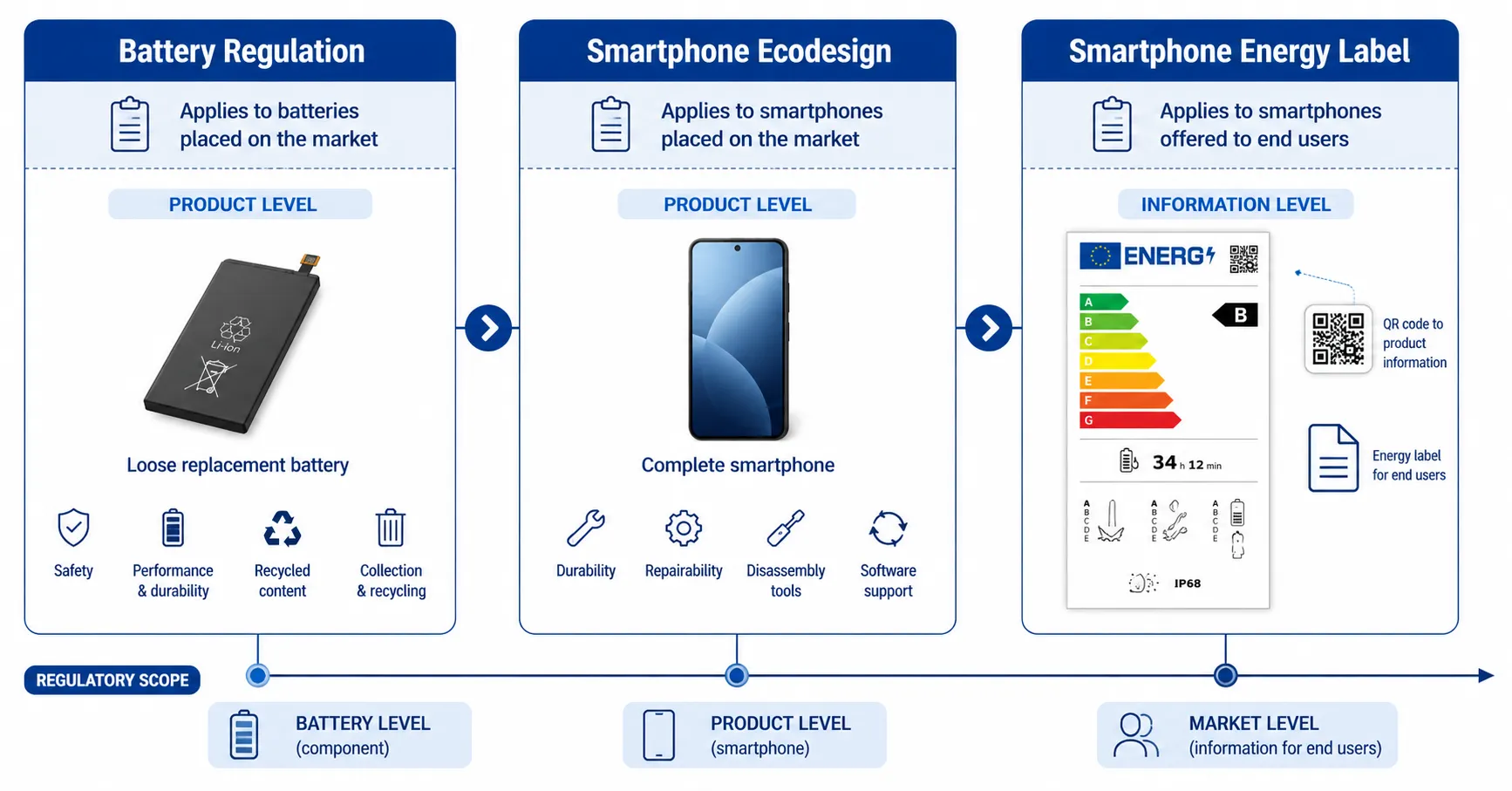
The EU framework combines several regulations rather than relying on one single “removable battery law.”
| Date | Regulatory milestone | Main impact |
|---|---|---|
| 20 June 2025 | Smartphone ecodesign requirements apply | Battery durability, repairability, spare parts and software support |
| 20 June 2025 | Smartphone energy labels apply | Battery endurance, durability and repairability information |
| 2026 | Manufacturer preparation period | Product redesign, documentation, testing and supply-chain preparation |
| 18 February 2027 | Article 11 of Regulation (EU) 2023/1542 applies | Removability and replaceability requirements for portable batteries |
The 2025 smartphone rules are already in effect. The 2027 battery provisions should therefore be treated as the next stage of compliance, not the beginning of the entire EU smartphone sustainability framework.
What Changed for Smartphones in 2025?
Commission Regulation (EU) 2023/1670 introduced ecodesign requirements for smartphones, feature phones, cordless phones and slate tablets placed on the EU market from 20 June 2025.
The corresponding energy-labelling requirements are established under Regulation (EU) 2023/1669.
According to the European Commission’s smartphone and tablet guidance, the requirements focus on extending product life through better battery durability, repairability, spare-parts availability and software support.
Battery cycle-life requirements
Smartphone batteries must withstand at least 800 complete charge and discharge cycles while retaining at least 80% of their initial usable capacity.
For manufacturers and battery suppliers, this means that nominal capacity alone is not enough. Compliance planning should also address:
-
Cell consistency
-
Cycle-life testing
-
Charge and discharge conditions
-
Battery management system calibration
-
Temperature control
-
Test-report traceability
-
Production-batch consistency
A battery that passes an initial capacity test but degrades too quickly can still create a compliance and warranty risk.
Spare-parts availability
Critical spare parts must remain available for several years after a smartphone model leaves the EU market.
The European Commission states that certain parts must be supplied to professional repairers within approximately 5–10 working days and remain available for seven years after the end of sales of the relevant model.
Smartphone brands should therefore establish a long-term parts plan before product launch. This plan should cover batteries, displays, charging ports, back covers and other regulated components.
Repair and disassembly
Manufacturers must consider how a device can be disassembled, repaired and reassembled without unnecessary damage.
Compliance teams should document:
-
Required tools
-
Disassembly steps
-
Adhesive-removal procedures
-
Safety warnings
-
Replacement-battery specifications
-
Software pairing or calibration requirements
-
Post-repair validation procedures
Professional repairers must also receive non-discriminatory access to software or firmware needed to complete a replacement.
Software support
The ecodesign framework also requires longer operating-system support.
The European Commission describes a minimum period of five years from the date on which the last unit of a model is placed on the market.
This requirement is separate from battery replacement, but both rules support the same objective: keeping smartphones functional for longer.
What Changes in February 2027?
Article 11 of Regulation (EU) 2023/1542 addresses the removability and replaceability of portable batteries.
It generally requires businesses placing products with portable batteries on the EU market to ensure that those batteries can be removed and replaced by the end user during the product’s lifetime.
The relevant provisions apply from 18 February 2027.
This does not necessarily mean that every phone must return to the removable plastic back covers used by older mobile devices.
Instead, compliance depends on how the battery can be accessed, removed and replaced.
What Does “Readily Removable and Replaceable” Mean?
Under Regulation (EU) 2023/1542, a portable battery can be considered readily removable when it can be removed using commercially available tools.
The process generally should not require:
-
Proprietary tools
-
Specialised tools, unless supplied free of charge
-
Thermal energy
-
Solvents
-
Destructive disassembly
After removal, the battery should be replaceable with a compatible battery without negatively affecting the product’s functionality, performance or safety.
Commercially available tools may be allowed
The rules do not necessarily require consumers to remove a battery with their bare hands.
Ordinary tools available to the public may be used. Depending on the final product design and applicable guidance, these could include common screwdrivers, opening tools or other non-proprietary equipment.
Heat and solvents are important design issues
Many modern smartphones use strong adhesives to secure batteries.
If removing a battery requires controlled heating, aggressive solvents or a process that creates a significant risk of puncturing the cell, the design may face compliance concerns under Article 11.
Manufacturers should review:
-
Battery pull-tab design
-
Adhesive strength
-
Battery enclosure tolerances
-
Cable and connector accessibility
-
Screw selection
-
Protection against accidental puncture
-
Water-resistance restoration procedures
Replacement must preserve safety and performance
A battery is not truly replaceable if installing a compatible replacement disables important device functions or creates safety warnings that cannot reasonably be resolved.
Brands should evaluate:
-
Battery authentication
-
Battery health reporting
-
Charging-rate limitations
-
Serial-number pairing
-
Thermal-control functions
-
Safety-related firmware
-
Post-repair diagnostics
Software controls intended to protect users should not become unreasonable barriers to legitimate battery replacement.
Are There Exceptions?
Yes. Regulation (EU) 2023/1542 includes exceptions for certain product categories, particularly where safety, water exposure or specialised operating conditions justify a different approach.
In July 2026, the European Commission adopted an additional delegated act concerning exemptions for certain products containing portable batteries. The new categories include some wearable devices, electric toys and other specialised products.
The Commission also released updated technical guidance to support consistent interpretation of Article 11.
These developments do not mean that smartphones are automatically exempt. A business should not assume that water resistance, a compact enclosure or adhesive use creates an automatic exception.
Any exception should be assessed against:
-
The exact product category
-
The final adopted legal text
-
The product’s intended operating environment
-
Documented safety risks
-
Applicable ecodesign requirements
-
Current Commission guidance
See the European Commission’s 2026 announcement for the latest exemption developments.
Who Is Responsible for Compliance?
Responsibility does not rest solely with the battery-cell manufacturer.
The primary obligation generally falls on the business that places the finished product on the EU market. Depending on the supply chain, this may include:
-
Smartphone manufacturers
-
EU importers
-
Private-label brands
-
Authorised representatives
-
Distributors selling products under their own name
-
Online sellers importing directly into the EU
Battery suppliers still play an essential supporting role because device brands need accurate specifications and test evidence.
A qualified supplier should be able to provide documentation covering:
-
Rated and typical capacity
-
Nominal voltage
-
Cell chemistry
-
Cycle-life performance
-
Charging limits
-
Operating-temperature range
-
Protection-circuit design
-
IEC 62133-related safety testing
-
UN38.3 transport testing
-
Material and substance information
-
Batch traceability
EU Smartphone Battery Compliance Checklist
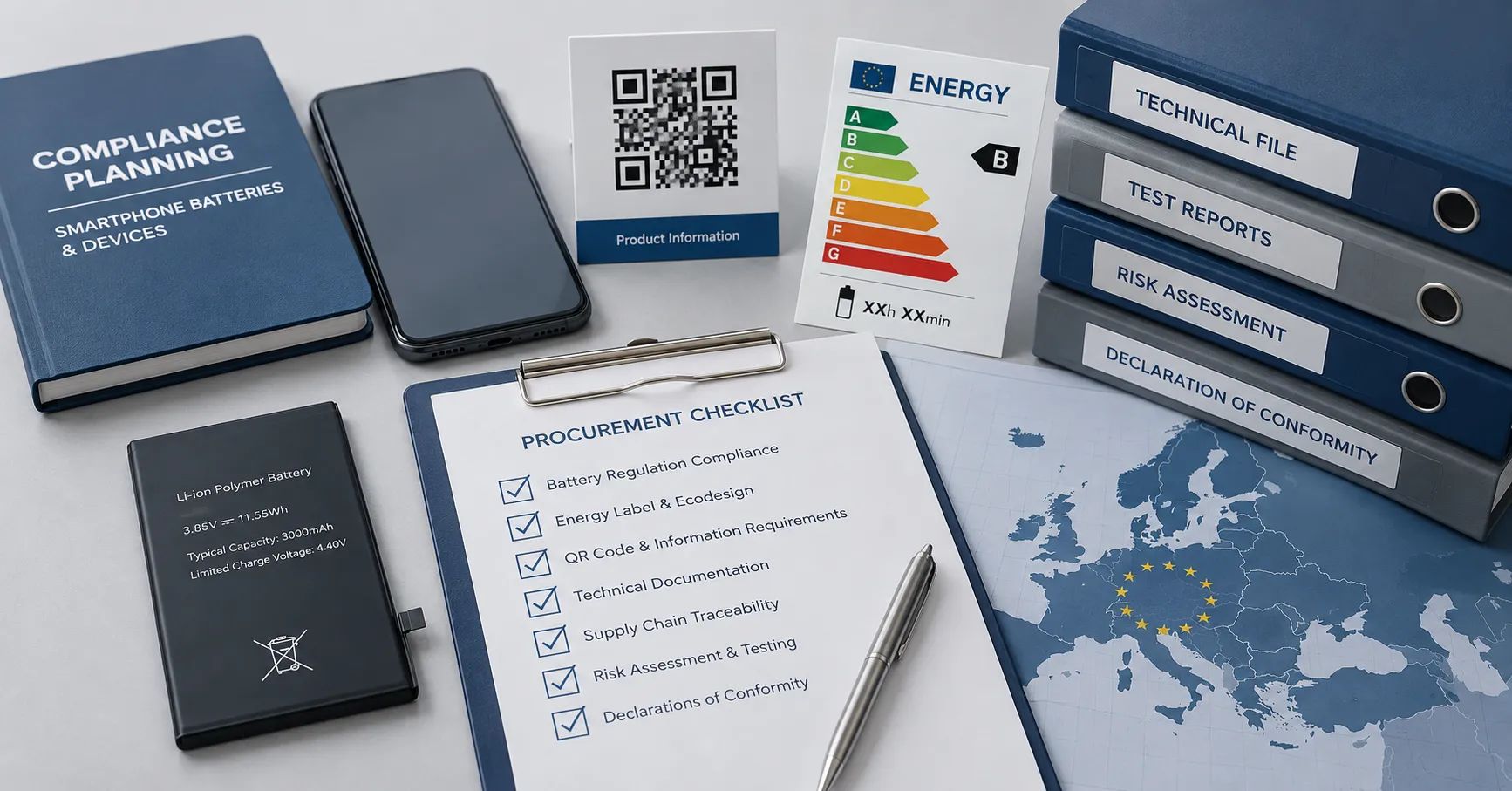
Manufacturers and importers can use the following checklist when preparing a smartphone for the EU market.
| Compliance item | Evidence to prepare | Primary owner |
| Battery retains at least 80% capacity after 800 cycles | Cycle-life test report | Battery supplier and device manufacturer |
| Battery can be safely accessed | Disassembly procedure | Mechanical engineering team |
| Battery removal avoids prohibited methods | Tool and adhesive assessment | Product-design team |
| Compatible replacement battery is available | Spare-parts plan | Brand and after-sales team |
| Replacement preserves device functionality | Firmware and diagnostic validation | Software engineering team |
| Repair instructions are available | Online repair and safety documentation | Brand compliance team |
| Spare parts meet supply deadlines | Inventory and distribution plan | Supply-chain team |
| Energy-label information is accurate | Test data and registration records | EU compliance team |
| Battery safety documentation is traceable | IEC, transport and materials documents | Battery supplier |
| Technical records match production units | Batch-quality records | Manufacturer and quality team |
Recommended Testing Before EU Market Launch
A paper review is not enough. Brands should validate the complete replacement process using production-representative devices.
1. Cycle-life testing
Verify battery capacity at defined intervals throughout at least 800 charge and discharge cycles.
Testing should control:
-
Ambient temperature
-
Charge voltage
-
Discharge cut-off voltage
-
Charging current
-
Discharge current
-
Rest periods
-
Capacity-measurement method
2. Removal testing
Ask both trained and non-specialist users to follow the proposed instructions.
Record:
-
Tools required
-
Time required
-
Damage to the enclosure
-
Damage to the battery
-
Adhesive residue
-
Risk of puncture or bending
-
Ability to restore water protection
3. Replacement testing
Install a compatible replacement battery and confirm:
-
Normal startup
-
Correct charging
-
Battery-health reporting
-
Temperature monitoring
-
Full performance
-
No unresolved warning messages
-
No loss of safety functions
4. Documentation review
Ensure the online instructions match the final mass-production design.
A frequent compliance problem occurs when a manufacturer changes an adhesive, connector, screw or internal layout without updating the repair documentation.
What Battery Buyers Should Ask Suppliers
Smartphone brands and importers should not select a battery solely on unit price and advertised capacity.
Ask potential suppliers:
-
Can you provide an 800-cycle capacity-retention report?
-
Are the results based on the same cell used in production?
-
How is production-batch traceability managed?
-
Can you support model-specific pull tabs or connector designs?
-
What IEC 62133 and UN38.3 documents are available?
-
Can you provide material and restricted-substance information?
-
How are replacement batteries stored and supplied long term?
-
Can the battery-management system support post-repair diagnostics?
-
What controls prevent swelling, overcharging and abnormal heating?
-
Can the supplier support future EU documentation updates?
The strongest supplier is not simply the one with the largest certification list. It is the supplier that can connect each document to the actual battery cell, protection circuit and production batch being delivered.
Common Compliance Mistakes
Treating 2027 as the only deadline
The ecodesign and energy-labelling rules have already applied since June 2025. Waiting until 2027 ignores existing battery durability and repairability obligations.
Assuming every phone needs a removable back cover
The regulation focuses on the practical battery-removal and replacement process. It does not simply mandate a return to one historic smartphone design.
Relying on marketing certificates
A CE or RoHS logo does not prove battery cycle life, repairability or Article 11 compliance.
Ignoring software pairing
A mechanically replaceable battery may still create a compliance risk if software prevents a compatible replacement from functioning correctly.
Failing to maintain spare parts
A compliant product design is not enough if replacement batteries disappear shortly after the phone is discontinued.
Using outdated legal summaries
The EU continues to publish guidance and delegated rules. Compliance teams should monitor official European Commission and EUR-Lex sources rather than relying only on news articles.
Frequently Asked Questions
Do all smartphones need removable batteries in the EU by 2027?
Portable batteries in covered products generally need to be removable and replaceable in accordance with Article 11 of Regulation (EU) 2023/1542. However, the detailed process, applicable product-specific rules and possible exemptions must be evaluated carefully.
The rule does not necessarily require a tool-free removable back cover.
When does the EU replaceable battery rule take effect?
The Article 11 removability and replaceability provisions apply from 18 February 2027.
Separate smartphone ecodesign and energy-labelling requirements have already applied since 20 June 2025.
Can tools be used to replace a smartphone battery?
Commercially available tools may generally be used. Proprietary or specialised tools should not be required unless they are supplied free of charge under the conditions established by the regulation.
Can a smartphone battery be glued in place?
Manufacturers must evaluate whether adhesive prevents ready removal. A process requiring thermal energy or solvents can create compliance concerns.
The entire removal process—not simply the presence of adhesive—should be assessed.
Does the EU require 800 battery cycles?
The EU smartphone ecodesign requirements include a battery-durability benchmark of at least 800 charge and discharge cycles while retaining at least 80% of initial capacity.
Do the rules apply to phones already owned by consumers?
Market-entry dates generally concern products placed on the EU market after the relevant requirements become applicable. Businesses should verify transitional provisions for their particular inventory, model and distribution arrangement.
Who is responsible: the battery supplier or smartphone brand?
The business placing the finished product on the EU market normally carries the primary compliance responsibility. Battery suppliers support compliance by providing accurate specifications, testing and traceability documentation.
Should manufacturers obtain legal advice?
Yes. This article provides general technical and commercial information, not legal advice. Manufacturers and importers should consult qualified EU regulatory professionals before making final product or market-entry decisions.
Preparing Your Smartphone Battery Supply Chain
The EU rules create more than a product-design challenge. They require coordination between battery suppliers, smartphone manufacturers, software teams, repair networks, importers and compliance professionals.
Companies preparing for 2027 should begin by auditing:
-
Existing battery adhesives and pull tabs
-
Replacement-tool requirements
-
Battery-health software behaviour
-
Cycle-life evidence
-
Spare-parts availability
-
Repair instructions
-
Supplier traceability
-
EU technical documentation
Early preparation reduces the risk of rushed redesigns, delayed market entry and expensive after-sales changes.
ESC supports smartphone brands, wholesalers and repair-channel distributors with model-specific replacement batteries and supporting safety, transport and product documentation.
For an upcoming EU smartphone project, request a battery specification and compliance-document review before confirming mass production.
Official References
Last updated: August 2026
Disclaimer: This article provides general information and does not constitute legal advice. Requirements should be confirmed against current EU legislation and professional regulatory guidance before a product is placed on the market.