
For refurbishment factories, iPhone battery replacement is not only a repair step. It is part of the final product quality system.
A refurbished iPhone may pass appearance grading, screen testing, camera testing and charging tests, but if the battery behaves abnormally after resale, the buyer will still return the device. Fast drain, unstable Battery Health, warning messages, sudden shutdown and charging problems can damage resale value, increase warranty cost and create disputes with downstream wholesalers.
That is why more refurbishers search for a diagnostic iPhone battery for refurbishment factory.
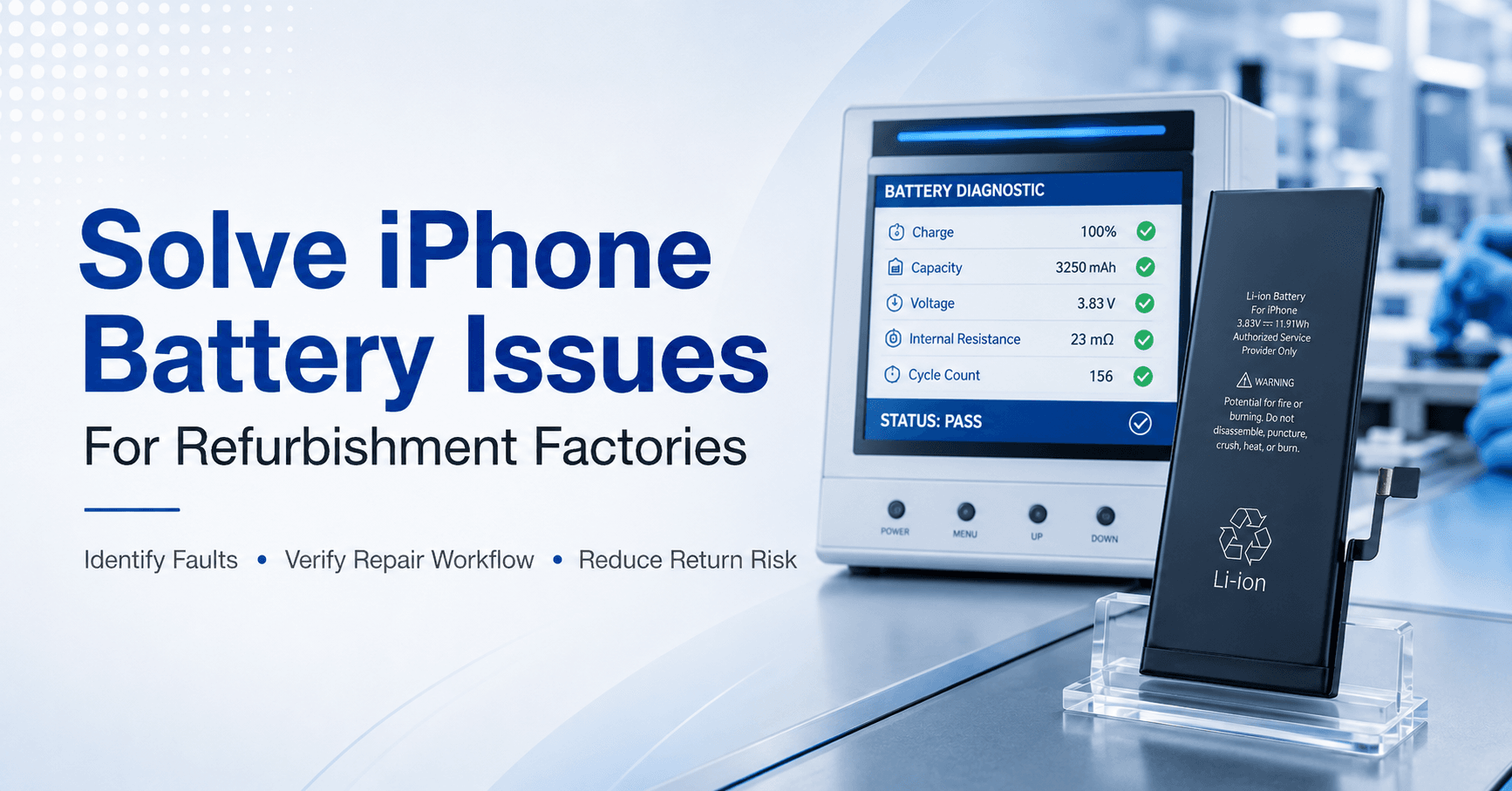
A diagnostic iPhone battery is not just another replacement battery. In a refurbishment workflow, it can be used as a testing and validation tool. It helps technicians separate battery-related faults from motherboard, charging circuit, software or repair workflow problems before the factory installs the final battery for resale.
ESC supplies compatible iPhone replacement batteries, diagnostic battery options, no-pop-up battery options, battery health display solutions and OEM packaging support for repair shops, wholesalers and refurbishment factories. For refurbishment projects, our focus is not only to provide batteries, but to help buyers build a repeatable testing and replacement process.
Why Refurbishment Factories Need Diagnostic iPhone Batteries
Refurbishment factories process phones in batches. That makes their battery problem different from a local repair shop.
A local repair shop usually handles one customer device at a time. A refurbishment factory may handle hundreds or thousands of iPhones across different models, device grades, storage histories and repair conditions. Some devices have original batteries. Some have previous third-party repairs. Some have board-level issues. Some only need battery replacement.
Without a diagnostic process, technicians may blame the battery too early or replace batteries unnecessarily.
A diagnostic iPhone battery helps factories answer practical questions:
- Is the device’s charging function normal?
- Is fast drain caused by the battery or the phone board?
- Does Battery Health display correctly?
- Does the device show Parts and Service History information?
- Is the replacement workflow completed correctly?
- Does the phone need a standard, high-capacity, no-pop-up or battery health display battery?
- Can this model pass final QC after battery replacement?
- Should this device be sold as Grade A, Grade B or repair-only stock?
This makes diagnostic batteries useful for factory process control, not just repair.
Battery Aging Creates Refurbishment Demand
Refurbished phones often come from used-device channels, trade-ins, returns or secondary-market stock. Battery condition is one of the main reasons a used iPhone needs refurbishment before resale.
Apple explains that lithium-ion batteries chemically age, and as they age, their maximum capacity and peak performance capability can decline. Apple also provides battery service guidance when battery performance is affected by aging.
For refurbishment factories, this means battery testing must be part of device grading. A phone with poor battery condition may still look good externally, but it may not meet resale quality expectations.
The goal is not simply to install a new battery into every device. The goal is to identify the correct repair path for each device and reduce post-sale returns.
Diagnostic Battery Is Not Apple Official Diagnostic Service
This point must be clear.
In this article, diagnostic iPhone battery refers to a repair-market battery or test battery solution used by refurbishment factories and professional repair channels for troubleshooting, validation and workflow support. It does not mean Apple official diagnostic service, Apple genuine battery or Apple-authorized repair part.
Apple’s Parts and Service History explains that an iPhone may show information such as Genuine, Unknown, Used or Finish Repair depending on part status and repair process. Apple states that Unknown may appear when a part is not genuine, is not working as expected, has not been verified and linked to the iPhone after repair, or has been modified or cannot be verified.
For independent refurbishment factories, the safe wording is:
- compatible diagnostic iPhone battery
- iPhone repair diagnostic battery
- iPhone battery testing solution
- iPhone diagnostic battery for refurbishment workflow
- aftermarket iPhone battery test solution
- iPhone battery for refurbished phone factories
This wording avoids misleading claims and protects the buyer from unrealistic expectations.
How Diagnostic iPhone Batteries Fit Into a Refurbishment Workflow
A refurbishment factory should not treat diagnostic batteries as a final retail product only. They should be integrated into a workflow.
| Workflow Stage | Diagnostic Battery Role | Factory Benefit |
|---|---|---|
| Incoming Inspection | Test device power and charging response | Sort devices before repair |
| Fault Diagnosis | Separate battery fault from board fault | Reduce wrong repairs |
| Battery Version Selection | Compare standard, health display or no-pop-up options | Match product tier |
| Repair Verification | Confirm charging, display and warning behavior | Reduce after-sales disputes |
| Final QC | Recheck device before resale | Improve shipment quality |
| Sample Testing | Test supplier battery before bulk order | Control procurement risk |
For refurbishment factories, the diagnostic battery is a process tool. It helps factories make better repair decisions before mass replacement.
Standard Battery, Diagnostic Battery, No-Pop-Up Battery and Health Display Battery
These terms are related, but they should not be mixed.
| Battery Type | Main Purpose | Best Use in Refurbishment |
| Standard iPhone Battery | Basic battery replacement | Cost-controlled refurbishing |
| High Capacity Battery | Longer runtime positioning | Premium resale or e-commerce listing |
| Diagnostic Battery | Troubleshooting and repair validation | Incoming inspection and fault diagnosis |
| No-Pop-Up Battery | Reduce warning-message friction for selected models | Premium repair or resale channels |
| Battery Health Display Battery | Support visible Battery Health experience | Grade A refurbished iPhones |
| Decoded Battery | Repair-market data recognition solution | Professional repair workflows |
| OEM-Packaged Battery | Private label or repair kit sales | E-commerce refurbished parts sales |
A refurbishment factory may need more than one battery version. The correct choice depends on target resale market, device grade, customer expectation and warranty policy.
Parts and Service History Matters for Refurbished iPhones
Refurbished iPhone buyers may check settings after purchase. If the phone shows unexpected battery information, the seller may face questions or returns.
Apple states that Parts and Service History can show part status after repair. The same Apple guidance explains that Finish Repair can appear until the repair is completed with Repair Assistant.
For refurbishment factories, this creates a practical requirement: test display behavior before resale. It is not enough to confirm the phone charges.
Technicians should check:
- Battery Health
- Parts and Service History
- Unknown Part status
- Used part status where applicable
- Finish Repair message
- Charging behavior
- Temperature during charging
- Standby drain
- Restart behavior
- Final customer-facing display
This helps the factory decide whether the device is ready for resale or needs further repair.
Repair Assistant and Workflow Verification
Apple’s Repair Assistant is used to finish eligible repairs by installing calibration data after a part has been replaced. Apple states that the device must be connected to Wi-Fi and have more than 20% battery, among other requirements.
For refurbishment factories, Repair Assistant should be treated as part of the diagnostic checklist when applicable.
A practical workflow:
- Confirm the exact iPhone model.
- Record the iOS version.
- Install or connect the diagnostic battery.
- Confirm battery level is above 20%.
- Connect to Wi-Fi.
- Open Settings.
- Go to General.
- Open About.
- Check Parts and Service History.
- Run Restart & Finish Repair if available.
- Recheck Battery Health and warning status.
- Record the final test result.
This process helps technicians avoid false judgment. Sometimes the battery is not the issue. The repair workflow may simply be incomplete.
What Refurbishment Factories Should Test Before Bulk Orders
Before buying diagnostic iPhone batteries in bulk, factories should test samples under real refurbishment conditions.
| Test Item | Why It Matters |
| Model Fitment | Confirms size, connector and flex compatibility |
| Charging Stability | Verifies the device can charge normally |
| Capacity Behavior | Helps evaluate real runtime expectations |
| Internal Resistance | Indicates cell consistency and performance stability |
| Battery Health Display | Important for resale and customer confidence |
| Warning Message Behavior | Affects handover and after-sales risk |
| Repair Assistant Result | Helps verify workflow compatibility |
| Heat Observation | Reduces safety and complaint risk |
| Repeatability | Confirms whether results are stable across samples |
| Technician Feedback | Shows installation difficulty and process risk |
A supplier who refuses sample testing is not suitable for serious refurbishment buyers.
How Diagnostic Batteries Reduce Return Risk
Returns in refurbished phone businesses are expensive. A returned phone may require rechecking, repacking, warranty replacement, customer communication and logistics handling.
Battery-related returns often come from:
- fast drain after resale
- battery health not showing
- unexpected warning messages
- charging instability
- sudden shutdown
- customer doubts about battery quality
- poor explanation of aftermarket repair status
Diagnostic batteries help reduce these risks by identifying problems before the device leaves the factory. They also help factories build internal rules:
- which devices need battery replacement
- which devices need board-level repair
- which models require premium battery versions
- which units should be downgraded in resale grade
- which repair results need customer explanation
The value is not only the battery itself. The value is lower uncertainty.
What Buyers Should Ask Diagnostic iPhone Battery Suppliers
A refurbishment factory should ask more detailed questions than a normal repair shop.
Before placing an order, ask the supplier:
- Which iPhone models are supported?
- Which models support diagnostic battery options?
- Does the solution support Battery Health display?
- Does it reduce pop-up warning friction?
- Is it compatible with selected Repair Assistant workflows?
- Which iOS versions have been tested?
- Can we test samples before bulk order?
- What is the MOQ per model?
- Can mixed iPhone models be combined?
- Can batteries be supplied for final installation as well as diagnostics?
- Can OEM packaging or internal factory labels be customized?
- What warranty policy applies to diagnostic and replacement batteries?
A serious supplier should answer with model-specific information. Broad promises are not enough.
Diagnostic Battery vs Standard Replacement Battery
Refurbishment factories should separate diagnostic batteries from standard replacement batteries.
| Item | Diagnostic iPhone Battery | Standard iPhone Replacement Battery |
| Main Purpose | Troubleshooting and workflow verification | Final battery replacement |
| Buyer Scenario | Refurbishment factory, repair lab, technical repair chain | Repair shops, wholesalers, e-commerce sellers |
| Main Value | Fault separation and process control | Cost-effective repair and replacement |
| Testing Focus | Device behavior, warning status, workflow result | Capacity, fitment, charging and daily use |
| Purchase Logic | Technical validation and factory QC | Volume replacement and resale |
| Best Used For | Incoming inspection and repair decision-making | Final refurbishment and customer handover |
A factory may use diagnostic batteries to test devices and then use standard, high-capacity, no-pop-up or battery health display batteries for final assembly.
OEM and Labeling for Refurbishment Factories
Refurbishment factories often need internal labels rather than retail packaging.
Useful customization may include:
- model code label
- batch code label
- QC passed label
- internal SKU
- production date
- battery version marking
- warehouse barcode
- technician workflow label
- carton label
- replacement batch tracking
For private label or e-commerce refurbished phone sellers, retail packaging can also be added:
- branded battery label
- retail box
- warranty card
- instruction sheet
- tool kit packaging
- barcode sticker
- warning notice
- outer carton label
The right packaging depends on whether the battery is used internally by a factory or sold as a repair part.
Shipping and Export Documents
Diagnostic iPhone batteries are still lithium battery products. International buyers should confirm transport documents before bulk shipment.
IATA’s 2026 lithium battery guidance states that lithium ion cells and batteries must have a UN38.3 test summary showing they passed the applicable UN Manual of Tests and Criteria, Part III, Sub-section 38.3.
Refurbishment factories and importers may need:
- MSDS
- UN38.3 test summary
- battery specification sheet
- packing information
- carton label information
- invoice and packing list
- destination-specific document support
A supplier who understands both diagnostic workflow and lithium battery shipping is more valuable than a seller who only offers a battery price.
Practical Case: Refurbishment Factory Reducing Battery-Related Failures
A refurbishment factory receives mixed used iPhone inventory from different channels. Some devices charge normally. Some show fast drain. Some show battery warning messages. Some have previous repairs. Some fail final QC after battery replacement.
At first, the factory replaces batteries based only on Battery Health percentage. This creates problems. Some phones still show warnings. Some phones have board-level faults. Some devices are over-repaired. Some replacement batteries are installed into devices that should have been downgraded or rejected.
A better process uses diagnostic iPhone batteries before final installation.
The factory tests incoming devices, separates battery faults from board faults, checks Parts and Service History, records Repair Assistant results, compares standard and premium battery options, and only then installs the final battery version.
The result is fewer wrong replacements, better grading, clearer resale positioning and lower return risk.
Why Choose ESC for Diagnostic iPhone Battery Projects?
ESC supports iPhone battery buyers who need practical repair-market solutions for refurbishment, wholesale and professional repair channels.
ESC can support:
- diagnostic iPhone battery options for selected models
- standard iPhone replacement batteries
- high-capacity iPhone battery options
- battery health display solutions
- no-pop-up battery options
- decoded iPhone battery options
- mixed iPhone model orders
- sample testing before bulk purchase
- factory internal labels
- OEM packaging
- export packing and shipping support
- after-sales issue analysis
ESC does not position aftermarket batteries as Apple genuine parts. The real value is helping refurbishment factories test correctly, choose the right battery version, reduce device returns and build a more controlled refurbishment workflow.
What Refurbishment Buyers Should Send Before Quotation
To get a useful quotation, send:
- Target iPhone model list
- Device grade or resale channel
- Diagnostic use or final replacement use
- Required battery version
- Quantity per model
- Whether Battery Health display is required
- Whether no-pop-up behavior is required
- Whether Repair Assistant workflow needs to be tested
- Packaging or internal labeling requirement
- Shipping country
- Required documents
- Sample testing plan
The more detailed the inquiry, the faster the supplier can recommend a useful solution.
FAQ About Diagnostic iPhone Battery for Refurbishment Factories
What is a diagnostic iPhone battery?
A diagnostic iPhone battery is a repair-market battery or test battery solution used to troubleshoot iPhone battery-related problems, verify repair workflow and help technicians identify whether the problem comes from the battery, device board, software or repair process.
Is a diagnostic iPhone battery an Apple genuine battery?
No. It is an aftermarket repair-market solution for independent repair and refurbishment channels. It should not be marketed as an Apple genuine battery.
Why do refurbishment factories need diagnostic batteries?
They need diagnostic batteries to test used devices before final battery replacement, reduce wrong repairs, separate battery faults from board faults, verify warning-message behavior and reduce returns after resale.
Can diagnostic iPhone batteries remove Unknown Part messages?
Not universally. Unknown Part behavior depends on the model, part status, repair workflow, iOS version and whether the part can be verified. Buyers should test exact models before bulk orders.
What is the difference between diagnostic battery and no-pop-up battery?
A diagnostic battery focuses on troubleshooting and workflow validation. A no-pop-up battery focuses on reducing warning-message friction for selected models. Some solutions may overlap, but they should be tested separately.
What is the difference between diagnostic battery and battery health display battery?
A diagnostic battery helps identify and verify repair behavior. A battery health display battery focuses on visible Battery Health information after replacement. Refurbishment factories may use both depending on device grade.
What should factories test before bulk orders?
Factories should test model fitment, charging stability, capacity behavior, internal resistance, Battery Health display, warning-message behavior, Repair Assistant workflow, heat, repeatability and technician feedback.
Can ESC support mixed iPhone models?
Yes. ESC can support mixed iPhone model requirements depending on the model list, quantity, stock, battery version and packaging needs.
Can diagnostic batteries be customized with factory labels?
Yes. ESC can support internal labels, model codes, batch codes, SKU labels, carton labels and OEM packaging depending on order requirements.
How can I get a quotation?
Send your iPhone model list, quantity, diagnostic requirement, final battery version requirement, packaging needs and shipping country. ESC can help check suitable options and arrange sample testing.
Work with ESC
A diagnostic iPhone battery for refurbishment factories is not only a product. It is part of a controlled repair and QC process.
For refurbishment factories, the key value is not a broad promise. The key value is better device testing, clearer fault diagnosis, correct battery version selection, reduced warning-message disputes, lower return risk and repeatable bulk supply.
ESC provides compatible iPhone battery solutions for refurbishment factories, repair chains, wholesalers, e-commerce sellers and private label buyers.
For troubleshooting and repair validation, visit our Diagnostic Battery category.
For warning-message solutions, visit our No-Pop-Up Battery category.
For visible Battery Health options, visit our Battery Health Display Battery category.
For private label or factory labeling projects, visit our OEM Battery Packaging service page and send us your model list for quotation.