
Quick Answer: Successful cell phone replacement parts wholesale depends on delivering the correct components, quantities, and approved product configurations when repair businesses need them. Professional buyers should establish model-specific SKU records, calculate demand from actual repair jobs, verify samples, coordinate supplier delivery schedules, and track order accuracy. For replacement batteries, electrical compatibility, capacity, mechanical fit, batch traceability, and lithium battery transport documentation are essential purchasing considerations.
A repair technician may have a compatible replacement display available but cannot complete a customer's phone because the required battery has not arrived.
A distributor may receive hundreds of replacement batteries, only to discover that some have the wrong connectors or belong to a different smartphone model.
A refurbishment company may purchase inexpensive components but lose its expected margin through repeated freight charges, installation delays, and warranty claims.
These situations demonstrate why cell phone replacement parts wholesale is not simply a question of finding cheaper components.
The real purchasing objective is to create repair-ready inventory that supports predictable operations.
For professional repair chains and distributors, every unavailable, incorrect, or unqualified component can delay revenue and increase operating costs.
ESCCharge specializes in aftermarket replacement batteries and charging products for professional repair businesses, wholesalers, distributors, refurbishment operations, and private-label customers.
This guide explains how to establish a more efficient replacement-parts purchasing system, with particular attention to model-specific battery sourcing.
1. What Is Cell Phone Replacement Parts Wholesale?
Cell phone replacement parts wholesale refers to the commercial purchasing and distribution of smartphone repair components in quantities intended for professional businesses.
Unlike retail purchases for individual repairs, wholesale procurement must support recurring demand, multiple device models, inventory planning, quality verification, and repeat-order consistency.
A professional purchasing system connects four activities:
-
Identifying actual repair demand.
-
Selecting approved replacement components.
-
Coordinating procurement and delivery.
-
Verifying component quality and completed repairs.
Common wholesale mobile phone replacement parts
| Product category | Typical repair application | Critical purchasing requirement |
|---|---|---|
| Replacement batteries | Short runtime, battery degradation, power-related faults | Capacity, voltage, dimensions and compatibility |
| OLED and LCD screens | Cracked displays and touch failures | Optical quality, touch response and exact fit |
| Charging ports | Charging and connection faults | Connector type and flex configuration |
| Camera modules | Image, focus and camera-related faults | Device compatibility and calibration |
| Flex cables | Button, sensor and internal connection problems | Connector arrangement and revision |
| Speakers and microphones | Audio output and voice-input faults | Acoustic and electrical performance |
| Adhesives and seals | Device reassembly | Dimensions and material suitability |
| Small repair components | Mechanical assembly and component retention | Accurate specification and quantity |
These categories describe the wider mobile phone repair industry.
ESCCharge's core verified product offering focuses on replacement batteries and charging-related products. Buyers requiring screens, cameras, or other components should verify their availability separately.
2. Who Should Purchase Wholesale Cell Phone Replacement Parts?
Different professional buyers require different procurement strategies.
A successful wholesale program should reflect the customer's business model rather than applying identical purchasing rules to every order.
Independent phone repair shops
Independent repair stores often need smaller quantities across several popular smartphone models.
Their priorities include manageable inventory, accurate compatibility, reliable quality, and efficient replenishment.
Mixed-model battery orders can help these businesses avoid purchasing excessive quantities of one model.
Multi-location repair chains
Repair chains need consistent components across multiple service locations.
A replacement battery approved by the central purchasing department should not change unexpectedly between orders or branches.
Standardized SKU records and centralized supplier qualification are especially important.
Smartphone refurbishment companies
Refurbishers purchase components according to the condition of incoming used devices.
Their requirements may include multiple generations of iPhone and Android replacement batteries, with different quantities determined by inspection results.
Regional wholesalers and distributors
Distributors must maintain sufficient inventory to support downstream repair shops without accumulating excessive slow-moving stock.
Their purchasing decisions should consider sales velocity, regional model demand, packaging, replenishment schedules, and warranty procedures.
Private-label battery brands
Private-label customers need reliable product specifications combined with consistent branding, labels, packaging, and technical documentation.
ESCCharge supports appropriate OEM and private-label battery purchasing projects, subject to confirmed product and commercial requirements.
Who may not benefit from wholesale purchasing?
Wholesale purchasing may not be appropriate for individual consumers who only need one repair component, businesses without suitable battery-handling and installation capabilities, or buyers seeking genuine manufacturer service parts exclusively.
ESC's aftermarket replacement batteries should not be confused with genuine Apple or other original-device-manufacturer service components.
3. Why Do Repair Businesses Experience Missing-Part Delays?
A repair-ready order is an order containing all approved components needed to complete the intended repair jobs.
Many purchasing problems occur because buyers measure inventory by total units rather than complete repair requirements.
For example, having 100 replacement batteries does not mean a repair business can complete 100 battery-related repairs if the available models do not match its incoming devices.
Common procurement problems and solutions
| Procurement problem | Operational consequence | Recommended solution |
|---|---|---|
| Incorrect device model | Installation failure or unusable inventory | Maintain verified model mapping |
| Missing order items | Repairs remain unfinished | Check order completeness by SKU |
| Inconsistent supplier revisions | Previously approved parts may behave differently | Establish change-control requirements |
| Mixed complete batteries and cells | Technicians receive unsuitable configurations | Separate product codes |
| Delayed battery shipment | Other repair parts remain unused | Coordinate shipping schedules |
| Insufficient fast-moving stock | Lost repair opportunities | Use demand-based replenishment |
| Excess slow-moving inventory | Cash tied up in unused components | Adjust order quantities by sales velocity |
| Unclear warranty responsibility | Disputes and delayed replacements | Define return and investigation procedures |
Identify the actual repair bottleneck
The most important component is not always the most expensive one.
A relatively inexpensive battery, adhesive, or connector can prevent the completion of a higher-value smartphone repair.
Purchasing teams should identify components that regularly stop repairs and prioritize their availability accordingly.
4. How Do You Build a Repair-Ready Wholesale Order?
A repair-ready purchasing system begins with actual work requirements.
Instead of ordering from a general catalog without a clear demand plan, buyers should connect purchasing quantities to diagnosed repairs and expected replenishment needs.
Step 1: Record the device and repair requirement
For every relevant repair, identify the exact smartphone model and the confirmed failed component.
Do not assume that a customer complaint automatically establishes which replacement part is needed.
Step 2: Match the approved replacement SKU
Use a controlled compatibility list that connects the device model to the approved component specification.
Step 3: Review usable inventory
Available inventory should exclude quarantined, damaged, reserved, or otherwise unqualified components.
Step 4: Calculate the purchasing shortage
Compare confirmed requirements with usable stock and incoming approved purchase orders.
Step 5: Consolidate the order
Group required components by supplier, product family, required delivery date, and transport conditions.
Step 6: Verify the supplier's order confirmation
Confirm the model, configuration, quantity, unit price, packaging, and expected shipment date for each line item.
Step 7: Inspect and release incoming components
Do not make received inventory available to technicians until the applicable quantity, identification, and quality checks are complete.
This workflow helps turn wholesale purchasing into a controlled repair-support process.
5. How Can Buyers Prevent Incorrect Smartphone Model Matching?
Model accuracy is one of the most important requirements in cell phone replacement parts wholesale.
Smartphones with similar commercial names may use different internal components.
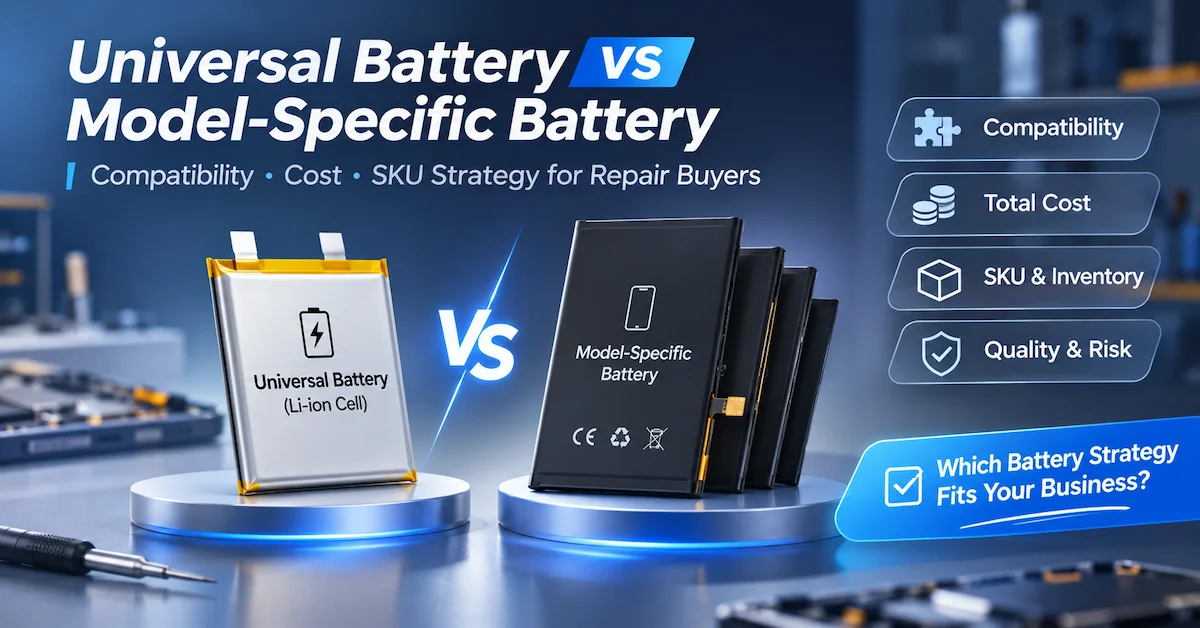
For example, an iPhone 12, iPhone 12 mini, iPhone 12 Pro, and iPhone 12 Pro Max should not automatically be treated as one battery application.
The same principle applies to Samsung, Xiaomi, OPPO, Huawei, and other Android smartphone families.
Recommended component identification record
| Identification field | Purchasing purpose |
|---|---|
| Smartphone brand | Establishes device family |
| Commercial model name | Identifies intended application |
| Regional model number | Helps distinguish model variants |
| Original component reference | Supports accurate component matching |
| Supplier SKU | Identifies the replacement product |
| Product configuration | Complete assembly or component-only |
| Electrical specification | Confirms applicable voltage and capacity |
| Mechanical specification | Verifies dimensions and connector arrangement |
| Approved revision | Controls repeat-order consistency |
| Packaging barcode | Supports warehouse identification |
Apple provides official device model identification guidance, which can help repair businesses distinguish specific iPhone variants before ordering components.
However, identifying the phone model is only the first step.
The buyer must still confirm that the replacement component's specification and assembly configuration match the actual repair requirement.
Why supplier SKU mapping matters
Two suppliers may use different commercial codes for apparently similar products.
The purchasing team should maintain an internal approved SKU rather than relying entirely on a supplier's product name.
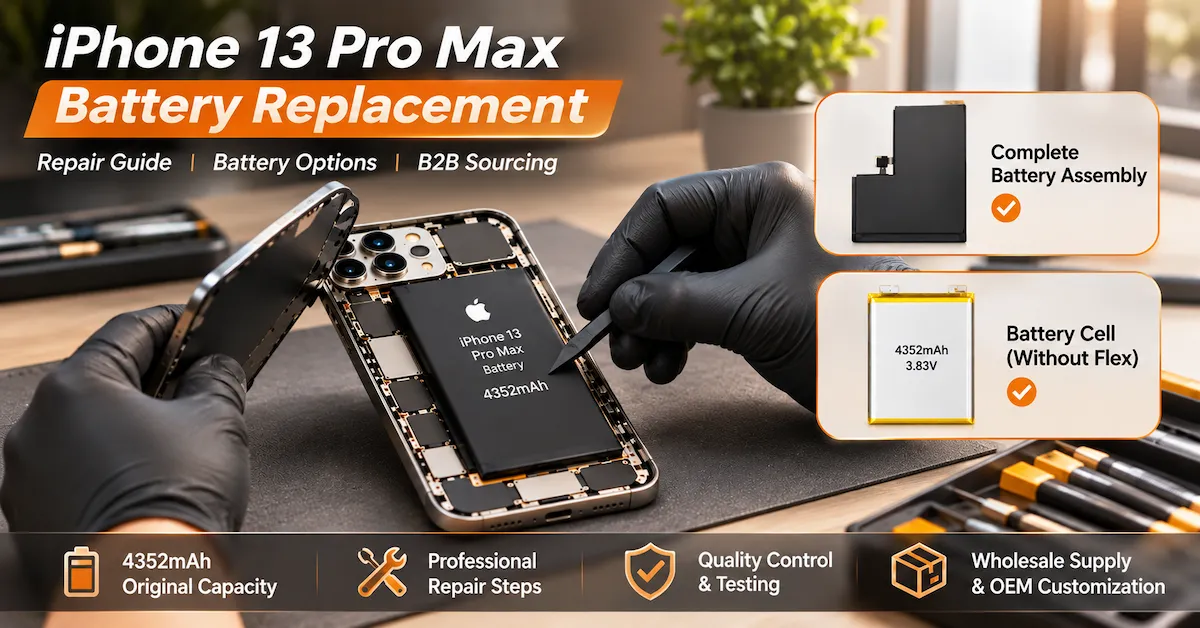
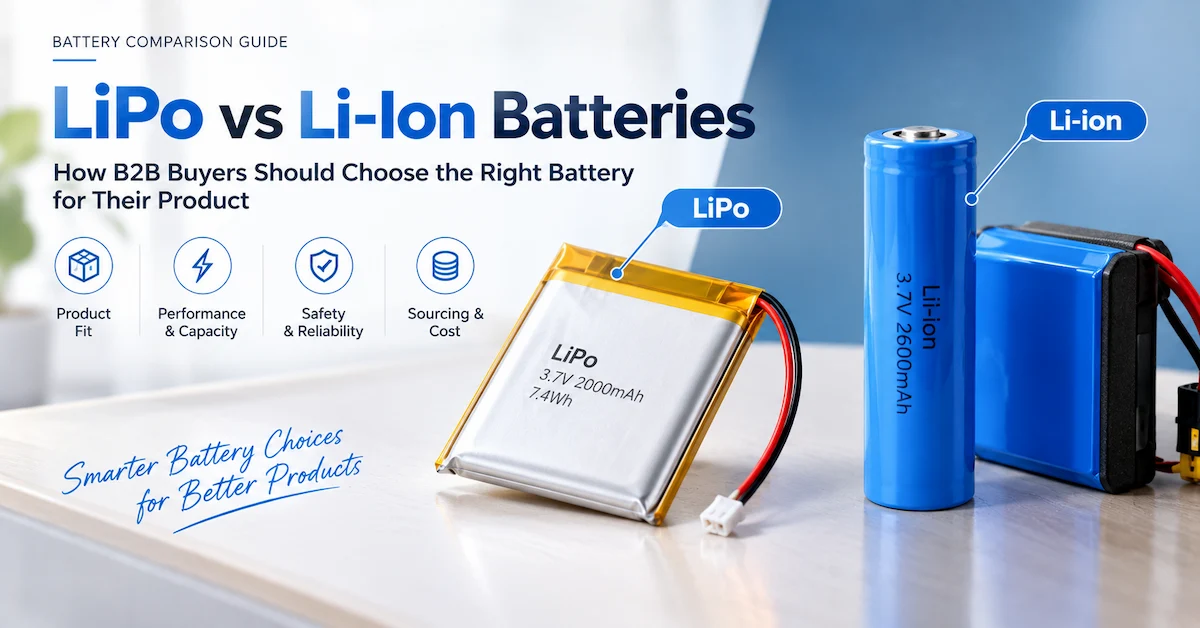
This is particularly important when purchasing complete battery assemblies and battery cells without flex cables or battery management electronics.
6. Which Replacement Batteries Should Wholesale Buyers Stock?
Replacement batteries are a recurring repair category because rechargeable batteries gradually lose usable capacity during normal aging.
A professional battery purchasing program should support the device families serviced by the customer's repair business.
ESCCharge provides a mobile phone replacement battery range covering selected iPhone and Android devices.
Smartphone battery sourcing by product family
| Product family | Typical buyer requirement | Purchasing priority |
|---|---|---|
| iPhone replacement batteries | Multiple generations and repair configurations | Exact model and software-related behavior |
| Samsung replacement batteries | Galaxy smartphone repair programs | Original battery reference and dimensions |
| Xiaomi replacement batteries | Diverse smartphone model inventory | Accurate model mapping |
| OPPO replacement batteries | Model-specific repair demand | Battery code and connector verification |
| Motorola replacement batteries | Regional Android repair demand | Device and battery-reference compatibility |
| Google Pixel replacement batteries | Model-specific Android refurbishment | Assembly and electrical specification |
| Huawei replacement batteries | Established and older device repair | Verified model coverage |
Actual product availability, specifications, and commercial conditions should be checked against the current catalog and supplier quotation.
Standard-capacity replacement batteries
Standard-capacity products are intended to match an established capacity class for the compatible device.
These products may suit repair businesses seeking a consistent replacement configuration without making unsupported capacity-upgrade claims.
High-capacity replacement batteries
High-capacity alternatives may offer a different rated capacity.
However, buyers should verify actual capacity, physical dimensions, charging compatibility, protection electronics, and supporting test conditions.
A higher printed capacity is not automatically evidence of better performance.
Diagnostic replacement batteries
Some replacement batteries are designed to support particular device-information or recognition functions.
Their actual behavior can depend on the device, iOS version, installed electronics, and repair process.
Software recognition should be evaluated separately from genuine-part authenticity and measured battery capacity.
Battery cells without flex
Cell-only products are intended for specialized repair workflows.
They should not be treated as ready-to-install complete battery assemblies.
7. Complete Replacement Batteries vs. Cell-Only Products
One of the most costly purchasing errors occurs when the buyer expects a complete battery but receives only the internal cell.
Both products may have the same stated capacity and voltage while serving different technical purposes.
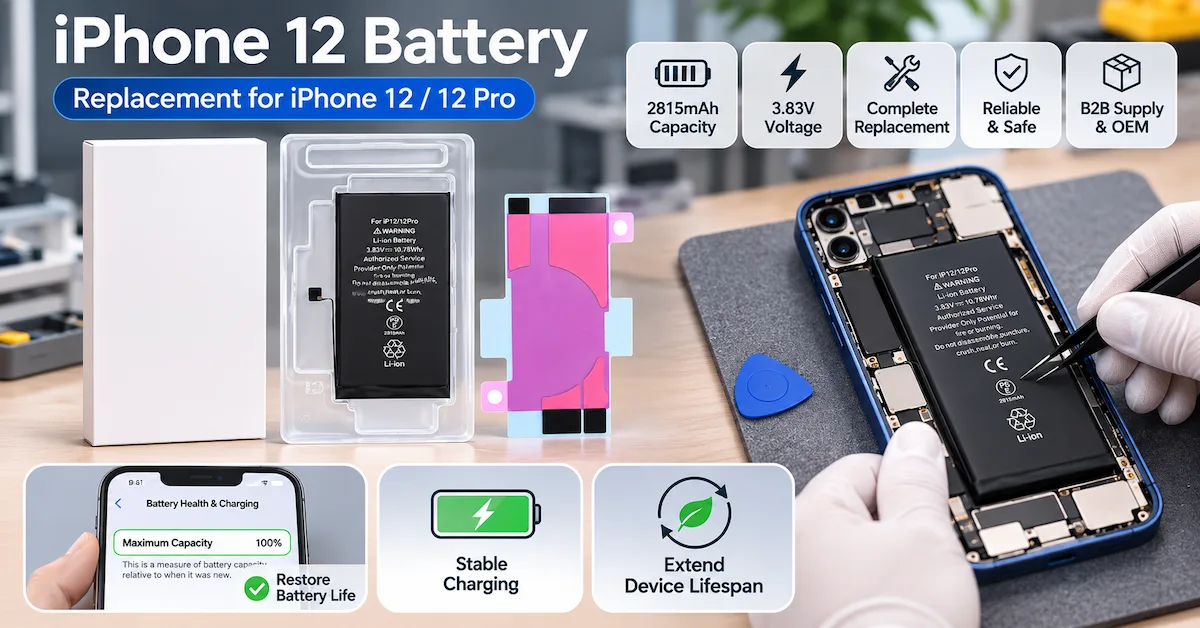
Example: ESC iPhone 12 and iPhone 12 Pro battery comparison
| Specification | Complete replacement battery | Cell without flex |
|---|---|---|
| Compatible application | iPhone 12 / iPhone 12 Pro | iPhone 12 / iPhone 12 Pro |
| Rated capacity | 2815mAh | 2815mAh |
| Nominal voltage | 3.83V | 3.83V |
| Product configuration | Finished replacement assembly | Cell-only component |
| Flex cable | Included in the specified complete configuration | Not included |
| BMS or management electronics | Confirm finished assembly specification | Not included |
| Intended repair workflow | Professional battery replacement | Specialized cell-level repair |
| Buyer type | Repair shops and refurbishment companies | Technically equipped repair facilities |
Related ESCCharge products:
These products illustrate why a battery purchasing list must specify more than the device name and rated capacity.
The two configurations require different installation capabilities, quality checks, and acceptance procedures.
Cell-level battery work should only be performed by appropriately equipped and qualified facilities.
8. How Do You Calculate Mixed-Model Wholesale Order Quantities?
A mixed-model order allows buyers to purchase several approved battery models within one purchasing program.
However, order flexibility does not eliminate the need for demand planning.
The quantities should reflect actual device repairs, forecast demand, usable inventory, and confirmed incoming supply.
Recommended replenishment formula
Required Order Quantity = Forecast Demand During Coverage Period + Target Safety Stock − Usable Inventory − Confirmed Incoming Inventory
If the result is negative, the immediate purchasing requirement is normally zero.
The final order may need adjustment for supplier MOQ, packaging multiples, and shipment requirements.
Illustrative mixed-model battery order
| Approved battery application | Forecast demand | Safety stock | Usable stock | Incoming stock | Suggested order |
|---|---|---|---|---|---|
| iPhone 11 | 80 | 20 | 25 | 15 | 60 |
| iPhone 12 / 12 Pro | 100 | 25 | 30 | 20 | 75 |
| iPhone 13 | 65 | 15 | 20 | 10 | 50 |
| Samsung selected SKU | 45 | 10 | 15 | 5 | 35 |
| Xiaomi selected SKU | 30 | 10 | 8 | 2 | 30 |
| Total | 320 | 80 | 98 | 52 | 250 |
This example uses hypothetical demand and stock quantities.
It does not represent actual ESC sales data, availability, or customer orders.
How does MOQ affect the calculation?
If a supplier requires a minimum quantity for a particular SKU, the buyer must compare that requirement against forecast demand and storage risk.
A lower unit price may not justify buying several months of unnecessary stock.
ESCCharge publishes mixed-model purchasing options for selected battery products. Applicable MOQ and order conditions should be confirmed for the proposed product mix.
9. How Should Repair Chains Manage Inventory Across Multiple Locations?
Repair chains often experience inventory imbalance.
One branch may have excessive stock of a particular battery while another branch cannot complete repairs because the same product is unavailable.
Centralized purchasing can reduce this problem when supported by accurate stock records.
Recommended inventory allocation system
| Inventory location | Main function |
|---|---|
| Central warehouse | Consolidated supplier orders and incoming inspection |
| Regional distribution point | Replenishment coordination |
| Individual repair store | Frequently used approved components |
| Quarantine area | Unqualified or damaged products |
| Warranty return area | Components awaiting investigation |
Classify components by repair importance
Fast-moving components should receive regular replenishment based on verified demand.
Slow-moving models may require lower safety stock or demand-triggered purchasing.
Newly introduced replacement products should undergo sample qualification before significant inventory commitments are made.
Avoid unlimited battery storage
Lithium-ion batteries can age during storage, even when they are not installed.
Inventory planning should therefore consider supplier storage guidance, lot age, physical condition, and applicable safety procedures.
Maintaining more stock is not always the correct response to unreliable purchasing.
Better forecasting, accurate replenishment, and dependable supplier communication may provide a more suitable solution.
10. How Do You Measure Wholesale Order Fulfillment?
Professional buyers should establish purchasing indicators that measure whether components actually support completed repair work.
A supplier delivering most of an order may still cause substantial delays if the missing components are critical.
Recommended order fulfillment indicators
| KPI | Calculation | Business purpose |
|---|---|---|
| Order accuracy | Correct order lines ÷ received order lines × 100% | Identifies wrong-model and configuration errors |
| Line fill rate | Order lines supplied in full ÷ total order lines × 100% | Measures component availability |
| On-time delivery | Orders delivered by agreed date ÷ total orders × 100% | Evaluates delivery reliability |
| Repair-kit completeness | Jobs with all required approved parts ÷ total planned jobs × 100% | Measures repair readiness |
| First-pass acceptance | Units passing initial inspection ÷ inspected units × 100% | Evaluates incoming quality |
| Verified return rate | Confirmed defective units ÷ supplied units × 100% | Monitors proven component problems |
Each metric should have a consistent reporting period, population, and counting method.
Why repair-kit completeness matters
Consider a hypothetical refurbishment operation preparing 100 repair jobs.
If only 85 jobs have all the required approved components, repair-kit completeness is:
85 ÷ 100 × 100% = 85%
Even if the warehouse has received a large overall quantity of replacement parts, 15 jobs may still be delayed.
This metric helps identify the operational impact of missing components more effectively than general inventory volume alone.
11. What Quality-Control Requirements Should Wholesale Battery Buyers Establish?
Replacement battery quality influences device performance, repair success, customer satisfaction, and warranty exposure.
A professional quality-control program should combine supplier evidence, representative sample testing, incoming inspection, and completed-device verification.
Recommended replacement battery QC checklist
| Inspection item | What buyers should verify |
|---|---|
| Product identification | Correct device model and approved SKU |
| Physical appearance | No unacceptable deformation or damage |
| Dimensions | Matches approved mechanical specification |
| Connector and flex | Correct configuration and workmanship |
| Rated capacity | Supported by appropriate capacity testing |
| Nominal voltage | Matches approved electrical specification |
| Internal resistance | Within agreed model-specific limits |
| Protection electronics | Required configuration and documented performance |
| Charging behavior | Normal operation under defined conditions |
| Batch identification | Traceable production lot |
| Packaging | Appropriate protection and correct labels |
| Final inspection | Meets agreed acceptance requirements |
Why capacity testing conditions matter
A valid capacity comparison requires consistent test conditions, including appropriate charge and discharge parameters, temperature, and measurement methods.
Two batteries with different printed capacities cannot be compared reliably without understanding how the actual values were established.
Quality inspection at ESCCharge
ESCCharge describes battery quality-control procedures that include electrical testing, charging and discharging verification, and final inspection.
Buyers should request the exact procedures, acceptance limits, and available test records for their approved products.
Company-level quality statements should not be interpreted as independently verified performance guarantees for every purchase lot.
Handle failures correctly
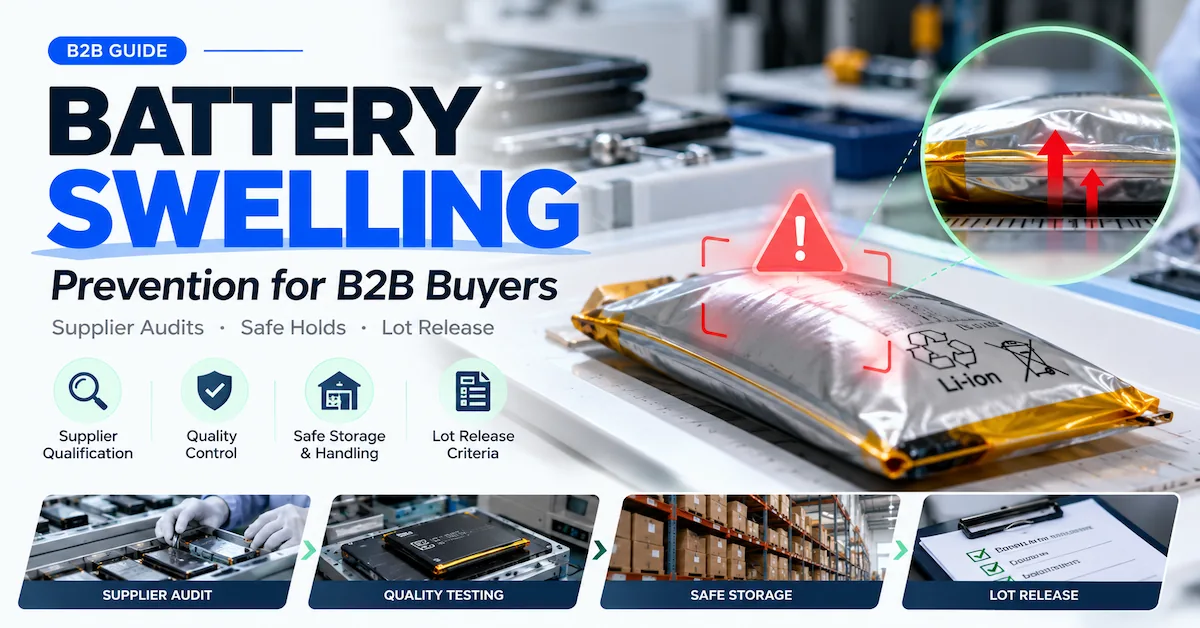
Damaged or swollen lithium-ion batteries should be removed from ordinary inventory and handled under appropriate professional safety procedures.
They should not be charged or subjected to routine performance testing.
12. Why Is Total Procurement Cost More Important Than Unit Price?
The quoted component price represents only one part of the actual purchasing cost.
Missing components, incorrect models, rejected units, emergency freight, technician delays, and warranty handling can increase the total cost of a wholesale order.
Total procurement cost formula
Total Procurement Cost = Component Cost + Freight + Import Charges + Inspection + Rework + Delay Costs + Expected Warranty Costs
Illustrative comparison of two wholesale orders
Assume two purchasing programs each require 200 replacement batteries.
| Cost item | Supplier A | Supplier B |
|---|---|---|
| Component purchases | $1,000 | $1,120 |
| Freight | $150 | $150 |
| Incoming inspection | $40 | $40 |
| Assumed error and replacement expenses | $90 | $20 |
| Emergency replenishment | $120 | $30 |
| Repair-delay costs | $100 | $20 |
| Total procurement cost | $1,500 | $1,380 |
Supplier B has a higher initial component price but a lower total expected procurement cost under these hypothetical assumptions.
The illustrative difference is $120 per order.
These figures are not actual supplier quotations, ESC product prices, or measured customer savings.
The purpose is to demonstrate why buyers should calculate the full cost of maintaining repair-ready inventory.
Which costs should repair chains track?
Track actual emergency freight, confirmed incorrect components, additional labor, delayed repairs, and warranty costs.
Avoid assigning the same expense to several categories, which could exaggerate purchasing losses.
A reliable cost comparison should use consistent accounting rules across suppliers.
13. How Should Buyers Coordinate Multiple Phone Parts Suppliers?
A replacement battery manufacturer, display supplier, camera component provider, and repair-tool distributor can have different production schedules and transport requirements.
Attempting to purchase every component from one unverified source may create technical and quality-control risks.
A specialized supplier strategy can be more appropriate when each component category requires different expertise.
Supplier responsibility matrix
| Component category | Supplier qualification focus |
|---|---|
| Replacement batteries | Cell quality, capacity, compatibility and transport documentation |
| Display assemblies | Optical performance, touch response and mechanical fit |
| Camera modules | Imaging function and calibration requirements |
| Charging components | Electrical connections and mechanical configuration |
| Adhesives and seals | Material suitability and dimensional accuracy |
| Repair equipment | Tool suitability and operational safety |
Coordinate delivery around repair schedules
A repair business should establish the required availability date for each component rather than relying only on individual supplier dispatch dates.
This requires coordination between:
-
Confirmed order quantities.
-
Production or stock availability.
-
Shipment readiness.
-
International transportation.
-
Incoming quality inspection.
-
Planned repair activity.
For battery-related procurement, ESCCharge can be evaluated as a specialized supply partner within a broader mobile phone repair supply chain.
This approach preserves technical specialization without requiring unsupported claims of universal component availability.
14. What Are the Shipping Requirements for Wholesale Replacement Batteries?
Replacement lithium-ion batteries require different transport considerations from ordinary non-battery phone components.
International purchasing teams should confirm the applicable shipping classification, packaging, documentation, and carrier acceptance requirements before dispatch.
Lithium battery transportation documents
| Document or information | Main purpose |
|---|---|
| UN38.3 test summary | Provides information about relevant battery transport testing |
| SDS or MSDS | Communicates product hazards and handling information |
| Commercial invoice | Identifies goods and commercial transaction |
| Packing list | Records quantities and packaging information |
| Battery specification | Supports product identification and transport classification |
| Applicable labels and declarations | Supports relevant transport requirements |
The exact requirements depend on the product design, shipment configuration, transport mode, route, quantity, and current regulations.
The International Air Transport Association's lithium battery transport guidance provides relevant information for air transport planning.
Why UN38.3 is not a complete quality guarantee
Transport testing addresses specific transportation-related hazards.
It does not independently establish that a replacement battery meets its advertised capacity, fits a particular phone, or satisfies a repair company's warranty requirements.
Similarly, an SDS should not be treated as a substitute for the applicable battery transport test information.
Plan battery shipments separately when necessary
Some non-battery repair components may have different shipping options from standalone lithium-ion batteries.
Coordinating their arrival dates can help prevent incomplete repair orders.
Confirm the actual logistics plan with the supplier, freight forwarder, and carrier before commercial shipment.
15. How Do MOQ, Lead Time, and Private Label Requirements Affect Wholesale Purchasing?
MOQ and delivery timing should be evaluated at the product and order level.
A general supplier statement about flexible MOQ does not necessarily apply to every battery configuration.
Example of published ESC product purchasing conditions
| Commercial item | iPhone 12 / 12 Pro complete battery | iPhone 12 / 12 Pro cell-only battery |
|---|---|---|
| Product capacity | 2815mAh | 2815mAh |
| Published MOQ | Negotiable | 20 pieces for single-model orders |
| Mixed-model MOQ | Confirm quotation | 100 pieces listed |
| Published lead time | 7–15 working days | Approximately 7 days |
| Published warranty | 12 months | 12 months |
| Customization | OEM and private-label options | Custom labels and packaging |
These conditions are based on the supplier's published product information.
They are not universal terms or guarantees for future orders.
Buyers should confirm current availability, applicable MOQ, customization costs, delivery schedule, and warranty coverage before placing a purchase order.
OEM and private-label battery purchasing
ESCCharge supports suitable customized battery and private-label projects.
Depending on the approved project, customization may involve battery labels, brand logos, barcode labels, retail packaging, and export packaging.
Separate technical approval from packaging approval
A customized battery label does not establish that the electrical or mechanical product underneath has changed.
However, changes to the cell, capacity, connector, protection electronics, or battery assembly may require additional qualification.
Professional buyers should approve the technical configuration before finalizing packaging and branding.
16. How Can Wholesale Buyers Reduce Return and Warranty Disputes?
A component returned by a repair technician is not automatically a manufacturing defect.
A returned battery may have been ordered incorrectly, installed improperly, damaged during handling, or associated with an unrelated device problem.
A reliable warranty process requires actual investigation.
Recommended return classification
| Return category | Example |
|---|---|
| Incorrect supplier fulfillment | Wrong approved SKU received |
| Buyer ordering error | Incorrect battery model requested |
| Incoming physical damage | Product damaged before installation |
| Confirmed electrical defect | Battery fails agreed technical requirement |
| Installation-related damage | Component damaged during repair |
| Existing device fault | Phone has unrelated charging or power problem |
| Software-related issue | Unexpected device-information behavior |
| Unconfirmed complaint | Reported problem cannot be reproduced |
Establish traceability before shipment
Each order should preserve the approved model, supplier SKU, product revision, relevant lot identification, and quantity.
When a defect occurs, technicians should retain relevant inspection results and follow the agreed return procedure.
Define warranty terms clearly
The purchase agreement should specify the warranty period, covered failures, exclusions, evidence requirements, investigation process, and available remedies.
A clear commercial agreement can be more valuable than a broad warranty statement without practical claim-handling procedures.
17. What Should a Cell Phone Replacement Parts Wholesale RFQ Include?
A detailed request for quotation helps suppliers identify the correct replacement components and provide comparable commercial terms.
For battery purchasing, a generic model name and estimated quantity may be insufficient.
Professional replacement battery RFQ template
| RFQ field | Required information |
|---|---|
| Buyer type | Repair chain, distributor, refurbisher or private-label brand |
| Destination market | Country or region |
| Device brand | Apple, Samsung, Xiaomi or other brand |
| Device model | Exact compatible smartphone |
| Battery reference | Original battery part number where available |
| Battery configuration | Complete battery, diagnostic, high-capacity or cell-only |
| Rated specification | Required capacity and nominal voltage |
| Quantity | Requested units for each approved SKU |
| Order frequency | Initial purchase and expected replenishment |
| Quality requirements | Sample testing and acceptance criteria |
| Packaging | Standard wholesale or customized packaging |
| Documentation | Applicable technical and shipping records |
| Delivery requirement | Target shipment and arrival schedule |
| Warranty | Required coverage and claims procedure |
Example B2B purchasing inquiry
"We are a mobile phone repair chain sourcing replacement batteries for multiple iPhone and Android models.
Please review our attached model and quantity list and confirm the available battery configurations, current technical specifications, sample availability, mixed-model MOQ, quality-control documentation, OEM packaging options, wholesale pricing, warranty terms, and estimated shipment schedule.
We are looking for a repeat-order battery purchasing program with consistent SKU identification and batch traceability."
This request gives the supplier enough information to identify potential compatibility issues and propose a suitable purchasing arrangement.
18. Why Work With a Specialized Replacement Battery Supplier Like ESCCharge?
ESCCharge focuses on aftermarket replacement batteries and charging products for professional repair and distribution markets.
For businesses purchasing wholesale cell phone replacement parts, the company can be evaluated as a battery supply partner rather than an unverified universal source for every smartphone component.
Model-specific replacement battery sourcing
Buyers can review ESCCharge's mobile phone battery catalog to identify relevant smartphone applications and available configurations.
Multiple battery configurations
The product portfolio includes selected standard-capacity, high-capacity, diagnostic, and cell-only battery products.
This allows buyers to discuss the configuration appropriate for their actual repair procedures.
Mixed-model purchasing
Professional customers can request quotations for multiple device models.
The applicable quantities, MOQ, availability, and shipment conditions should be confirmed individually.
OEM and private-label support
Suitable brand customers can discuss customized labels, packaging, and related battery purchasing requirements.
Technical and commercial verification
Repair chains and distributors should request representative samples, product specifications, applicable quality information, and written commercial terms before approving repeat purchases.
Planning your next wholesale replacement battery order?
Explore ESCCharge's replacement battery products or contact the ESCCharge team to submit your device model list, purchasing quantities, technical requirements, and target delivery market.
A detailed purchasing inquiry helps establish the correct configuration before commercial shipment.
Frequently Asked Questions
1. Where can I buy cell phone replacement parts wholesale?
Professional buyers can purchase replacement components from specialized manufacturers, wholesalers, and qualified repair-parts distributors. ESCCharge supplies aftermarket smartphone replacement batteries for repair chains, distributors, refurbishment businesses, and private-label projects. Other component categories should be sourced through appropriately verified suppliers.
2. What are the most important wholesale cell phone replacement parts?
Common categories include replacement batteries, display assemblies, charging ports, camera modules, flex cables, speakers, microphones, and reassembly components. The most important purchasing categories depend on actual repair demand and the devices serviced by the business.
3. Can I order different phone battery models in one wholesale order?
Some battery suppliers support mixed-model orders. ESCCharge publishes mixed-model purchasing options for selected replacement battery products. Buyers should confirm the exact model list, quantities, applicable MOQ, and availability before ordering.
4. How do I prevent ordering the wrong replacement battery?
Verify the exact device model, regional model identifier where relevant, original battery reference, electrical specifications, physical dimensions, connector configuration, and required assembly format. Maintain an approved internal SKU mapping for repeat purchasing.
5. Are cell-only batteries the same as complete phone replacement batteries?
No. A cell-only battery may be supplied without a flex cable or battery management electronics. Complete replacement batteries and cell-only products have different configurations and repair requirements. Specialized cell-level work should only be performed by qualified facilities.
6. How much do wholesale phone replacement parts cost?
Prices depend on component type, device model, technical specifications, quantity, customization, and supplier terms. Professional buyers should calculate total procurement cost, including freight, inspection, fulfillment errors, repair delays, and expected warranty expenses.
7. What is the MOQ for wholesale mobile phone batteries?
MOQ varies according to model, configuration, supplier inventory, packaging, and customization requirements. ESCCharge lists different purchasing conditions across selected products. Buyers should request an order-specific quotation rather than assuming a universal MOQ.
8. How can repair chains avoid replacement-part shortages?
Use accurate repair demand forecasts, approved SKU lists, usable inventory records, appropriate safety stock, and confirmed supplier delivery schedules. Track repair-kit completeness alongside general inventory levels to identify missing components that prevent repairs from being completed.
9. What documents are required for international replacement battery shipments?
The required documents depend on the battery, transport classification, shipment configuration, and destination. Relevant information may include applicable UN38.3 test summaries, safety data sheets, product specifications, shipping labels, and commercial documentation. Confirm current requirements with qualified logistics providers.
10. Can ESCCharge provide customized wholesale replacement batteries?
ESCCharge supports suitable OEM and private-label battery purchasing projects, including selected customized labeling and packaging options. Buyers should confirm the technical configuration, sample requirements, order quantities, branding specifications, applicable documentation, and commercial terms directly.
Conclusion
Successful cell phone replacement parts wholesale requires more than purchasing large quantities at competitive prices.
For repair chains, distributors, and smartphone refurbishment businesses, the real objective is to maintain an approved inventory that supports complete and timely repairs.
Accurate compatibility records, model-specific purchasing, controlled mixed-model orders, consistent quality inspection, and reliable fulfillment all contribute to that objective.
Replacement batteries deserve particular attention because their electrical specifications, mechanical configuration, protection components, and transportation requirements differ from ordinary non-battery repair parts.
Professional buyers should distinguish complete battery assemblies from cell-only products and verify the actual compatibility and performance of each approved SKU.
Purchasing decisions should also account for total procurement costs, including emergency replenishment, component errors, delayed repairs, and warranty expenses.
ESCCharge supplies aftermarket replacement batteries for selected iPhone and Android smartphone applications, with purchasing options designed for professional repair centers, refurbishment businesses, wholesalers, distributors, and private-label customers.
Buyers establishing a new replacement battery purchasing program can explore the ESCCharge mobile phone battery range.
To discuss compatible models, sample evaluation, mixed-model order requirements, OEM packaging, and wholesale quotations, Contact Us with your detailed purchasing list.
By connecting procurement decisions to actual repair requirements, businesses can reduce avoidable inventory errors, improve component availability, control operating costs, and establish more dependable long-term supply relationships.