
What Should B2B Buyers Expect From an iPad Battery Supplier?
A reliable iPad battery supplier should do more than provide a list of replacement batteries and wholesale prices.
For repair centers, refurbishment facilities, tablet-parts wholesalers, distributors and private-label battery brands, the supplier should help control four major risks:
incorrect model matching, unstable electrical performance, difficult installation and inconsistent bulk quality.
Apple states that rechargeable batteries are consumable components whose capacity and performance decline over time and eventually require replacement. Apple also provides model-specific battery health information and repair procedures for supported iPads.
That makes replacement-battery sourcing a practical aftermarket requirement, but it also means professional buyers must take compatibility and repair quality seriously.
ESC currently lists iPad batteries within its tablet and laptop replacement battery range, including products for different iPad generations.
For professional buyers, the right question is not:
“Where can I buy the cheapest iPad battery?”
It is:
“Which iPad battery supplier can repeatedly deliver the correct battery structure and verified electrical performance for the models my customers actually repair?”
Who Typically Buys Wholesale iPad Replacement Batteries?
Different B2B customers experience different sourcing risks.
Tablet Repair Centers
Professional repair shops normally prioritize:
- exact iPad model compatibility;
- connector position;
- battery dimensions;
- battery structure;
- reliable charging;
- predictable runtime;
- low repeat-repair rates.
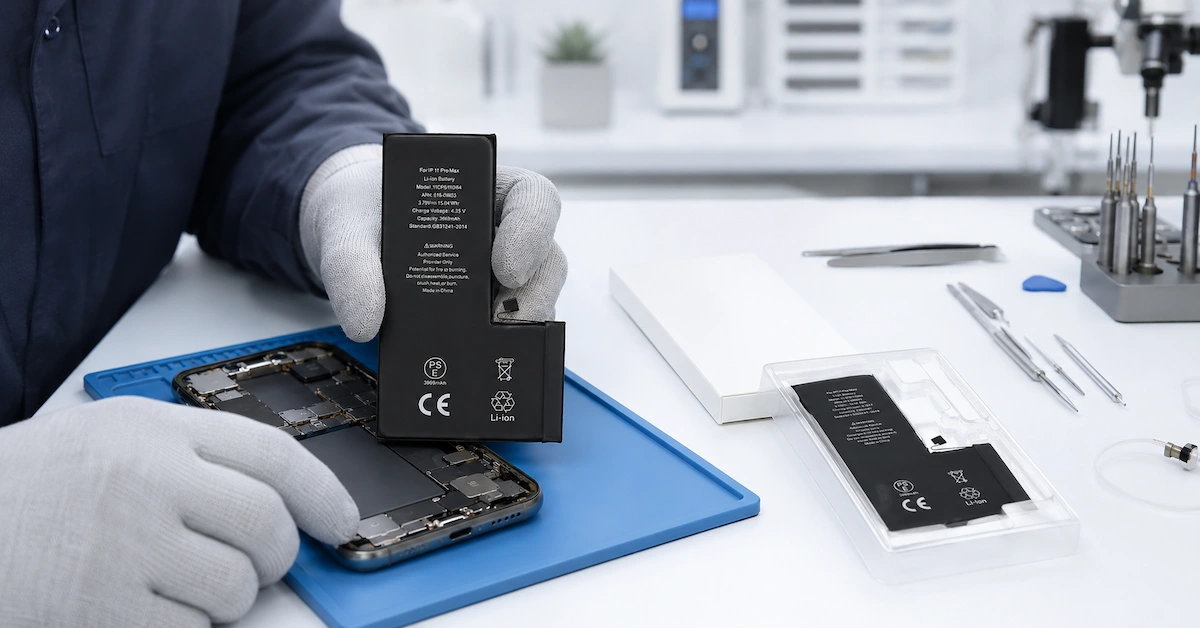
Unlike many smaller smartphone batteries, an iPad battery occupies a large internal area and can require more time to remove and reinstall.
A compatibility error therefore wastes both a battery and technician labor.
Refurbishment Facilities
Tablet refurbishers often process batches of used devices.
Their priorities include:
- repeatable capacity;
- predictable physical fitment;
- stable batch quality;
- low swelling risk;
- low rework rates;
- stable replenishment.
For this customer group, one perfect sample is not enough.
The real question is whether production batteries continue to match the approved sample.
Spare-Parts Wholesalers and Distributors
Wholesalers need broader model coverage.
They should evaluate:
- fast-moving iPad models;
- battery-reference mapping;
- mixed-model purchasing;
- inventory labels;
- safe packaging;
- reorder stability;
- warranty procedures.
A wholesaler's challenge is not simply finding batteries.
It is maintaining an organized iPad replacement battery portfolio that downstream repair businesses can order accurately.
E-Commerce Spare-Parts Sellers
Online sellers need accurate compatibility data because buyers often search using:
- iPad generation;
- display size;
- device model number;
- battery reference.
Poor product mapping can cause returns even when the battery itself is functional.
Private-Label Battery Brands
Private-label customers need battery consistency plus commercial customization.
Requirements may include:
- branded labels;
- barcodes;
- retail packaging;
- model identification;
- warning information;
- warranty information;
- inner-carton labels;
- export cartons.
ESC's current A2042 product page states that customized labels, barcodes and OEM packaging can be supported for professional battery programs.
Why iPad Battery Compatibility Is More Complex Than Screen Size
One of the most important purchasing rules is:
Do not select an iPad battery only by the screen size or commercial product name.
An “11-inch iPad battery,” for example, is not a sufficiently precise specification.
Different iPad generations may use different:
- battery references;
- connector positions;
- cell layouts;
- voltage platforms;
- dimensions;
- internal structures.
Use the Device Model Number
A professional purchasing database should identify the exact iPad device model.
For example, ESC's current A2042 replacement battery is mapped to the 2018 first-generation iPad Pro 11-inch family, including device models A1980, A2013, A1934 and A1979.
This example shows why “iPad Pro 11 battery” is not enough information by itself.
Verify the Battery Reference
The battery reference should be treated separately from the iPad device model.
A useful purchasing structure is:
iPad Family → Generation → Device Model → Battery Reference → Voltage → Capacity → Connector → Supplier SKU
This reduces mistakes when a distributor stocks many generations.
Check Connector Position
Two large tablet batteries may appear similar while using different connector arrangements.
The connector must align with the intended logic-board configuration.
Check the Complete Physical Structure
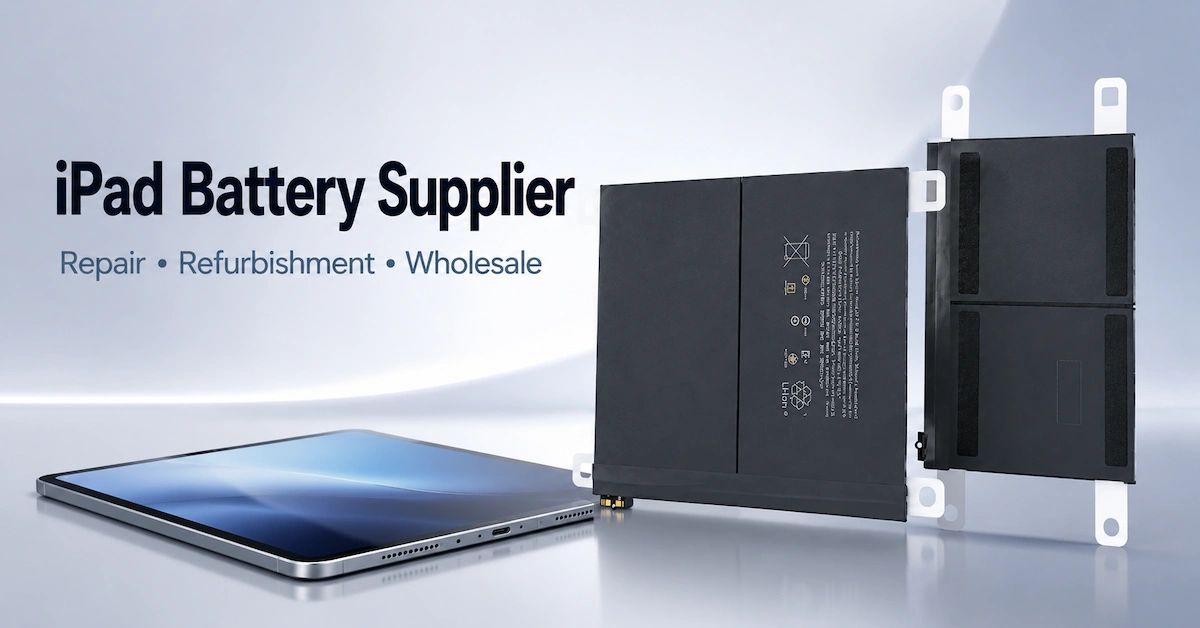
Some iPad batteries use model-specific multi-cell structures.
Therefore, buyers should verify:
- cell layout;
- overall dimensions;
- flex routing;
- connector position;
- adhesive area;
- pack geometry.
This is more reliable than selecting by catalog photo.
Which Specifications Should an iPad Battery RFQ Include?
An RFQ should give the supplier enough information to identify the correct battery and quote the same specification that the buyer intends to test.
| Specification | What Buyers Should Verify | Why It Matters |
|---|---|---|
| iPad family | Air, Pro, standard, mini | First compatibility layer |
| Generation | Exact generation | Prevents cross-generation errors |
| Device model | Axxxx model number | Precise device identification |
| Battery reference | Replacement battery code | Improves sourcing accuracy |
| Rated capacity | mAh | Defines battery capacity |
| Energy | Wh | Cross-checks battery rating |
| Nominal voltage | Voltage platform | Electrical compatibility |
| Battery structure | Single/multi-cell layout | Installation compatibility |
| Dimensions | Physical pack measurements | Mechanical fitment |
| Connector | Position and configuration | Installation reliability |
| Internal resistance | Representative QC data | Batch consistency |
| Capacity test | Actual discharge result | Verifies performance |
| Aging test | Finished-product screening | Helps identify early failures |
| Packaging | Cell and flex protection | Reduces logistics damage |
| Batch identification | Lot or production reference | Supports traceability |
A supplier quotation that does not clearly identify the battery being quoted creates unnecessary risk.
Why Capacity Must Be Verified Instead of Assumed
The capacity printed on a battery label is a specification.
It is not automatically proof that every battery in a shipment will deliver that result.
Professional buyers should verify representative samples through controlled capacity testing.
Useful data includes:
- rated mAh;
- measured discharge capacity;
- nominal voltage;
- Wh;
- charging behavior;
- discharge behavior;
- variation between tested units.
ESC's current A2042 listing, for example, specifies 3.77V, 7812mAh and 29.45Wh for its compatible first-generation iPad Pro 11-inch replacement battery. Those figures apply to that specific product and should not be reused for unrelated iPad models.
This model-specific approach is important.
An iPad battery supplier should provide specifications SKU by SKU rather than giving one generic tablet-battery parameter table for every product.
Why Wh and mAh Should Be Checked Together
B2B buyers often compare only mAh.
However, watt-hours provide another useful specification because they relate capacity to battery voltage.
When reviewing quotations, check whether:
mAh + voltage + Wh
are logically consistent.
If one specification looks significantly different from expected values for a particular model, confirm it before approving the product.
The goal is not to find the largest printed number.
The goal is to verify the correct battery platform for the intended iPad.
Why Internal Resistance Matters for iPad Battery QC
Internal resistance provides useful information about how a battery behaves under load.
For procurement, the objective should not be to chase one universal resistance number across every iPad battery.
Different battery designs and testing conditions can produce different readings.
Instead, buyers should ask:
How consistent are representative batteries tested under the same conditions?
Compare Multiple Samples
Test several units from a sample lot.
Look for unusually high or inconsistent values.
Keep Testing Conditions Consistent
Resistance can vary with:
- state of charge;
- temperature;
- measurement method;
- battery condition.
Supplier comparison is more meaningful when the test method remains consistent.
Use Resistance as One QC Indicator
Internal resistance should complement:
- capacity testing;
- voltage inspection;
- physical inspection;
- installation testing;
- charge-discharge evaluation.
No single measurement should replace a complete incoming QC process.
Why Physical Fitment Is Especially Important With iPad Batteries
Tablet batteries are physically larger than typical phone batteries.
This increases the importance of mechanical accuracy.
A poorly matched battery can cause:
- difficulty positioning the cells;
- connector misalignment;
- adhesive problems;
- pressure inside the housing;
- additional technician labor;
- damage during reassembly.
ESC's A2042 product information specifically recommends confirming the exact iPad model, original battery reference, connector position and physical battery structure before bulk purchasing.
For repair businesses, this is an important cost consideration.
A slightly cheaper battery is not a saving if installation takes significantly longer.
How Should Buyers Test iPad Battery Samples?
A structured sample test can identify many sourcing problems before the first large shipment.
Step 1: Confirm the Exact Model
Record:
- iPad series;
- generation;
- device model;
- battery reference;
- capacity;
- voltage.
Do this before testing electrical performance.
Step 2: Compare the Original Battery Structure
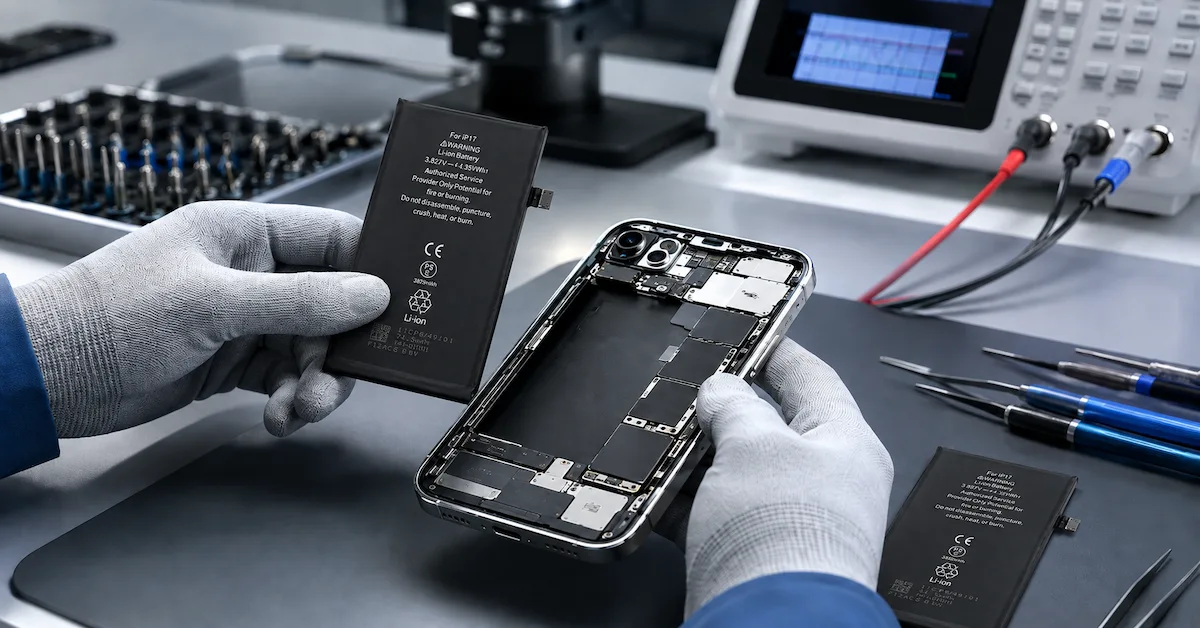
Before installing a replacement battery, compare it with the battery removed from the target device.
Check:
- cell shape;
- cell layout;
- connector;
- flex location;
- pack dimensions.
Step 3: Conduct Physical Inspection
Check representative samples for:
- deformation;
- swelling;
- wrinkles;
- damaged flex cables;
- poor insulation;
- connector damage;
- inconsistent assembly.
Because iPad batteries have relatively large cell surfaces, physical abnormalities should not be ignored.
Step 4: Measure Voltage
Compare several batteries from the same sample lot.
Do not evaluate only one unit.
Step 5: Measure Internal Resistance
Use consistent equipment and testing conditions.
Record both individual readings and batch variation.
Step 6: Conduct Capacity Testing
Run representative batteries through an agreed charge-discharge test.
Compare actual results with the supplier's specification.
Step 7: Perform Real-Device Installation
This step is essential.
Confirm:
- battery structure;
- connector fit;
- installation position;
- device startup;
- charging;
- battery-percentage behavior;
- standby operation.
Apple publishes device-specific repair manuals that include dedicated battery safety and battery procedures, reinforcing that battery servicing should follow the requirements of the specific device rather than a generic tablet-repair method.
Step 8: Conduct Aging Observation
A battery that passes the initial electrical test can still develop an early failure.
Pre-shipment aging can help detect abnormal units before distribution.
Step 9: Record the Approved Sample
Maintain an approval record containing:
Supplier
Battery reference
Device models
Voltage
Capacity
IR results
Installation result
Appearance
Approval date
This gives incoming inspectors a reference for future shipments.
Sample Quality vs. Production Quality
The sample answers:
“Can this supplier produce a good battery?”
Bulk production answers:
“Can this supplier repeatedly produce the same battery?”
The second question matters more for B2B operations.
Before approving an iPad battery supplier, ask how production controls:
- incoming cells;
- component consistency;
- cell matching;
- connector assembly;
- protection circuits;
- insulation;
- capacity;
- voltage;
- internal resistance;
- appearance;
- aging;
- outgoing inspection.
For a refurbishment factory processing hundreds of tablets, a small increase in defective or difficult-to-install batteries can create substantial additional labor.
Why Used-Battery and New-Replacement Decisions Matter
Apple's current iPad parts guidance recommends installing new batteries rather than used battery cells, noting that used cells can be damaged during removal and may create risks such as overheating or swelling.
For B2B refurbishers, this provides a useful procurement principle:
Do not evaluate only whether a battery can physically be reused. Evaluate whether the replacement strategy supports predictable safety and service quality.
A professional refurbishment program should have a clear battery policy based on:
- battery condition;
- device grade;
- customer expectation;
- repair warranty;
- incoming diagnostic results.
How Should Wholesalers Build an iPad Battery SKU Portfolio?
Buying every possible iPad battery in equal quantities is rarely efficient.
Wholesalers can divide models by real market demand.
A-Class Models
High-turnover repair and refurbishment models.
Strategy:
- deeper inventory;
- frequent replenishment;
- closer QC monitoring.
B-Class Models
Regular but moderate demand.
Strategy:
- controlled stock;
- scheduled replenishment.
C-Class Models
Long-tail or aging models.
Strategy:
- lower inventory;
- flexible purchasing;
- avoid overstocking.
ESC's current tablet and laptop battery category includes multiple tablet battery SKUs, including an iPad Air 4/5 A2288 listing, illustrating why model-level inventory organization matters.
A useful wholesale database can contain:
| Field | Purpose |
| iPad family | Product grouping |
| Device model | Compatibility |
| Battery reference | Purchasing accuracy |
| Supplier SKU | Reordering |
| Monthly demand | Inventory planning |
| Current stock | Reorder control |
| Lead time | Purchasing schedule |
| Claim rate | Quality monitoring |
| Return reason | Problem analysis |
Over time, this gives buyers evidence for deciding which models deserve deeper inventory.
What Is the Real Cost of a Cheap iPad Battery?
Unit price is only one part of sourcing cost.
| Risk | Hidden Cost |
| Incorrect model | Reordering and delays |
| Wrong connector | Technician rework |
| Poor fitment | Longer repair time |
| Low actual capacity | Customer complaints |
| Early degradation | Warranty claims |
| Swelling | Repair and safety risk |
| Poor packaging | Transit damage |
| SKU errors | Warehouse returns |
| Inconsistent batches | Higher incoming inspection |
| OEM quality issues | Private-label reputation |
For repair and refurbishment buyers, the useful calculation is:
Battery cost + installation labor + rework + returns + warranty + inventory errors
A lower unit price may not produce a lower total cost.
What Packaging Should Wholesale iPad Batteries Use?
iPad batteries require careful logistics handling because of their larger size and relatively broad cell surfaces.
Professional buyers should discuss packaging before bulk production.
Important considerations include:
Cell Protection
Packaging should reduce bending, crushing and pressure.
Flex and Connector Protection
The flex cable and connector should not be able to move freely against other components during transport.
Model Identification
When cartons contain multiple iPad battery models, labels should clearly identify:
- battery reference;
- compatible model;
- quantity;
- buyer SKU.
Private-Label Packaging
OEM buyers may additionally require:
- branded labels;
- retail boxes;
- barcodes;
- warranty cards;
- inner cartons;
- export-carton markings.
ESC states on its current A2042 page that it supports customized battery labels, barcodes, retail packaging and export-carton options for OEM projects.
What Should Importers Check Before Shipping iPad Batteries?
Lithium batteries are regulated during international transport.
The UN Manual of Tests and Criteria includes subsection 38.3, which covers lithium cells and batteries. Buyers should confirm applicable documentation for the exact battery configuration being shipped rather than assuming paperwork from one model applies to every battery.
Importers should discuss:
- applicable UN 38.3 documentation;
- exact battery identification;
- shipment packaging;
- marks and labels;
- transport mode;
- carrier requirements;
- destination requirements.
The official UN Manual of Tests and Criteria should be used when checking the relevant framework.
What Should Private-Label iPad Battery Buyers Customize?
Private-label supply involves more than adding a logo.
Battery Label
Possible fields include:
- brand;
- battery reference;
- compatible model;
- voltage;
- capacity;
- Wh;
- warnings;
- barcode.
Retail Packaging
A retail package can provide:
- device compatibility;
- battery reference;
- installation notes;
- distributor information;
- warranty information;
- local-language content.
SKU Management
Private-label distributors should build one consistent coding system across all tablet battery models.
Carton Identification
Mixed-model orders should be organized so warehouse employees can identify the battery without opening every retail package.
Quality Specification
OEM branding should only begin after the technical battery specification and approved sample are confirmed.
Otherwise, buyers risk investing in packaging before verifying the product.
What Questions Should You Ask an iPad Battery Supplier?
Before approving a new supplier, ask questions that reveal actual manufacturing and QC capability.
- Which iPad generations and device models do you currently support?
- How do you map device model numbers to battery references?
- How do you verify connector and battery structure?
- What capacity applies to each battery model?
- Can buyers perform sample testing before bulk ordering?
- Is internal resistance checked?
- How is capacity tested?
- What outgoing inspections are performed?
- Is aging included in the production process?
- How are production batches identified?
- Can you support mixed-model wholesale orders?
- What packaging protects larger tablet batteries?
- Can labels and packaging be customized?
- Which transport documents are available for the exact battery?
- How are warranty or quality claims handled?
The answers to these questions are generally more valuable than a catalog claiming to offer hundreds of battery models.
Common iPad Battery Sourcing Mistakes
Choosing Only by Screen Size
An 11-inch or 12.9-inch description does not confirm battery compatibility.
Confusing Device Models and Battery References
Keep both identifiers in the purchasing database.
Trusting Capacity Labels Without Testing
Use representative discharge testing before bulk approval.
Testing Only One Sample
Several units provide better information about consistency.
Ignoring Physical Battery Structure
Large tablet batteries require accurate shape, connector and cell layout.
Skipping Real-Device Installation
Electrical test results cannot prove physical compatibility.
Buying Every Model in Equal Quantity
Build inventory according to actual repair and refurbishment demand.
Choosing by Price Alone
Include labor, return and warranty costs in supplier evaluation.
Assuming One Certification File Covers Every SKU
Check documentation for the exact product being purchased.
FAQ About iPad Battery Suppliers
How do I choose a reliable iPad battery supplier?
Evaluate the supplier's model-matching process, battery reference accuracy, voltage, capacity, Wh, internal resistance, connector configuration, physical battery structure, sample testing, batch QC, packaging and after-sales procedure.
For B2B buyers, repeatability is usually more important than the lowest quotation.
Does ESC supply iPad replacement batteries?
ESC currently lists iPad batteries in its tablet and laptop replacement battery category and has model-specific product pages such as its A2042 battery for compatible first-generation iPad Pro 11-inch devices.
Current model availability should be confirmed before ordering.
Should repair shops test iPad batteries before bulk purchasing?
Yes.
Testing should include:
- model verification;
- physical inspection;
- voltage;
- capacity;
- internal resistance;
- battery structure;
- connector compatibility;
- real-device installation;
- charging behavior.
Multiple samples provide better evidence than one unit.
Why is the iPad model number important?
Different generations with similar names or display sizes can use different battery configurations.
The Axxxx device model provides a more precise starting point for compatibility verification.
Can iPad replacement batteries be private labeled?
Yes, depending on the supplier and project requirements.
ESC's A2042 product page currently states support for customized battery labels, barcodes, retail packaging and export-carton options.
Does higher capacity automatically mean a better iPad battery?
No.
The battery should match the correct electrical and physical platform. Capacity claims should be technically credible and verified through testing.
How can wholesalers reduce iPad battery return rates?
Use accurate model mapping, maintain battery-reference data, test representative samples, check production batches, use clear SKU labels and track return reasons by model and supplier.
What information should I provide when requesting an iPad battery quotation?
Provide:
- iPad family;
- generation;
- device model number;
- battery reference if available;
- quantity per SKU;
- destination;
- packaging requirements;
- OEM requirements;
- sample requirements.
This allows the supplier to provide a more accurate quotation.
Conclusion: Choose an iPad Battery Supplier by Compatibility and Repeatable Quality
A professional iPad battery supplier should help buyers reduce compatibility problems, installation delays, quality variation and after-sales costs.
Repair centers need precise battery fitment.
Refurbishment facilities need stable batches.
Wholesalers need clear model mapping and inventory management.
Private-label brands need consistent batteries that can support their reputation.
Before approving a bulk order, verify:
iPad generation
device model
battery reference
voltage
capacity
Wh
battery structure
connector
dimensions
internal resistance
real-device fitment
Then evaluate how the supplier manages sample approval, production QC, aging, packaging, traceability and after-sales claims.
ESC supplies tablet replacement batteries for professional repair, refurbishment, wholesale and distribution applications, with model-specific iPad products available in its current catalog.
If you are sourcing iPad replacement batteries, prepare your device models, battery references, quantities, destination market and packaging requirements, then contact ESC to confirm current models, samples and project terms.