
Quick Answer: AirPods Pro repair should begin with the exact generation and the reported fault. Crackling, weak Active Noise Cancellation (ANC), poor microphone quality, and one-ear audio loss may result from blocked acoustic meshes, poor ear-tip sealing, software issues, charging faults, or damaged hardware. Start with Apple's supported cleaning, settings, charging, and reset procedures. If those fail, compare official service or earbud replacement with professional component-level repair. Only source a replacement battery after confirming a battery-related fault and model compatibility.
AirPods Pro are compact wireless earbuds with closely integrated audio, battery, microphone, and wireless electronics.
That integration makes fault diagnosis more important than it is for many larger consumer electronics.
A customer might report that the left earbud produces static during calls. Another might complain that Active Noise Cancellation no longer blocks background noise. A refurbishment business might receive a shipment of used earbuds with inconsistent audio quality and battery runtime.
These complaints do not necessarily have the same cause.
AirPods Pro repair is therefore best approached as a structured diagnostic and commercial decision rather than a general instruction to replace internal components.
For repair shops, the goal is to identify the actual fault before choosing a service procedure.
For refurbishers, the goal is to determine whether a device can meet the required resale standard.
For battery distributors, the goal is to source the correct replacement cell only when the technical evidence supports battery replacement.
ESCCharge supplies aftermarket replacement batteries for selected wireless-earbud applications, including a verified CP1154 product for first-generation AirPods Pro.
1. What Are the Most Common AirPods Pro Repair Problems?
The main repair complaints can be divided into audio output, noise control, microphones, connectivity, charging, and battery runtime.
AirPods Pro fault diagnosis matrix
| Reported problem | Possible cause | First recommended check |
|---|---|---|
| Crackling or static | Acoustic obstruction, software, microphone or hardware problem | Reproduce the sound under controlled conditions |
| ANC not working | Poor ear-tip seal, blocked mesh, settings or hardware fault | Verify noise-control mode and fit |
| Weak bass | Poor seal, contamination or audio-system problem | Check ear tips and speaker mesh |
| One earbud silent | Charging, pairing, audio or hardware fault | Confirm individual charging and playback |
| One earbud quieter | Debris, audio balance or speaker problem | Inspect mesh and balance settings |
| Microphone sounds muffled | Obstruction, device settings or microphone fault | Compare controlled microphone recordings |
| Random disconnections | Wireless connection, software or power issue | Check updates and supported reset procedure |
| Short runtime | Battery aging, incomplete charging or usage conditions | Compare controlled left/right runtime |
| Case loses charge | Case battery, charging input or electronics fault | Diagnose the charging case separately |
| Earbud overheats or deforms | Potential battery or electrical safety problem | Stop ordinary use and isolate safely |
This matrix is a starting point, not proof of a specific defective component.
Several faults can produce similar symptoms.
A repair business should record what the device actually does rather than immediately assigning a replacement part.
2. How Do You Identify AirPods Pro 1, 2, and 3?
Before performing any repair or ordering replacement batteries, identify the exact model.
The name "AirPods Pro" refers to several product generations with different hardware and charging-case configurations.
AirPods Pro model comparison
| Generation | Earbud model numbers | Introduced | Charging-case configuration |
|---|---|---|---|
| AirPods Pro 1 | A2083, A2084 | 2019 | Lightning charging case |
| AirPods Pro 2, Lightning | A2698, A2699, A2931 | 2022 | MagSafe case with Lightning |
| AirPods Pro 2, USB-C | A3047, A3048, A3049 | 2023 | MagSafe case with USB-C |
| AirPods Pro 3 | A3063, A3064, A3065 | 2025 | MagSafe case with USB-C |
Source: Apple — Identify Your AirPods.
How to check the model
For a paired device, open Settings and review the connected AirPods information.
Apple also provides model identifiers printed on the earbuds.
The case model and the individual earbuds should both be checked when assessing a used set.
Why exact identification matters
Earbuds from different generations should not be treated as universally interchangeable.
Differences can affect:
-
Internal battery construction
-
Mechanical dimensions
-
Charging interfaces
-
Acoustic components
-
Firmware and pairing behavior
-
Replacement-part sourcing
For B2B purchasing, a product described only as an "AirPods Pro battery" is not sufficiently specified.
The buyer should identify the exact generation and the battery's intended location before requesting a quotation.
3. How Do You Fix AirPods Pro Crackling or Static Noise?
Crackling is one of the better-known AirPods Pro complaints.
The problem may appear during music playback, calls, exercise, or exposure to particular environmental sounds.
Step 1: Reproduce the problem
Determine whether the noise occurs:
-
On the left or right earbud
-
During music playback
-
During voice calls
-
With ANC enabled
-
With Transparency mode enabled
-
During movement
-
Across more than one compatible source device
A clear record helps distinguish a recurring fault from an isolated connection issue.
Step 2: Review software and firmware
Check that the connected device uses appropriate current software and that the AirPods firmware is updated.
A software problem should be considered before attempting invasive repair.
Step 3: Inspect acoustic openings
Earwax, dust, or other contamination may interfere with acoustic performance.
Follow Apple's model-specific cleaning guidance.
Do not use sharp objects to puncture microphone or speaker meshes.
Step 4: Check the noise-control modes
Compare the reported symptom with ANC and Transparency mode under appropriate conditions.
Record whether the complaint is associated with a particular mode.
Step 5: Try a supported reset
If the problem remains, follow Apple's model-specific reset procedure.
Do not assume that every AirPods Pro generation uses the same reset controls.
Step 6: Decide whether professional service is required
If the fault persists after supported troubleshooting, professional evaluation may be necessary.
Replacing the battery will not automatically repair a defective speaker, microphone, or acoustic component.
What about Apple's original AirPods Pro sound service program?
Apple published a service program addressing certain first-generation AirPods Pro manufactured before October 2020.
Affected symptoms included crackling/static and ANC problems.
The program covered eligible units for three years after their first retail sale.
It was not a lifetime service entitlement, did not cover later AirPods Pro generations, and did not include the charging case.
Because that coverage window was limited, a buyer in 2026 should not assume an old unit remains eligible. Check current service options directly with Apple.
Reference: Apple — AirPods Pro Service Program for Sound Issues.
4. Why Is AirPods Pro Active Noise Cancellation Not Working?
ANC uses microphones and audio processing to counter external sound.
Its effectiveness also depends on the physical seal between the ear tip and the ear.
A loss of noise reduction does not necessarily prove that the electronic noise-cancellation system has failed.
Check ear-tip fit first
Poor sealing can reduce perceived bass and isolation.
Apple provides an Ear Tip Fit Test for AirPods Pro 1 and 2.
AirPods Pro 3 uses the Acoustic Seal Test.
Repair shops should use the applicable test and confirm that the selected ear tips provide a suitable fit.
Inspect microphone meshes
Blocked external microphones may affect ANC and produce unwanted audio behavior.
Use the correct cleaning procedure for the identified generation.
Verify noise-control settings
Confirm that ANC is actually selected.
Where available, check whether an adaptive noise-control setting is changing the behavior.
The available modes vary by generation and software.
Repeat the test consistently
For a professional inspection, use a consistent source device, ear-tip configuration, firmware version, and background-noise environment.
This allows the technician to compare a suspect earbud with a known-good reference.
Does weak ANC always require replacing an earbud?
No.
First exclude fit, cleaning, settings, and connection problems.
If the issue persists and the hardware is defective, official service or replacement may be more practical than internal microphone repair.
Apple provides troubleshooting guidance in If Active Noise Cancellation Isn't Working as Expected.
5. How Should You Diagnose AirPods Pro Microphone Problems?
A microphone complaint may involve muffled audio, low recording volume, intermittent speech pickup, or distortion.
These symptoms can result from contamination, environmental noise, audio routing, or microphone hardware problems.
Separate playback from microphone performance
A customer may hear music normally while callers report poor voice quality.
That distinction suggests the technician should investigate the microphone path rather than replacing the speaker or battery.
Recommended microphone inspection
-
Confirm the exact device generation and firmware.
-
Inspect the external microphone openings.
-
Check the source device's audio-input selection.
-
Use a test application or communication session that is confirmed to use the AirPods microphone.
-
Compare left and right microphone behavior where supported.
-
Record intelligibility, distortion, interruptions, and background-noise behavior.
-
Repeat the test after supported cleaning or software troubleshooting.
Avoid an unreliable recording test
A recording made on an iPhone does not automatically prove that the AirPods microphone was used.
Some applications may use the phone's built-in microphone depending on routing and software behavior.
Verify the actual input source before interpreting the result.
When is microphone replacement justified?
Only when the fault has been confirmed and an appropriate repair procedure is technically and commercially feasible.
Internal microphone work in sealed earbuds can require specialized tools and may create a high risk of damaging other components.
For many ordinary repair operations, replacing an eligible earbud through a supported service channel may be more practical.
6. What Should You Do When Only One AirPods Pro Earbud Works?
A silent earbud is not automatically a dead earbud.
It may not have charged correctly.
It may also have a pairing or audio-balance issue.
Recommended one-ear troubleshooting
Check the case's charge state and confirm that both earbuds are charging.
Inspect the relevant charging contacts without damaging them.
Then test the malfunctioning earbud individually.
Apple's official procedure includes charging the earbuds briefly, checking the charge indication, and testing the affected side while the other earbud remains in the case.
If playback still fails, a supported reset may help.
Compare left and right
| Check | Left earbud | Right earbud |
|---|---|---|
| Identified model | Record | Record |
| Charges in case | Pass/Fail | Pass/Fail |
| Connects normally | Pass/Fail | Pass/Fail |
| Plays audio | Pass/Fail | Pass/Fail |
| Normal volume | Pass/Fail | Pass/Fail |
| Microphone behavior | Pass/Fail | Pass/Fail |
| ANC/Transparency | Pass/Fail | Pass/Fail |
| Runtime | Record | Record |
This record is especially useful for used-AirPods refurbishment.
What if the fault remains?
The technician should determine whether the issue concerns charging, audio electronics, battery performance, or another internal problem.
Only then should the business approve a component repair or replacement.
For charging-case-specific problems, see ESC's AirPods Charging Case Repair Guide.
7. Is AirPods Pro Battery Replacement Worth Attempting?
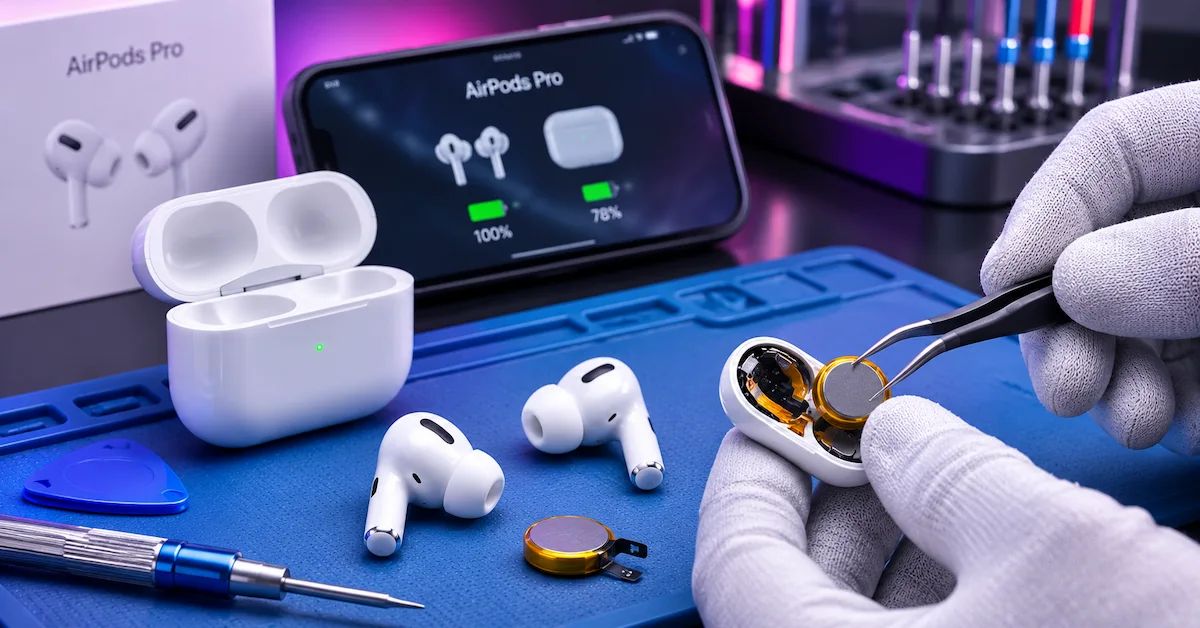
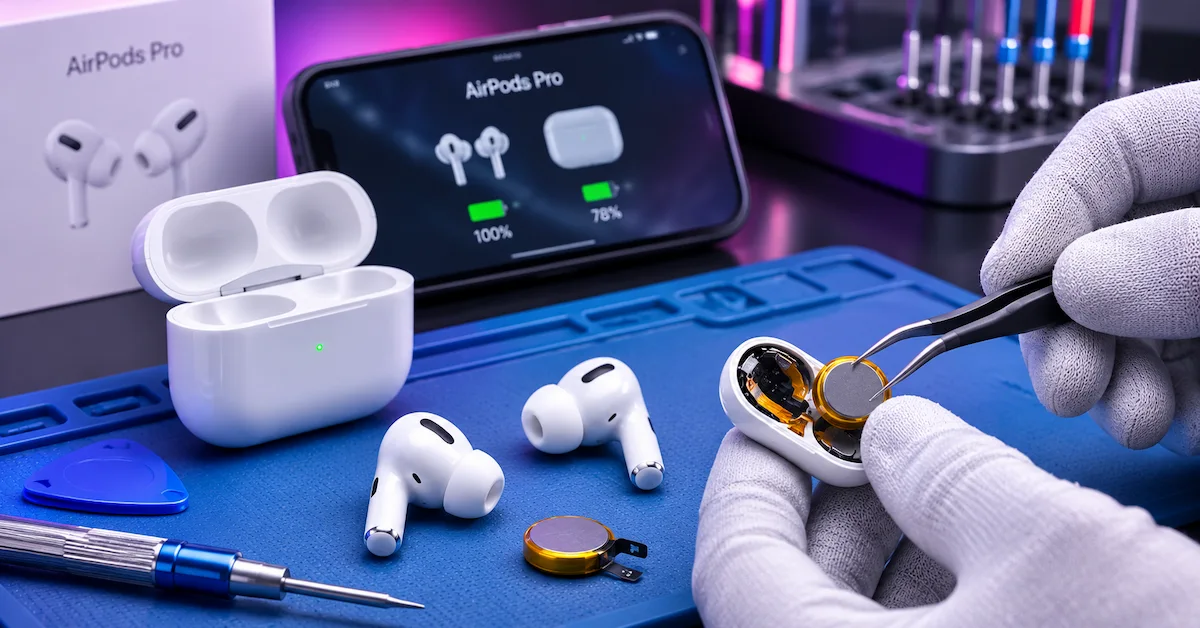
Battery replacement is technically possible in specialized repair operations, but AirPods Pro earbuds are difficult to open and reassemble.
Unlike many smartphones, their small enclosures are densely packed with glued components.
The repair process can expose the internal battery, acoustic hardware, and delicate electrical connections to damage.
What does independent teardown evidence show?
iFixit's AirPods Pro Teardown documents the original earbuds' compact, heavily integrated construction and major repairability limitations.
This supports an important practical distinction:
A replacement battery being commercially available does not mean installing it is easy, safe, or economical for every repair business.
Who should consider component-level battery repair?
The most suitable buyers are specialized facilities with appropriate micro-repair capability, battery-handling procedures, and completed-device inspection.
A general electronics retailer without suitable tools or trained technicians may be better served by offering official replacement options.
When does battery replacement make sense?
Consider it when:
-
The battery fault is reasonably confirmed.
-
The exact generation and cell are identified.
-
A compatible replacement battery is available.
-
The repair facility can perform the procedure safely.
-
The completed earbud can meet agreed functional standards.
-
Labor and risk costs remain commercially acceptable.
What should not be repaired routinely?
Do not treat visibly damaged, swollen, leaking, or unusually hot lithium cells as ordinary repair items.
Avoid puncturing, crushing, short-circuiting, or applying uncontrolled heat to a battery.
The repair facility must have clear procedures for stopping unsafe work.
8. Which AirPods Pro Battery Does ESCCharge Actually Supply?
ESCCharge publishes a specific replacement battery for first-generation AirPods Pro.
Its product is intended for professional component-level earbud repair and B2B sourcing.
ESC CP1154 AirPods Pro 1 battery specifications
| Specification | ESC published information |
|---|---|
| Product | CP1154 Replacement Battery |
| Device generation | AirPods Pro 1 |
| Compatible earbud models | A2083, A2084 |
| Application | Internal earbud battery |
| Battery chemistry | Lithium-ion |
| Nominal voltage | 3.7V |
| QC described | Voltage, internal resistance, consistency and aging checks |
| Supplier warranty | 12 months listed |
| Published lead time | Approximately 3–5 days, subject to confirmation |
| MOQ guidance | 100-piece mixed-model order recommended |
| Private-label MOQ | 200 pieces listed |
| B2B buyers | Repair shops, refurbishers, wholesalers and distributors |
These are supplier-published specifications and commercial statements.
They are not independently verified test results or automatically guaranteed terms for every purchase order.
ESC also lists product documentation, but buyers should request the applicable files for the actual item and destination market.
Where can you review the product?
CP1154 AirPods Pro 1 Replacement Battery for A2083/A2084
Important compatibility restriction
This product is specified for first-generation AirPods Pro.
Do not assume it fits AirPods Pro 2 or AirPods Pro 3.
Their internal battery configurations and mechanical requirements must be verified separately.
Is this a charging-case battery?
No.
The CP1154 product is for the individual earbuds.
It should not be confused with the battery inside an AirPods charging case.
ESC also maintains an AirPods Replacement Battery category.
9. How Do You Compare Cleaning, Repair, and Full Earbud Replacement?
Each method has different technical and commercial implications.
AirPods Pro service decision matrix
| Option | Suitable situation | Main limitation | B2B consideration |
|---|---|---|---|
| Cleaning and supported troubleshooting | Obstruction, minor audio issue, software-related symptoms | Cannot repair confirmed internal hardware damage | Low intervention cost |
| Supported reset and reconnection | Pairing or software-related issue | Does not repair defective electronics | Good early diagnostic step |
| Official Apple service | Eligible hardware failures | Pricing and eligibility vary | Document service cost and turnaround |
| Replace one earbud | Confirmed single-side hardware fault | Exact model matching required | Verify final paired operation |
| Professional battery replacement | Confirmed battery fault on supported model | High micro-repair complexity | Evaluate yield and labor |
| Replace complete set | Multiple faults or uneconomical repair | Higher replacement expense | Compare with resale economics |
| Reject refurbishment | Unsafe or commercially unsuitable unit | No direct resale recovery | Prevents unqualified devices entering inventory |
How does Apple handle repairs?
Apple offers service and replacement options for AirPods and charging cases.
Availability and actual fees depend on the product, location, coverage, and inspection result.
AppleCare coverage may affect battery-service charges when eligible conditions are met.
See Apple's Official AirPods Service and Repair page.
Why the cheapest method may not be best
A battery cell may cost less than a replacement earbud, but the cell cost is only one part of the repair.
Labor, opening damage, reassembly, functional testing, and future returns must also be considered.
The appropriate decision is the one that meets the finished-device standard at an acceptable total cost.
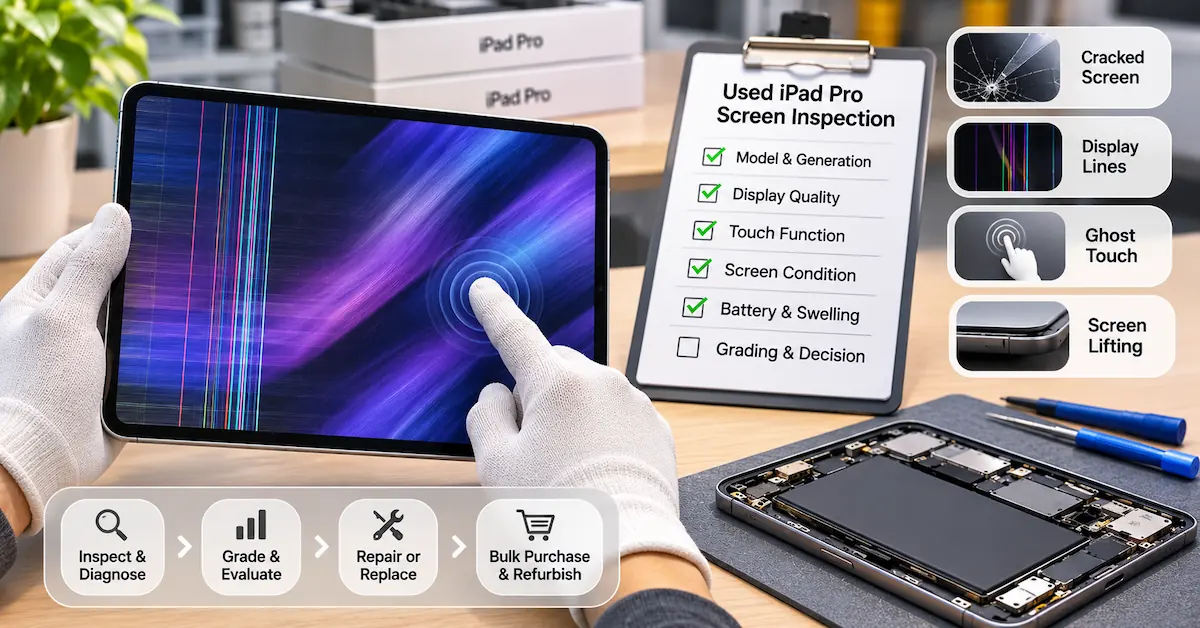
10. How Should a Refurbishment Business Test Used AirPods Pro?
For used-device refurbishment, the objective is to grade the complete left-earbud, right-earbud, and charging-case system.
This differs from diagnosing a single customer complaint.
Recommended B2B inspection checklist
| Inspection area | Acceptance requirement |
|---|---|
| Model identity | Correct generation confirmed |
| Earbud pairing | Both earbuds connect correctly |
| Charging case | Compatible case and normal charging behavior |
| Left/right charging | Each earbud charges reliably |
| Stereo playback | Both earbuds operate |
| Audio balance | No unacceptable imbalance |
| Crackling and static | No unresolved abnormal noise |
| ANC | Required mode operates acceptably |
| Transparency | Expected behavior confirmed |
| Microphone | Acceptable voice pickup |
| Controls and sensors | Required functions verified |
| Ear tips and meshes | Clean and appropriate for resale |
| Battery runtime | Meets written acceptance criteria |
| Physical condition | No unacceptable damage |
| Safety | No battery or enclosure safety concerns |
| Ownership and pairing | Previous-owner association appropriately resolved |
| Final grade | Written resale condition assigned |
How should ANC be tested?
An ordinary listening test may help identify severe problems, but it does not measure an exact noise-reduction figure.
If a purchaser requires numerical ANC attenuation specifications, an appropriate acoustic measurement setup and agreed procedure are necessary.
Do not invent a universal pass/fail decibel threshold.
How should microphone quality be graded?
Use a controlled test with a verified microphone input path.
Compare the result against an approved reference under similar environmental conditions.
A defined sample evaluation is more reliable than a statement that the microphone "sounds fine."
How should battery runtime be tested?
For repeatable comparisons, standardize relevant conditions such as:
-
Starting charge state
-
Listening mode
-
Playback level
-
Audio content
-
Source device
-
Test duration
-
Firmware and relevant settings
Record left and right earbuds separately.
A displayed battery percentage does not independently prove the actual usable capacity of the internal cell.
11. How Do You Calculate AirPods Pro Repair Profitability?
Repair-versus-replace decisions are particularly important for older first-generation AirPods Pro.
A business should consider the resale value of the complete tested set, not only the cost of a replacement component.
Cost-per-accepted-device formula
Expected Repair Cost = Parts + Labor + Consumables + Testing + Expected Rework + Warranty Allowance
The business can then calculate:
Expected Contribution = Net Resale Revenue − Acquisition Cost − Total Repair Cost − Other Selling Costs
Illustrative example
The following example is hypothetical and does not represent actual ESC prices, service quotations, or measured repair success rates.
| Cost item | Component-level battery repair | Replacement earbud route |
|---|---|---|
| Parts or replacement | $12 | $42 |
| Labor | $25 | $8 |
| Inspection and consumables | $8 | $7 |
| Expected rework allowance | $18 | $5 |
| Total expected cost | $63 | $62 |
Even though the battery component is less expensive, the assumed labor and rework costs make the completed repair slightly more expensive.
The real comparison should use data from the repair facility's own process.
When should refurbishment be rejected?
Consider rejection when the device has multiple confirmed hardware failures, serious enclosure damage, unresolved pairing or ownership issues, or an unsafe battery condition.
A repair should also be reconsidered if the completed product cannot meet the promised grade or required commercial contribution.
12. What Quality Records Should Repair Shops Keep?
A consistent inspection record can reduce confusion when a repaired earbud fails again.
The main objective is to distinguish a defective replacement component from an installation issue or unrelated host-device fault.
Recommended repair traceability
| Record field | Why it matters |
|---|---|
| Device generation and model | Confirms correct application |
| Left/right identity | Isolates the failed side |
| Original complaint | Preserves reported symptom |
| Pre-repair condition | Establishes existing faults |
| Repair method | Documents what was performed |
| Replacement part SKU | Identifies component |
| Supplier lot | Supports batch investigation |
| Technician or facility | Enables process review |
| Final audio tests | Records functional acceptance |
| Final runtime test | Supports battery decisions |
| Warranty complaint | Tracks later failure |
| Root-cause category | Distinguishes actual defect types |
Suggested defect categories
Component defect: The replacement cell or other supplied part fails its agreed specification.
Installation defect: The earbud is damaged during opening, connection, or reassembly.
Existing device defect: The original audio, charging, or wireless electronics are faulty.
Software or pairing issue: The reported behavior relates to configuration or connection.
Unconfirmed complaint: The problem cannot be reliably reproduced.
A supplier warranty claim should use the relevant evidence rather than classifying every unsuccessful repair as a defective battery.
13. How Should Buyers Qualify an AirPods Pro Battery Supplier?
For wholesale repair businesses, the main purchasing objective is consistent model-specific performance.
Small batteries must fit constrained enclosures and work with the intended charging electronics.
Battery supplier qualification checklist
| Purchasing requirement | Buyer verification |
|---|---|
| Device compatibility | Exact generation and model |
| Battery identity | Approved cell model or part reference |
| Chemistry | Correct battery type |
| Voltage | Matches approved requirement |
| Physical dimensions | Suitable for intended enclosure |
| Connection | Correct terminals and polarity |
| Capacity | Tested using an appropriate method |
| Internal resistance | Measured under controlled conditions |
| Lot consistency | Representative sample results |
| Packaging | Appropriate battery protection |
| Documentation | Relevant product and shipping records |
| Warranty | Written scope and claims process |
| Supply terms | Confirmed quantity and lead time |
| Change control | Notification of material revisions |
What matters beyond capacity?
A higher advertised mAh rating does not automatically mean a better replacement battery.
In a very small earbud enclosure, dimensions, resistance, electrical stability, connections, and usable capacity all matter.
A buyer should not approve a cell based only on its printed capacity.
What does ESC publish about CP1154 quality control?
ESC describes voltage, internal resistance, consistency, and aging checks for its CP1154 AirPods Pro 1 replacement battery.
A professional buyer should confirm the exact acceptance criteria and supporting records for the approved order.
Can private-label buyers purchase CP1154?
ESC's product page lists OEM and private-label support, including a published private-label MOQ.
The specific design, labeling, quantity, price, and delivery terms should be confirmed through an order-specific quotation.
14. What Should an AirPods Pro Battery RFQ Include?
A generic request such as "Need AirPods Pro battery price" is not enough for reliable sourcing.
A useful quotation request should identify the generation, exact battery application, commercial quantities, and relevant technical requirements.
Recommended B2B RFQ
| RFQ field | What to provide |
|---|---|
| Buyer type | Repair chain, wholesaler, distributor or refurbisher |
| Device | AirPods Pro generation |
| Earbud model | Exact A-series number |
| Battery model | CP1154 or another verified specification |
| Battery location | Left/right earbud, not charging case |
| Required voltage | Approved nominal specification |
| Required capacity | Verified requirement; request data if unknown |
| Sample quantity | Planned qualification volume |
| Expected purchase volume | Initial and repeat orders |
| QC requirements | Voltage, capacity, resistance and consistency |
| Packaging | Standard or private-label |
| Destination market | Country or region |
| Documentation | Applicable product and transport records |
| Commercial terms | MOQ, lead time, warranty and quotation |
Example purchasing inquiry
"We are a wireless-earbud refurbishment and repair business sourcing CP1154 replacement batteries for first-generation AirPods Pro models A2083 and A2084. Please confirm the current 3.7V product specification, physical dimensions, connection details, sample availability, quality-control documentation, MOQ, wholesale pricing, lead time, warranty terms, and available packaging options."
Request an ESC quotation
For a verified first-generation AirPods Pro battery requirement, review the ESC CP1154 replacement battery.
For broader sourcing, browse the ESC AirPods battery category.
Repair chains, battery distributors, and refurbishment companies can contact ESC with exact models, quantities, sample requirements, and target markets.
A product-specific inquiry helps establish real compatibility and commercial terms before bulk purchasing.
Frequently Asked Questions
1. Can AirPods Pro be repaired?
Some problems can be resolved through supported cleaning, configuration, or reset procedures. Apple also offers service and replacement options. Internal component-level repairs may be technically possible for specialized facilities, but the compact construction makes them difficult and potentially uneconomical.
2. Why do my AirPods Pro make crackling noises?
Possible causes include acoustic obstruction, software or connection problems, microphone-related behavior, and internal hardware failure. Apple also documented crackling and ANC issues affecting certain first-generation units manufactured before October 2020. Diagnose the actual problem before replacing parts.
3. How do I fix AirPods Pro noise cancellation?
Confirm the correct listening mode, software and firmware status, ear-tip seal, and microphone mesh condition. Use Apple's model-specific Ear Tip Fit Test or Acoustic Seal Test where available. If supported troubleshooting does not resolve the issue, professional service may be needed.
4. Why is my AirPods Pro microphone not working?
Potential causes include blocked microphone openings, incorrect audio input selection, software problems, or hardware failure. Test with an application confirmed to use the AirPods microphone before treating the earbud as defective.
5. Can one AirPods Pro earbud be replaced separately?
Apple supports replacement options for individual earbuds, subject to model compatibility, availability, and applicable service conditions. The replacement must be properly matched and set up. The exact process depends on the generation.
6. How much does AirPods Pro repair cost?
Costs depend on the generation, warranty or AppleCare coverage, service provider, fault, and whether an individual earbud or another component requires replacement. Obtain a current service quotation. For professional refurbishment, include labor, inspection, and expected rework costs.
7. Can AirPods Pro batteries be replaced?
Battery replacement may be possible through specialized component-level repair. However, the small, heavily integrated enclosure makes the process difficult. A replacement cell should be purchased only after the exact battery fault, model compatibility, and repair feasibility have been established.
8. Is ESC CP1154 compatible with AirPods Pro 2 or AirPods Pro 3?
ESC identifies CP1154 as a replacement battery for first-generation AirPods Pro models A2083 and A2084. Compatibility with second- or third-generation AirPods Pro has not been established by that specification and must not be assumed.
9. How should refurbishers test used AirPods Pro?
Verify the generation, case and earbud charging, pairing, left/right audio, microphone function, ANC and Transparency behavior, acoustic condition, battery runtime, and physical safety. Record results by device and apply a consistent acceptance policy.
10. Where can repair businesses buy AirPods Pro replacement batteries wholesale?
ESC publishes a CP1154 aftermarket replacement battery for first-generation AirPods Pro and provides B2B purchasing information on its product page. Buyers can request specifications, samples, current MOQ, pricing, quality documentation, and packaging options through ESC's contact page.
Conclusion
AirPods Pro repair should begin with a confirmed fault, not a replacement-parts order.
Crackling, weak ANC, poor microphone performance, and one-ear audio problems may arise from different causes.
Supported cleaning, ear-tip fitting, software checks, and model-specific reset procedures can resolve some complaints without invasive work.
When a hardware fault remains, the business should compare official service, earbud replacement, and specialized component-level repair.
For refurbishment programs, successful repair also requires reliable audio testing, battery-runtime evaluation, clear grading, and consistent quality records.
Battery replacement is a separate decision.
A degraded battery can cause short runtime or unexpected power loss, but replacing it will not automatically resolve a defective microphone or speaker.
For professional repair facilities working with first-generation AirPods Pro, ESC offers a CP1154 3.7V replacement battery for A2083 and A2084.
The product should be evaluated against the intended repair process, including compatibility, sample performance, safe installation capability, and order-specific quality requirements.
Repair shops, refurbishment companies, wholesalers, and distributors can contact ESC to request technical information, sample availability, wholesale terms, and private-label options.
A structured approach to diagnosis, repair selection, and battery sourcing helps businesses reduce unnecessary component purchases, improve repair consistency, and make more defensible refurbishment decisions.