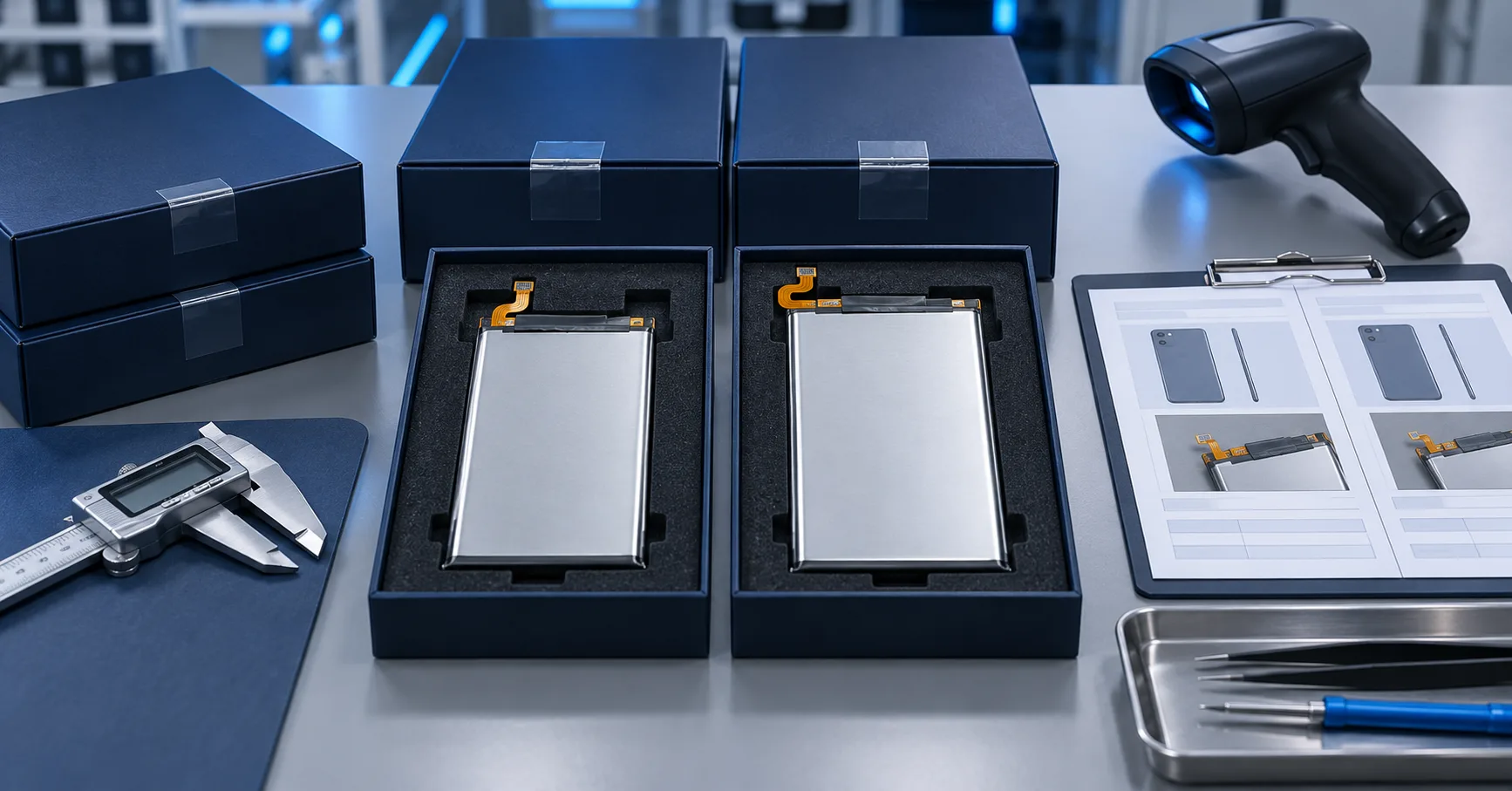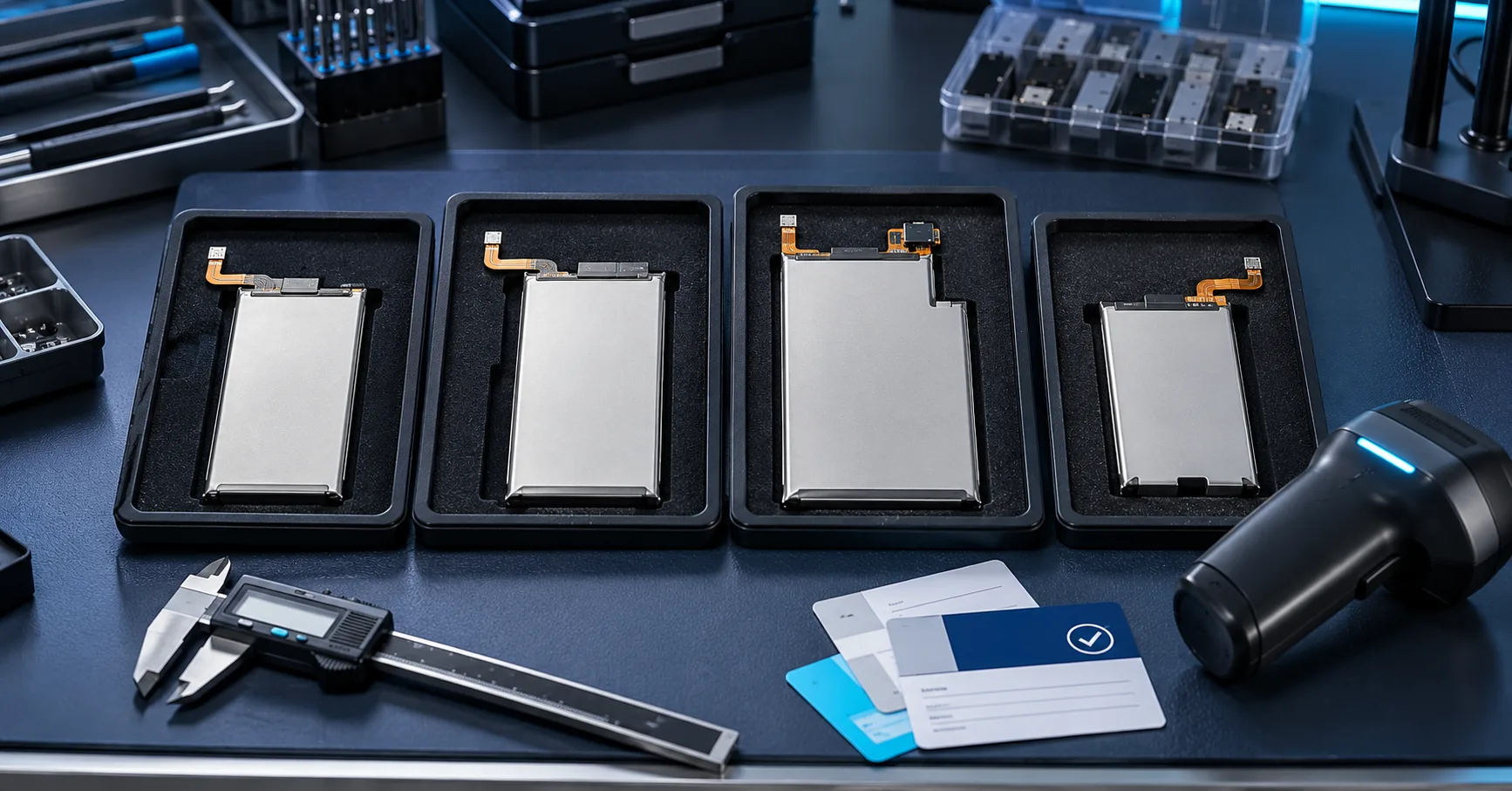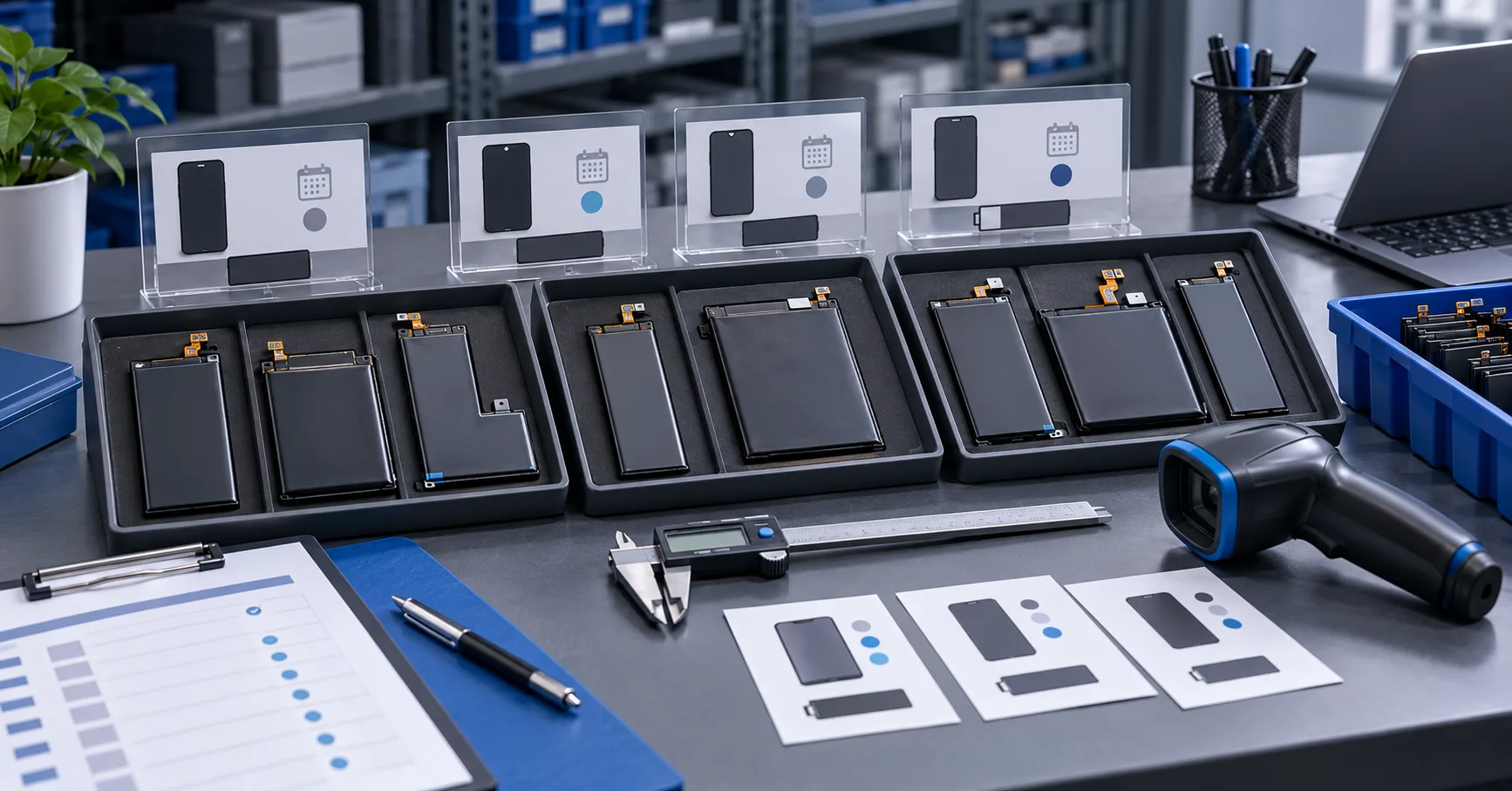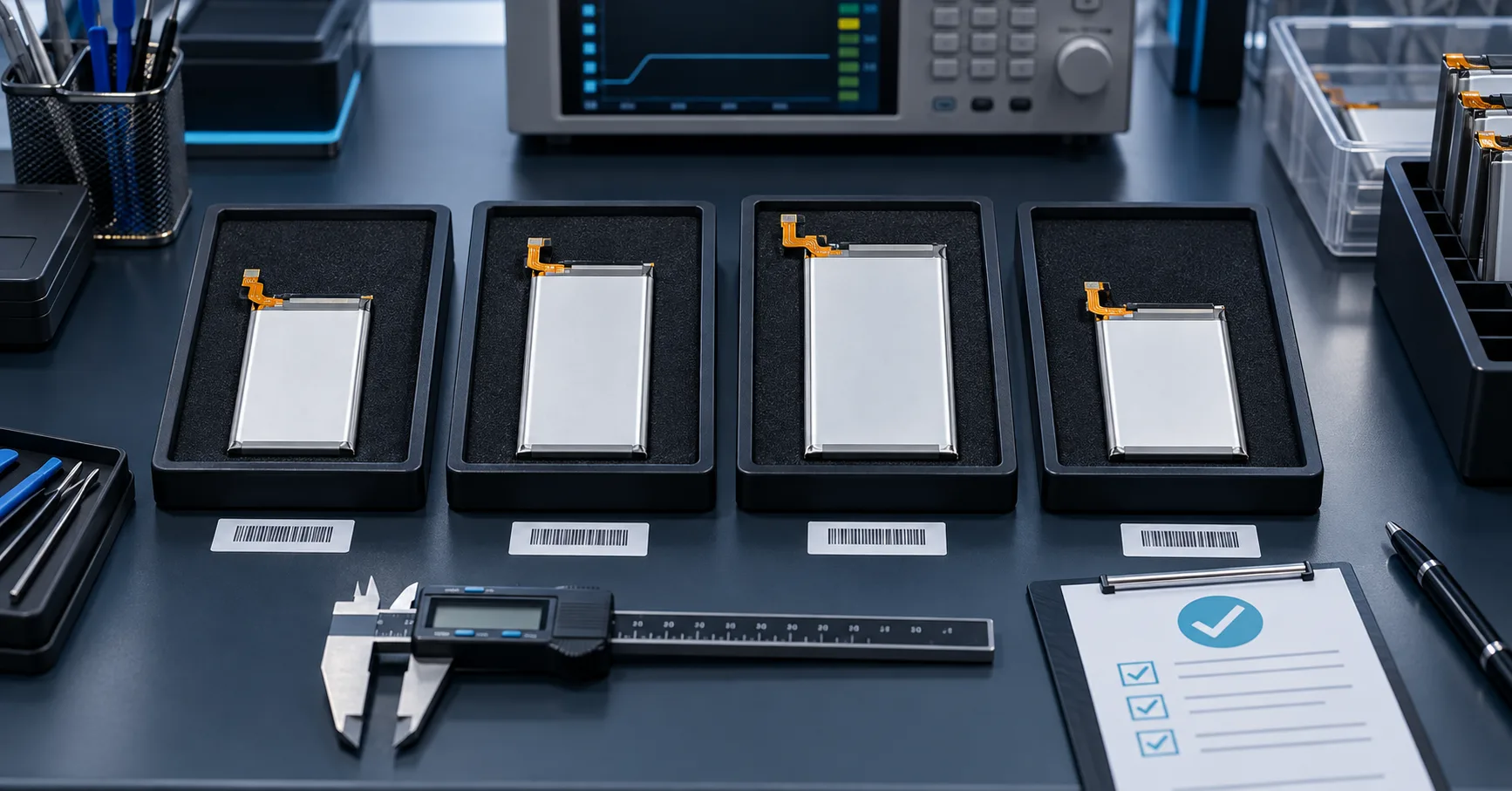

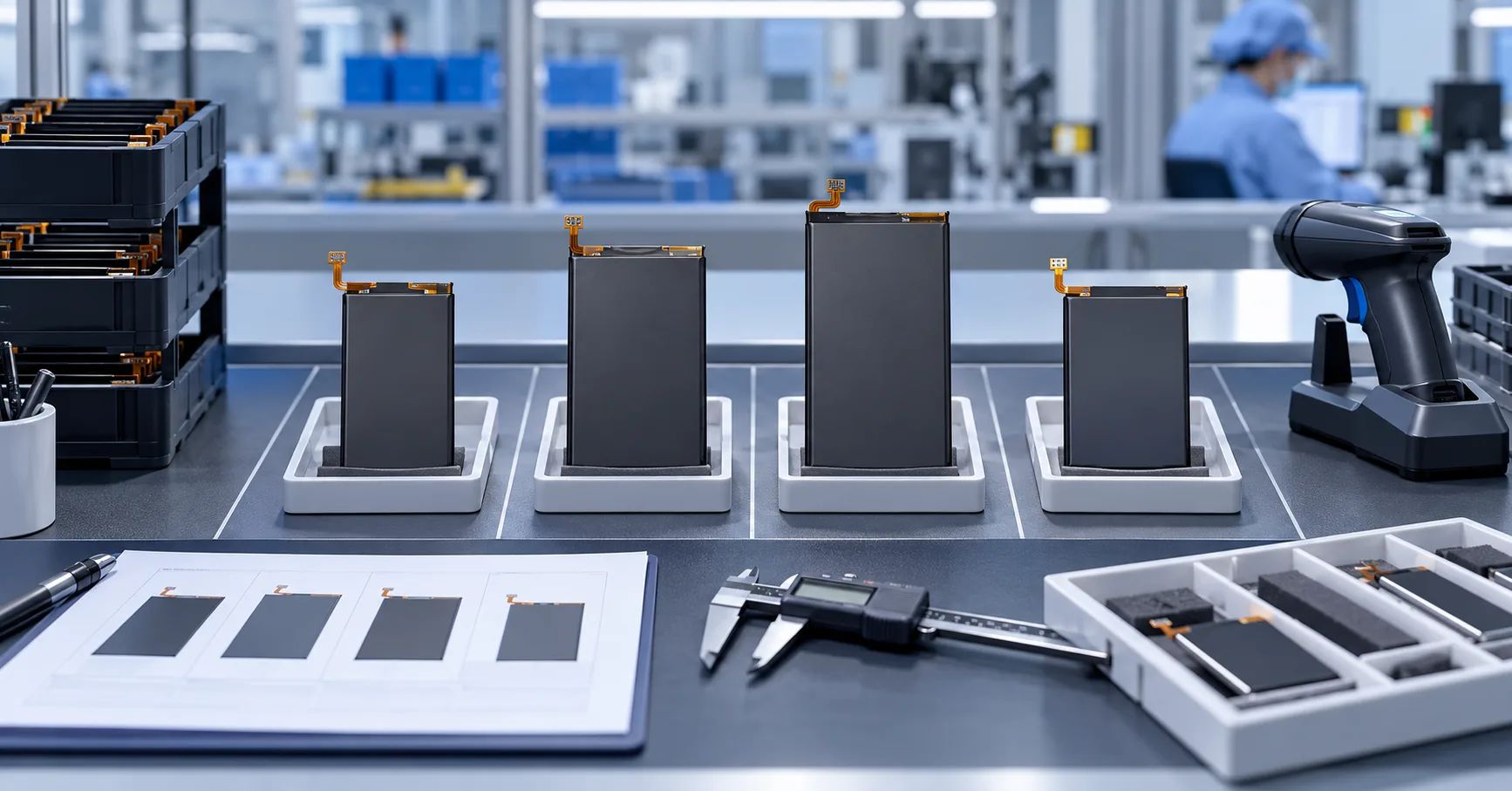
Quick answer: a Galaxy S20-family purchasing program should use separate approval lanes for the S20, S20+, S20 Ultra and S20 FE. Similar naming, the same launch family, or an equal advertised capacity does not prove that two finished battery assemblies are interchangeable. A professional buyer should approve each device-and-pack combination by exact model identity, physical construction, electrical specification, installed performance and production-lot traceability.
This distinction is especially important for buyers searching for samsung galaxy s20 fe battery replacement supply. The FE is not simply another label for the S20+. Both are advertised with a 4,500 mAh typical battery, but capacity alone says nothing about cell outline, flex position, connector, protection circuit, sensing or installation stack-up. Repair chains, refurbishment facilities and wholesalers need a controlled SKU decision, not a family-name shortcut.
Why the S20 Family Needs Four Approval Lanes
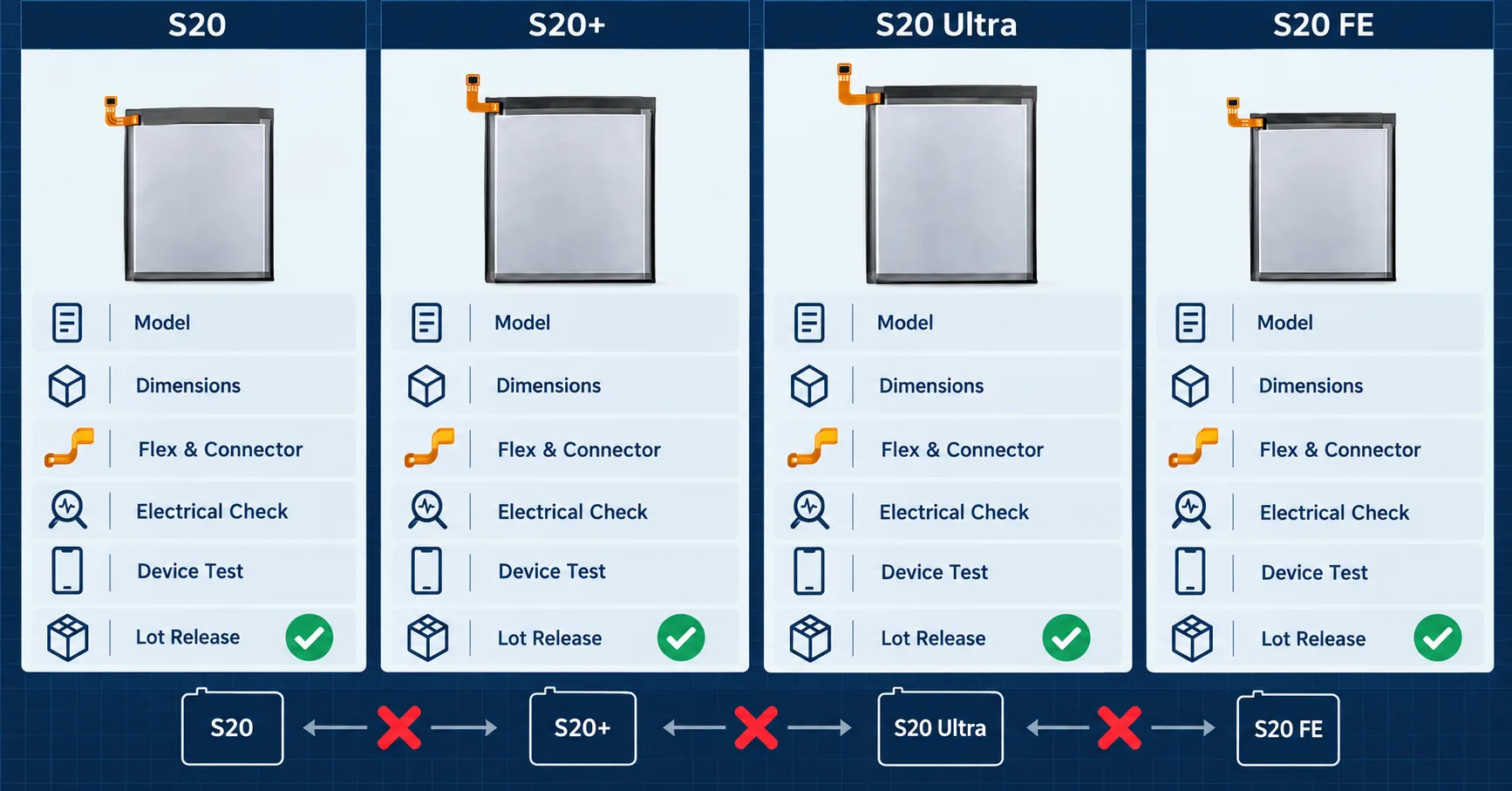
Samsung's official launch specification separates the original three models by typical capacity: 4,000 mAh for S20, 4,500 mAh for S20+ and 5,000 mAh for S20 Ultra. Samsung also explains that typical value is an estimated average that considers variation among tested samples. In its official announcement, Samsung describes these as 4000mAh (typical)
, 4500mAh (typical)
and 5000mAh (typical)
. Buyers can review the complete qualification on the Samsung Global Newsroom S20 specification page.
Samsung's business data sheet separately lists the S20 FE 5G at 4,500 mAh and says it is Up to 25W Super Fast Charge Capable
. That statement is a device-level reference, not proof that any aftermarket pack will reproduce a particular charging result. See the official Galaxy S20 FE 5G data sheet.
| Device lane | Official device-level battery reference | B2B approval consequence |
|---|---|---|
| Galaxy S20 | 4,000 mAh typical; 3,880 mAh rated minimum | Maintain a dedicated model and pack record. |
| Galaxy S20+ | 4,500 mAh typical; 4,370 mAh rated minimum | Do not approve from capacity similarity to FE. |
| Galaxy S20 Ultra | 5,000 mAh typical; 4,855 mAh rated minimum | Validate its larger device-specific assembly independently. |
| Galaxy S20 FE | 4,500 mAh typical in Samsung's FE data sheet | Create its own identity, fit and test lane. |
These figures are reference points for device identification and claim normalization. They are not ESCCharge test results, and they must not be copied onto a replacement-battery label without verifying the specific pack, applicable capacity definition and test method.
Start with Device Identity, Not the Sales Name
A purchase order that says only “S20 battery” is incomplete. Regional, radio and sales variants can use different device codes, and a supplier listing may collapse several devices into a convenient commercial title. Before approving a samsung s20 battery replacement SKU, collect the full model code from the target device population and connect it to a controlled battery specification.
Samsung's own product-support pages demonstrate why the code matters. For example, its US business support page identifies an unlocked Galaxy S20 5G as SM-G981U1, while the wider S20 launch material references SM-G980, SM-G981, SM-G985, SM-G986 and SM-G988 test devices. The support page also marks the battery as Removable: No
. Use the Samsung Galaxy S20 5G support record as an example of model-level identification, not as a universal compatibility list.
Your controlled identity record should include:
- full device model code and target sales region;
- supplier battery model or internal SKU;
- cell and finished-pack label revision;
- nominal voltage, rated capacity and typical-capacity claim, if used;
- pack dimensions and thickness at defined measurement points;
- flex length, routing, connector position and contact orientation;
- protection-board and sensing configuration;
- adhesive, insulation and packaging configuration;
- approved sample ID, test date and reviewer.
If a vendor offers one galaxy s20 replacement battery across multiple device codes, request a device-to-pack mapping with photographs, drawings and controlled part identifiers. A marketplace title is weak evidence. Compatibility must be confirmed by device model and battery specification.
Do Not Infer Interchangeability from Capacity
The S20+ and S20 FE illustrate a common procurement error: both have a 4,500 mAh typical device specification, so a buyer assumes they can share a pack. Equal capacity is only an energy-storage headline. It does not establish the same footprint, thickness, tab arrangement, flex geometry, connector, polarity, thermistor behavior, protection logic or adhesive boundary.
For the same reason, a quotation for a galaxy s20 plus battery should not be approved using an FE sample, and a galaxy s20 ultra battery replacement should not be accepted because its printed capacity resembles Samsung's device specification. The buyer needs evidence for the finished assembly that will actually enter the repair or refurbishment process.
Use three evidence levels:
- Identity evidence: device code, pack code, label revision and supplier mapping.
- Construction evidence: dimensioned drawing, connector and flex photographs, polarity, insulation and protection-board configuration.
- Functional evidence: controlled bench checks plus installed-device tests in every approved model lane.
Build a Sample Approval Matrix
Do not treat “powers on” as sample approval. A battery can boot a device and still create fit pressure, unstable charging, percentage jumps, rapid voltage sag or early warranty returns. The sample matrix should connect every test result to the exact sample serial or lot and to a known device code.
| Approval stage | What to verify | Reject or investigate when |
|---|---|---|
| Document review | Model mapping, drawing revision, capacity terminology, label and transport-document scope | Codes conflict, revision is missing or documents describe another configuration |
| Visual inspection | Cell surface, edges, insulation, flex, connector, markings and packaging | There is deformation, contamination, exposed conductive area or mixed labeling |
| Dimensional check | Length, width, thickness, flex reach, connector position and adhesive boundary | The pack needs force, presses another component or routes incorrectly |
| Electrical screening | Open-circuit voltage, polarity, basic communication or sensing behavior and consistency | Values fall outside the buyer's approved specification or vary without explanation |
| Capacity validation | Defined charge, rest, discharge, cutoff, temperature and equipment | The method is undocumented or results cannot be tied to sample identity |
| Installed test | Boot, charging, percentage progression, controlled load, temperature observation and restart behavior | Abnormal heat, charging interruption, unexpected shutdown or mechanical stress appears |
| Pilot lot | Multiple units across technicians and target device variants | Failures cluster by model, technician, lot, material or revision |
For a deeper receiving workflow, use ESCCharge's mobile phone battery incoming-inspection guide. It complements this model-specific matrix by explaining how buyers can structure lot sampling and evidence capture.
Separate Engineering Approval from Commercial Approval
Engineering approval confirms that a defined configuration is suitable for a defined device lane under the buyer's test conditions. Commercial approval confirms that the supplier can quote, label, pack and repeat that configuration without uncontrolled substitution. Both are necessary.
A practical RFQ should request:
- each supported device code, listed separately;
- the finished-pack code and revision for each device code;
- capacity definition and test method rather than a headline mAh value alone;
- dimensional drawing and tolerance;
- connector, flex, polarity, protection and sensing details;
- sample quantity by model lane;
- packaging, barcode and carton-mark requirements;
- change-notification and traceability expectations;
- target market and required model-specific compliance or transport files;
- order mix, forecast and acceptable shipment split.
MOQ, lead time, certification availability and warranty depend on the selected model, customization scope, target market and commercial agreement. Buyers should obtain written confirmation for the exact configuration instead of applying a general supplier statement to every S20-family SKU. ESCCharge's published Samsung replacement-battery supplier guide provides the broader supplier-qualification context without replacing this model-level approval work.
Control Mixed-SKU Orders and Production Lots
The commercial risk rises when four visually similar products move through the same warehouse. Model separation must continue after sample approval. Assign a unique SKU, barcode and pack artwork to each approved configuration. Receiving labels should show the device mapping, supplier lot, production date or trace code and revision needed for investigation.
Before releasing a production lot, compare it with the approved reference for:
- cell and finished-pack label revision;
- dimensions, flex route and connector orientation;
- packaging and model barcode;
- electrical screening distribution;
- capacity-test method and sample results;
- installed-device behavior on the correct lane;
- declared material, process or component changes.
Quarantine mixed labels, unexplained revision changes or model-mapping discrepancies before stock reaches technicians. After release, connect returns to model, battery lot, technician, symptom and device condition. ESCCharge's mobile phone battery warranty-claims workflow can help convert field reports into supplier evidence instead of isolated anecdotes.
Who Should Use This S20-Series Program?
This program suits repair chains standardizing technician inputs, refurbishers processing batches, wholesalers building a controlled Samsung catalog, distributors managing regional variants and private-label buyers responsible for packaging and traceability. It is not intended as a consumer disassembly tutorial, and it does not establish that ESCCharge currently stocks every model or regional variant.
The buyer's final approved list should reflect real downstream demand. High-turnover lanes may justify routine stock and repeat-lot controls. Low-volume variants may be handled as project orders. This prevents slow-moving batteries from aging in inventory while protecting availability for frequently repaired devices.
Frequently Asked Questions
Can the Galaxy S20+ and S20 FE use the same replacement battery?
Do not assume so. Their equal 4,500 mAh typical device specifications do not prove identical finished battery assemblies. Confirm the exact device code, pack code, dimensions, flex, connector, protection configuration and installed-device results before approval.
Is the printed capacity enough to approve an S20 battery?
No. Printed capacity must be tied to a defined capacity term and controlled test method. Fit, connector alignment, electrical behavior, installed charging and production consistency remain separate approval requirements.
How many samples should a wholesale buyer test?
There is no universal number. Set sample quantity according to order size, supplier history, model risk, regional variants and the cost of a field failure. Record the rationale and use a pilot lot when a small engineering sample cannot represent production variation.
Does Samsung's official capacity prove an aftermarket battery's performance?
No. Samsung's figures describe Samsung device specifications under stated definitions and conditions. A replacement-battery supplier must provide evidence for its own specific pack and test method.
What should trigger reapproval?
Reapprove after changes to the cell, protection board, flex, connector, adhesive, label, pack dimensions, manufacturing site, key process or test method. Unexplained lot shifts or recurring field failures can also trigger focused revalidation.
Prepare a Model-Specific RFQ
Send ESCCharge the complete S20-family device codes, target market, expected model mix, order quantity, packaging needs and required evidence. ESCCharge can review the requested configuration and propose a sampling plan. Actual compatibility, capacity claims, certification availability, MOQ, lead time and warranty must be confirmed for the specific battery model and agreement before purchase.
External Source References
- Samsung Electronics — Introducing the Samsung Galaxy S20: Change the Way You Experience the World — 2020.
- Samsung Electronics America — Galaxy S20 FE 5G Data Sheet — 2020.
- Samsung Electronics America — Galaxy S20 5G SM-G981U1 Support and Manual.