
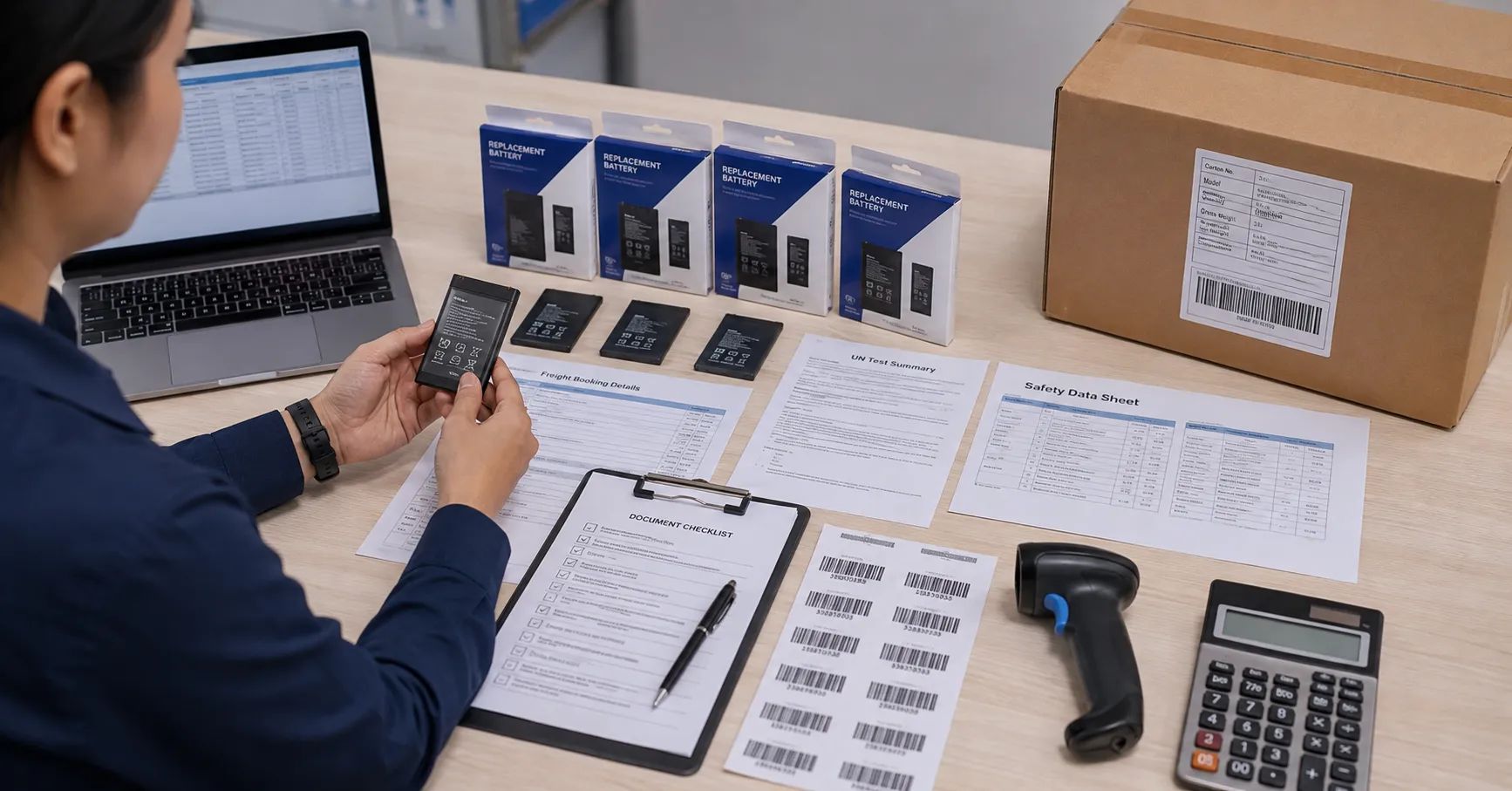
Mobile phone battery certificates are often requested as if one document can approve a battery for every country, customer, sales channel, and shipping method. In reality, a buyer may need several different forms of evidence, and each one serves a different purpose.
A UN transport test summary does not replace a safety data sheet. An SDS does not prove that a battery design passed UN 38.3 testing. A product safety certificate does not automatically determine how a shipment must be classified, packed, marked, labeled, documented, or accepted by an airline.
For importers and wholesalers, the practical objective is to build a shipment-specific compliance file. The file should connect the exact battery model and production configuration with its test evidence, product specification, packaging, transport classification, destination requirements, and carrier instructions.
This guide does not replace the current dangerous-goods regulations or professional advice. Requirements can change by transport mode, origin, destination, battery configuration, Watt-hour rating, package quantity, carrier, and operator variation. Always confirm the shipment with a trained dangerous-goods professional and the selected carrier before dispatch.
Stop Asking Only for a Battery Certificate
“Send me the battery certificate” is too vague for reliable procurement. Purchasing teams should first identify what decision the document is expected to support.
Common document requests include:
-
UN 38.3 test summary;
-
underlying test report where contractually required;
-
safety data sheet or material safety data sheet;
-
battery specification sheet;
-
declaration of conformity;
-
IEC or other product safety test evidence;
-
transport classification statement;
-
dangerous-goods declaration where applicable;
-
air or ocean freight booking data;
-
package test or packaging specification;
-
carton markings and hazard labels;
-
commercial invoice and packing list;
-
certificate of origin;
-
carrier-specific checklist;
-
local importer or market-access documentation.
These documents are not interchangeable. Some concern product safety. Others concern dangerous-goods transport, customs, workplace communication, commercial identity, or carrier acceptance.
The buyer should name the required document, revision, destination, product model, and intended use instead of accepting a folder of unrelated PDF files.
Understand UN 38.3 Evidence
Lithium cells and batteries offered for transport generally need to be of a type that has passed the applicable tests in Part III, subsection 38.3 of the UN Manual of Tests and Criteria.
The United Nations publishes the current Manual of Tests and Criteria, which includes the relevant lithium-cell and battery testing framework. Buyers should verify the applicable revision and amendments with the responsible shipping professional.
The test summary is a standardized summary of the tested battery type. The US Pipeline and Hazardous Materials Safety Administration explains on its lithium-battery transport page that manufacturers and subsequent distributors must make the required test summary available for applicable lithium cells and batteries offered for transportation.
A lithium battery test summary should be reviewed for elements such as:
-
manufacturer name and contact details;
-
test-laboratory identity and contact details;
-
unique report identification;
-
report date;
-
battery type;
-
physical description;
-
battery mass;
-
Watt-hour rating;
-
model numbers;
-
tests conducted and pass/fail results;
-
reference to the applicable UN Manual edition;
-
responsible signatory information.
The battery model on the summary must match the product being shipped. A report for a similar capacity, older cell, different protection board, or different model code should not be accepted merely because the document says “lithium battery.”
Test Summary Versus Full Test Report
A test summary and a complete laboratory report are different documents.
The summary provides standardized traceability and confirmation that the applicable test series was addressed. A full report may contain detailed sample information, procedures, equipment, observations, and results.
Transport rules may require the summary to be made available rather than attaching a complete report to every consignment. However, a buyer, platform, insurer, carrier, regulator, or contract may request additional evidence.
The purchasing agreement should define whether the supplier must provide:
-
the summary only;
-
the complete report;
-
a laboratory verification channel;
-
an online document link;
-
controlled access during audits;
-
an updated document after design changes.
Do not alter a summary or copy data into a buyer-created template unless the responsible organization has verified the result. Edited files weaken traceability.
What an SDS Can and Cannot Prove
A safety data sheet communicates information about hazards, handling, storage, emergency response, and other safety topics. It may support workplace, customer, carrier, or internal compliance processes depending on the jurisdiction and product.
However, IATA’s dangerous-goods transport FAQ notes that an SDS is not the document that proves compliance with UN 38.3. IATA advises checking with the manufacturer or distributor for recent battery test information.
Buyers should check whether an SDS:
-
identifies the supplier or manufacturer;
-
names the relevant battery or product family;
-
contains current contact information;
-
matches the chemistry and configuration;
-
uses a current revision date;
-
provides credible handling and emergency information;
-
is consistent with the product specification;
-
has not been reused from an unrelated model.
An SDS should not be judged solely by whether it has many pages or a company stamp. Technical consistency is more important than appearance.
Product Safety Certification Is a Separate Question
Product safety standards may apply according to the battery design, device type, target market, customer, or certification scheme. Examples frequently discussed in portable-battery sourcing include IEC 62133-2 and other national or industry standards.
The relevant standard must be identified by scope and market. A certificate should be checked for:
-
certification body;
-
applicant and manufacturer;
-
factory or production location where relevant;
-
product and model coverage;
-
standard edition;
-
certificate number;
-
issue and expiry dates where applicable;
-
referenced test report;
-
product ratings;
-
authorized verification method;
-
current status.
Do not accept a certificate merely because the supplier’s company name appears somewhere on it. The listed battery model, factory, applicant, and ratings must support the product being ordered.
A certificate for a cell does not automatically cover every assembled battery pack using that cell. A report for a finished pack does not automatically cover later changes to the cell, protection circuit, insulation, connector, or mechanical design.
Confirm Whether the Battery Is Shipped Alone or with Equipment
Transport classification depends on the shipment configuration.
The 2026 IATA battery guidance document distinguishes lithium-ion batteries shipped by themselves from batteries packed with equipment or contained in equipment.
For common lithium-ion configurations, the relevant UN entries may include:
-
UN 3480 for lithium-ion batteries shipped by themselves;
-
UN 3481 for lithium-ion batteries packed with equipment;
-
UN 3481 for lithium-ion batteries contained in equipment.
The correct classification must follow the actual shipment. Spare mobile phone batteries placed in a carton with no phones are not the same configuration as batteries installed in phones.
Do not change the written description simply to obtain a cheaper or easier booking. Misclassification can lead to rejection, delay, repacking, penalties, loss, or safety risk.
Build a Shipment-Specific Compliance File
A strong export file begins with product identity and ends with carrier acceptance.

The file should connect:
-
supplier and manufacturer;
-
battery SKU and model code;
-
cell and pack configuration;
-
rated voltage and capacity;
-
Watt-hour rating;
-
production lot;
-
UN test evidence;
-
product safety evidence where required;
-
SDS or product information;
-
shipment configuration;
-
quantity and net battery weight;
-
inner and outer packaging;
-
package markings and labels;
-
shipping declaration where applicable;
-
forwarder and carrier instructions;
-
destination requirements;
-
final acceptance record.
A document set should be approved for a defined shipment, not stored in a shared folder with no connection to the goods.
Check Watt-Hour Calculations and Labels
Rechargeable battery transport provisions frequently refer to Watt-hour rating. Buyers should confirm that the declared rating is consistent across the battery label, specification, test summary, packing list, and carrier data.
The basic relationship is:
Watt-hours = nominal voltage × ampere-hours
If capacity is stated in milliampere-hours, convert it to ampere-hours before calculating.
Do not overwrite a supplier’s official rating based only on an informal calculation. Investigate discrepancies and obtain corrected controlled documentation from the responsible party.
Common warning signs include:
-
voltage differs between label and report;
-
mAh and Ah are confused;
-
Wh is rounded inconsistently;
-
one document covers a cell while another covers the complete pack;
-
the model number is missing;
-
a high-capacity version uses an older standard-capacity report;
-
the report shows a different mass or physical description.
The mobile phone battery incoming inspection guide can help buyers connect labels, physical products, quantities, and technical records when a shipment reaches the warehouse.
Air Shipment Requires Current Instructions
Air transport requirements are revised regularly. The current IATA Dangerous Goods Regulations, applicable packing instruction, operator variations, and state requirements should be checked for every shipping program.
IATA’s 2026 guidance states that lithium-ion batteries shipped by themselves under the relevant configuration are subject to state-of-charge and aircraft restrictions. It also explains that batteries packed with or contained in equipment use different entries and instructions.
Do not turn one rule into a universal statement for all battery shipments. The applicable requirements can depend on:
-
battery shipped alone, packed with equipment, or contained in equipment;
-
Watt-hour rating;
-
package quantity;
-
net battery weight;
-
state of charge;
-
passenger or cargo aircraft;
-
section of the packing instruction;
-
origin and destination states;
-
carrier variation;
-
damaged, defective, prototype, or waste status.
A freight forwarder’s earlier acceptance does not guarantee that the same shipment will be accepted later under a different airline or rule edition.
Packaging Must Match the Approved Shipping Plan
Paperwork cannot compensate for weak packaging. Replacement phone batteries should be protected against short circuit, movement, impact, crushing, and unintended activation where relevant.
A packaging review should examine:
-
terminal and connector protection;
-
individual separation;
-
nonconductive inner packaging;
-
cushioning;
-
resistance to movement;
-
carton strength;
-
package quantity;
-
weight limits;
-
closure method;
-
package testing where applicable;
-
orientation or handling requirements;
-
required markings and labels;
-
barcode and lot traceability.
Do not place loose batteries together in a carton. Connector flexes and terminals should not contact conductive materials.
Packaging used for samples may not be suitable for a larger commercial shipment. Validate the actual production packing method.
Shipping Documents Must Describe the Same Goods
Lithium battery shipping documents should be consistent with the physical shipment. Cross-check:
-
shipper and consignee;
-
product description;
-
battery model;
-
UN number and proper shipping name where applicable;
-
hazard class;
-
packing instruction;
-
quantity;
-
package count;
-
net and gross weight;
-
Watt-hour rating;
-
emergency contact;
-
declaration language;
-
invoice and packing-list description;
-
carrier booking.
A commercial invoice that says “electronic accessories” while the dangerous-goods file describes spare lithium-ion batteries creates an avoidable discrepancy.
Descriptions should be commercially accurate and suitable for customs without obscuring the battery content.
Verify the Carrier Before Packing the Final Shipment
Carrier acceptance is an operational decision, not only a document review.
Before production packing is completed, ask the forwarder or carrier to confirm:
-
accepted battery configuration;
-
required documents;
-
booking description;
-
package quantity and weight;
-
required labels and marks;
-
state-of-charge evidence where relevant;
-
approved airport or route;
-
operator variations;
-
cutoff and inspection process;
-
procedure for rejected packages.
Get the instructions in writing. Verbal messages can be lost when staff or routing changes.
IATA states that its Dangerous Goods Regulations are used by airlines, forwarders, handlers, and shippers. Its Dangerous Goods Regulations page should be treated as a starting point for identifying the current edition, not as a substitute for the complete requirements.
Handle Damaged and Returned Batteries Separately
Do not send swollen, leaking, crushed, recalled, damaged, defective, waste, or recycling batteries using the same process as normal new products.
These batteries may be subject to additional restrictions or prohibitions. They require specialist assessment, safe isolation, and a transport or disposal plan suitable for their condition.
A supplier’s normal test summary does not make a visibly damaged battery acceptable for ordinary shipment.
Audit Documents Before Every Bulk Order
Documents should be reviewed when:
-
a new battery model is introduced;
-
cell supplier changes;
-
protection circuit changes;
-
capacity or rating changes;
-
factory changes;
-
label or model code changes;
-
test standard changes;
-
certificate expires;
-
packaging changes;
-
carrier or route changes;
-
regulations are updated.
The mobile phone battery manufacturer guide can help procurement teams assess whether a supplier has repeatable testing, model control, packaging, and documentation capability.
Frequently Asked Questions
Is an SDS the same as a UN 38.3 test summary?
No. They serve different purposes. The test summary supports traceability to the applicable UN transport testing, while an SDS communicates safety and handling information.
Must every shipment include a paper test summary?
Current guidance may allow the summary to be made available electronically rather than attached as a paper copy to every consignment. Confirm the applicable requirement and carrier process.
Can one test summary cover several battery models?
Only when the document and underlying tested type legitimately cover those models. Verify model numbers, construction, ratings, and change history.
Does UN 38.3 mean the battery can be shipped by any airline?
No. Testing is one part of transport readiness. Classification, packaging, marking, labeling, documentation, state-of-charge limits, operator variations, and carrier acceptance still apply.
Is MSDS mandatory for every air shipment?
Do not assume so. Requirements depend on the applicable regulation, jurisdiction, carrier, and customer. IATA notes that an SDS is not the evidence used to prove UN 38.3 compliance.
Who should approve the shipping file?
Use trained dangerous-goods personnel and obtain confirmation from the selected forwarder or carrier. Sales or purchasing staff should not make the final classification alone.
Turn Documents into Shipment Control
Reliable export preparation is not about collecting the largest number of PDFs. It is about proving that the exact battery being shipped is supported by valid evidence and that the actual package follows the current transport plan.
A strong mobile phone battery certificates process connects model identity, test evidence, product documents, packing, labels, declarations, and carrier acceptance. That connection reduces booking delays, document disputes, repacking costs, and preventable shipment rejection.
ESC supports mobile phone battery buyers with model confirmation, packaging coordination, document collection, shipment preparation discussions, and batch traceability. Final classification and transport acceptance must still be confirmed for the actual shipment with qualified logistics professionals and the selected carrier.
External Source References
-
International Air Transport Association — 2026 Battery Guidance Document — 2026
-
International Air Transport Association — Dangerous Goods Regulations — accessed 2026
-
International Air Transport Association — Transportation of Dangerous Goods by Air FAQ — accessed 2026
-
United Nations Economic Commission for Europe — UN Manual of Tests and Criteria, Revision 8 — 2023
-
US Pipeline and Hazardous Materials Safety Administration — Transporting Lithium Batteries — accessed 2026