

Poor warehouse control can turn an acceptable battery lot into mixed, untraceable, or commercially unusable stock. For wholesalers, repair chains, refurbishment facilities, and private-label distributors, laptop battery storage therefore requires more than placing cartons on a shelf. It needs a documented workflow that controls receiving status, physical protection, stock age, inspections, exceptions, and outbound release.
A practical system should preserve three things: battery condition, model identity, and batch traceability. The exact storage limits must come from the battery specification, supplier instructions, applicable safety requirements, and the buyer’s own validation—not from a universal number applied to every chemistry and pack design.
Why Warehouse Control Matters
Laptop replacement batteries contain stored electrical energy and components that may present fire, chemical, and electrical hazards if damaged, improperly handled, or exposed to unsuitable conditions. The US Occupational Safety and Health Administration recommends storing lithium-ion batteries and devices in dry, cool locations, following manufacturer instructions, limiting stored quantities where appropriate, and preparing workers for battery-related emergencies in its Lithium-ion Battery Safety fact sheet.
Storage control also protects commercial performance. A buyer may receive the correct model and quantity, yet still face avoidable losses when:
-
different production lots are mixed without records;
-
old cartons remain behind new deliveries;
-
connector leads are compressed or bent;
-
batteries are stored beside heat, moisture, conductive parts, or incompatible materials;
-
damaged packs return to normal stock;
-
warehouse staff cannot identify which lot supplied a warranty claim;
-
batteries leave the warehouse without a final visual or identity check.
These failures affect repair success, return rates, labor costs, and the buyer’s ability to investigate complaints.
Build a Controlled laptop battery Storage Workflow
A warehouse should separate battery status physically and digitally. At minimum, establish zones for receiving, inspection hold, approved stock, outbound staging, and abnormal or rejected batteries.

1. Receive Every Shipment into a Hold Zone
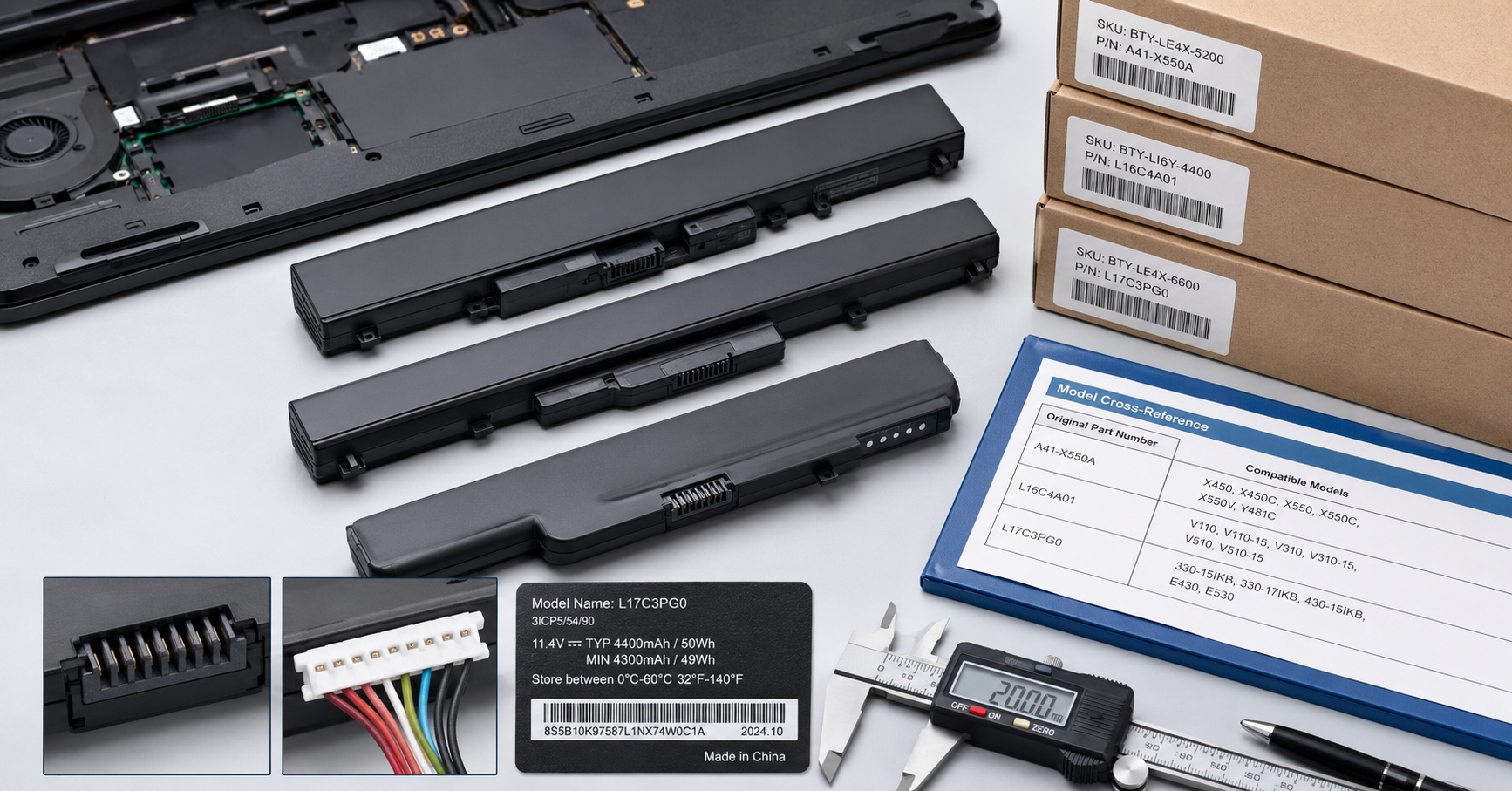
Do not move newly arrived cartons directly into saleable stock. Record the supplier, purchase order, arrival date, SKU, battery part number, stated model compatibility, quantity, and supplier lot code before opening the shipment.
Compare the shipment with the approved purchase specification. Buyers that need a structured receiving process can use the existing laptop battery incoming inspection guide to plan identity, appearance, electrical, and sample-installation checks.
Any mismatch should remain on hold until purchasing and quality personnel decide whether to accept, rework, return, or reject it.
2. Preserve Model and Lot Identity
Laptop batteries with similar housings may use different connectors, pin assignments, cable lengths, mounting points, rated values, or firmware behavior. Store each approved SKU and lot in a clearly identified location instead of combining visually similar packs.
The location record should connect:
-
internal SKU;
-
supplier part number;
-
compatible laptop models;
-
production or supplier lot;
-
receiving date;
-
approved quantity;
-
inspection status;
-
storage location;
-
review history;
-
outbound order or customer batch.
Before adding a new SKU, verify its identity against the purchase specification and sample approval record. The laptop battery part-number matching guide explains why a familiar model name alone is not enough for purchasing approval.
3. Protect Batteries from Physical and Electrical Damage
Keep batteries in packaging or trays that prevent movement, crushing, puncture, connector deformation, and unintended terminal contact. Do not place loose conductive tools or metal parts in the same container.
Cartons should not be stacked beyond the packaging or warehouse limit. Shelf layouts should keep products away from water exposure, uncontrolled heat sources, direct sunlight, and traffic areas where cartons may be struck.
Warehouse personnel should never flatten, squeeze, bend, open, or attempt to repair a suspect pack merely to return it to saleable condition.
4. Define Storage Limits by Product
The supplier should provide written storage, handling, charging, and maintenance instructions for the specific battery pack. The buyer should translate those instructions into controlled warehouse fields rather than relying on an informal rule remembered by individual employees.
For every approved SKU, document:
-
permitted storage temperature and humidity conditions;
-
acceptable condition or voltage at receipt and release;
-
review or maintenance interval;
-
maximum approved storage period;
-
packaging and stacking limits;
-
conditions requiring reinspection;
-
abnormal-battery handling instructions.
Do not invent a single state-of-charge percentage, voltage window, temperature range, or shelf-life promise for all laptop batteries. Chemistry, protection circuitry, pack design, supplier specifications, transport condition, and intended storage duration can change the appropriate limits.
Rotate Inventory by Status, Lot, and Age
First-in, first-out is useful only when the oldest stock is still approved for release. A better approach combines date-based rotation with quality status.
The warehouse system should identify stock approaching its scheduled review date and prevent unapproved or overdue cartons from being picked automatically. When commercial demand is uneven, purchasing teams should compare sell-through by SKU with minimum order quantities before placing replenishment orders.
A useful replacement battery inventory dashboard can show:
-
on-hand quantity by SKU and lot;
-
oldest approved receiving date;
-
stock awaiting inspection;
-
stock approaching periodic review;
-
quarantined quantity and reason;
-
recent outbound volume;
-
claim rate linked to each shipped lot.
This makes slow-moving models visible before they become an after-sales problem.
Perform Periodic Condition Reviews
Periodic reviews should follow the written SKU plan. The review may include packaging condition, label readability, evidence of deformation or swelling, connector condition, abnormal odor, contamination, corrosion, and the electrical checks authorized by the supplier or quality team.
Do not perform uncontrolled charging or improvised testing inside the main storage area. Use an approved test location, suitable equipment, trained personnel, and documented acceptance limits.
Record the date, sample identity, method, equipment, result, operator, and disposition. If the sample result suggests a lot-level problem, place the affected stock on hold until the scope is understood.
Quarantine Abnormal Batteries Immediately
A battery showing swelling, leakage, unusual heat, smoke, impact damage, puncture, severe corrosion, or an abnormal odor must not remain in normal inventory. Stop handling it unnecessarily, restrict access, follow the site emergency plan, and apply the manufacturer’s instructions and applicable local requirements.
OSHA notes that repair and maintenance activities can expose workers to battery-related physical or chemical hazards. Its interpretation on lithium-ion batteries and workplace hazard communication also emphasizes the relevance of hazard information and worker training when employees access batteries during maintenance, repair, or recycling.
The quarantine record should include the SKU, lot, quantity, observed condition, discovery location, date, photographs where safe, person reporting, and final disposition. Never place damaged or rejected lithium-ion batteries in ordinary municipal waste or general recycling bins.
Check Stock Before Outbound Release
Storage approval does not replace a final release check. Before shipment or transfer, confirm:
-
the picked SKU and part number match the order;
-
the lot is approved and within its review period;
-
packaging and labels are intact;
-
there is no visible swelling, leakage, crushing, or connector damage;
-
quantities match the packing record;
-
outbound records retain lot traceability;
-
the shipping method and documentation are appropriate.
For international orders, warehouse status and transport readiness are separate decisions. Review the laptop battery shipping documents checklist before dispatch because a product that is acceptable in inventory may still require specific packaging, test-summary information, declarations, labels, or carrier acceptance.
Questions to Put in a Supplier Agreement
Before approving a long-term battery program, ask the supplier to confirm:
-
Which storage conditions apply to each SKU?
-
What voltage or condition is expected at delivery?
-
When should stored stock be reviewed?
-
Which inspection method and acceptance limits are authorized?
-
How should abnormal packs be isolated and handled?
-
Which lot and production information appears on the battery and packaging?
-
Can the supplier investigate claims using the buyer’s lot record?
-
Which transport and safety documents are available for the supplied configuration?
-
How will specification or material changes be communicated?
A qualified laptop battery supplier should be able to connect product identification, quality records, storage guidance, and after-sales investigation instead of treating them as unrelated requests.
Frequently Asked Questions
Can all laptop batteries use the same warehouse conditions?
No. The warehouse may maintain one management framework, but product-specific limits should follow the battery specification, supplier instructions, applicable requirements, and validated handling plan.
Is FIFO enough for battery stock control?
No. FIFO does not confirm that the oldest lot remains approved. Rotation should also consider inspection status, scheduled review dates, model identity, and exception records.
Should batteries be fully charged before long-term warehousing?
Do not apply one charging rule to every pack. Follow the written instructions and approved electrical limits for the specific product. Any maintenance charging should occur under a controlled procedure with suitable equipment and trained personnel.
What should staff do when they find a swollen battery?
Keep it out of normal stock, minimize unnecessary handling, restrict access, and follow the manufacturer’s instructions and the facility’s emergency and disposal procedures. Staff should be trained before an incident occurs.
Which records are most important for warranty investigations?
The internal SKU, battery and packaging labels, supplier lot, receiving date, inspection results, storage location, periodic review history, outbound customer or order, and claim evidence should remain connected.
Turn Storage into a Traceable Quality Process
A well-run warehouse does not promise that storage alone can prevent every battery failure. It creates evidence that products were identified, protected, reviewed, rotated, isolated when abnormal, and released under controlled conditions.
ESC can support laptop replacement battery buyers with compatibility review, sample confirmation, packaging coordination, inspection requirements, and batch-based sourcing discussions. Send your target models, expected order mix, destination market, and quality requirements to begin a structured battery supply review.
External Source References
-
US Occupational Safety and Health Administration — Lithium-ion Battery Safety — 2025
-
US Occupational Safety and Health Administration — Applicability of the Hazard Communication Standard to Lithium-Ion Batteries — 2022