

Laptop battery shipping documents must describe the same battery that is physically packed in the shipment. A valid-looking report is not enough if its model number, Watt-hour rating, manufacturer, battery type, or transport configuration does not match the goods.
For importers, distributors, repair chains, refurbishment facilities, and private-label buyers, the document review should begin before mass production and finish before cargo booking. The buyer should confirm five connected layers:
-
Product and model identity
-
UN 38.3 testing evidence
-
Transport classification
-
Packaging, marks, and labels
-
Carrier and route acceptance
The exact requirements depend on the battery, shipment configuration, transport mode, route, destination, and carrier. A checklist is therefore a control process—not a universal promise that the same document package works for every shipment.
Why Laptop Battery Documents Fail at the Booking Stage
Replacement laptop batteries are often purchased as ordinary spare parts, but logistics providers handle them as lithium-battery shipments.
Common booking problems include:
-
The commercial model does not appear in the test summary
-
The Watt-hour rating differs between the battery label and documents
-
A report covers a cell but not the finished battery type being shipped
-
The shipper selects the wrong UN number or packing instruction
-
Standalone batteries are booked as batteries contained in equipment
-
The declared state of charge does not meet the applicable air-transport rule
-
Package marks or labels do not match the classification
-
The carrier requests additional documents that were not prepared
-
A damaged, defective, recalled, prototype, or waste battery enters a normal shipment
These gaps may lead to rebooking, repacking, extra inspection, refusal by the carrier, or cargo delay. The best time to resolve them is before labels and cartons are finalized.
Buyers still selecting products should first confirm the exact part number and device fit. ESC’s laptop battery part-number matching guide explains why laptop model names alone may be insufficient for compatibility decisions.
Start with a Product Identity File
Every shipping-document review should begin with one controlled product identity file.
Record:
-
Buyer SKU
-
Supplier model number
-
Battery manufacturer
-
Battery type and chemistry description
-
Nominal voltage
-
Rated capacity
-
Watt-hour rating
-
Battery mass
-
Physical description
-
Compatible laptop models or part numbers
-
Label revision
-
Packaging revision
-
Production or assembly batch
-
UN 38.3 test-summary reference
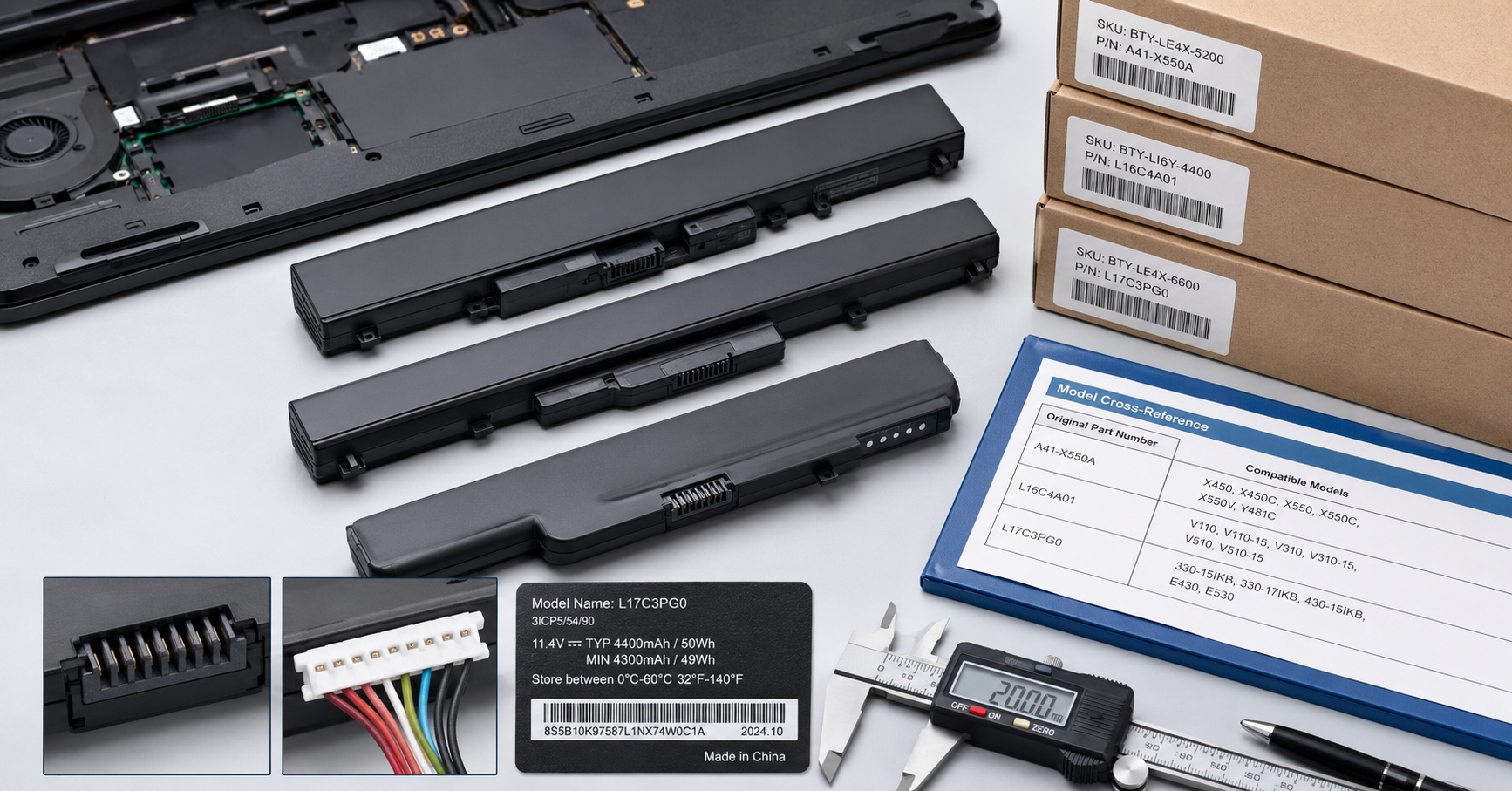
The Watt-hour rating is normally calculated from rated capacity in ampere-hours multiplied by nominal voltage. The declared rating should be checked against the battery label, specification, test summary, commercial documents, and booking data.
Do not assume two products are covered by the same evidence because their housings look similar. Changes to the cells, battery design, protection system, mass, energy rating, or other relevant characteristics may affect whether the tested type still represents the product being shipped.
Understand What a UN 38.3 Test Summary Is
The UN Manual of Tests and Criteria, Part III, Subsection 38.3 addresses testing used for the transport classification of lithium cells and batteries.
The test summary is a standardized summary of information relating to the tested battery type. It is not simply a certificate logo, an SDS, or a one-line statement that the product “passed UN 38.3.”
A buyer’s review should check whether the summary includes the required elements, such as:
-
Manufacturer identity and contact information
-
Test-laboratory identity and contact information
-
Unique test-report identification number
-
Test-report date
-
Battery type
-
Mass
-
Watt-hour rating
-
Physical description
-
Model numbers
-
List of applicable tests and pass/fail results
-
Reference to the edition and amendments used
-
Name, title, and signature of the responsible signatory
The summary must map to the actual laptop battery model. If the model number is missing, altered, or inconsistent with the product label, request clarification before shipment.
The PHMSA lithium battery test-summary guidance explains that test summaries support traceability and help downstream parties confirm that the battery design was tested under UN 38.3 requirements.
Do Not Confuse the Test Summary with Other Documents
Several files may appear in a supplier’s “battery certificates” folder, but they serve different purposes.
| Document | Main purpose | What the buyer should verify |
|---|---|---|
| UN 38.3 test summary | Summarizes required information about the tested battery type | Model, manufacturer, report ID, battery description, Wh rating, test results, edition, and signature |
| Full UN 38.3 test report | Contains more detailed laboratory testing information | Whether the report actually covers the shipped battery type and agrees with the summary |
| SDS or MSDS | Communicates safety, composition, handling, and emergency information in its applicable context | Product identity, issue date, supplier, language, and consistency with the battery |
| Product specification | Defines commercial and technical product requirements | Model, voltage, capacity, Wh rating, dimensions, connector, and revision |
| Commercial invoice and packing list | Describes the transaction and packed quantities | Product description, quantity, weight, carton count, and consistency with booking data |
| Dangerous-goods declaration or carrier form | Communicates regulated shipment information when required | Classification, packing instruction, quantity, packaging, shipper details, and signatures |
An SDS does not replace a UN 38.3 test summary. A test summary does not replace classification, packaging, marking, labeling, or documentation required for the actual consignment.
The required file set also varies. Do not advertise a fixed bundle of “mandatory certificates” for every market and transport route.
Confirm the Transport Configuration
The transport classification depends partly on how the battery is presented.
A replacement laptop battery may be:
-
Shipped by itself
-
Packed in the same package with a laptop
-
Installed or contained in a laptop
These configurations are not interchangeable.
Under the IATA framework, lithium-ion batteries shipped alone are generally identified as UN 3480. Lithium-ion batteries packed with or contained in equipment are generally identified as UN 3481, with the applicable packing instruction determined by the configuration.
For most replacement-battery wholesale shipments, the batteries are shipped without laptops. Buyers should not select an equipment-based classification merely because the battery is designed for a laptop.
Confirm the classification with a qualified dangerous-goods professional and the accepting carrier before booking.
Build a Five-Layer Document Check
Use one checklist that connects the physical product to the final booking.
| Review layer | Key question | Release evidence |
| Product identity | Do the model, label, voltage, capacity, Wh rating, and manufacturer match? | Approved specification, label, sample, and batch record |
| Test evidence | Does the test summary cover the actual battery type? | Verified UN 38.3 test summary and applicable supporting report |
| Classification | Are the UN number, configuration, packing instruction, and state-of-charge rule correct? | Written classification review |
| Package presentation | Are packaging, terminal protection, marks, labels, quantity, and weight correct? | Packing inspection and approved artwork |
| Booking | Has the actual carrier accepted the route and document set? | Booking confirmation and final document review |

No layer should be reviewed in isolation. A correct label attached to the wrong carton is still a shipment error. A correct classification supported by a mismatched test summary remains incomplete.
Check the Air-Transport State of Charge
The IATA 2026 lithium-battery guidance states that lithium-ion cells and batteries shipped alone under the relevant UN 3480 provisions must be offered for air transport at a state of charge not exceeding 30% of rated capacity, unless the applicable approval conditions are met.
The guidance also states that standalone lithium-ion batteries are forbidden as cargo on passenger aircraft unless approved under the applicable provisions.
From January 1, 2026, the guidance also applies reduced state-of-charge requirements to specified lithium-ion batteries packed with equipment under PI 966. The details depend on the section and battery rating.
This means the shipper should not use one state-of-charge statement for every configuration. Confirm:
-
Whether the battery is alone, packed with equipment, or contained in equipment
-
The applicable packing instruction and section
-
How state of charge is controlled and recorded
-
Whether an approval is required
-
Whether the carrier imposes a stricter operational policy
-
Whether the route changes the accepting operator or transfer requirements
A warehouse storage target is not automatically the same as the air-transport state-of-charge requirement.
Verify Packaging, Marks, and Labels Against the Actual Shipment
Document approval should be followed by physical package inspection.
Check:
-
Protection against short circuit
-
Protection against unintended activation where applicable
-
Movement of batteries inside the inner and outer packaging
-
Package strength and configuration
-
Net battery quantity or weight where required
-
Correct marks and labels
-
Readability and durability of printed information
-
Shipper and consignee details
-
Carton count and packing-list consistency
-
Carrier-specific label placement requirements
Do not approve package artwork using a generic lithium-battery icon without confirming the required format, dimensions, content, and placement.
Packaging rules can change depending on battery rating, quantity, packing instruction, shipment section, and whether batteries are shipped alone or with equipment.
Add Model Matching to the Logistics Review
Laptop battery transport documents are only useful when the buyer ordered the correct product.
Before releasing a mixed-model shipment, match:
-
Laptop model
-
Original battery part number
-
Replacement battery model
-
Voltage
-
Connector
-
Battery shape
-
Mounting positions
-
Communication requirements
-
Label and packaging SKU
ESC’s laptop battery supplier guide provides a broader sourcing checklist covering model accuracy, samples, documentation, packaging, and wholesale planning.
For MacBook-focused programs, buyers can also review ESC’s MacBook battery manufacturing guide when planning model coverage and supplier evaluation.
Control Document Revisions
A document may be authentic but obsolete.
Create a controlled register containing:
-
Document name
-
Product models covered
-
Document or report number
-
Issue date
-
Revision
-
Issuer
-
Expiry date when applicable
-
Verification status
-
Storage location
-
Reviewer
-
Last review date
Review the file again when the product design, cell, protection system, label, manufacturer, test laboratory, transport rule, carrier, route, or destination changes.
Do not rename unrelated reports into a product folder and assume that the folder name proves coverage. The model identity inside the document controls the review.
Pre-Booking Checklist for Importers
Before authorizing shipment, confirm:
-
The commercial SKU matches the physical battery
-
The test-summary models match the shipped models
-
The Watt-hour rating is consistent across all documents
-
The supplier and manufacturer identities are clear
-
The transport configuration is correct
-
The UN number and packing instruction have been reviewed
-
The applicable state-of-charge rule is confirmed
-
The carrier accepts the product and route
-
Packaging and terminal protection are approved
-
Required marks and labels match the final package
-
Invoice, packing list, carton count, and weight are consistent
-
No damaged, defective, recalled, waste, or prototype battery is included
-
A qualified person has completed the final dangerous-goods review
Do not release cargo solely because a previous shipment used the same forwarder. Rules, carrier policies, routes, product configurations, and documents can change.
FAQ
Is a UN 38.3 test summary the same as a certificate?
It is better treated as a standardized summary of the tested battery type rather than a generic certificate. Buyers should check its required information and confirm that the listed models match the shipment.
Does an SDS replace the UN 38.3 test summary?
No. They serve different purposes. An SDS may be part of the requested document package, but it does not replace evidence associated with UN 38.3 testing.
Can replacement laptop batteries be shipped as batteries contained in equipment?
Not when the batteries are shipped separately from laptops. Classification depends on the actual shipment configuration, not the product’s intended use after delivery.
Can standalone laptop batteries travel as passenger-aircraft cargo?
IATA’s 2026 guidance states that standalone lithium-ion batteries are forbidden as passenger-aircraft cargo unless the relevant approval applies. Confirm the actual booking with the operator and dangerous-goods specialist.
Does one test summary cover every battery from the same supplier?
No. Coverage depends on the tested battery type and the models identified in the summary. Buyers must match the shipped model to the document rather than relying only on the supplier name.
Are shipping requirements the same for every country and carrier?
No. Applicable rules and operational acceptance may vary by mode, route, jurisdiction, carrier, and shipment configuration. Complete a shipment-specific review.
Verify Documents Before Printing and Booking
Reliable laptop battery shipping documents form a consistent chain from the battery label to the test summary, classification, package, commercial paperwork, and carrier booking.
A document pack should not be judged by the number of PDF files it contains. It should be judged by whether each file applies to the actual battery and supports the real shipment.
Send ESC your target laptop battery models, quantities, destination, shipping mode, packaging format, and forwarder requirements. ESC can help review the product identity, sample plan, packaging information, and available shipment documentation before order confirmation.
External Source References
-
International Air Transport Association (IATA) — Guidance Document for Lithium Batteries and Sodium Ion Batteries, 2026 — 2026
-
United Nations Economic Commission for Europe (UNECE) — UN Manual of Tests and Criteria, Revision 8, and Amendment 1 — 2023–2025
-
U.S. Pipeline and Hazardous Materials Safety Administration (PHMSA) — Lithium Battery Test Summaries — Updated 2024