
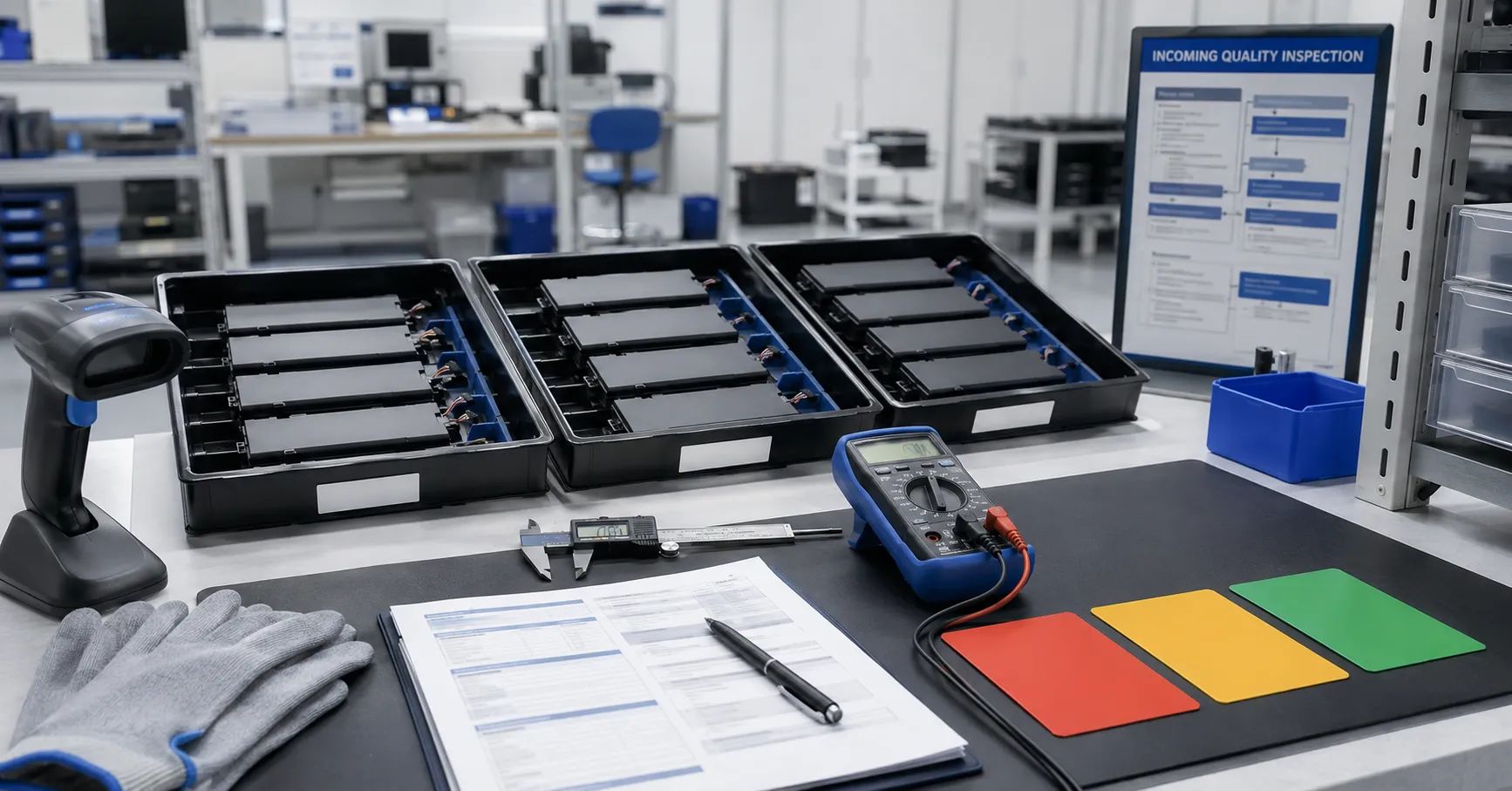
Laptop battery incoming inspection should determine whether a received lot matches the approved product and can be released without exposing the buyer to compatibility, safety, traceability, or warranty risk. Counting cartons and checking for visible damage is not enough. A practical IQC process connects the purchase order, approved sample, battery specification, lot identity, physical product, measured results, defect decision, and final release status.
For repair chains, refurbishment facilities, parts wholesalers, and private-label buyers, the most useful approach is risk-based. Verify identity and traceability for every received lot, then apply an approved sampling plan to the characteristics that can be inspected by sample. Any abnormal heating, leakage, swelling, damaged insulation, reverse polarity, short-circuit indication, or document mismatch should trigger containment and qualified review rather than routine release.
Define the Lot Before Opening the Cartons
A shipment should not automatically be treated as one homogeneous inspection lot. Separate batteries when the supplier model, cell source, production date, factory, connector version, protection-board revision, label, or packaging configuration differs. Mixing unlike production groups can hide a concentrated defect and make later complaints difficult to trace.
Assign an internal receiving or lot number and connect it to the purchase order, supplier, delivery date, quantity, carton numbers, supplier batch codes, production dates, and inspection status. Keep rejected, pending, and approved stock physically and digitally separated.
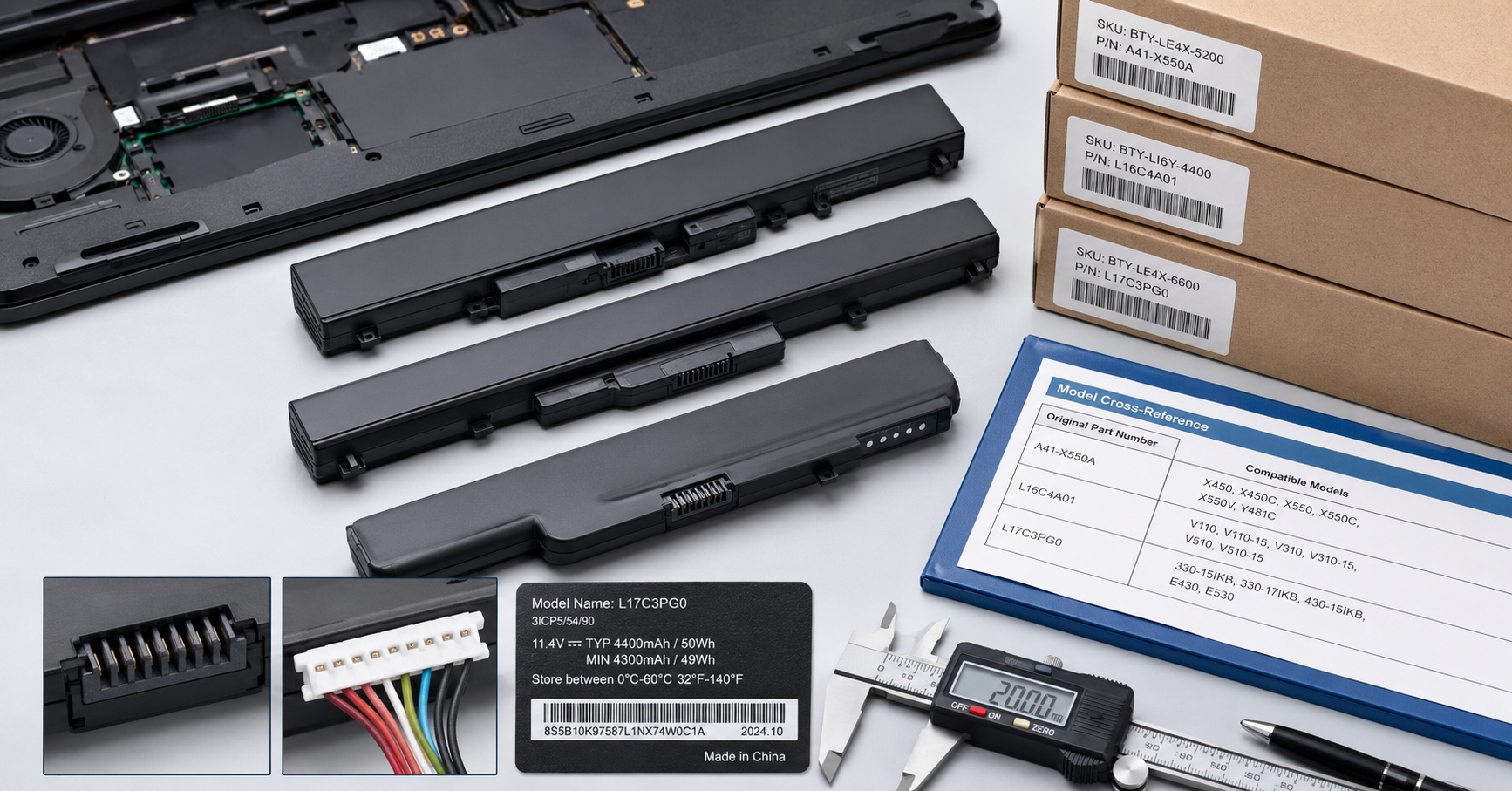
If the order contains several laptop models, use ESC’s laptop battery part-number matching guide to keep device identity, original battery codes, electrical specifications, dimensions, connectors, and cable layouts separated before inspection begins.
Create a Document Gate Before Product Testing
The inspector needs an approved reference package. Depending on the product and agreement, it may include the purchase order, controlled specification, drawing, approved sample record, label artwork, packaging standard, application list, change history, inspection plan, test method, and required compliance or transport documents.
Document availability does not prove that the received product conforms. IEC 62133-2 specifies safety requirements and tests for portable sealed secondary lithium cells and batteries, but a report or certificate must still be checked for the applicable model, construction, scope, version, laboratory, and target-market requirement. It does not replace incoming identity, workmanship, dimensional, electrical, or functional inspection.
For transport-related files, confirm that the battery model and physical description correspond to the goods received. IATA’s 2026 battery guidance explains that an applicable UN 38.3 test summary includes identifying information such as the manufacturer, test laboratory, report number, battery description, watt-hour rating, physical description, and model numbers. ESC’s laptop battery shipping-document checklist provides a related importer workflow.
Use a Five-Layer Laptop Battery Incoming Inspection Flow
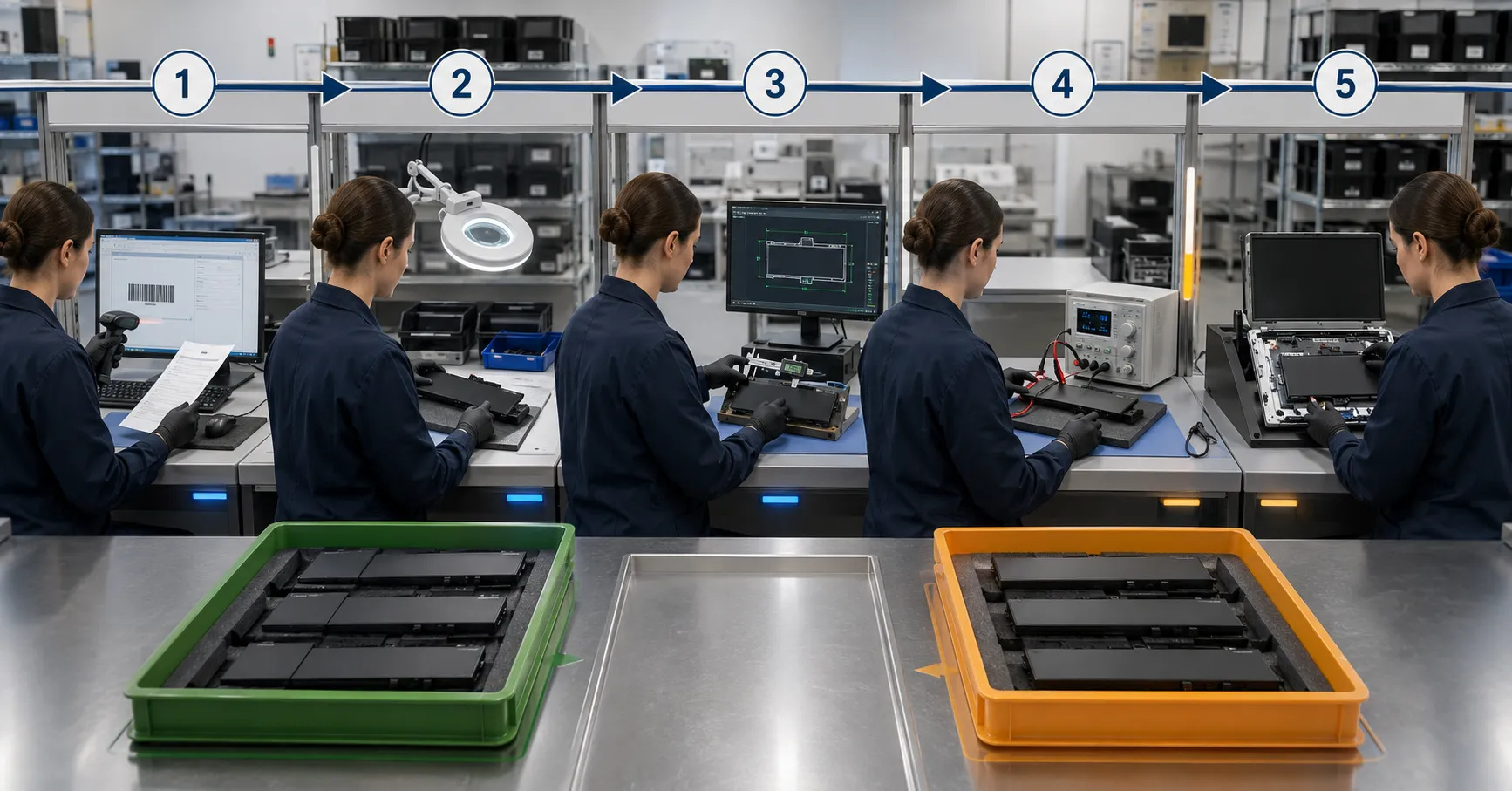
Layer 1: Identity and traceability
Compare the supplier model, buyer SKU, battery part number, compatible-device reference, nominal voltage, rated capacity, watt-hour value, production or lot code, label revision, carton identification, and quantity against the approved documents. Scan barcodes where used and check that one code does not resolve to conflicting products.
Identity checks should be performed before destructive packaging removal or electrical testing. If the label, carton, product, and order disagree, quarantine the affected quantity until the correct identity is established.
Layer 2: Packaging and visual condition
Inspect outer cartons, internal separation, cushioning, terminal protection, moisture exposure, compression, contamination, label legibility, and evidence of mishandling. On the battery, check the enclosure or pouch, seams, insulation, wires, connector, adhesive, screw points, tabs, and exposed surfaces.
Define unacceptable conditions in advance. Examples may include swelling, leakage, puncture, deformation, corrosion, damaged insulation, loose terminals, crushed connectors, exposed conductors, abnormal odor, contamination, or a label that prevents traceability. Suspect batteries should not be charged, installed, repacked, or returned through an ordinary channel without qualified safety review.
Layer 3: Mechanical and connector verification
Measure the characteristics that affect installation: length, width, thickness, mounting-hole or tab position, cable exit, cable length, connector housing, pin count, keying, latch, and mating orientation. Compare them with the controlled drawing or approved sample, including the stated measurement method and tolerance.
A battery can fit the laptop cavity and still be unsuitable if a cable is placed under tension, the connector is keyed differently, the enclosure presses the pack, or screw and adhesive points do not align. Installation fit should therefore be confirmed in an approved device or fixture for each claimed application.
Layer 4: Electrical and protection checks
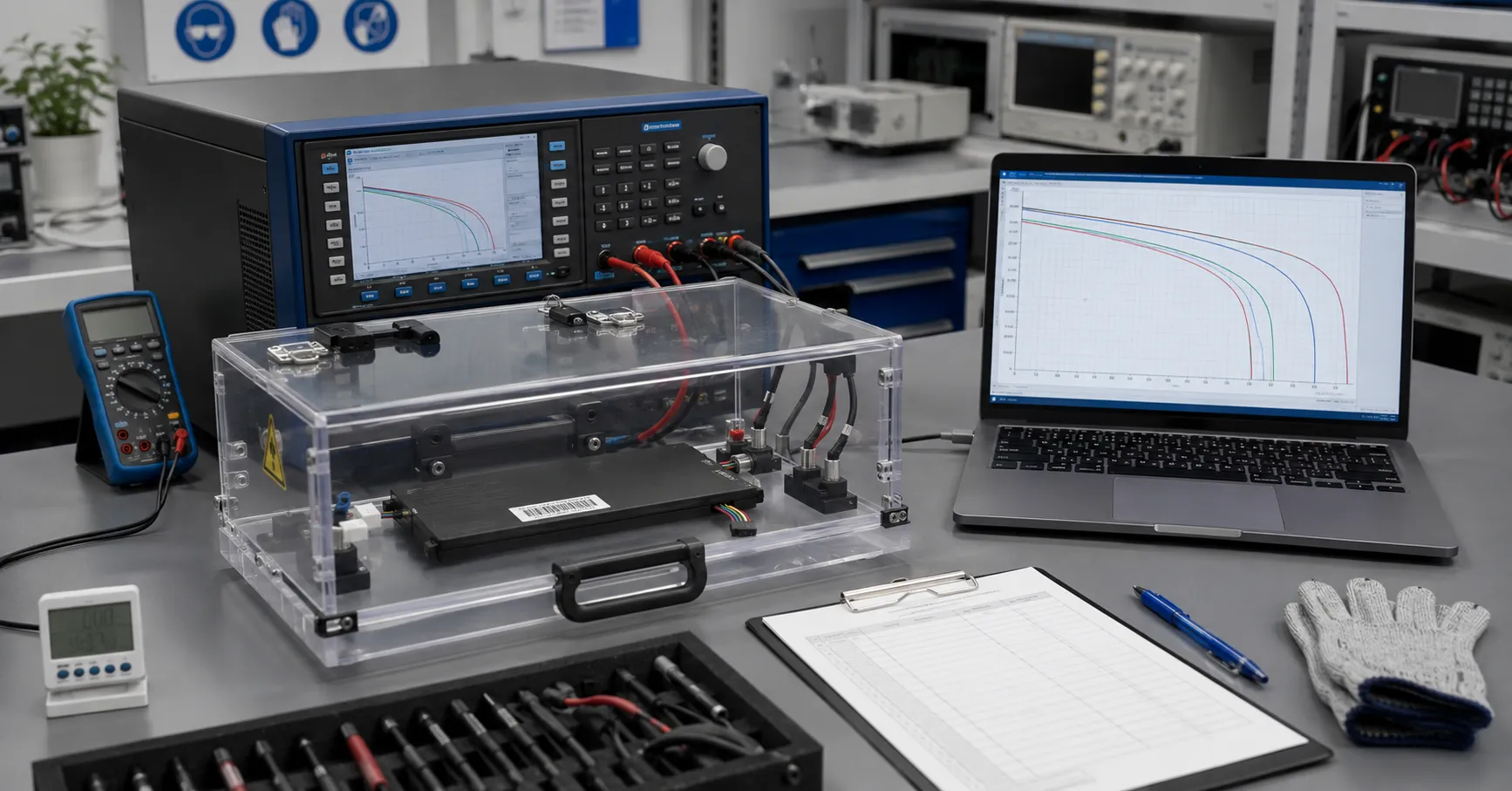
Use qualified personnel, suitable fixtures, calibrated equipment, and an approved method. Depending on the specification, checks may include open-circuit voltage, polarity, connector pin assignment, communication or identification behavior, temperature-sensing line, charging recognition, and other defined protection or functional signals.
Do not improvise acceptance limits from generic internet values. Voltage windows, test loads, rest periods, temperatures, equipment accuracy, and pass/fail criteria must be linked to the exact battery design and agreement. Stop testing if the unit shows abnormal heat, odor, instability, deformation, or unsafe behavior.
Layer 5: Installation and functional confirmation
Install selected samples in the correct laptop model or an approved representative fixture. Confirm connector engagement, enclosure closure, battery detection, charging indication, discharge operation, communication, and normal device behavior. Record the laptop model, firmware or BIOS state where relevant, charger, software, starting condition, test duration, and result.
Initial function does not prove capacity, runtime, cycle life, or long-term reliability. Those claims require separate methods with controlled conditions and approved criteria.
Turn Requirements Into an Inspection Matrix
| Inspection item | Reference | Method | Decision output |
|---|---|---|---|
| SKU, model and part number | Purchase order and approved specification | Document and label comparison | Match, mismatch or pending |
| Lot and production traceability | Approved label and traceability rule | Visual check or barcode scan | Traceable or not traceable |
| Packaging and appearance | Packaging standard and defect catalogue | Visual inspection | Defect type and quantity |
| Dimensions and connector | Controlled drawing or approved sample | Measurement and comparison | Measured value and pass/fail |
| Electrical condition | Model-specific electrical specification | Approved test fixture and equipment | Measured result and pass/fail |
| Installation and function | Approved device and test procedure | Controlled installation test | Observed behavior and disposition |
The matrix should identify whether each characteristic is checked on every unit, every carton, or a defined sample. It should also specify responsibility, equipment, calibration status, tolerance, defect class, acceptance rule, and required evidence.
Choose a Sampling Plan Based on Lot and Risk
ISO 2859-1:2026 defines acceptance-sampling schemes indexed by acceptance quality limit for lot-by-lot inspection. A buyer may use such a system when appropriate, but the standard’s existence does not select the correct inspection level, AQL, sample size, or acceptance number for a particular laptop battery order.
Define the plan in the quality agreement before shipment. Consider lot size, supplier history, process changes, product complexity, complaint severity, inspection cost, and the consequence of accepting a defect. Critical safety or identity conditions may require containment rules that are different from ordinary sampled appearance defects.
Sampling also does not remove the supplier’s responsibility for the entire lot. An accepted sample means the lot met the agreed sampling decision rule; it does not mean every uninspected unit was proven conforming.
Classify Defects Before the Inspector Finds Them
A defect catalogue makes decisions consistent. Buyers commonly separate critical, major, and minor defects, but each organization must define those categories and examples for its product, market, and risk policy.
- Critical-condition examples for qualified review: leakage, swelling, damaged insulation exposing conductors, reversed polarity, short-circuit indication, abnormal heat, or a serious identity or safety-document conflict.
- Major-defect examples: wrong connector, dimensions outside the approved tolerance, failure to charge or communicate, missing traceability, incorrect label, or packaging that cannot protect the product as specified.
- Minor-defect examples: limited cosmetic or presentation variation that does not affect identity, fit, function, safety, traceability, or agreed retail appearance.
These examples are not universal acceptance rules. The approved defect catalogue, sampling plan, and quality agreement control the actual disposition.
Control Nonconforming Lots and Corrective Action
When a lot fails, identify and quarantine the affected stock, stop unintended release, record the defect and evidence, notify responsible quality and purchasing personnel, and determine the scope. Do not sort, rework, return, or dispose of suspect batteries until an approved process addresses product safety, traceability, transport, and local requirements.
The supplier response should identify containment, affected lots, root cause, corrective action, verification, and prevention of recurrence. If rework or sorting is accepted, define the method, personnel, inspection evidence, new lot identity, and reinspection requirement. Retain the original failure evidence and compare later deliveries with the corrective-action commitment.
Keep a Release Record That Supports Warranty Analysis
The final file should connect the order and received lot to the specification revision, supplier batch, sample IDs, inspector, date, equipment, results, photographs, defect decision, concessions, corrective action, and release authorization. Retain an approved reference sample and selected production samples when practical.
A complete record lets the buyer compare field complaints with the received lot rather than treating every failure as an isolated event. The same closed-loop principle is used in ESC’s mobile phone battery incoming-inspection guide, while the device-specific checks in this article address laptop battery fit, connectors, communication, and installation.
Frequently Asked Questions
Should every laptop battery be electrically tested?
The inspection scope should be defined by the buyer’s risk assessment, specification, quality agreement, lot history, and applicable requirements. Some identity or safety controls may apply to every unit or carton, while other tests may use an approved sample.
Can a certificate replace incoming inspection?
No. A relevant document can support compliance review, but it does not prove that the received lot has the correct identity, construction, dimensions, connector, workmanship, electrical condition, and functional behavior.
What is the correct AQL for laptop batteries?
There is no single value suitable for every buyer, defect class, supplier, and market. The organization responsible for product quality should approve the sampling plan and distinguish critical, major, and minor risks.
What should happen when one battery is swollen or leaking?
Stop ordinary handling, isolate the affected product and potentially related stock, prevent charging or installation, document the condition, and obtain qualified safety and disposal or transport guidance.
When should a lot require requalification?
Review requalification when the cell, pack construction, protection board, connector, cable, label, production site, specification, process, or claimed application changes, or when complaint and inspection data indicate increased risk.
Release the Lot Only When the Evidence Is Complete
Laptop battery incoming inspection is a release decision supported by traceable evidence. Define the lot, verify documents, inspect identity and workmanship, confirm mechanical and electrical requirements, test function under controlled conditions, apply the approved sampling rule, and contain nonconforming stock.
Send ESC your target laptop models, original battery part numbers, forecast quantity, sales market, packaging needs, and current inspection standard. ESC can help organize the specification and sample-confirmation information needed for a replacement laptop battery project. Final parameters, certifications, sampling, and acceptance criteria must be confirmed for the specific model and order.
External Source References
- International Organization for Standardization — ISO 2859-1:2026: Sampling procedures for inspection by attributes — 2026
- International Electrotechnical Commission — IEC 62133-2:2017: Safety requirements for portable sealed secondary lithium cells and batteries
- International Air Transport Association — Battery Guidance Document — Revised for 2026 Regulations