

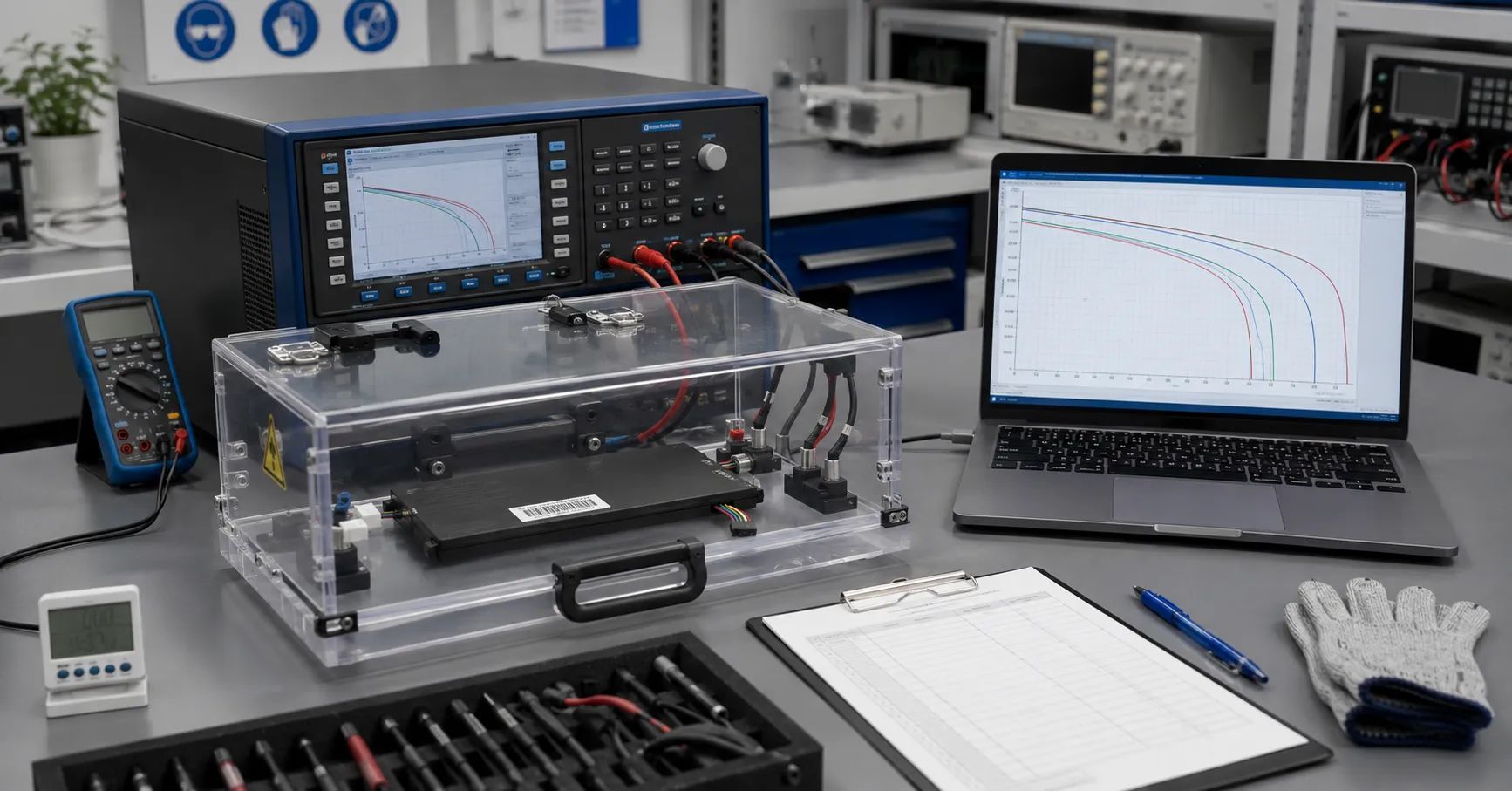
Laptop battery capacity testing must use a defined method before buyers compare a supplier’s claim with a measured result. A number from a label, operating-system estimate, handheld meter, or one uncontrolled runtime trial is not enough to approve samples for repair, refurbishment, wholesale, or private-label orders.
A useful test fixes the battery identity, charging procedure, rest period, discharge current or power, cutoff condition, ambient temperature, measurement equipment, data interval, and result calculation. It also records the sample’s age, storage history, previous cycles, and physical condition. Without those controls, two laboratories can test the same nominal product and report results that are not directly comparable.
Separate Rated Capacity, Measured Capacity, and Runtime
Capacity in ampere-hours describes electric charge delivered under stated conditions. Energy in watt-hours also accounts for voltage and is often more useful when comparing packs with different nominal voltages. Runtime depends on the battery’s delivered energy and the device’s changing power demand, software, screen brightness, processor load, wireless activity, temperature, and power-management settings.
These values answer different questions:
- Rated or marked capacity: the value declared for the product under its applicable specification.
- Measured capacity: the result produced by a defined charge-and-discharge method.
- Device-estimated capacity: information calculated by the laptop battery-management system and operating system.
- Observed runtime: how long a specific laptop operates under a particular workload and configuration.
Do not present one value as proof of another. A pack can operate a laptop successfully while still requiring a controlled capacity measurement, and a satisfactory bench result does not guarantee identical runtime across different computers.
Use the Right Reference for the Test Objective
IEC 61960-3 specifies performance tests, designations, markings, dimensions, and other requirements for secondary lithium cells and batteries used in portable applications. Buyers should determine whether that standard, another applicable method, or a mutually approved company procedure fits the exact cell format, pack construction, product claim, market, and contract.
Performance testing and safety evaluation are not interchangeable. IEC 62133-2 addresses safety requirements and tests for portable sealed secondary lithium cells and batteries. A capacity result does not replace applicable safety evidence, and a safety certificate does not prove that every received production lot delivers the ordered capacity.
For device-side review, Microsoft explains how Windows 11 can generate a battery report containing usage and estimated-capacity information. That report can support diagnostics and sample comparison, but it should not be treated as a calibrated laboratory measurement unless the approved test method specifically establishes how the data will be used.
Confirm the Sample Identity Before Charging
Every result must remain connected to the physical sample. Record the buyer SKU, supplier model, original laptop battery part number, claimed compatible devices, nominal voltage, rated ampere-hours and watt-hours, serial or lot code, production date, sample receipt date, label revision, and photographs.
Inspect the pack before connecting it to equipment. Do not test batteries showing swelling, leakage, puncture, deformation, damaged insulation, crushed connectors, exposed conductors, corrosion, unusual odor, or other suspect conditions. Quarantine them under the buyer’s safety procedure.
When several laptop models or battery codes are involved, use ESC’s laptop battery part-number matching guide to separate identity, dimensions, connectors, pinout, cable layout, and device application before evaluating electrical performance.
Build a Controlled Discharge Test
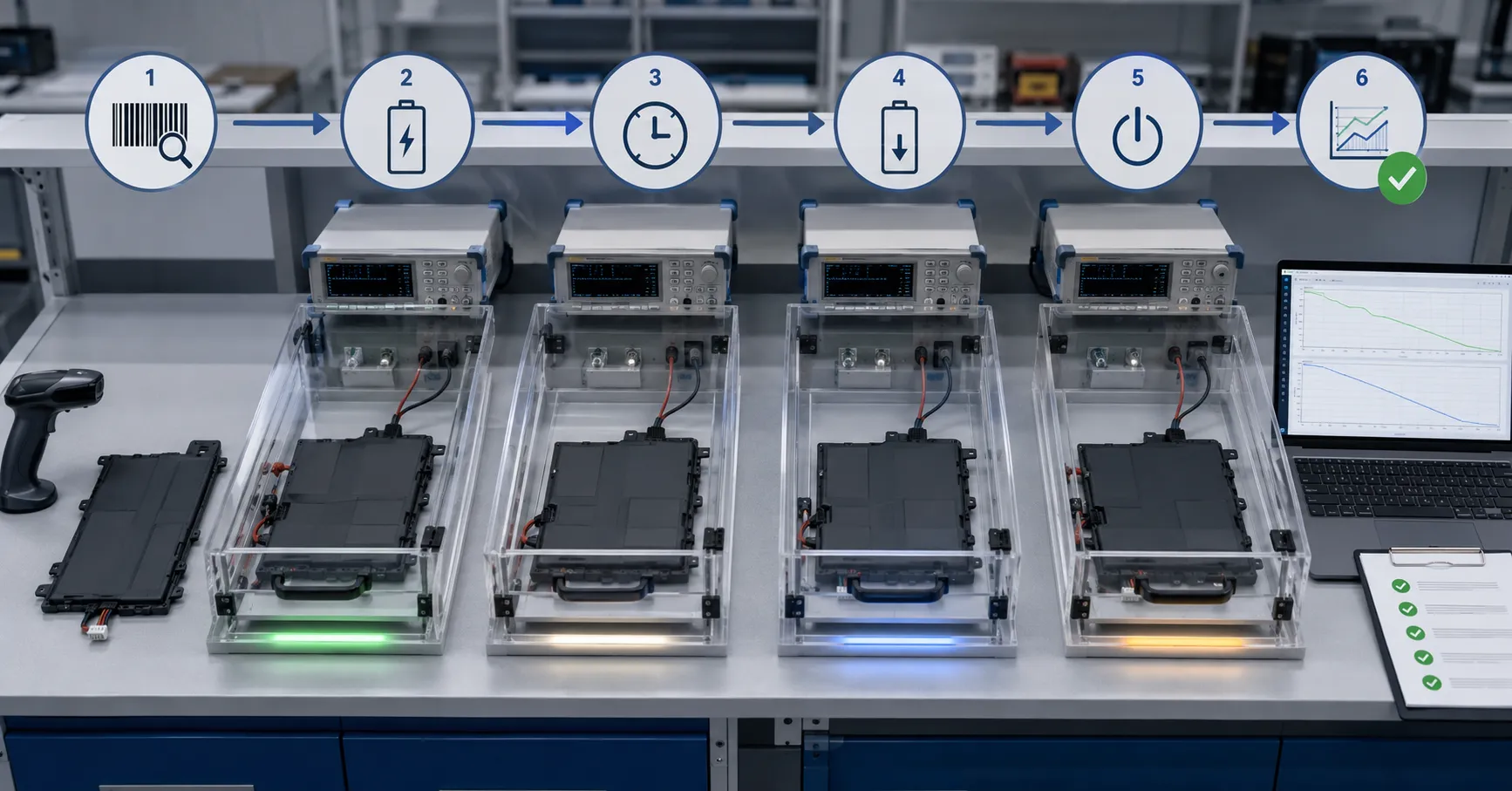
1. Define sample conditioning
Record how samples were transported and stored, their temperature before testing, and whether any preliminary cycles are permitted. Do not quietly add conditioning cycles after a poor result. The approved method should define them before testing begins.
2. Control the charging stage
Specify the charger or analyzer, voltage and current profile, termination rule, temperature range, and any communication requirements. Record the actual start and finish time and stop the test if the pack shows abnormal temperature, instability, deformation, or odor.
3. Use a defined rest period
A rest period can affect voltage stabilization and the starting condition for discharge. Use the duration and environment stated in the approved method rather than moving directly from charging to discharge for some samples but not others.
4. Fix the discharge condition
Define constant current, constant power, or another approved load profile; the cutoff voltage or device-defined endpoint; ambient conditions; data-recording interval; fixture; wire and connector arrangement; and channel accuracy. If the battery requires communication with a device or simulator, identify the hardware and software configuration.
5. Calculate and retain both charge and energy results
Where the method requires them, calculate delivered ampere-hours from current over time and watt-hours from power over time. Retain the raw time, voltage, current, temperature, and status data instead of recording only a final pass/fail value.
6. Repeat under the approved rule
Define how many cycles and samples are required, which cycle provides the reported result, and how invalid tests are handled. A failed channel, interrupted connection, or incorrect setup should be documented, not deleted without explanation.
Document the Variables That Change the Result
| Test variable | What to record | Risk if uncontrolled |
|---|---|---|
| Sample history | Age, storage, transport and prior cycles | Samples begin from different conditions |
| Charging | Profile, termination, charger and temperature | Starting state is inconsistent |
| Rest | Duration and environment | Voltage stabilization differs |
| Discharge | Current or power, cutoff and profile | Delivered result cannot be compared |
| Equipment | Analyzer, fixture, channel and calibration status | Measurement error is hidden |
| Environment | Ambient and monitored battery temperature | Performance changes with test conditions |
| Calculation | Raw data, software version and result formula | Reported values cannot be reproduced |
A clear laptop battery capacity testing record makes supplier and buyer results easier to reconcile. If results disagree, compare the method and raw curves before concluding that one laboratory or product is wrong.
Do Not Invent a Universal Passing Percentage
The acceptance limit must come from the approved product specification, test method, contract, applicable standard, and sample status. Do not automatically apply one percentage to every laptop battery chemistry, model, age, storage condition, discharge rate, or market.
Before samples arrive, define:
- which value is being verified;
- the applicable test method and revision;
- the number and condition of samples;
- the charge, rest, discharge, cutoff, and temperature conditions;
- whether ampere-hours, watt-hours, or both control acceptance;
- the rule for rounding and measurement uncertainty;
- the treatment of invalid tests, outliers, and retests;
- the acceptance decision and escalation path.
Separate Sample Approval From Production-Lot Control
Development samples establish whether the proposed design can meet the approved requirement. They do not prove that every future lot will remain consistent. Convert the approved configuration and method into production documentation, change control, incoming inspection, and periodic verification.
ESC’s laptop battery incoming-inspection guide explains how buyers can connect lot identity, appearance, dimensions, connectors, electrical checks, functional confirmation, defect classification, and release evidence. Capacity verification can be one part of that system, but not every incoming test needs to repeat a full development program.
Define when capacity should be checked again—for example, according to the approved periodic plan, after a relevant design or process change, when inspection trends deteriorate, or when field complaints indicate a possible performance shift. The actual trigger must be written into the quality agreement.
Review the Curves, Not Only the Final Number
A final capacity value can hide unstable voltage, premature cutoff, unusual temperature behavior, intermittent connection, or channel interruption. Review voltage, current, energy, temperature, time, and status curves together. Compare repeated cycles and multiple samples for consistency.
Do not publish precise performance claims without retaining the model, sample identity, equipment, calibration, load, cutoff, environment, date, and raw data. ESC’s verified-facts rules require model-specific evidence before measured capacity is presented as a product or company claim.
Common Capacity-Test Errors
- Comparing mAh values from packs with different nominal voltages
- Using laptop runtime as the only capacity measurement
- Treating an operating-system estimate as calibrated bench data
- Changing discharge current, cutoff, or temperature between suppliers
- Ignoring storage history and previous cycles
- Reporting only the best sample or cycle
- Deleting invalid or failed tests without a documented reason
- Approving a design without converting the method into lot-control criteria
Build a Report That Purchasing Can Use
The final report should include sample and lot identity, label photographs, applicable specification, test method revision, equipment and calibration status, fixture, software, charging conditions, rest period, discharge profile, cutoff, environment, raw-data file, calculated ampere-hours and watt-hours, curve review, deviations, result, reviewer, and date.
Purchasing also needs a clear commercial conclusion: approved, conditionally approved, rejected, or pending additional evidence. If approval depends on a revised label, different connector, repeated test, or supplier corrective action, state that condition before placing the bulk order.
Buyers evaluating the broader relationship can use ESC’s laptop battery supplier guide to review model coverage, documentation, sampling, quality control, and repeat-order support alongside test performance.
Frequently Asked Questions
Can Windows battery report prove the actual capacity of a new sample?
It provides useful system-reported and estimated information, but buyers should not treat it as a substitute for a controlled measurement unless the approved procedure defines and validates that use.
Should buyers compare mAh or Wh?
Use the quantity required by the specification and test method. Watt-hours account for voltage and are important when comparing packs with different nominal voltages; many programs record both values.
How many samples and cycles should be tested?
The number should be defined by the buyer’s approved validation plan, product risk, supplier history, test objective, and agreement. One universal number should not be applied automatically.
Does passing a capacity test prove the battery is safe?
No. Performance testing, safety evaluation, transport compliance, compatibility, and production quality control are related but separate evidence areas.
When should capacity be retested after approval?
Use the periodic and change-control triggers defined in the quality agreement. Relevant design, cell, process, factory, protection-board, or performance-trend changes may justify renewed verification.
Approve the Method Before Comparing the Numbers
Laptop battery capacity testing should produce a reproducible decision, not just a favorable number. Fix the sample identity, conditioning, charge, rest, discharge, cutoff, environment, equipment, calculation, and acceptance rule before testing. Retain the raw curves and convert the approved method into production and incoming-quality controls.
Send ESC your target laptop models, original battery part numbers, required voltage and capacity, sample quantity, sales market, and proposed test method. ESC can help organize the specification and sample information needed for a replacement laptop battery project. Final claims, conditions, acceptance criteria, certifications, and order terms must be confirmed for the exact model and agreement.
External Source References
- International Electrotechnical Commission — [IEC 61960-3:2017: Performance requirements for secondary lithium cells and batteries for portable applications] — 2017
- International Electrotechnical Commission — [IEC 62133-2:2017: Safety requirements for portable sealed secondary lithium cells and batteries] — 2017, amendment consolidated in current offering
- Microsoft Support — [Caring for your battery in Windows]