
The replacement battery market continues to grow as more consumers choose repair, refurbishment, and aftermarket maintenance instead of replacing their phones immediately. For distributors, repair chains, mobile accessory brands, and electronics wholesalers, choosing the right iPhone battery manufacturer is an important step in building a stable and profitable product line.
However, sourcing iPhone-compatible batteries is not just about finding a low-cost supplier. Buyers need a manufacturing partner that understands compatibility, battery safety, cell quality, protection circuits, testing procedures, export compliance, and long-term production consistency.
A professional manufacturer should be able to support not only product supply, but also OEM development, private-label packaging, quality inspection, and bulk delivery planning. That is especially important for brands that want repeat orders with stable performance and fewer after-sales issues.
If you are building a broader battery and charging product line, you can also review ESC’s product solutions, About Us, and customized solutions to understand the company’s manufacturing support and OEM capabilities.
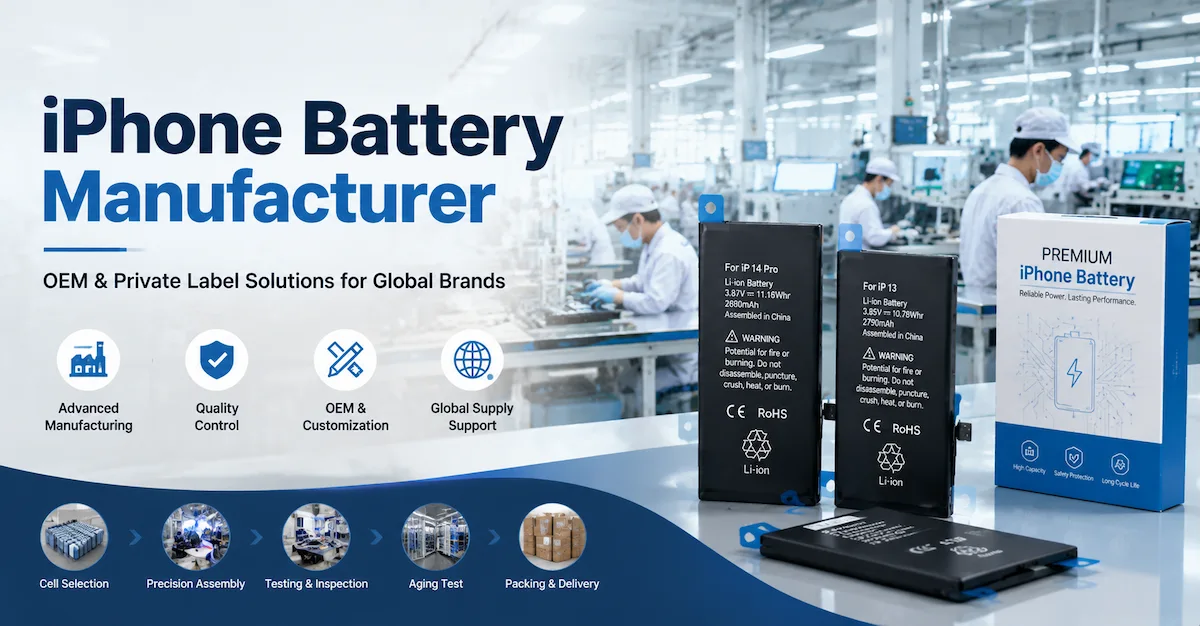
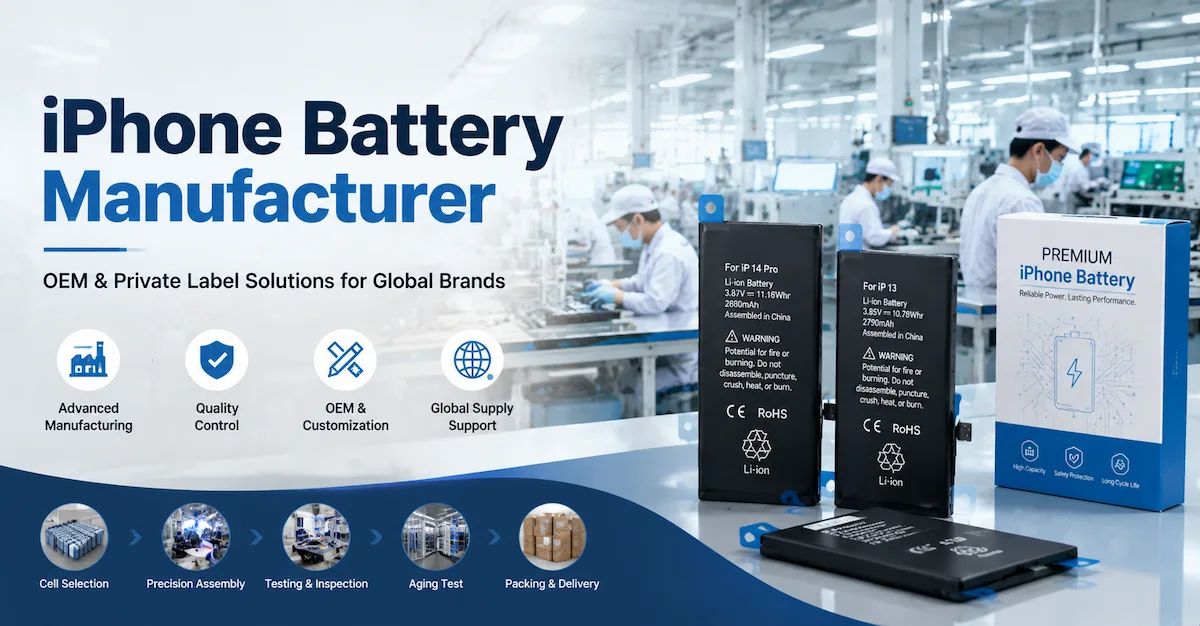
Why Work with a Professional iPhone Battery Manufacturer?
Stable Production Capability
A true manufacturer offers better control over production than a general trader. That includes:
- Battery cell sourcing
- Protection board integration
- Connector assembly
- Labeling and packaging
- Final testing and inspection
For buyers handling wholesale distribution or repair-channel supply, this matters because consistent product availability is just as important as product quality.
Better Product Consistency
One of the biggest problems in the aftermarket battery business is inconsistency between batches. A professional iPhone battery manufacturer should reduce this risk by controlling:
- Cell selection
- Production parameters
- Capacity verification
- Connector accuracy
- Finished-goods inspection
This helps ensure that repeat orders match the approved sample more closely.
OEM and Brand Support
Many buyers do not want plain generic batteries. They need a factory that can support:
- Custom brand labels
- Private-label packaging
- Barcode and SKU labeling
- User instructions
- Batch traceability
- Market-specific compliance labeling
That level of support is especially important for importers and repair brands that want stronger brand identity in local markets.
What Does an iPhone Battery Manufacturer Usually Produce?
The term “iPhone battery manufacturer” in B2B sourcing usually refers to a factory producing replacement batteries compatible with specific iPhone models for the aftermarket repair and distribution business. These products are generally intended for replacement and service channels rather than official original device assembly.
Standard Replacement Batteries
These are designed for routine battery replacement and are often the highest-demand items for:
- Phone repair shops
- Distributors
- Service centers
- E-commerce replacement-parts sellers
Their value lies in stable quality, correct fit, and reliable everyday performance.
High-Capacity Replacement Batteries
Some markets prefer higher-capacity battery options for extended runtime. These products may appeal to:
- Premium repair channels
- Power users
- E-commerce sellers seeking product differentiation
However, buyers should confirm that “high capacity” claims are backed by real testing and not just marketing language.
OEM and Private-Label Batteries
For larger buyers, a manufacturer may support OEM projects that include:
- Custom printed labels
- Brand packaging
- Technical documentation
- Specific capacity positioning
- Distributor-ready retail presentation
| Battery Type | Best For |
|---|---|
| Standard replacement battery | Repair and maintenance markets |
| High-capacity battery | Premium retail and value-added repair services |
| OEM/private-label battery | Brand owners and distributors |
iPhone-Compatible Battery Manufacturing Process
Understanding the manufacturing process helps buyers evaluate whether a factory can actually deliver reliable products.
Battery Cell Selection
The cell is the foundation of battery quality. A factory should carefully evaluate:
- Cell consistency
- Energy density
- Cycle performance
- Safety performance
- Supplier stability
If the cell quality is unstable, the final battery product will also be unstable, no matter how good the packaging looks.
Protection Circuit Integration
A replacement battery usually includes a protection system that helps manage:
- Overcharge protection
- Over-discharge protection
- Short-circuit protection
- Temperature management
The protection board and battery cell must work together properly. Buyers should ask whether the manufacturer verifies circuit performance during production.
Connector and Structure Assembly
For iPhone-compatible batteries, structural accuracy is critical. The manufacturer should control:
- Connector position
- Flex-cable integrity
- Dimensions
- Adhesive stability
- Housing fit
Minor structural variation may create installation problems, which can increase returns and repair time.
Testing and Inspection
A serious factory should test batteries during and after production. Common steps include:
- Capacity test
- Voltage test
- Charging test
- Aging test
- Visual inspection
- Safety-function verification
Key Specifications Buyers Should Evaluate
Before approving samples or placing a bulk order, buyers should review the core technical points.
| Specification | Why It Matters |
|---|---|
| Capacity | Affects device runtime |
| Voltage | Must match device requirements |
| Size and thickness | Ensures installation compatibility |
| Connector design | Determines correct connection |
| Cycle life | Reflects long-term durability |
| Protection function | Supports safety and reliability |
Capacity
Battery capacity is a major selling point, but it should be realistic. Buyers should focus on:
- Rated capacity
- Measured capacity
- Batch consistency
If a supplier claims unusually high capacity without solid test data, buyers should be cautious.
Voltage and Charging Compatibility
The battery must work properly with the device’s charging system. Confirm:
- Nominal voltage
- Charging behavior
- Compatibility with target models
- Stability under daily-use conditions
Cycle Life
Cycle life affects how long a battery remains useful in the field. For aftermarket products, this matters because poor cycle performance may quickly lead to complaints, bad reviews, and warranty claims.
OEM and Private Label iPhone Battery Manufacturing
For distributors and brands, OEM capability is often what separates a factory from a simple component seller.
Custom Labeling
A factory may support:
- Brand logo printing
- Model labeling
- Safety text
- Capacity labeling
- Traceability codes
This helps turn a generic product into a branded aftermarket solution.
Packaging Customization
Packaging influences both product protection and market perception. Common options include:
- Retail boxes
- Repair-shop packaging
- Anti-static packaging
- Bulk carton solutions
- Multilingual manuals
Documentation Support
A strong OEM partner should also help with supporting materials such as:
- Specification sheets
- Packing lists
- Compliance labeling
- Shipping marks
- Product instruction inserts
For customized battery and charging projects, ESC’s customized solution page is relevant for buyers evaluating branding and development support.
Quality Control Standards for iPhone Batteries
Quality control is one of the most important sections in this type of sourcing article because battery failures can create both financial and reputational damage.
Incoming Material Inspection
A manufacturer should inspect core materials before production, including:
- Cells
- Protection boards
- Connectors
- Labels
- Packaging components
In-Process Inspection
During assembly, the factory should verify:
- Structural accuracy
- Connector installation
- Welding or bonding quality
- Protection-board integration
Final Product Testing
Before shipment, the battery should go through relevant tests such as:
- Capacity verification
- Charging test
- Discharge performance test
- Aging test
- Appearance inspection
| QC Item | Purpose |
|---|---|
| Capacity test | Confirms real battery performance |
| Charging test | Confirms charging stability |
| Aging test | Evaluates long-term consistency |
| Appearance inspection | Reduces cosmetic defects |
| Safety-function test | Verifies protection performance |
Batch Consistency Control
For wholesalers and brands, one approved sample is not enough. The manufacturer should also demonstrate that mass production can stay consistent across repeat orders.
Certifications and Export Documents
Because batteries contain lithium components, compliance and shipping documents are essential.
Common documents may include:
- CE
- RoHS
- FCC
- UN38.3
- IEC62133
- MSDS
Why These Documents Matter
They help support:
- Import clearance
- Shipping approval
- Market compliance
- Buyer confidence
Buyers should confirm that the documents match the actual battery model being ordered, rather than assuming all documents automatically apply to every version.
How to Choose the Right iPhone Battery Factory
A professional iPhone battery manufacturer should be evaluated as a long-term production partner, not just a quote provider.
Check Manufacturing Experience
Ask about:
- Years in battery production
- Export markets
- Main customer types
- Model range
- Experience in the repair/aftermarket sector
Review Testing Capability
A supplier should be able to explain:
- What it tests
- How it tests
- When it tests
- Whether it keeps test records
If the answers are vague, quality control may be weak.
Verify OEM Ability
Not all factories with products online can really support private-label projects. Confirm:
- Custom label MOQ
- Packaging options
- Lead time for customization
- Artwork approval process
- Repeat-order consistency
Evaluate Communication and Support
A good factory should also be responsive and organized. That includes:
- Clear quotations
- Accurate sample communication
- Timely updates
- Shipment coordination
- Problem-solving ability
MOQ, Lead Time, and Production Planning
Production planning is important for both first orders and repeat orders.
MOQ
MOQ depends on:
- Battery model
- Packaging requirements
- Branding level
- Existing stock situation
- Production schedule
Sample Process
Before mass production, buyers should usually confirm:
- Product model
- Technical specifications
- Sample performance
- Label and packaging details
- Final quotation
Lead Time
Lead time may depend on:
- Order quantity
- Custom packaging
- Material readiness
- Production schedule
- Inspection requirements
For B2B buyers, clear lead-time planning is essential to avoid inventory gaps in repair channels and distribution networks.
Common Mistakes When Choosing an iPhone Battery Manufacturer
Choosing Only by Price
The lowest quotation may reflect:
- Lower-grade cells
- Less testing
- Inconsistent materials
- Weak after-sales support
Ignoring Sample Verification
Bulk orders should not be placed without checking:
- Capacity
- Fit
- Charging behavior
- Appearance
- Label accuracy
Not Confirming Compatibility Carefully
Even a good battery is a problem if it does not match the intended models properly.
Overlooking Documentation
Without proper shipping and compliance documents, import and logistics problems may delay delivery and increase costs.
Treating the Factory as a One-Time Vendor
For stable business growth, it is better to build cooperation with a manufacturer that can support repeat orders and future product expansion.
Why Work with ESC as Your Battery Manufacturing Partner?
ESC supports global customers in battery and charging product development with a focus on:
- OEM customization
- Product quality
- Manufacturing support
- Supply stability
- Export cooperation
For buyers who want to evaluate broader company capability, ESC’s About Us page provides a useful starting point, while the products page shows the wider product scope that can support cross-selling or category expansion.
This is especially useful for businesses that want to combine battery sourcing with power banks, charging accessories, or other portable power products under one supply network.
FAQ
What does an iPhone battery manufacturer usually provide?
A manufacturer typically provides replacement batteries compatible with selected iPhone models, along with quality control, labeling, packaging, and sometimes OEM support for brands and distributors.
Can manufacturers produce private-label iPhone batteries?
Yes. Many manufacturers support private-label projects, including custom labels, retail packaging, and documentation, depending on MOQ and project scope.
What certifications are commonly required?
Common documents may include CE, RoHS, FCC, UN38.3, IEC62133, and MSDS, depending on the destination market and shipping method.
How are iPhone-compatible batteries tested?
Common tests include capacity testing, charging performance testing, aging tests, appearance inspection, and safety-function verification.
What MOQ is required for OEM batteries?
MOQ varies by model, packaging requirement, and branding level. Standard products may have lower MOQs, while fully customized OEM orders often require more.
How can buyers reduce sourcing risk?
Test samples carefully, verify compatibility, review QC procedures, confirm documentation, and choose a factory with stable communication and production capability.
Are higher-capacity batteries always better?
Not always. Higher-capacity products should still be evaluated for fit, safety, realistic performance, and consistency. Marketing claims should be backed by testing.
What should I check before placing a bulk order?
Confirm technical specifications, compatibility, sample approval, QC standards, packaging, certifications, lead time, and shipment terms.
Conclusion
Choosing the right iPhone battery manufacturer is essential for brands, distributors, and repair businesses that want reliable product quality and long-term supply stability.
A strong manufacturing partner should offer more than just a catalog and a price list. It should provide controlled production, realistic capacity performance, compatibility accuracy, quality testing, OEM support, and proper export documentation.
For businesses that want to build a stronger battery and charging product line, working with a reliable factory partner can improve quality, reduce sourcing risk, and support long-term growth.
If you are planning an OEM or bulk battery project, ESC can support your sourcing process with battery and charging product experience, manufacturing coordination, and customized solution support.