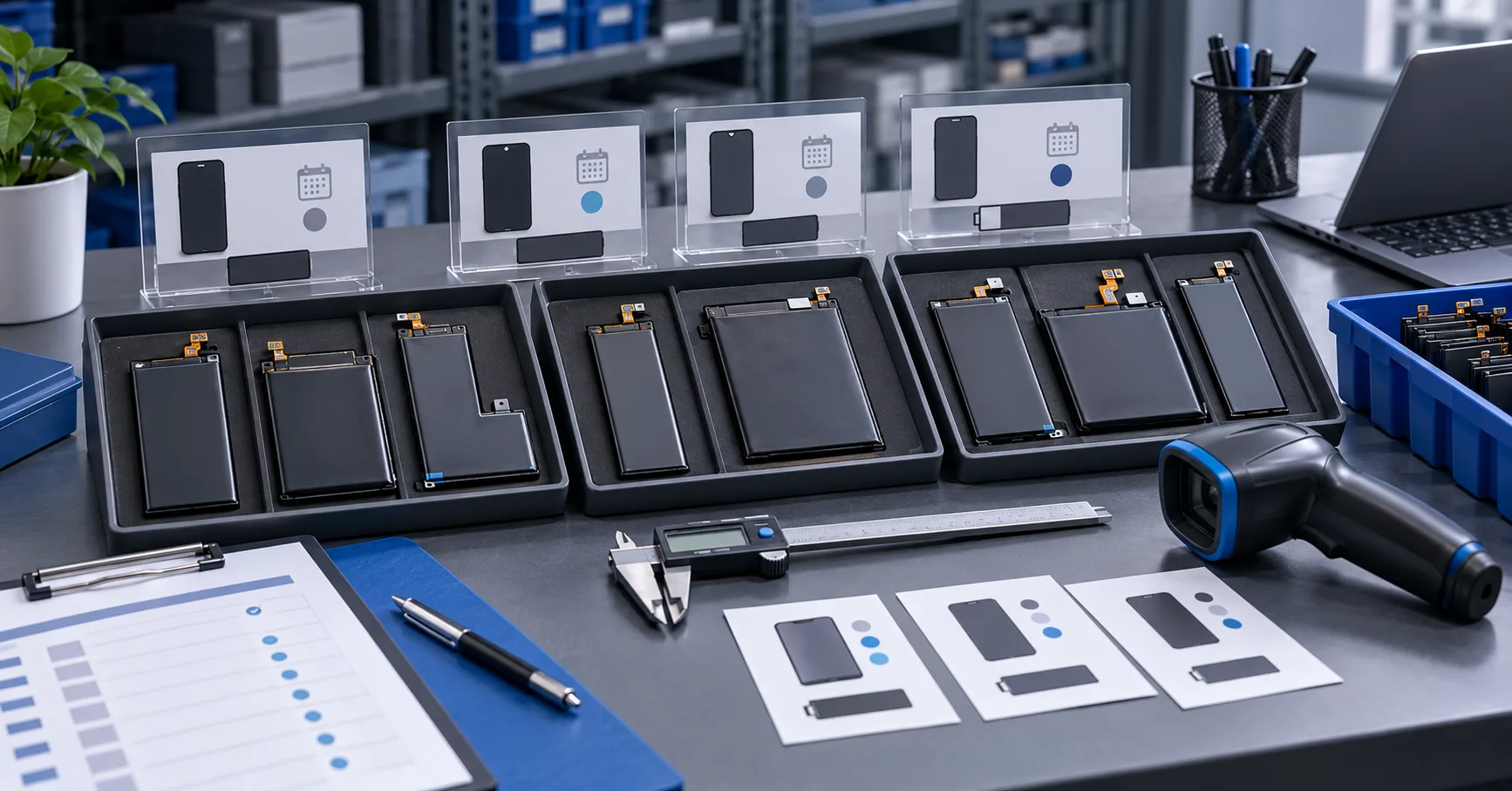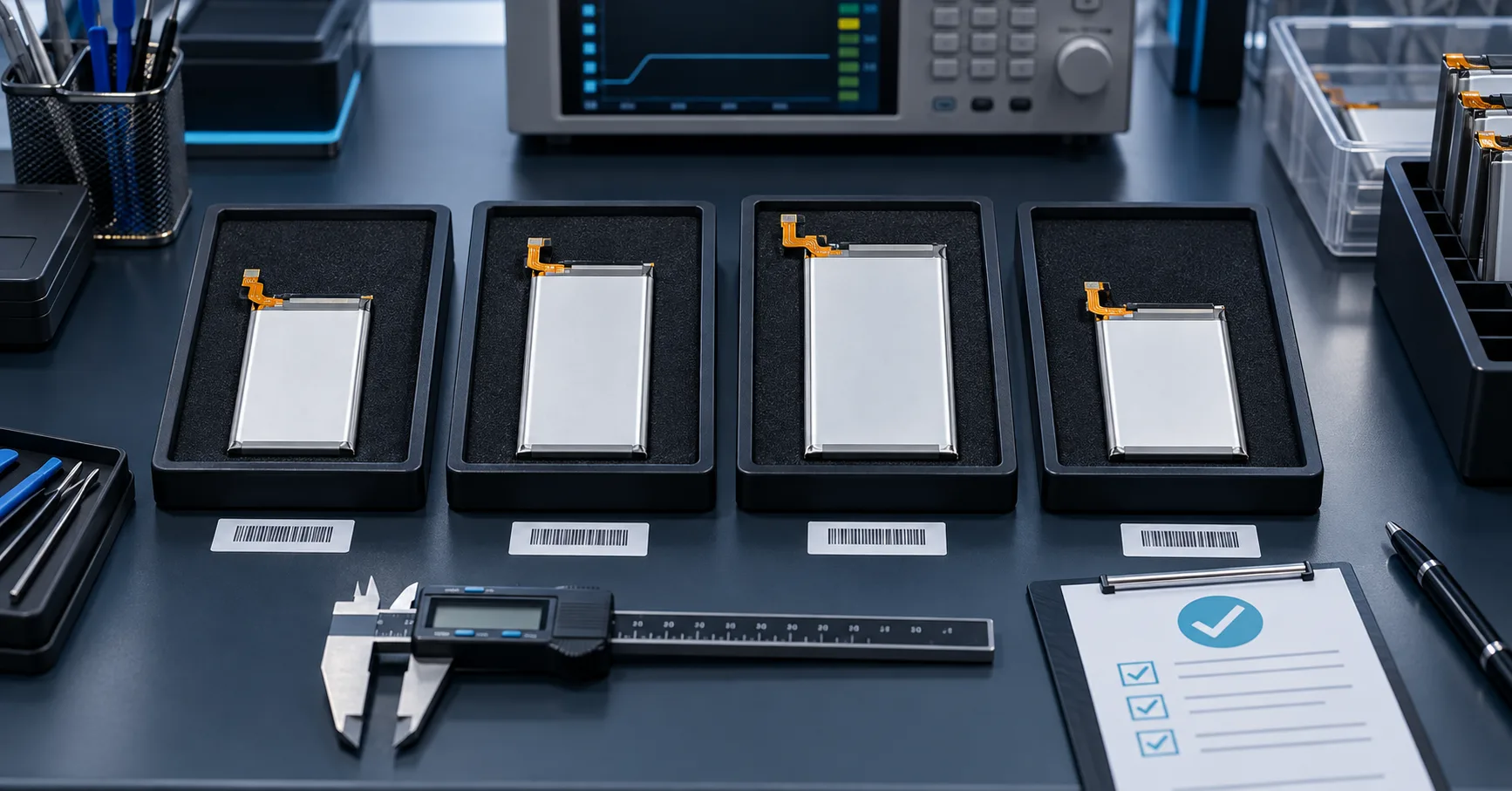

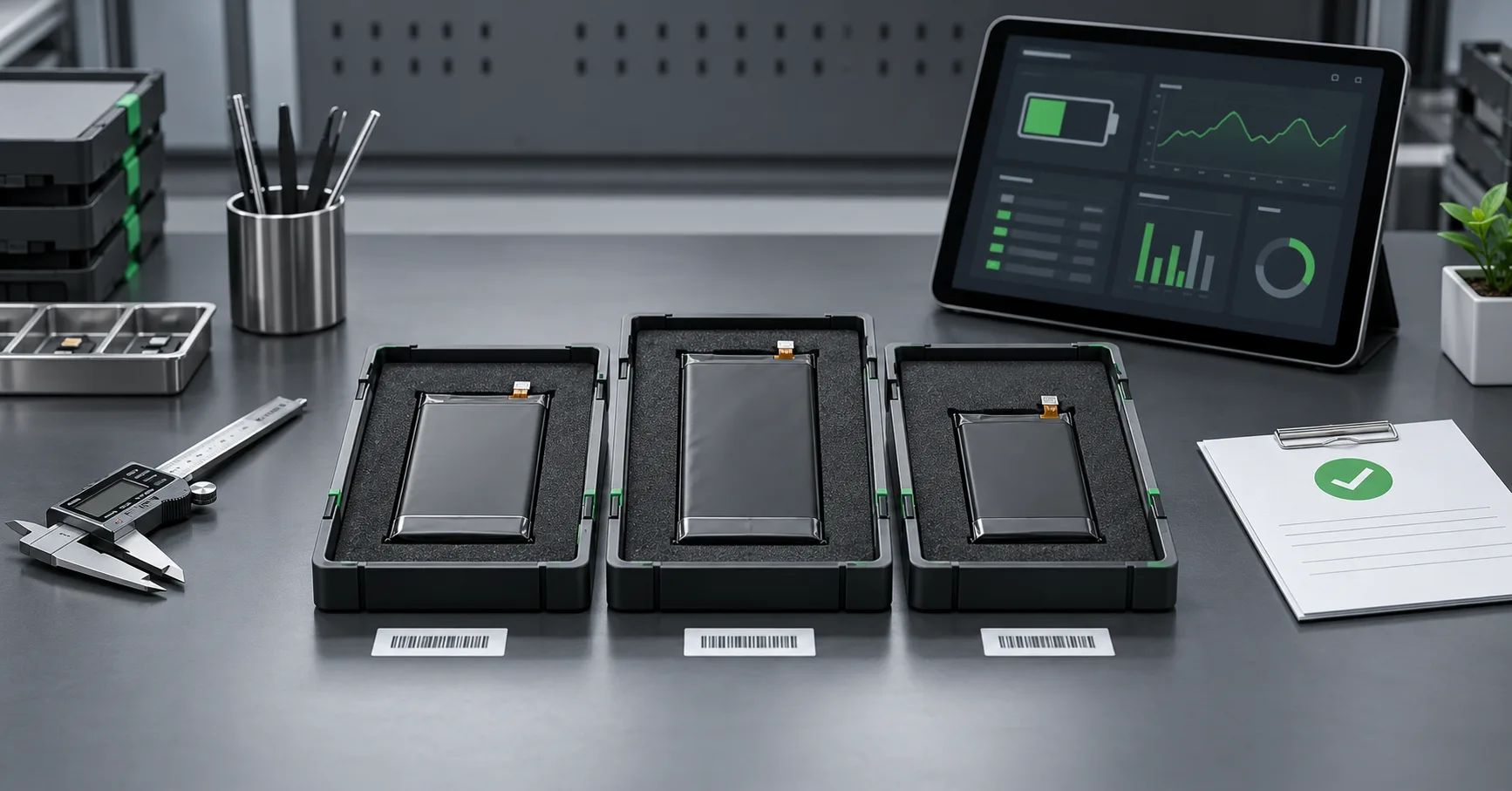
Quick answer: Pixel 7, Pixel 7 Pro and Pixel 7a should be purchased and approved as three separate replacement-battery SKUs. They belong to one commercial family, but their official capacity references, device structures and service parts are not the same. A B2B buyer should approve each finished pack against an exact device identity, controlled drawing, electrical specification, installed-device test and traceable production lot.
For buyers researching google pixel 7 battery replacement supply, the main risk is not simply choosing the wrong mAh figure. It is allowing a broad marketplace title to substitute for evidence. Repair chains, refurbishment facilities and wholesalers need a device-to-pack mapping that survives receiving inspection, technician installation and repeat orders.
Define the Pixel 7 Series Before Requesting Quotes
The procurement scope normally contains three devices: Pixel 7 and Pixel 7 Pro, introduced in 2022, plus Pixel 7a, introduced in 2023. The “a” model is not a smaller label variation of Pixel 7, and the Pro is not defined by capacity alone. Keep separate internal records for all three even when one supplier quotation groups them together.
Google's official hardware specification page lists the following device-level battery capacities:
| Device lane | Google typical capacity | Google minimum capacity | B2B purchasing consequence |
|---|---|---|---|
| Pixel 7 | 4,355 mAh | 4,270 mAh | Use a Pixel 7-specific drawing, sample and warehouse SKU. |
| Pixel 7 Pro | 5,000 mAh | 4,926 mAh | Validate the Pro assembly independently; do not approve by family name. |
| Pixel 7a | 4,385 mAh | 4,300 mAh | Create a third approval lane despite its capacity being close to Pixel 7. |
Google describes the Pixel 7a value as Typical 4385 mAh
and publishes both typical and minimum figures for the series on its Pixel phone hardware specifications. These are useful device references, not test results for an ESCCharge or other aftermarket pack. A replacement-battery claim must be supported by evidence for the exact finished assembly and its stated test method.
Build a Three-SKU Approval Matrix
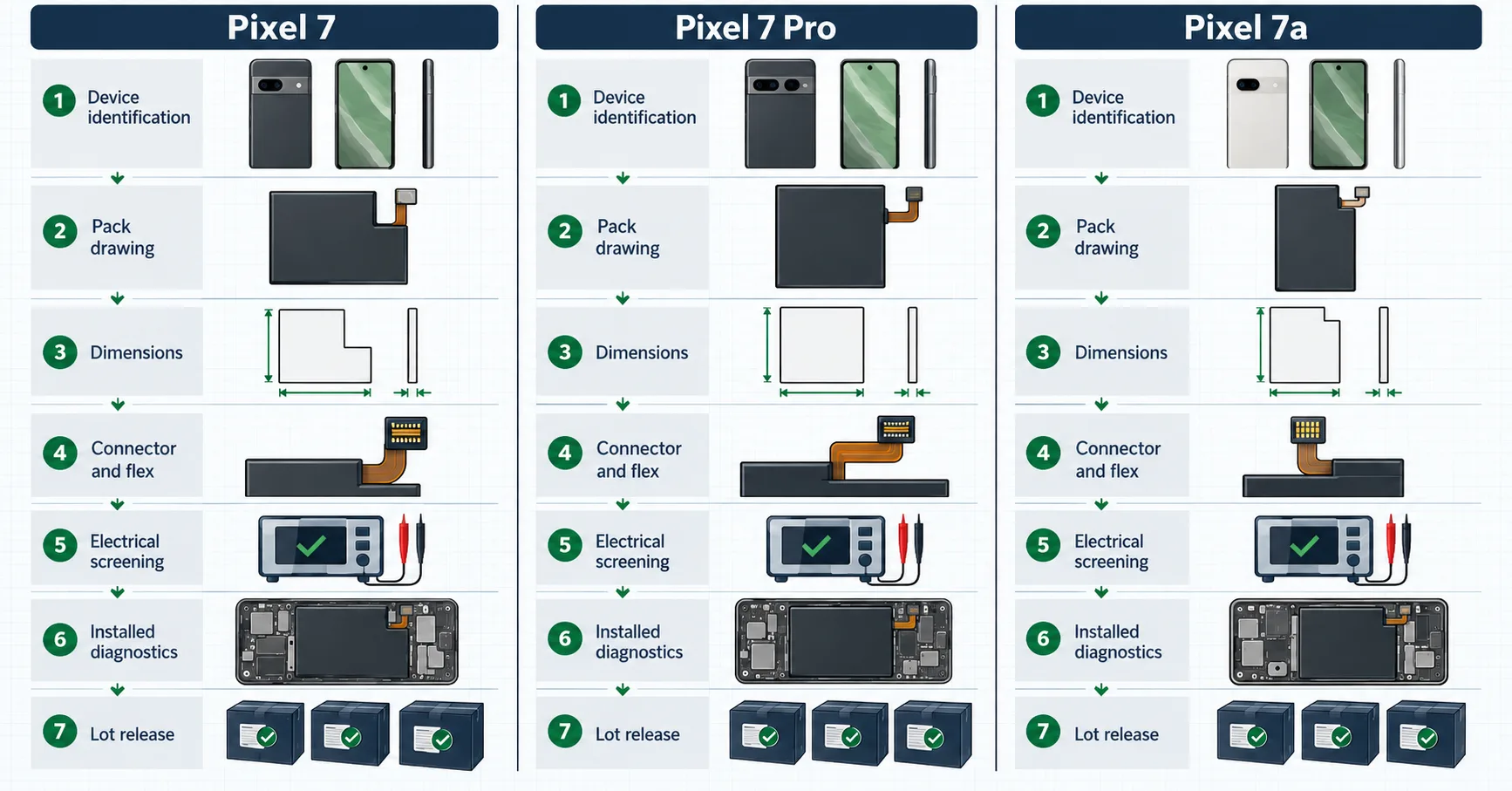
Start the matrix with the complete device model shown in the device's regulatory information, not only the retail name. Google's safety information identifies multiple Pixel 7 and Pixel 7 Pro regulatory models, including GQML3, GVU6C, G03Z5, GE2AE, GFE4J and GP4BC. Network and regional variants do not automatically prove a different battery, but they must remain visible in the approval record until the buyer verifies the mapping. See Google's Pixel 7 and Pixel 7 Pro safety and regulatory guide.
A quotation for pixel 7 battery replacement stock should identify:
- every supported device model and target sales region;
- supplier battery code, buyer SKU and revision level;
- cell and finished-pack label photographs;
- nominal voltage, minimum or rated capacity, typical capacity and test method;
- length, width and thickness with tolerances and measurement points;
- flex geometry, connector position, contact orientation and polarity;
- protection-board, temperature-sensing and communication configuration;
- adhesive, insulation, pull-tab and packaging requirements;
- sample serial or lot identity and approved device record.
Do not infer interchangeability because Pixel 7 and Pixel 7a have similar published capacities. A difference of only 30 mAh between their typical device figures says nothing about pack outline, flex route, connector, protection electronics or enclosure stack-up. Capacity is one specification field, not a compatibility certificate.
Review Capacity Claims on a Common Basis
A buyer should first determine whether a supplier's printed value is a minimum, rated or typical capacity. These terms cannot be compared as if they were interchangeable. Request the charge procedure, rest period, discharge rate, cutoff voltage, ambient condition, sample count and equipment used for the claim. Tie every report to the exact pack revision and sample IDs.
The same discipline applies to google pixel 7 pro battery replacement offers. A label near 5,000 mAh may look consistent with Google's device specification, but it does not prove the pack delivers that result, fits correctly or behaves safely in the phone. Conversely, a lower minimum figure should not be compared directly with a higher typical figure without aligning the definitions.
For sample comparison, use one written method across suppliers. Record individual results rather than only an average, investigate outliers, and set acceptance limits before testing. Repeat the relevant checks on a pilot lot because one carefully selected sample cannot represent production variation.
Verify Mechanical Fit Before Power Testing
Mechanical acceptance protects both the device and the later electrical test. Inspect the cell surface, edge sealing, flex, connector, insulation and adhesive condition before installation. Measure thickness at controlled locations; an average thickness can hide a localized high point that loads the display or rear cover.
Install only in the matching approval device. The pack should seat without force, connector alignment should not require flex tension, and the flex should follow its intended route without folding across an unsafe edge. Confirm clearance from neighboring components and verify that adhesives do not cover service features or extend into prohibited areas.
A separate pixel 7 pro battery replacement lane is especially important because a buyer may otherwise treat the larger 5,000 mAh specification as the only difference. The approval record must show the actual Pro drawing, measured sample and installed photographs rather than a verbal assurance that the product is “for the 7 series.”
Use Google Diagnostics as Post-Repair Evidence
Installed validation should cover boot, charging, percentage progression, controlled load, restart behavior, temperature observation and relevant diagnostics. Google says its Pixel Repair Diagnostics App can check a device before and after repair and is available on Pixel 3 and later phones. Its instructions tell users to dial *#*#7287#*#*
and follow the on-screen steps. See Google's Pixel self-repair and diagnostics guidance.
Diagnostics are supporting evidence, not a substitute for battery identity, dimensional inspection or controlled capacity testing. Record the device model, software version, diagnostic test selected, result, date and technician. If a feature is unavailable in a target region or software build, define an alternative test instead of assuming the workflow will be identical everywhere.
Google also provides battery diagnostics on Pixel 6 and later devices to help evaluate battery performance and replacement needs. Its guidance states that users can check battery health signals
and charging information. Buyers can review the official Pixel battery diagnostics information. Do not promise a particular health status, percentage or system message for a third-party pack unless it has been verified on the exact device and software configuration.
Protect Customer Data During Repair Validation
Repair operations also need a controlled data-handling path. Google explains that eligible phones running Android 14 with the December 2023 update or later can use Repair mode, which starts a clean Android environment in a dedicated secure partition. The company says this allows technicians to service devices without data loss through a factory reset
. See the Google Repair mode explanation.
A repair chain should document eligibility, customer consent, backup guidance, SIM handling, entry and exit checks, and exceptions. Repair mode does not remove the need for access-control procedures, and its availability can change with software state. Treat it as one controlled workflow element rather than a blanket security guarantee.
Move from Engineering Samples to a Production Lot
| Gate | Evidence required | Typical stop condition |
|---|---|---|
| Identity | Device mapping, pack code, labels and revision | Mixed codes, missing revision or unsupported mapping |
| Visual and dimensional | Surface, sealing, insulation, drawing and measured values | Deformation, damage or tolerance outside the approved range |
| Electrical | Voltage, polarity, sensing and unit consistency | Unexpected values or unexplained sample spread |
| Capacity | Defined method, raw data and sample traceability | Unclear terminology, missing conditions or failed limit |
| Installed device | Fit, boot, charge, load, temperature and diagnostics | Stress, abnormal heat, interruption, jump or shutdown |
| Pilot lot | Multiple units, technicians and target variants | Failures cluster by model, lot, process or revision |
ESCCharge's mobile phone battery incoming-inspection guide can help buyers translate these gates into a repeatable receiving workflow. Define quarantine authority and evidence retention before the first commercial shipment arrives.
Each released lot should remain linked to the approved reference through a unique SKU, barcode, supplier lot, production date or trace code and pack revision. Compare new lots with the approved label, dimensions, flex route, connector orientation, electrical distribution and capacity-test evidence. Require notification before changes to the cell, protection board, flex, connector, adhesive, label, manufacturing site, key process or test method.
Returns should be tied to device model, pack SKU, lot, technician, symptom, time in service and device condition. ESCCharge's battery warranty-claims evidence workflow shows how structured field data can support containment and supplier review instead of leaving each return as an isolated anecdote.
Prepare a Model-Specific RFQ
A complete RFQ should state the target device mix, region, forecast, sample quantity, packaging format and evidence requirements. Ask the supplier to quote Pixel 7, Pixel 7 Pro and Pixel 7a separately, even if the order will ship in one carton. The quotation should identify the finished-pack revision and applicable documentation for each SKU.
For google pixel 7a battery replacement procurement, do not accept a Pixel 7 report as evidence merely because the capacity values are close. Require the 7a drawing, sample results and installed validation. The same rule applies in reverse.
MOQ, lead time, certification availability and warranty depend on the exact configuration, target market, packaging and commercial agreement. ESCCharge's phone-battery supplier evaluation guide provides the broader supplier-selection context; this article owns the Pixel 7-series SKU and validation decision.
Frequently Asked Questions
Are Pixel 7 and Pixel 7a batteries interchangeable?
Do not assume so. Similar official capacity figures do not establish common dimensions, flex, connector, protection electronics or device fit. Approve each through its own controlled mapping and installed test.
Can Google's capacity specification validate an aftermarket battery?
No. Google's figures describe Google devices under stated definitions. A replacement-battery supplier must provide evidence for its own finished pack, label claim and test method.
Does passing Pixel Repair Diagnostics approve the battery?
No. It contributes post-repair evidence, but it does not replace identity, dimensional, electrical, capacity and production-consistency checks.
How many battery samples should a wholesale buyer test?
There is no universal quantity. Base sample and pilot size on order volume, model mix, supplier history, process risk and field-failure cost. Document the rationale and avoid relying on one golden sample.
What should trigger reapproval?
Reapprove after a material, cell, protection-board, flex, connector, adhesive, label, site, process or test-method change. Unexplained lot shifts and recurring field failures can also trigger focused revalidation.
Request a Pixel 7-Series Sampling Plan
Send ESCCharge the complete Pixel device models, target region, expected SKU mix, order quantity, packaging needs and required evidence. ESCCharge can review the requested configuration and propose a sample plan. Compatibility, capacity claims, documentation, MOQ, lead time and warranty must be confirmed for the specific battery model and agreement before purchase.
External Source References
- Google Pixel Help — Pixel Phone Hardware Technical Specifications.
- Google Pixel Help — Safety and Regulatory Guide for Pixel 7 and Pixel 7 Pro.
- Google Pixel Help — Repair Your Own Pixel Device.
- Google Pixel Help — Fix Issues with Your Pixel Phone Battery.
- Google Pixel Help — Learn How Repair Mode Works.