
In the high-stakes world of 2026, where AI-integrated hardware and 5G-enabled hybrid workflows are the norm, the humble "portable charger" has undergone a radical transformation. We no longer live in an era where any USB brick will suffice. Today, a power bank is a sophisticated Mobile Energy Hub—a complex intersection of semiconductor engineering, chemical stability, and algorithmic power management.
If you are a brand owner, a tech-focused retailer, or a corporate procurement specialist, understanding the "how" and "why" behind modern charging technology is no longer optional—it is a prerequisite for quality assurance.
What is Modern Fast Charging? (Beyond the Wattage Myth)
Most consumers equate "Fast Charging" solely with the number printed on the box—65W, 100W, or 140W. However, true fast charging is a synchronized "handshake" between the source and the device.
How does the charging handshake work?
When you plug a smartphone into a high-end power bank like the ESC FIXERA series, a data exchange occurs within milliseconds. The power bank asks, "What is your maximum voltage tolerance?" and the device responds with its specific profile. If this communication fails, the charger defaults to a slow, "safe" speed (usually 5V/1A), rendering your 100W investment useless.
| Question | Technical Explanation |
| What defines a "Protocol"? | A set of rules (like PD 3.1 or QC 5.0) that allows the charger and device to negotiate voltage and current. |
| How does PPS improve speed? | Programmable Power Supply (PPS) allows the power bank to adjust voltage in tiny 20mV increments to reduce heat. |
| Why does charging slow down at 80%? | This is "Trickle Charging," a safety phase designed to protect battery chemistry from over-saturation. |
Why the Internal "Brain" Matters: The Rise of Custom Chipsets
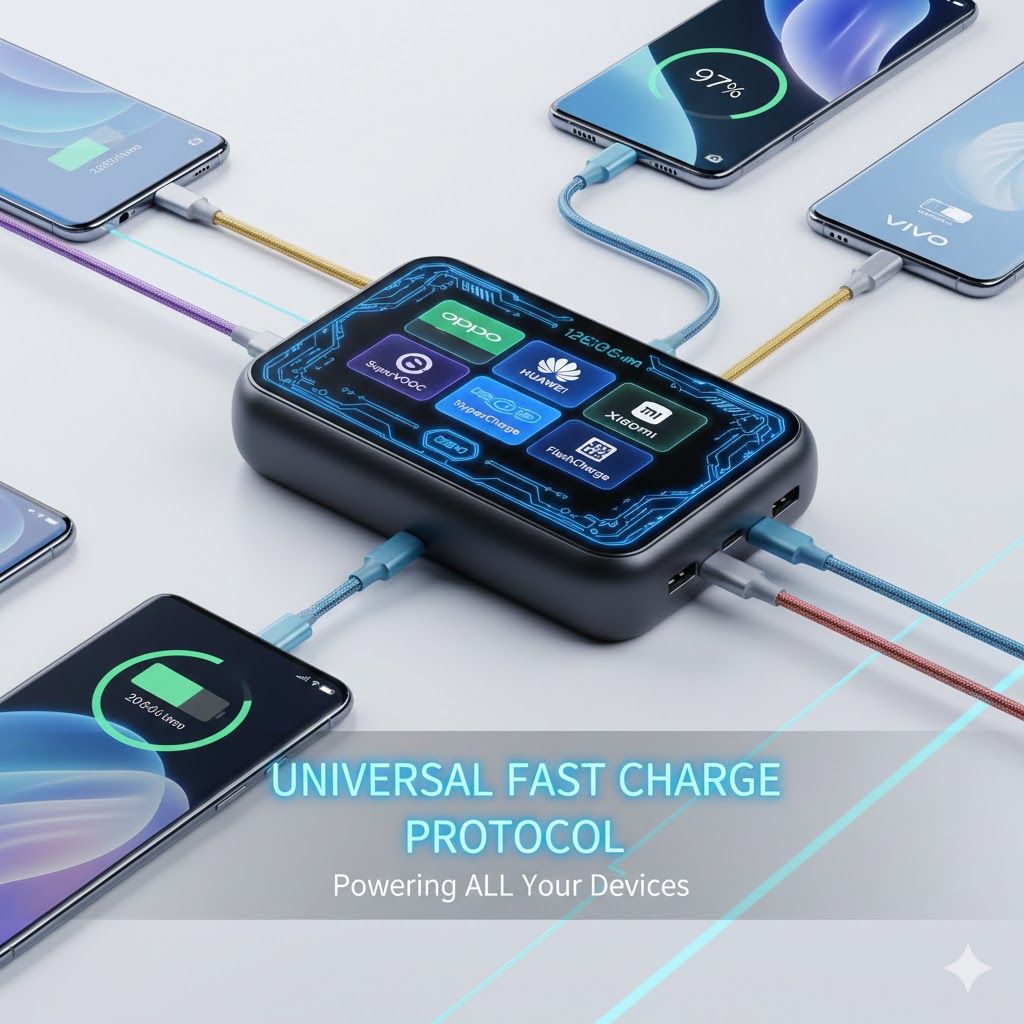
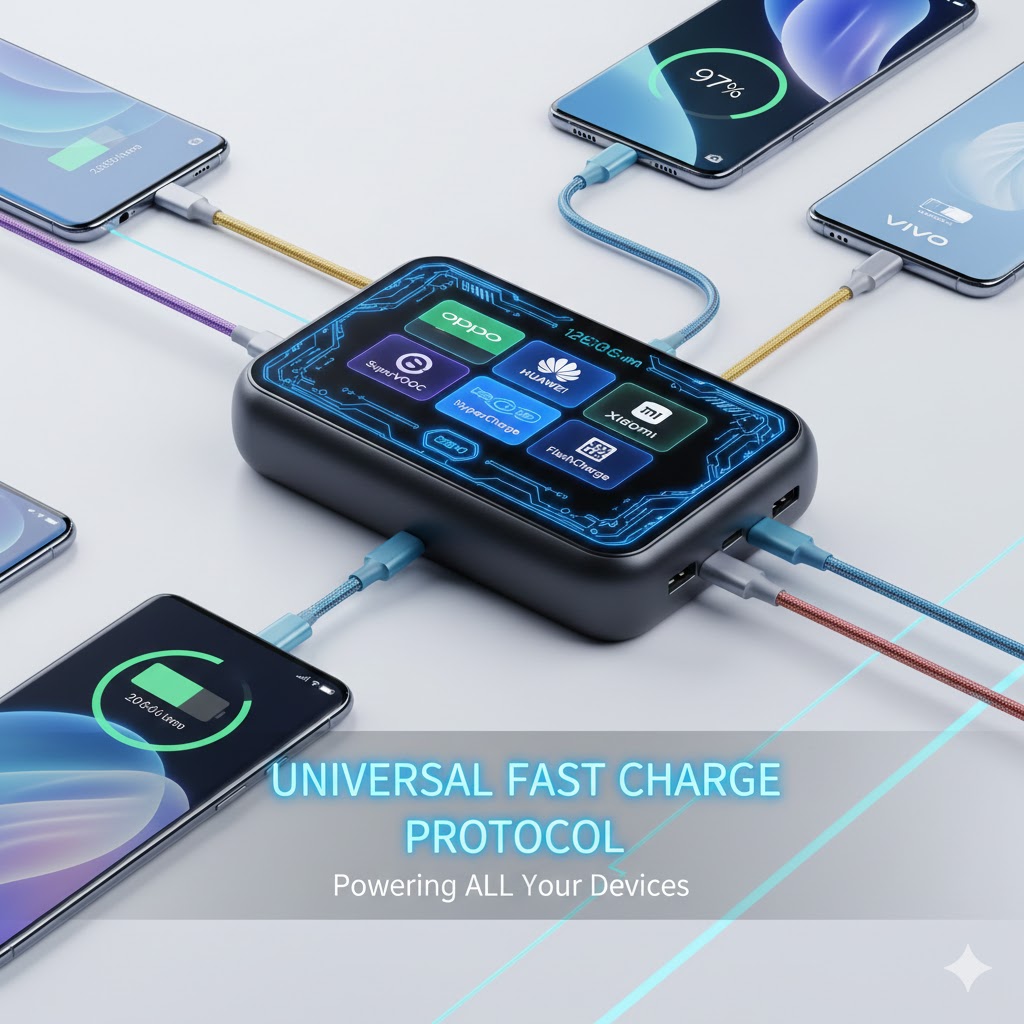
The difference between a generic power bank and a tier-one professional solution lies in the Integrated Circuit (IC). Many manufacturers use "off-the-shelf" or "stock" controllers that are programmed for generic loads. This leads to compatibility issues with brands like Huawei (SCP) or Oppo (VOOC).
Why invest in R&D for custom chips like FIXERA?
Custom chips allow for Dynamic Power Allocation. Imagine a 3-port power bank. If you plug in a laptop (65W) and then a phone (20W), a cheap chip might reset the entire board, cutting power to both briefly. A custom-engineered chip balances the load in real-time without interrupting the flow.
How can custom chips extend device lifespan?
By maintaining a "low ripple" voltage, custom chips ensure that the electricity entering your $1,000 smartphone is "clean." High ripple voltage—common in cheap power banks—causes micro-vibrations in the battery chemistry, leading to premature battery degradation.1
How to Identify High-Quality Battery Cells
The "heart" of the power bank is the lithium-ion or lithium-polymer cell. In 2026, the industry has shifted toward high-density A-Grade Polymer cells, which offer a thinner profile and higher safety margins than the old 18650 cylindrical cells.
| Component Feature | High-End (ESC Standards) | Budget/Generic |
| Cell Grade | A-Grade (New, high-cycle life) | B-Grade or Recycled (Short life) |
| Energy Density | High (Wh/kg) - smaller, lighter | Low - bulky for the same capacity |
| Safety Layers | NTC Thermistors + Fireproof Shell | Basic fuse only |
| Real Capacity | 100% Match to Label | Often 60-70% of stated capacity |
What is "Real Capacity" vs. "Rated Capacity"?
This is a common point of confusion.
-
Battery Capacity: The raw energy in the cells (e.g., 20,000mAh at 3.7V).
-
Rated Capacity: The actual energy delivered at 5V after conversion losses.
High-end engineering minimizes conversion loss, ensuring you get more "juice" per charge cycle.2
How do Multi-Port Power Bank Protocols Manage Concurrent Loads?
As we carry more devices—tablets, smartwatches, and wireless earbuds—the "single port" power bank is obsolete. However, managing three ports simultaneously is an engineering nightmare.
Why does my power bank get hot when using all ports?
Heat is the by product of resistance.3 When multiple ports are active, the internal DC-to-DC conversion circuits work overtime. ESC uses charging protocols Gallium Nitride (GaN) components and advanced thermal dissipation layers to move heat away from the cells and toward the outer casing
How can users optimize multi-device charging?
To get the best results, always prioritize the USB-C1 port for your hungriest device (laptop). Use the USB-A ports for low-current devices like AirPods or smartwatches.
| Port Configuration | Primary Use Case | Output Logic |
| Single USB-C | Laptop / MacBook Pro | Full 65W/100W Output |
| C1 + C2 | Laptop + Tablet | 45W + 20W Balanced Split |
| C1 + C2 + USB-A | Laptop + Phone + Watch | 45W + 15W + 10W Triple Split |
The Regulatory Landscape: Why 2026 Certifications Matter
The global market has tightened regulations on portable energy. Shipping a power bank today requires more than just a box; it requires a pedigree of safety testing.
What are the "Big Three" certifications for 2026?
-
UN38.3: This is the gold standard for air transport safety. It ensures the battery can survive altitude changes and pressure drops without exploding.
-
IEC 62368-1: The international safety standard for audio, video, and information technology equipment.
-
New 3C Standards (China): As of 2026, the mandatory 3C certification for power banks ensures that even "white-label" products meet rigorous fire-retardant and capacity-honesty benchmarks.
How to Choose the Right Power Bank for Your Business Model
If you are sourcing for a brand, you aren't just buying a product; you are buying a reputation. A single failure in a client's hand can ruin a year of marketing.
How can OEM services provide a competitive edge?
-
Private Molds: Avoid "me-too" products. Having a unique industrial design (ID) prevents price wars on platforms like Amazon.
-
Firmware Customization: Customizing the "handshake" logic to prioritize specific flagship phones.
-
Integrated Cables: The 2026 trend is moving toward "zero-cable" setups—power banks with built-in, high-durability MFi or E-mark cables.
Summary: The Future of Portable Energy
The transition from "simple battery" to "smart power node" is complete. As AI continues to drain mobile processors at unprecedented rates, the demand for stable, high-wattage, and safe portable power will only accelerate.
Final Checklist for Procurement:
-
Does it support PD 3.1? (Essential for 2026 laptop compatibility).
-
Is the chip proprietary? (Ensures better long-term firmware support).
-
Are the cells A-grade polymer? (Ensures safety and slim design).
-
Is it UN38.3 compliant? (Ensures global shippability).
Ready to elevate your product lineup? At ESC, we specialize in bridge-to-market engineering, moving from R&D to mass production with a focus on stability and "real" specifications.
Would you like me to provide a detailed technical comparison between our 65W and 100W FIXERA models for your next bulk order?
Shenzhen ESC is a leading power bank manufacturer with over 10 years of production experience. Specializing in fast-charging power banks and chargers, we feature an R&D team with listed company expertise and proprietary chip technology. Our high-power products deliver multi-brand fast charging compatibility without overheating.
Certified for quality and safety, our products are exported to dozens of countries worldwide.
Interested in OEM/ODM partnerships? Contact us today!
WhatsApp/WeChat: +86 18576695768
Email: amy@escpowerbank.com
YouTube: https://www.youtube.com/@escpowerbank
We look forward to powering your business!Partner with a leader in fast-charging technology. Powering your business, wherever you go.