
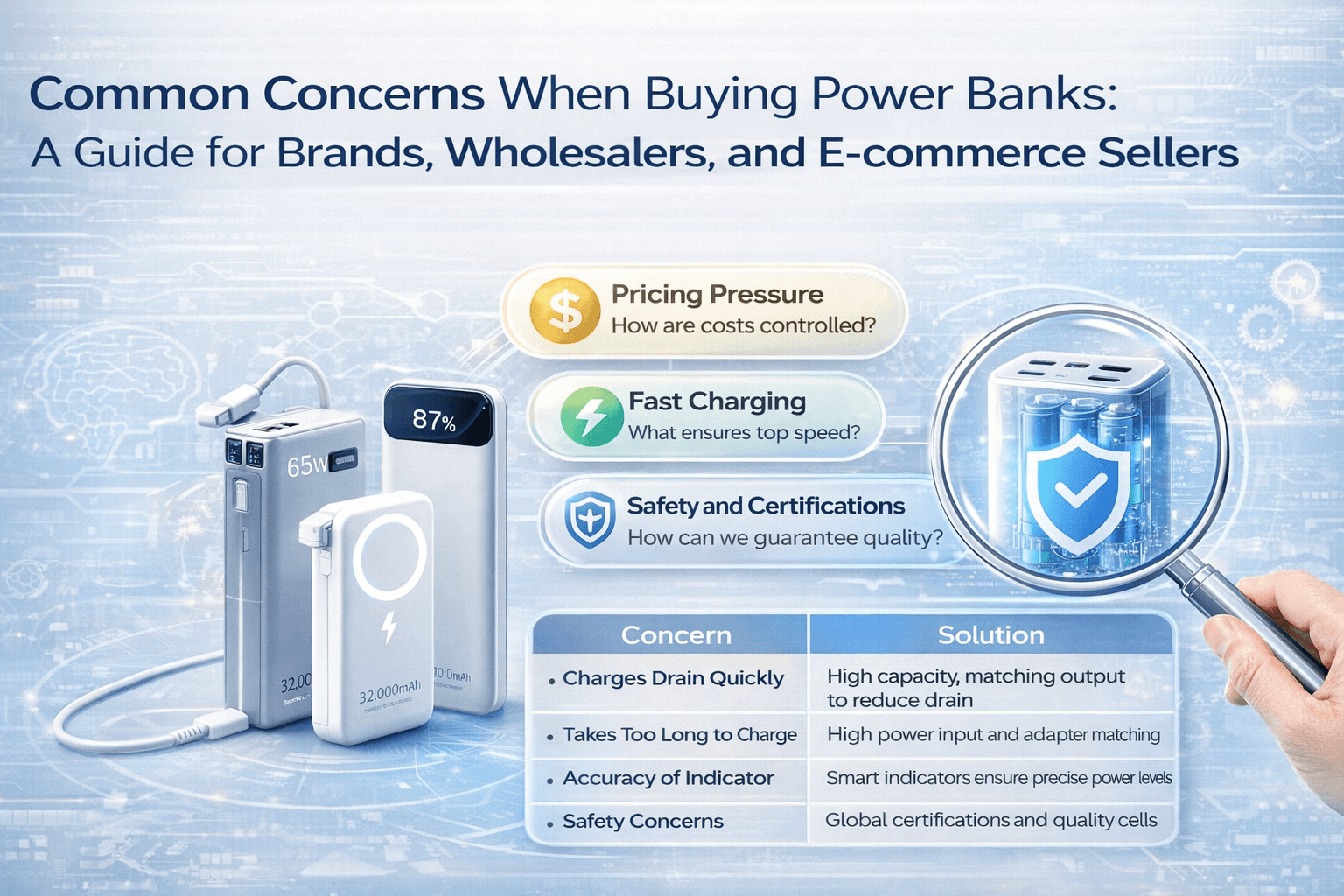
In the hyper-competitive consumer electronics market, sourcing power banks is no longer just about finding a factory with the lowest price. For brand owners, wholesalers, and Amazon/Shopify sellers, the stakes are incredibly high. A single batch of overheating batteries can destroy a reputation built over years.
Whether you are launching a private label line or restocking for Q4, you likely have burning questions: "How can I ensure these batteries won't explode?", "Why is there such a huge price gap between two identical-looking products?", or "What certifications do I actually need for the US vs. EU markets?"
This comprehensive guide pulls back the curtain on the manufacturing process. We will answer the toughest FAQs, debunk industry myths, and provide the technical framework you need to procure high-performance power banks (like the ESC-W016 and ESC-Z006) with absolute confidence.
1. What Defines a "Premium" Power Bank? (It’s Not Just Capacity)
A common misconception is that 20,000mAh equals quality. In reality, two power banks with the same capacity and power bank sourcing can perform drastically differently. How does this happen?
The Core Triangle of Quality
To evaluate a product, you must look beyond the casing. Here is the technical breakdown:
-
1. The Cell Quality (Grade A vs. Recycled):
-
Grade A Cells: Used in premium units (like ESC products). They offer stable voltage, high cycle life (800+ cycles), and low self-discharge.
-
Grade B/C Cells: Often used in "bargain" products. These may be recycled from old EVs or defective batches. They carry a high risk of swelling and sudden failure.
-
-
2. The BMS (Battery Management System):
-
What is it? The "brain" of the battery.
-
Why does it matter? A cheap BMS only prevents basic overcharging. A premium BMS (like those in the ESC-Z006) actively monitors temperature, balances voltage between cells, and prevents short circuits 100 times per second.
-
-
3. The Conversion Rate:
-
How to calculate? Actual Output Capacity / Rated Cell Capacity.
-
The Benchmark: Cheap units often struggle at 60-70% efficiency due to heat loss. High-end fast-charging banks should achieve ≥85% efficiency.
-
2. Fast Charging Protocols: What Do You Need to Know?
"Why does my 'Fast Charger' charge my Samsung phone slowly?" This is the #1 complaint from end-users. As a seller, power bank wholesale,you must understand the "Protocol Handshake."
The Protocol Compatibility Matrix
Different devices speak different "languages." Your OEM product dor power bank suppliers must be multilingual.
| Protocol | Primary Brand | Key Specs | ESC Product Support |
| PD 3.0 / 3.1 (Power Delivery) | iPhone, MacBook, Pixel | Universal standard. 20W - 140W output. | Supported (Up to 140W) |
| PPS (Programmable Power Supply) | Samsung (Galaxy S24/S25) | Dynamic voltage adjustment for heat control. | Supported (Critical for Samsung) |
| SuperVOOC | OPPO, OnePlus | High current, low voltage. Proprietary. | Supported |
| ChargeTurbo | Xiaomi | High wattage fast charging. | Supported |
| QC 3.0 / 4.0+ | General Android | Legacy fast charging. | Supported |
Pro Tip for Wholesalers:
Always choose a model like the ESC-W016 (45W) or ESC-Z006 (140W) that explicitly lists Multi-Protocol Support. A generic "Fast Charge" label is often a red flag for incompatibility.
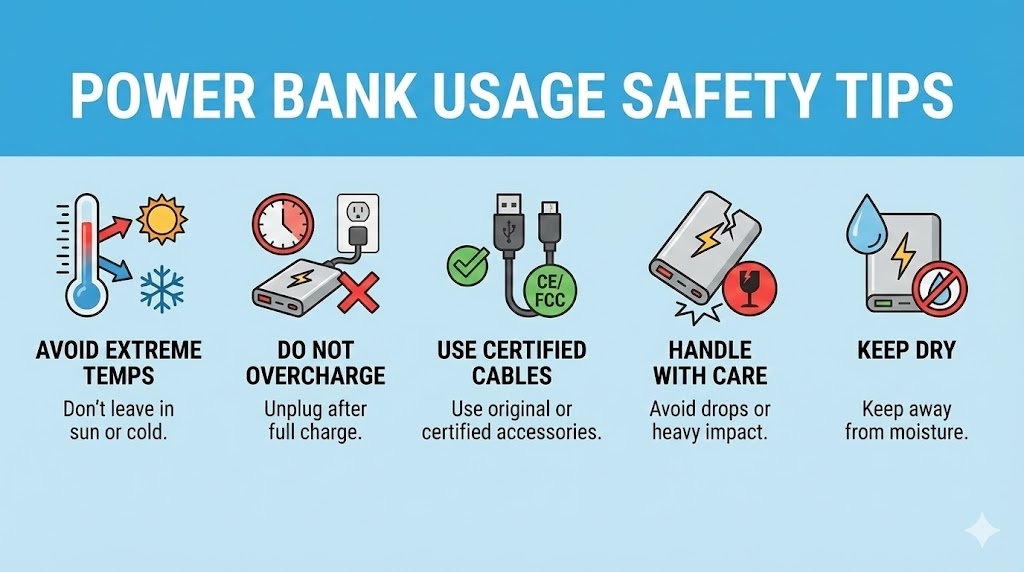
3. Addressing Safety: How Can You Prevent Returns and Recalls?
Safety is the elephant in the room. "How do I know this product won't catch fire?"
The answer lies in Thermal Management and Certification.
Why do power banks get hot?
Heat is a byproduct of energy conversion. However, excessive heat (>50°C surface temp) indicates poor circuit design or cheap resistance materials.
The Solution: NTC and Fire-Retardant Materials
-
NTC Protection: Negative Temperature Coefficient sensors must be placed directly on the battery cells. If the temperature spikes, the BMS automatically throttles the current to cool it down.
-
V0 Fire Rating: The outer casing (ABS+PC) must meet the UL94 V-0 standard, meaning it self-extinguishes within 10 seconds if ignited.
The Certification Checklist for Sellers
Do not import without these documents.
| Region | Essential Certification | Why You Need It |
| Global Logistics | UN38.3 + MSDS | Mandatory. You cannot ship batteries by air or sea without this. |
| USA | FCC / UL 2056 | FCC is legal requirement; UL is retailer requirement (e.g., Amazon). |
| Europe | CE / RoHS / REACH | Ensures electrical safety and chemical compliance. |
| China | CCC (3C) | New mandatory standard for power banks sold in China. |
4. Design & Innovation: How to Compete in a Saturated Market?
"How can I differentiate my brand when everyone sells black bricks?"
The era of generic plastic shells is over. To command a higher margin, you need unique selling points (USPs).
Case Study: The ESC-Z006 Desktop/Mobile Hybrid
-
The Problem: Users need a heavy-duty charger at their desk but a portable one for travel.
-
The Innovation: A 5-in-1 solution. It’s a 100W GaN desktop charger that includes a detachable 5000mAh magnetic power bank.
-
The Result: You aren't selling a battery; you are selling a "Power Ecosystem."
Case Study: The ESC-W016 "Invisible" Stand
-
The Feature: Built-in metal kickstand and integrated Type-C cable.
-
The Benefit: Solves the user pain point of "holding the phone while charging" and "forgetting the cable."
-
Private Mold: Unlike public molds used by 50 other sellers, private molds (like ESC's designs) offer brand exclusivity.
5. Logistics & Cost Control: How to Optimize Your Supply Chain?
"Why is shipping so expensive for power banks?"
Batteries are classified as Class 9 Dangerous Goods (DG). This adds complexity to shipping.
How to calculate the "True Landed Cost"?
Price per unit is just the beginning.
-
True Cost = EXW Price + DG Handling Fee + Freight + Duty + Last Mile Delivery.
Strategies to Reduce Risk:
-
Work with DG-Experienced Forwarders: Don't use a general logistics agent. Use one who specializes in UN3480 (Lithium-ion batteries).
-
Optimize Packaging: Minimize air gap in packaging to reduce volumetric weight. Compact designs like the ESC-W016 (17mm thickness) save significantly on freight compared to bulky older models.
-
MOQ Leverage: Ordering 2,000 pcs (Standard MOQ) allows for sea freight, which is 70% cheaper than air freight.
6. FAQ: Rapid Fire Answers for Procurement Managers
Q: Can I customize the logo and packaging? A: Yes. OEM services allow for laser engraving logos on the ABS/Metal shell and fully customized color boxes. This is essential for building brand equity.
Q: What is the lifespan of these power banks? A: High-quality units (ESC standard) retain >80% capacity after 500 full charge cycles. Cheap units often degrade after 300 cycles.
Q: Can the ESC-W016 really charge a laptop? A: Yes. With 45W PD output, it can power a MacBook Air or Ultrabook in an emergency, making it a "dual-purpose" device for business travelers.
Conclusion: Partnering for Success
Sourcing power banks involves navigating a minefield of technical specs and safety regulations. But with the right partner, it becomes your strongest asset.
At ESC, we don't just sell batteries; we provide Power Solutions. From Red Dot Award-winning designs to full protocol compatibility and rigorous safety testing, our products are built to protect your brand and delight your customers.
Ready to upgrade your product line? Don't gamble with generic suppliers. Choose precision, safety, and innovation.
Contact Our OEM Specialist Team:
-
Email: amy@escpowerbank.com
-
WhatsApp: +86 18576695768
-
Website: www.esccharge.com