
The Real Challenge of Wireless Charging in Cars
Drivers expect their phones to charge seamlessly during a commute — but automotive environments are hostile to stability:
-
Vibration and movement cause coil misalignment.
-
Temperature fluctuations inside the cabin affect heat control.
-
Airflow obstruction impacts thermal management.
-
Metal dashboards and vents interfere with electromagnetic fields.
Traditional Qi chargers often lose connection or overheat after 20 minutes on the road.
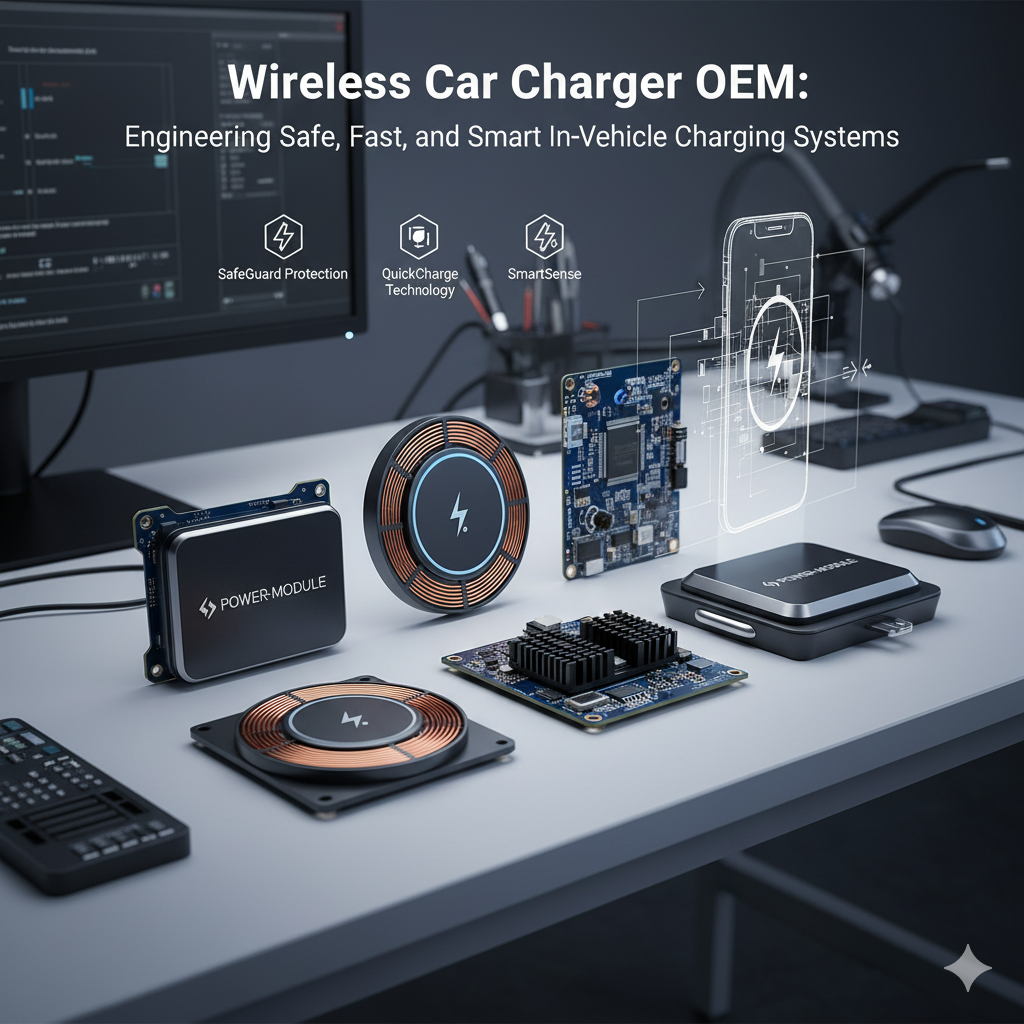
That’s why wireless car charger OEM development requires far more than consumer electronics design — it’s automotive-grade engineering involving magnetic physics, GaN power systems, and robust mounting mechanics.
How Wireless Car Charging Works: The Technical Core
Wireless car charging follows inductive coupling principles defined by the Wireless Power Consortium’s Qi 1.3 standard (WPC, 2024).
A transmitter coil in the charger emits an oscillating magnetic field; the receiver coil inside the smartphone converts it back to DC power.
However, automotive wireless chargers face three unique engineering constraints:
-
Angle Deviation Compensation — ESCCharge designs adjustable magnetic coils to maintain alignment during cornering or braking.
-
Active Cooling — Incorporating micro air ducts or heat sinks to stabilize thermal profiles.
-
Dynamic Voltage Control (GaN) — Intelligent ICs adapt output voltage for 5V–15V systems across brands.
Each of these parameters directly impacts efficiency, device safety, and user satisfaction.
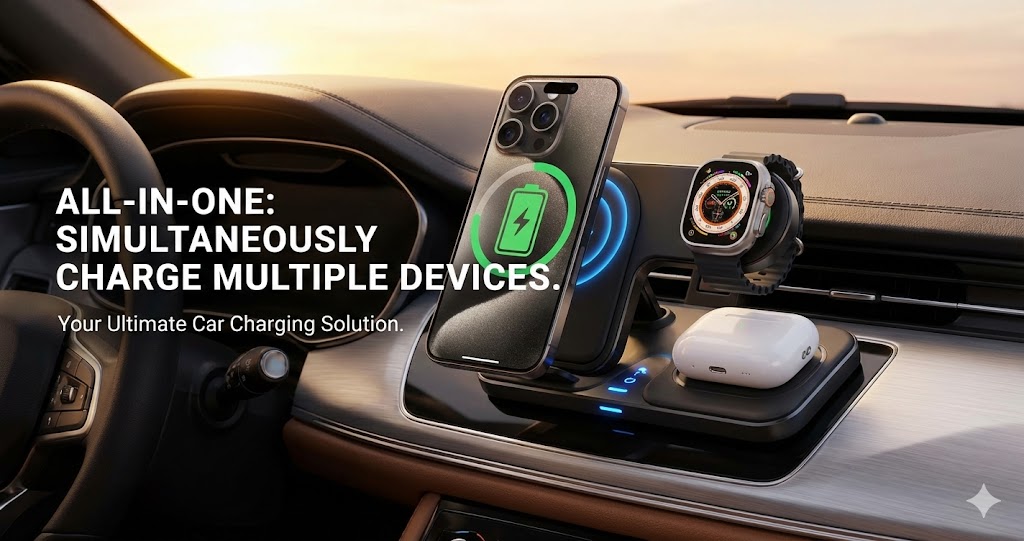
Magnetic Wireless Car Chargers vs. Conventional Mounts
| Feature | Standard Qi Car Mount | ESCCharge Magnetic Wireless Car Charger OEM |
|---|---|---|
| Coil Alignment | Manual | Auto magnetic alignment (N52 array) |
| Heat Dissipation | Passive | GaN active thermal modulation |
| Output Stability | Variable | Adaptive current control |
| Mount Security | Low (shaky) | Vibration-proof magnetic hold |
| Supported Protocols | Qi only | Qi + PD + PPS hybrid |
| Certification | Basic CE | Qi 1.3 / FCC / IEC 62368 |
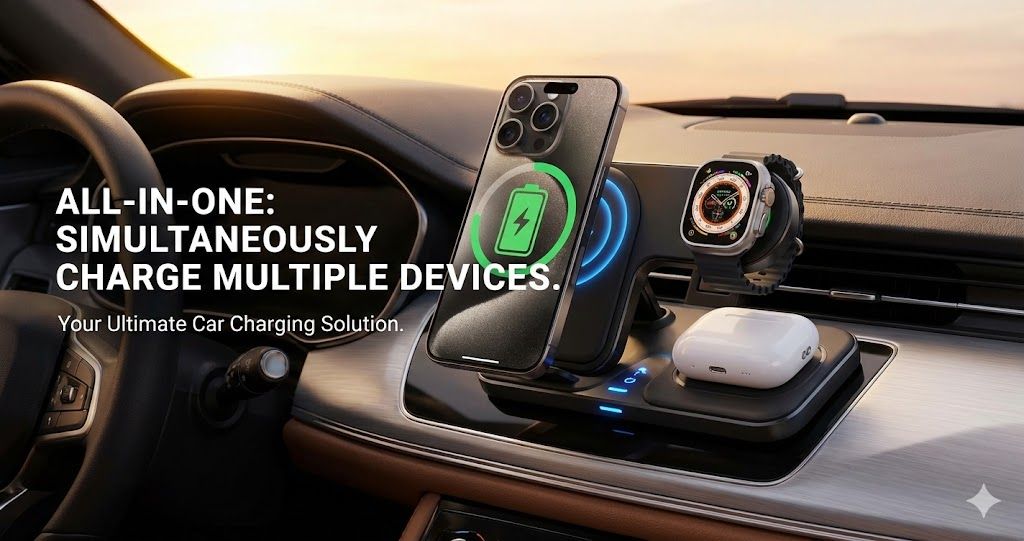
Unlike generic mounts, magnetic car chargers automatically snap to the optimal charging zone and maintain power even on bumpy terrain — making them a superior OEM solution for automakers and accessory brands alike.
Engineering Principles Behind ESCCharge’s OEM Wireless Car Charger Systems
1. Magnetic Architecture
-
16-point N52 rare-earth magnet array
-
Magnetic force 1100 gf for secure grip at 120 km/h vibration
-
Magnetic alignment tolerance ±1.5 mm
2. GaN Power Platform
-
Integrated GaNFast™ ICs for rapid switching
-
20% smaller PCB layout
-
94% efficiency at 15W wireless output
3. Structural Design
-
Aluminum heat sinks + PC flame-retardant shell
-
CNC-machined vent clip system for dashboard and air vent mounts
-
Rotational stability up to 360° pivot
4. Safety & Certification
-
Qi 1.3, CE, RoHS, FCC, MSDS
-
IEC 62368-1 compliance for automotive electronics safety
These features ensure that each ESCCharge OEM charger is not only sleek but built for the stress of real driving conditions.
Why OEM Buyers Choose Wireless Car Charging Systems
-
Hands-Free Compliance
-
Most global markets (EU / US / Japan) restrict handheld devices while driving.
-
Wireless car chargers solve usability + safety in one move.
-
-
Universal Compatibility
-
Qi-certified + PD hybrid protocols support iPhone, Samsung, Huawei, and Pixel.
-
-
GaN Efficiency for Heat Stability
-
Lower temperature means safer performance under direct sunlight.
-
-
Customizable for OEM Branding
-
Logo engraving, plug type, packaging, and housing materials fully customizable.
-
-
Integration Potential
-
Fits into vehicle dashboards, center consoles, or retail accessory lines.
-
Application Scenarios
| Application | Description | Recommended Design |
|---|---|---|
| Consumer Aftermarket | Sold via retail channels | Magnetic mount + fast wireless |
| Automotive OEM Integration | Built into car interior design | Embedded PCB + aluminum frame |
| Rideshare & Fleet Vehicles | Daily high-cycle charging | Reinforced vent clip design |
| Hospitality & Rental Fleets | Premium convenience add-on | 3-in-1 hybrid car charging stations |
These solutions balance cost, usability, and branding flexibility across different B2B verticals.
How to Choose the Right OEM Partner for Wireless Car Chargers
Evaluate Technical Capacity
Check if the manufacturer supports:
-
Coil tuning and testing
-
GaN integration
-
Full Qi 1.3 certification
Review Production Standards
-
ISO 9001 / IATF 16949 compliance for automotive-grade assembly
-
100% load testing
-
5000+ vibration cycle test
Prioritize Material Innovation
Choose aluminum heat spreaders and PC flame-retardant housings for durability.
Focus on Export Experience
A reliable wireless car charger OEM partner must understand customs documentation, regional certification, and logistics — ensuring smooth global delivery.
Frequently Asked Questions
Q: Are ESCCharge wireless car chargers compatible with all phones?
A: Yes. They support Qi 1.3, PD, and PPS, working across iPhone, Samsung, Huawei, and Google devices.
Q: What is the MOQ for OEM customization?
A: Samples start at 10 pcs; full production begins at 500 pcs.
Q: Can chargers be embedded directly into vehicle interiors?
A: Yes. ESCCharge supports OEM integration with dashboards and center consoles.
Q: How do you ensure safety during long drives?
A: Through IEC-compliant circuitry, overcurrent protection, and vibration endurance testing.
Q: Do these chargers overheat in summer?
A: No. GaN-based voltage control and aluminum cooling keep temperatures under 42°C even at 35°C ambient heat.
Powering Mobility: The Future of In-Vehicle Charging
The shift toward wireless mobility is irreversible. As cars become smarter and drivers demand cleaner interiors, wireless car chargers will become a standard part of every vehicle’s power ecosystem.
OEM buyers who partner with experienced manufacturers gain more than hardware — they gain access to design expertise, safety certification, and market credibility.
For scalable OEM solutions and next-generation in-vehicle charging systems, visit
ESCCharge official website to learn more.