
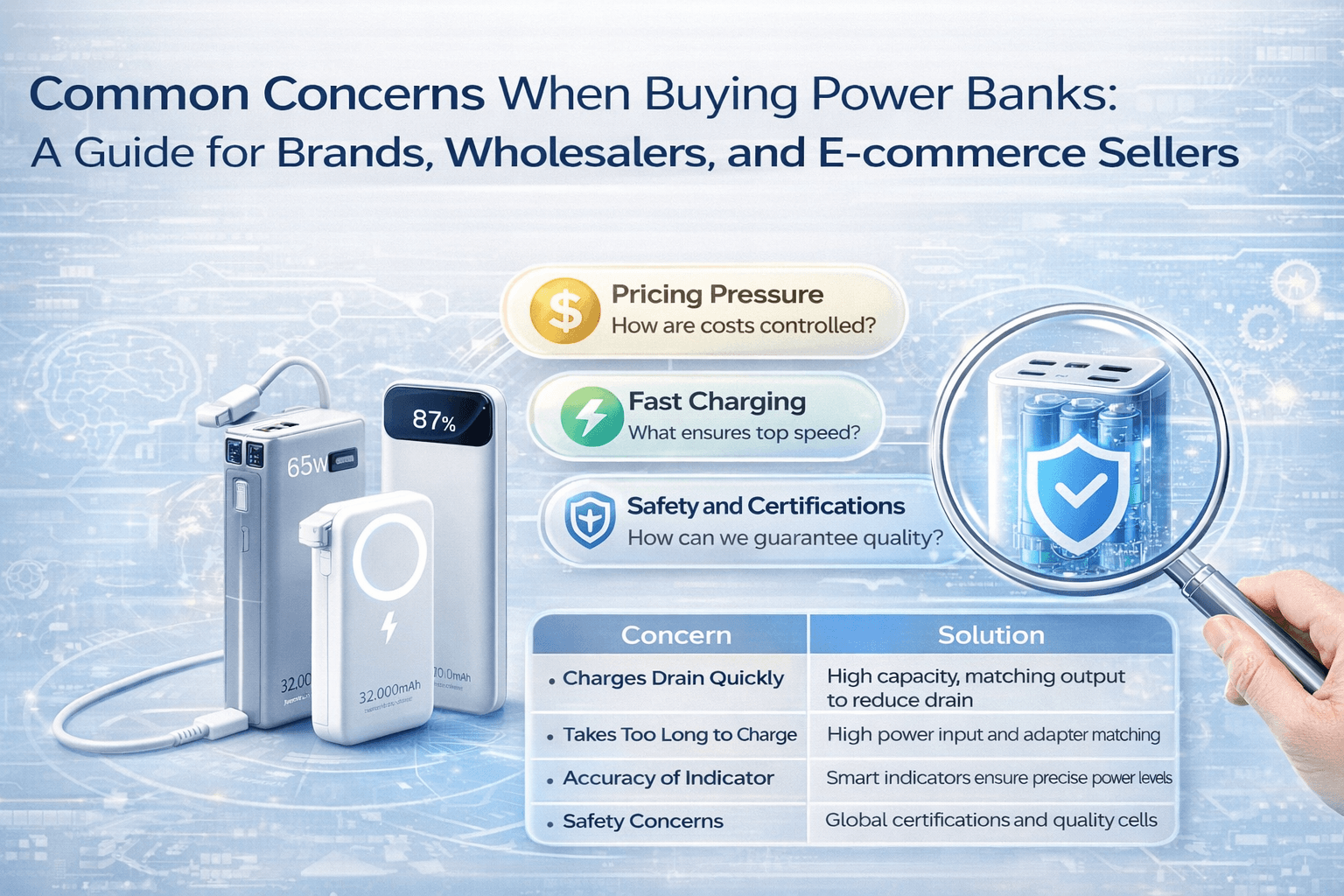
In the rapidly evolving mobile accessory market, power banks have become essential tools for on-the-go energy. However, when it comes to scaling a product to international markets, product functionality is only half the battle. The real challenge often lies in regulatory compliance and certifications.
So, what certifications do power banks need to be sold globally?
Why are they important—not just for customs clearance, but for customer trust, platform compliance, and brand reputation?
This article will walk you through the 5–7 most critical certifications every serious power bank supplier or buyer must know, and explain how these certifications influence market access, pricing, liability, and consumer confidence.
✅ 1. CE (Conformité Européenne) – Europe
What is it?
The CE mark is a mandatory conformity mark for products sold in the European Economic Area (EEA).
Why is CE important?
-
Ensures that the product complies with EU directives like EMC, LVD, and RoHS.
-
Required for customs clearance and online marketplace sales in Europe.
How to get CE?
Manufacturers need to:
-
Conduct relevant lab tests
-
Prepare a Declaration of Conformity (DoC)
-
Affix the CE logo on the product and packaging to get the CE Certification power bank
❗ Pro Tip: CE alone isn't enough. For batteries, CE testing must be done with EN 60950 / EN 62368 / EN 55032 / EN 55024 standards.
✅ 2. FCC (Federal Communications Commission) – United States
What is it?
FCC certification is mandatory for any electronic product sold in the U.S. that emits electromagnetic signals.
Why does FCC matter?
-
Prevents signal interference in devices like routers, TVs, and phones
-
Required for all consumer electronics entering the U.S. market
How can a power bank get FCC?
Testing must be done under:
-
Part 15B (unintentional radiators)
-
Submit documentation to a recognized TCB (Telecom Certification Body) to get the FCC Certificateion power bank
✅ 3. RoHS (Restriction of Hazardous Substances)
What is RoHS and RoHS certification power bank?
RoHS limits the use of hazardous materials (like lead, cadmium, and mercury) in electronic equipment.
Why RoHS?
-
Required in the EU, UK, and growing in other countries
-
Promotes eco-friendly supply chains
-
Necessary for green brand positioning
| Restricted Substance | Maximum Allowable Concentration |
|---|---|
| Lead (Pb) | 0.1% |
| Mercury (Hg) | 0.1% |
| Cadmium (Cd) | 0.01% |
| Hexavalent chromium | 0.1% |
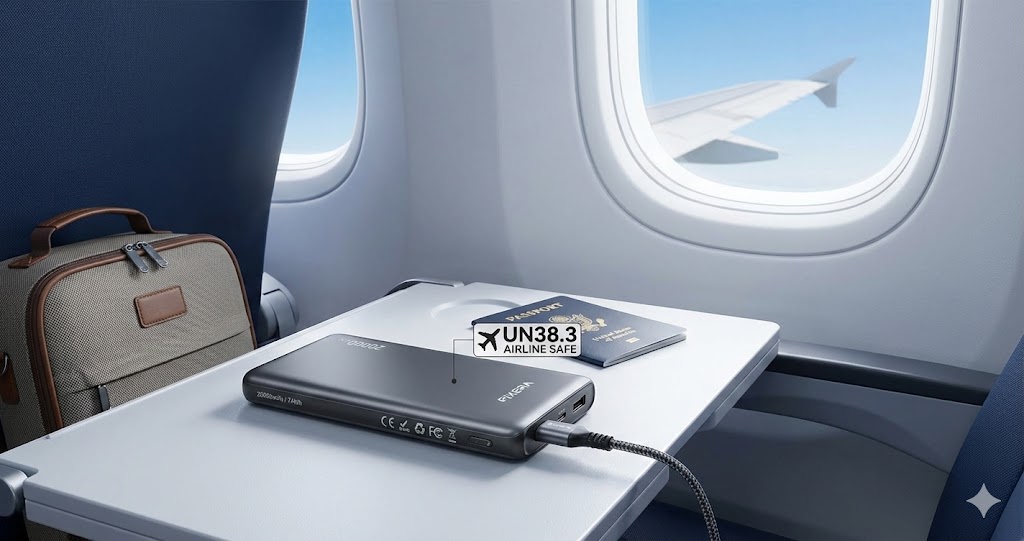
✅ 4. UN38.3 – Lithium Battery Transport Safety
What is UN38.3?
It’s a transport safety test required for all lithium batteries shipped by air, sea, or land.
What does it test?
-
Altitude simulation
-
Thermal cycling
-
Vibration
-
Shock
-
External short circuit
-
Crush & impact
-
Overcharge
-
Forced discharge
Why is UN38.3 non-negotiable?
-
you cannot ship without MSDS power bank internationally
-
Couriers like DHL, FedEx, UPS, and airlines will reject non-certified cargo
📦 UN38.3 is often paired with MSDS (Material Safety Data Sheet) and airway bill marking.
✅ 5. MSDS (Material Safety Data Sheet)
Why does it matter?
While MSDS isn’t a certification, it provides safety information on chemical components—especially relevant for power banks using lithium batteries.
How does MSDS help you?
-
Required by freight forwarders and warehouses
-
Adds credibility to customs inspections
-
Shows you’re prepared for hazardous materials declarations
✅ 6. IEC 62133 – Battery Safety Testing Standard
What is it?
This is the most globally recognized safety certification for lithium batteries.
Why is it important?
-
Mandatory in India, South Korea, and EU
-
Key for brands selling via Amazon, Best Buy, or other major retailers
IEC 62133 covers:
-
Battery design
-
Thermal abuse
-
Mechanical shock
-
Internal short circuits
-
Cell construction
✅ 7. PSE (Japan), BIS (India), KC (Korea) – Country-Specific
| Certification | Country | Notes |
|---|---|---|
| PSE | Japan | Requires factory inspection and in-country representative |
| BIS | India | Mandatory for mobile and IT equipment |
| KC | Korea | Similar to CE but localized to Korean standards |
📊 Comparison Table: Certifications Overview
| Certificate | Region | Mandatory | Purpose | Key Tests/Standards |
|---|---|---|---|---|
| CE | EU | Yes | EMC, Safety, Environment | EN 62368, EN 55032 |
| FCC | USA | Yes | EMI/EMC | FCC Part 15B |
| RoHS | EU/Global | Yes | Substance Restrictions | RoHS 2.0 Standard |
| UN38.3 | Global | Yes | Shipping Safety | UN Manual ST/SG/AC.10 |
| MSDS | Global | Yes | Safety Info Sheet | ANSI Z400.1 |
| IEC62133 | Global | Yes | Battery Safety | IEC 62133-2 |
| PSE/BIS/KC | JP/IN/KR | Country | Regional Regulatory Compliance | National standards |
❓FAQ: Power Bank Certification Essentials
Q: What happens if I import uncertified power banks?
A: Your goods can be seized, destroyed, or returned at the border. E-commerce platforms may also delist your products.
Q: Can I “self-declare” CE or FCC?
A: Only for non-critical devices. For lithium batteries, third-party lab testing is strongly advised.
Q: How long does certification take?
A: It varies:
-
CE/FCC: ~2–3 weeks
-
UN38.3: ~1 week (if tested)
-
IEC62133: ~4–6 weeks
Q: Are certifications reusable across models?
A: Only if product structure, battery, and PCBA remain the same. Any change requires re-testing.
📌 Final Thought: Certifications ≠ Just Paperwork
Certifications are not just legal requirements—they are market signals.
They say to a buyer: “We’ve invested in safety, longevity, and brand value.”
If you want to build a reliable supply chain, certifications are your first due diligence step.
Whether you’re sourcing for your brand, an e-commerce platform, or a wholesale distribution network, don’t just ask for pricing and MOQ.
Ask:
“Can I see your IEC, UN38.3, and CE reports?”
In 2026 and beyond, certified power banks won’t just be the standard—
Contact FIXERA Today:
FIXERA is a leading power bank manufacturer with over 10 years of production experience. Specializing in fast-charging power banks and chargers, we feature an R&D team with listed company expertise and proprietary chip technology. Our high-power products deliver multi-brand fast charging compatibility without overheating.
Certified for quality and safety, our products are exported to dozens of countries worldwide.
Interested in OEM/ODM partnerships? Contact us today!
WhatsApp/WeChat: +86 18576695768
Email: amy@escpowerbank.com
YouTube: https://www.youtube.com/@escpowerbank
We look forward to powering your business!Partner with a leader in fast-charging technology. Powering your business, wherever you go.
They’ll be the only viable option in a global, AI-powered, compliance-driven market.