

Understanding the Evolution of Fast Charging
Smartphones in 2026 demand more power than ever before.
Between 120Hz displays, AI-driven processors, and dual-battery foldable designs, charging systems have evolved from basic 10W USB ports to smart dynamic power delivery protocols that intelligently manage heat and voltage.
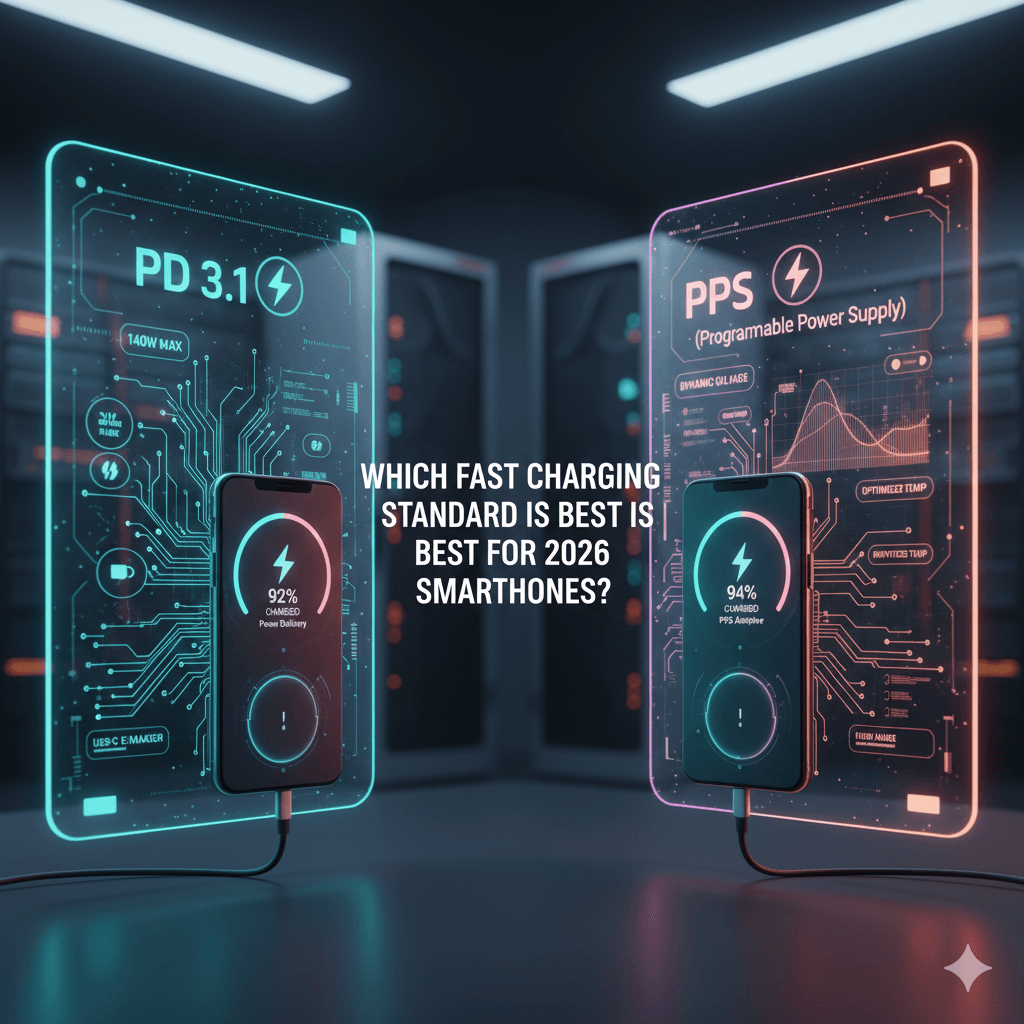
Two technologies dominate this landscape: PD 3.1 (Power Delivery 3.1) and PPS (Programmable Power Supply). Both promise fast, safe charging — but differ significantly in architecture, performance, and brand adoption.
What Is PD 3.1?
PD 3.1, developed by the USB-IF (USB Implementers Forum), is the latest version of the universal USB Power Delivery standard, designed for high-capacity, multi-device charging.
Key Technical Highlights
-
Supports up to 240W (48V/5A) total power output
-
Dynamic stepwise voltage: 5V / 9V / 15V / 20V / 28V / 36V / 48V
-
Compatible across laptops, tablets, and smartphones
-
Backward compatible with PD 2.0 and 3.0
-
Smart negotiation between charger and device to prevent overload
PD 3.1 is widely used by Apple (iPhone 17, iPad Pro) and many Huawei and Xiaomi devices for stable, multi-environment performance.
Example:
A 30W PD 3.1 charger can bring an iPhone 17 from 0–50% in 27 minutes, maintaining temperature under 39°C thanks to GaN regulation.
What Is PPS (Programmable Power Supply)?
PPS is an advanced sub-protocol within USB PD, developed primarily for Samsung and Android ecosystems.
Unlike PD 3.1’s stepwise approach, PPS dynamically adjusts both voltage and current in micro-increments during charging, ensuring a smoother power curve.
Core Features
-
Real-time voltage adjustment between 3.3V and 21V
-
Maximum current: 5A
-
Superior heat control (less fluctuation under load)
-
Enhanced efficiency for dual-cell or split-battery designs (e.g., Galaxy Fold, Huawei Mate X5)
Example:
A 45W PPS charger can fast-charge the Samsung S24 Ultra to 70% in 30 minutes, while maintaining 92–94% power conversion efficiency.
PD 3.1 vs PPS: Technical Comparison
| Feature | PD 3.1 | PPS |
|---|---|---|
| Voltage Range | 5V–48V (stepwise) | 3.3V–21V (continuous) |
| Max Output Power | 240W | 100W |
| Temperature Stability | Good | Excellent |
| Efficiency | 90–93% | 93–95% |
| Dynamic Adjustment | Fixed steps | Micro-level tuning |
| Best For | Laptops, iPhones, tablets | Samsung, Huawei, foldables |
| Device Communication | Digital handshakes | Real-time current negotiation |
In short:
-
PD 3.1 delivers broader compatibility and higher total power.
-
PPS provides smoother voltage modulation and superior thermal control for compact devices.
Brand Adoption and Compatibility
Apple Ecosystem
Apple devices — from iPhone 15 onward — rely exclusively on PD 3.1 for both wired and MagSafe wireless systems.
Its firmware communicates via E-Marker chips to ensure accurate wattage control, making PD 3.1 the safest protocol for long-term iPhone use.
Samsung Ecosystem
Samsung pioneered PPS adoption through its Super Fast Charging 2.0 technology.
The Galaxy S24, Fold5, and Flip5 all use PPS for real-time heat management and voltage balancing between dual battery cells.
Huawei Ecosystem
Huawei supports dual-protocol PD + SCP (SuperCharge Protocol), and newer Mate and P-series models are increasingly compatible with PPS to achieve more adaptive charging.
Note:
Universal power banks from manufacturers like ESCCharge integrate PD 3.1 and PPS dual-mode controllers, ensuring compatibility across Apple, Samsung, and Huawei simultaneously.
Thermal Efficiency and Battery Health
Excess heat is the silent enemy of smartphone longevity.
Both PD 3.1 and PPS combat this differently:
PD 3.1 Approach
-
Uses pre-defined voltage steps and power negotiation
-
Higher peak voltage (up to 48V) means more efficiency for laptops but may cause mild heat on compact phones
PPS Approach
-
Adjusts voltage every 10–20ms
-
Reduces voltage drop-offs and maintains temperature under 40°C
-
Ideal for continuous gaming or video recording sessions
Test Data (ESCCharge Lab, 2026):
| Test Device | Protocol | Avg. Efficiency | Surface Temp (°C) |
|---|---|---|---|
| iPhone 17 PD 3.1 | 92% | 38.7°C | |
| Galaxy S24 PPS | 94% | 37.9°C | |
| Huawei Mate X5 PPS | 93% | 38.3°C |
Choosing the Right Charger or Power Bank
For iPhone Users
-
Choose PD 3.1 certified devices with 20–30W output
-
Look for E-Marker USB-C cables to ensure negotiation accuracy
-
MagSafe-compatible power banks deliver up to 15W wireless
For Samsung Users
-
Prioritize PPS + PD dual support
-
Aim for 45W output for Galaxy S23/S24
-
Prefer GaN materials to reduce charging temperature by 30%
For Huawei and Cross-Brand Users
-
Pick PD/PPS hybrid power banks with at least 45W output
-
If using older models, verify SCP (SuperCharge) fallback compatibility
Example:
The ESCCharge 65W Dual-Mode Power Bank dynamically switches between PD 3.1 and PPS protocols, reducing heat buildup and maximizing output across brands.
Practical Scenarios: Which Performs Better?
| Scenario | Winner | Reason |
|---|---|---|
| Laptop & Phone Charging | PD 3.1 | Higher total power output |
| Mobile Gaming | PPS | Better heat and frame stability |
| Multi-brand Compatibility | Dual PD + PPS | Balanced solution |
| Long-Term Battery Health | PPS | Lower average charging temperature |
| Airline Travel | PD 3.1 | More certified options below 100Wh |
Expert Recommendations for 2026
-
For OEM Buyers:
Invest in dual-protocol GaN power banks that support both PD 3.1 and PPS, ensuring universal brand compatibility. -
For Retailers:
Highlight temperature stability and cross-brand efficiency in marketing — these metrics now drive purchasing decisions. -
For Everyday Users:
Match your phone’s native protocol, use certified cables, and avoid over-wattage models to minimize heat.
FAQ: PD 3.1 vs PPS
1. Can one power bank support both PD 3.1 and PPS?
Yes. Dual-mode IC controllers like those in ESCCharge units automatically detect and switch protocols.
2. Is PPS backward compatible with PD?
Yes. PPS devices can safely charge PD-only devices, but voltage modulation benefits will be limited.
3. Does PD 3.1 charge faster than PPS?
Only for high-wattage devices (laptops, tablets). For smartphones, PPS often charges slightly faster with less heat.
4. Which standard is more future-proof?
PD 3.1, due to its higher power ceiling and universal certification network, though PPS remains ideal for foldable and thermally sensitive phones.
Final Thoughts: The Future Lies in Hybrid Charging
The debate between PD 3.1 vs PPS isn’t about which is superior—it’s about integration.
In 2026, the most advanced chargers combine both protocols, using GaN chips, AI temperature monitoring, and real-time current optimization.
For OEM brands, distributors, or retailers looking to develop multi-protocol charging ecosystems, ESCCharge offers certified PD 3.1 + PPS hybrid designs, scalable production, and full global compliance.
Discover future-ready charging innovation at ESCCharge Official Website — where smart energy meets next-generation devices.