
What Does No Pop-Up iPhone Battery Wholesale Mean for B2B Buyers?
For repair shops, refurbishers and mobile-parts distributors, no pop-up iPhone battery wholesale sourcing is not simply about buying an aftermarket battery with a different label.
The term is generally used in the repair-parts market for replacement battery solutions intended to reduce or avoid battery-related warning pop-ups under defined device, battery and installation conditions.
That distinction matters.
Apple explains that newer iPhones can display battery-related information in Parts and Service History, including Genuine, Used, Unknown or other verification-related states depending on the part and repair process. Apple also notes that battery-health information may not be accurate when a battery cannot be verified.
For professional buyers, this means a supplier should never be evaluated only by the phrase “no pop-up.”
Buyers should verify:
- exact supported iPhone models;
- required installation procedure;
- BMS or battery-data handling;
- iOS compatibility conditions;
- battery capacity;
- physical fitment;
- charging behavior;
- repeatability across production batches.
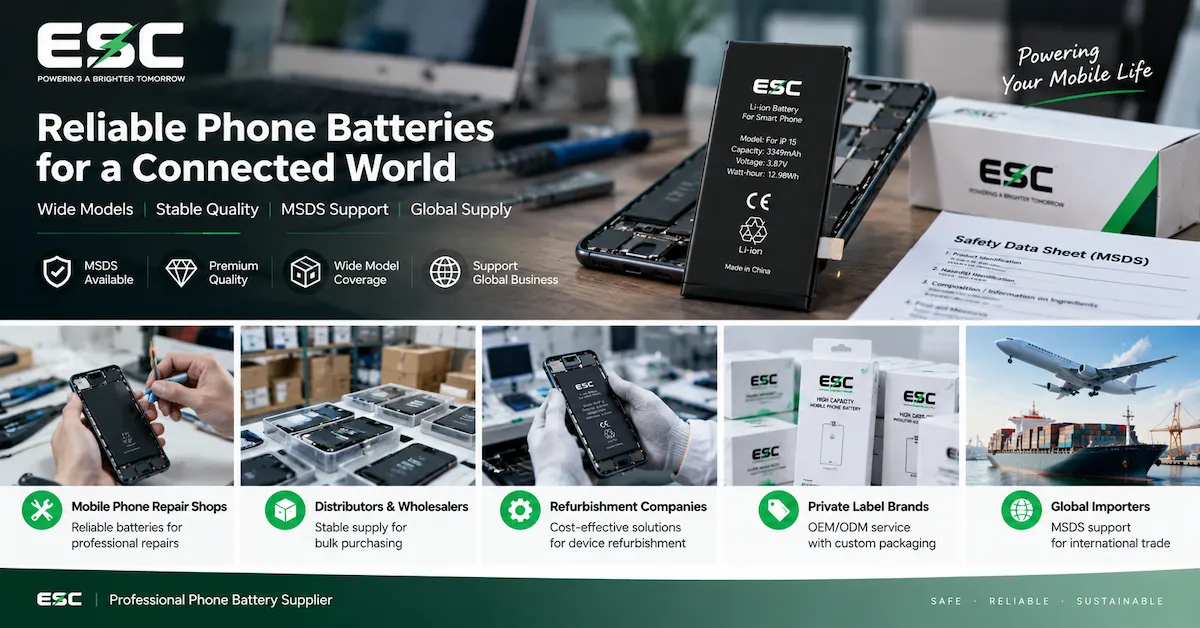
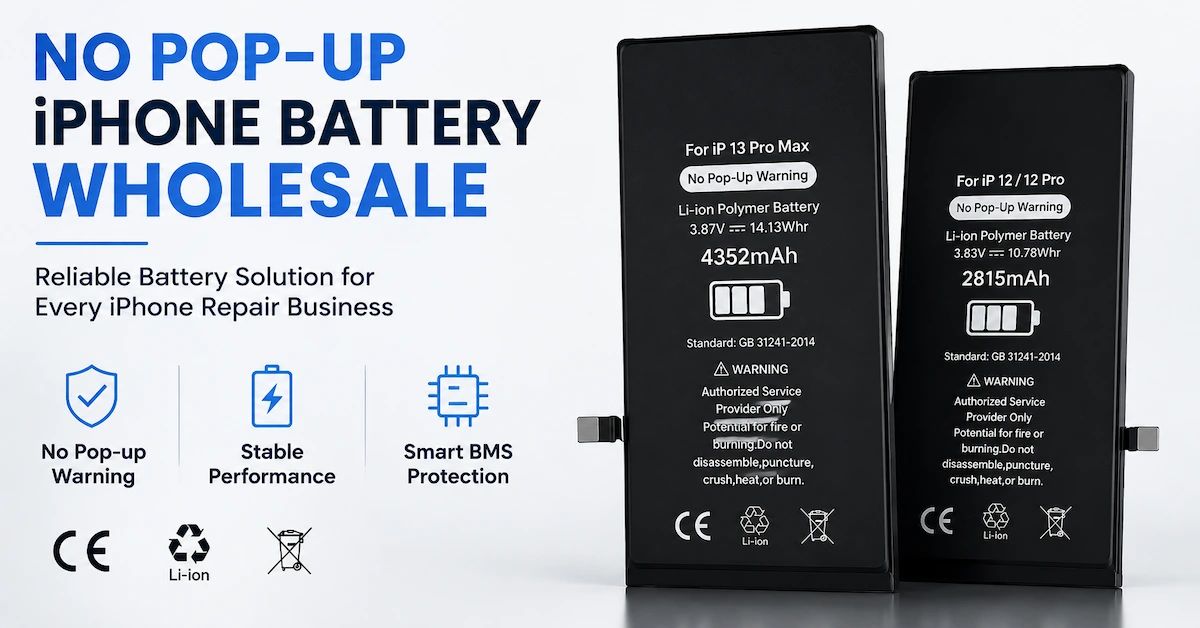
ESC offers a dedicated No Pop-Up Message iPhone Battery range as part of its broader mobile phone battery portfolio for professional repair, wholesale and distribution customers.
Who Buys No Pop-Up iPhone Batteries in Bulk?
Different buyers have different reasons for sourcing this type of replacement battery.
iPhone Repair Shops
Repair shops want to reduce post-repair questions from customers.
Their priorities normally include:
- correct battery fitment;
- stable charging;
- predictable battery information behavior;
- reliable capacity;
- fewer repeat visits.
For technicians, a battery that requires unexpected troubleshooting increases repair time even if the component price is attractive.
Repair Chains
Multi-location repair companies need standardization.
They usually care about:
- consistent models across branches;
- clear installation instructions;
- repeatable battery behavior;
- low claim rates;
- centralized purchasing.
For these buyers, supplier consistency is often more important than finding the lowest price on one shipment.
Smartphone Refurbishers
Refurbishment facilities may process hundreds or thousands of devices.
Their priorities include:
- batch-level consistency;
- efficient installation;
- stable capacity;
- predictable compatibility;
- production traceability.
A small increase in battery-related rework can significantly affect refurbishment throughput.
Mobile Parts Wholesalers
Wholesalers need:
- multiple iPhone models;
- mixed-SKU orders;
- stable replenishment;
- clear product identification;
- competitive commercial terms.
Their customers often include repair shops that expect fast model matching and reliable technical information.
Regional Distributors
Distributors need products that can be resold across a wider network.
Important factors include:
- consistent packaging;
- SKU clarity;
- warranty procedures;
- documentation;
- repeat-order availability.
Private-Label Battery Brands
Private-label customers may need:
- custom battery labels;
- branded boxes;
- barcodes;
- warranty information;
- carton identification;
- product-line planning.
ESC supports customization within its mobile phone battery solutions, subject to the exact model and project requirements.
Why Can Battery Warning Messages Appear After iPhone Repair?
Battery warning behavior is linked to more than the battery cell itself.
Apple states that iPhone repair history can identify whether a battery is genuine, used, unknown or otherwise unverified, depending on the model, part and repair process. An unverified battery may also result in inaccurate battery-health information.
For B2B sourcing, several factors therefore need to be considered.
Battery Identification and Communication
Modern phone batteries contain electronic components that communicate battery information to the device.
Compatibility problems can arise when the replacement battery and device do not interact as expected.
BMS-Related Configuration
The battery management system is part of the complete replacement solution.
Depending on product design, it may be involved in:
- electrical protection;
- battery monitoring;
- data handling;
- charging behavior.
Repair Procedure
The final behavior can also depend on the repair method.
That is why wholesalers should ask a supplier to state clearly:
- supported models;
- required tools;
- programming requirements, if any;
- installation procedure;
- expected system behavior.
Software Changes
A solution that works under one software environment should not automatically be assumed to behave identically after every future system update.
For distributors, this is an important risk-control point.
Avoid selling a battery with an unconditional claim unless the supplier has validated the exact device and software conditions.
What Should Wholesalers Verify Before Ordering?
Before placing a large order, buyers should create a technical specification for every SKU.
| Item | What to Confirm | Why It Matters |
|---|---|---|
| iPhone model | Exact supported device | Prevents wrong-model orders |
| Battery reference | Relevant battery identification | Improves traceability |
| No-pop-up conditions | Model/process/software requirements | Prevents misleading claims |
| Rated capacity | mAh | Defines product specification |
| Voltage | Nominal voltage | Electrical compatibility |
| Wh | Energy rating | Cross-checks specification |
| Dimensions | Length, width, thickness | Physical fitment |
| Connector / flex | Exact configuration | Installation compatibility |
| BMS-related solution | Product-specific approach | System behavior |
| Capacity test | Measured result | Verifies label claims |
| Internal resistance | Batch comparison | Helps assess consistency |
| Aging | Pre-shipment screening | Detects early defects |
| Packaging | Cell and flex protection | Reduces logistics damage |
| Lot identification | Production reference | Supports claims |
A quotation without this level of model detail is difficult to compare professionally.
No Pop-Up iPhone Battery vs Standard Replacement Battery
The main difference should be evaluated through repair requirements, not marketing terminology alone.
| Factor | Standard Replacement Battery | No Pop-Up-Oriented Battery |
| Main objective | Restore battery function | Restore function plus defined system experience |
| Compatibility focus | Electrical and mechanical fit | Electrical, mechanical and system-related behavior |
| Buyer type | General repair market | Professional repair/refurbishment |
| Installation requirements | Model dependent | May require more specific procedures |
| QC emphasis | Battery performance | Performance + compatibility validation |
| Commercial risk | Capacity/fitment claims | Capacity + fitment + system-experience claims |
This is why buyers sourcing No Pop-Up Message iPhone Batteries should validate the supplier's actual solution rather than relying only on the product name.
How Should Wholesalers Test Samples Before Bulk Purchasing?
A structured sample-approval process reduces risk before inventory is committed.
Step 1: Confirm Exact Models
Record:
- iPhone model;
- battery reference;
- capacity;
- voltage;
- connector structure;
- supplier SKU.
Do not approve a product from a generic “iPhone battery” description.
Step 2: Confirm the Required Repair Procedure
Ask the supplier:
- Is special programming required?
- Is BMS transfer required?
- Are additional tools needed?
- Which software versions have been tested?
- What should technicians expect after installation?
This should be documented before wholesale purchasing.
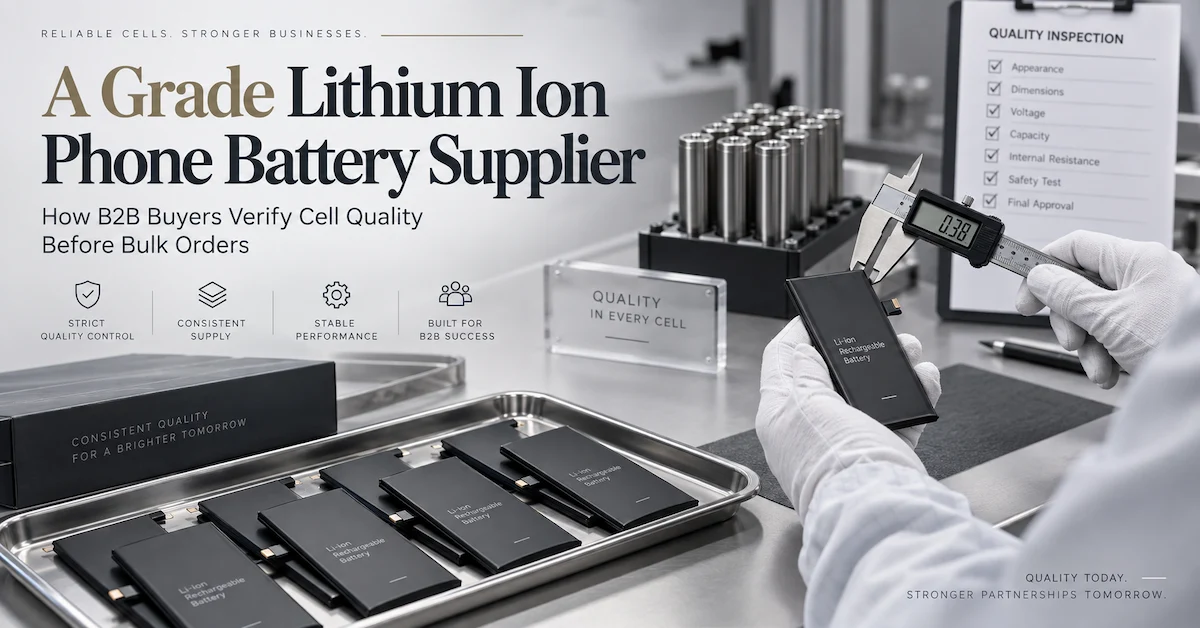
Step 3: Inspect Physical Quality
Inspect multiple samples for:
- swelling;
- deformation;
- damaged flex cables;
- connector defects;
- poor insulation;
- uneven labeling;
- irregular assembly.
Step 4: Verify Voltage
Measure representative samples under consistent test conditions.
Look for unusual variation between units.
Step 5: Test Capacity
Compare the measured discharge capacity with the supplier's stated specification.
The printed mAh value should be treated as a specification to verify, not proof of actual performance.
Step 6: Compare Internal Resistance
Internal resistance is useful as part of batch comparison.
Do not evaluate only one ideal sample.
Compare multiple units under equivalent conditions to look for abnormal variation.
Step 7: Install Batteries in Real Devices
This is essential for a no-pop-up-oriented product.
Check:
- physical fitment;
- connector alignment;
- charging;
- device startup;
- battery-level reporting;
- warning behavior;
- Battery Health behavior where applicable.
Step 8: Test Multiple Devices
One successful installation does not prove that a product is ready for wholesale.
Where practical, test several batteries across representative supported devices.
Step 9: Save the Approved Standard
Maintain:
model + supplier SKU + test results + installation procedure + expected system behavior + approval date
This becomes the reference for incoming QC.
Why Does Batch Consistency Matter More Than a Good Sample?
A supplier knows that buyers will inspect pre-order samples carefully.
The harder question is:
Will battery number 800 behave like battery number 8?
For wholesale purchasing, consistency should be evaluated across:
- battery cells;
- capacity;
- internal resistance;
- BMS-related configuration;
- flex assemblies;
- connectors;
- physical dimensions;
- finished-product testing.
The same principle applies to the no-pop-up claim.
A wholesaler needs to know whether production batches continue to meet the same compatibility standard as the approved sample.
This is especially important for repair distributors because a compatibility problem can spread quickly across many downstream repair shops.
How Can Distributors Reduce Returns and Claims?
Returns are not always caused by a completely defective battery.
They may result from:
- incorrect model selection;
- unclear installation requirements;
- unrealistic capacity expectations;
- warning-message behavior;
- poor packaging;
- inconsistent batches.
Use Model-Specific Product Data
Each listing should identify the exact compatible models.
Explain Installation Requirements
If the product requires a defined installation or programming procedure, tell customers before they purchase.
Avoid Overpromising
Do not describe a battery as universally warning-free across all devices and software versions unless that claim can actually be verified.
Track Claims by SKU
Record:
- SKU;
- device model;
- production lot;
- complaint type;
- installation method;
- return result.
This makes it easier to distinguish technical product problems from incorrect installation or model selection.
How Should Wholesalers Build a No Pop-Up iPhone Battery SKU Portfolio?
Buying every iPhone model in equal quantities is rarely efficient.
A more practical strategy is to classify inventory according to demand.
A-Class Models
High repair volume and strong repeat demand.
Maintain deeper inventory.
B-Class Models
Regular but moderate demand.
Keep controlled stock.
C-Class Models
Long-tail or older generations.
Use flexible replenishment to reduce inventory pressure.
A simple purchasing database can include:
| Data Field | Purpose |
| iPhone model | Compatibility |
| Battery reference | Identification |
| Supplier SKU | Reordering |
| No-pop-up procedure | Technician information |
| Monthly sales | Demand planning |
| Current inventory | Stock control |
| Supplier lead time | Reorder planning |
| Claim rate | Quality analysis |
| Return reason | Risk analysis |
This turns wholesale purchasing into a manageable product system instead of a collection of battery boxes.
What Is the Real Cost of a Cheap Wholesale Battery?
Unit price is only the first cost.
Professional distributors should consider:
Purchase price + incoming QC + technician rework + returns + warranty + reverse logistics + customer support
For example, a battery that saves a small amount per unit but produces more installation questions may cost more overall.
A low quotation becomes even less attractive if the supplier cannot provide:
- stable batches;
- model-specific information;
- technical support;
- traceability.
The objective is therefore not the lowest battery price.
It is the lowest total sourcing risk.
What OEM and Private-Label Options Matter to Wholesalers?
Distributors developing their own battery brands should evaluate customization after technical approval.
Battery Labels
Possible content includes:
- brand;
- model;
- capacity;
- voltage;
- SKU;
- warnings;
- barcode.
Retail Packaging
Packaging may include:
- compatible models;
- product instructions;
- warranty information;
- distributor details;
- local-language information.
Carton Identification
Mixed-SKU shipments should be clearly separated and labeled.
Technical Documentation
Private-label buyers should receive clear product information so their own sales teams do not make claims beyond the verified product capability.
Buyers can review ESC's company information when evaluating broader OEM and supply capabilities.
What Should a No Pop-Up iPhone Battery Wholesale RFQ Include?
Avoid sending only:
“Send your no-pop-up battery price list.”
A better RFQ should contain:
Product Requirements
- exact iPhone models;
- quantity per model;
- required capacity;
- target market.
Compatibility Requirements
Ask for:
- supported installation method;
- required programming;
- expected warning behavior;
- tested software conditions.
Quality Requirements
Specify:
- capacity testing;
- internal-resistance checks;
- sample quantity;
- real-device validation;
- batch inspection.
Packaging Requirements
Include:
- neutral or branded packaging;
- barcode;
- SKU labels;
- carton requirements.
Commercial Requirements
Include:
- destination;
- expected order frequency;
- delivery requirements;
- OEM needs.
The more precise the RFQ, the easier it is to compare suppliers on equal terms.
What Should Importers Check for Lithium Battery Transportation?
Replacement iPhone batteries are lithium batteries and are therefore subject to transport requirements.
UNECE's current Manual of Tests and Criteria includes subsection 38.3 addressing lithium cells and batteries, and the current Revision 8 materials include subsequent amendments.
Importers should confirm requirements for the exact battery configuration and transport route, including where applicable:
- UN 38.3 documentation;
- product identification;
- packaging;
- transport marks or labels;
- carrier requirements;
- destination requirements.
The official UNECE UN Manual of Tests and Criteria can be used as an authoritative reference.
Do not assume documentation for one iPhone battery automatically applies to every other SKU.
FAQ About No Pop-Up iPhone Battery Wholesale
What is a no pop-up iPhone battery?
It is a repair-market term generally used for replacement battery solutions designed to reduce or avoid battery-related warning pop-ups under defined device and installation conditions.
Buyers should confirm exactly which models, procedures and software conditions are supported.
Can no pop-up iPhone batteries be purchased wholesale?
Yes. They are commonly sourced by repair shops, wholesalers, refurbishers and parts distributors.
ESC offers No Pop-Up Message iPhone Battery solutions for professional buyers.
Does no pop-up mean there will never be any battery message?
Buyers should not assume that.
Apple's current parts and service system can display different battery statuses depending on the part, device and repair process.
A supplier should define the exact conditions under which its product has been tested.
Should wholesalers test samples before placing a bulk order?
Yes.
Sample testing should include capacity, voltage, physical inspection, fitment, charging and actual device-level compatibility checks.
For no-pop-up-oriented products, the required repair procedure should also be validated.
How can distributors reduce returns?
Use precise model mapping, clear installation information, multiple-sample approval, batch QC and claim tracking by SKU and production lot.
Can no pop-up iPhone batteries be private labeled?
Private-label options may include battery labels, retail packaging, barcodes and carton markings, depending on the supplier and project.
Technical product validation should be completed before finalizing branded packaging.
What should I ask a no pop-up iPhone battery supplier?
Ask about:
- supported iPhone models;
- required installation method;
- BMS-related solution;
- software compatibility conditions;
- capacity testing;
- batch QC;
- OEM support;
- after-sales procedures.
Where can I source no pop-up iPhone batteries from ESC?
Buyers can review ESC's No Pop-Up Message iPhone Battery products or browse the broader Mobile Phone Battery range.
For current models, samples and wholesale terms, contact ESC with your model list and required quantities.
Conclusion: Choose No Pop-Up iPhone Battery Wholesale Products by Verified Compatibility
Successful no pop-up iPhone battery wholesale sourcing depends on more than the wording printed on a product page.
Wholesalers and repair distributors should verify:
supported iPhone models
installation requirements
system behavior
capacity
voltage
physical fitment
BMS-related compatibility
batch consistency
packaging
after-sales support
A professional supplier should clearly explain what its product does, how it must be installed and under which conditions its compatibility has been validated.
ESC provides No Pop-Up Message iPhone Batteries and broader mobile phone replacement battery solutions for repair businesses, wholesalers, distributors and private-label buyers.
If you are planning a bulk purchase, prepare your target iPhone models, quantity per SKU, destination, packaging requirements and sample-testing needs, then contact ESC to confirm current product specifications and wholesale options.