
How to Find a Reliable iPhone Battery Manufacturer for B2B Buyers
Knowing how to find a reliable iPhone battery manufacturer is one of the most important sourcing decisions for repair shops, wholesalers, refurbished phone suppliers, e-commerce sellers and private label battery brands. An iPhone replacement battery is not a simple accessory. It affects repair quality, customer trust, warranty claims, battery health experience, installation efficiency, return rate and long-term brand reputation. Apple states that iPhone batteries use lithium-ion technology and chemically age over time, reducing the amount of charge they can hold and potentially affecting peak performance, so replacement battery demand will continue to exist in the repair and aftermarket supply chain.
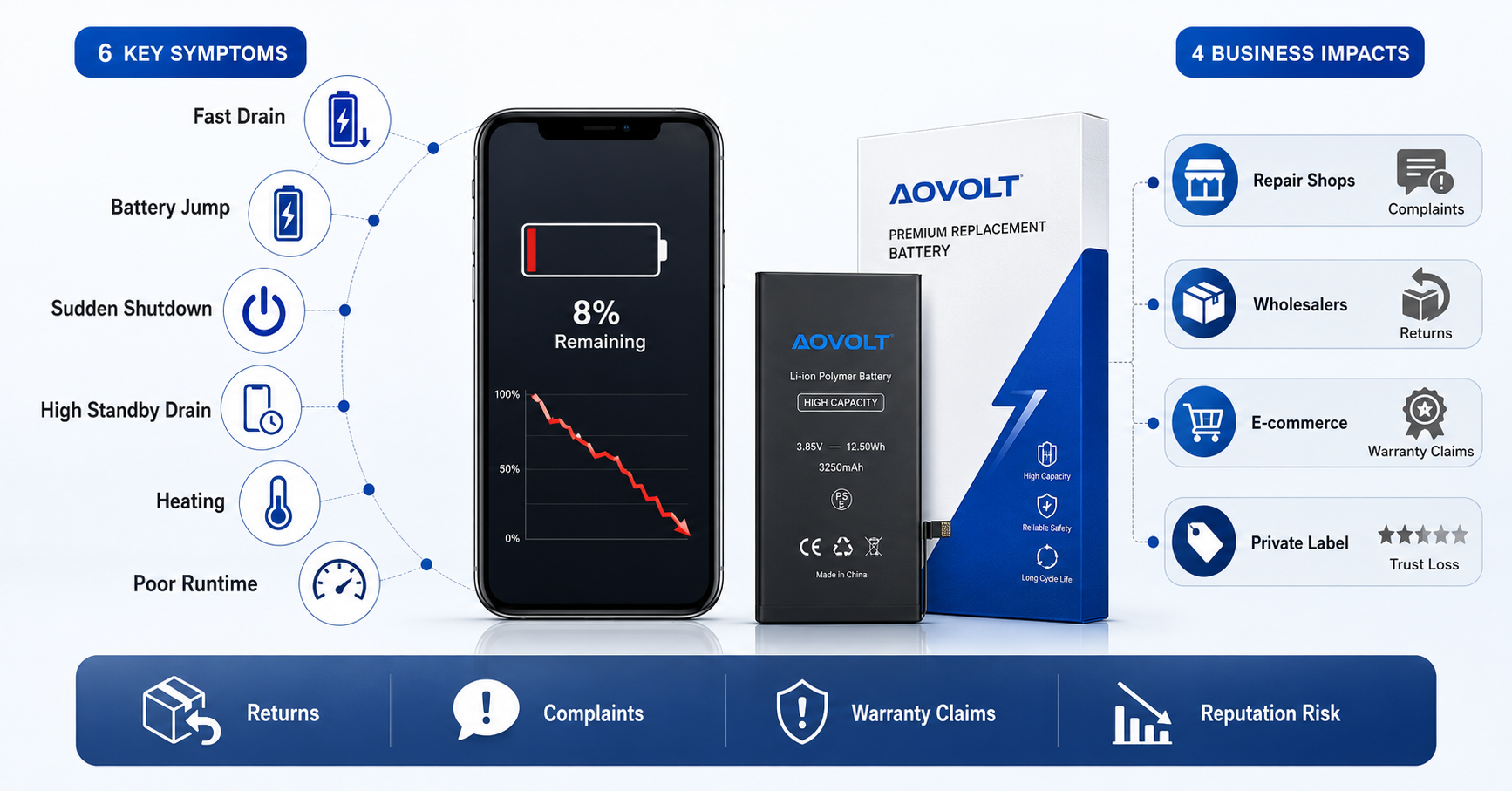
Product Pain Points: B2B Buyers Need More Than a Low Price
For B2B buyers, the biggest sourcing risk is choosing an iPhone battery supplier based only on price, packaging photos or printed capacity.
A low-cost battery may look acceptable before installation, but after real use it can create fast drain complaints, sudden shutdown, battery swelling, charging failure, abnormal percentage jumping, overheating, short cycle life, poor battery health display behavior or warning-message concerns.
Repair shops suffer because customers return and question the repair quality.
Wholesalers suffer because local repair stores request replacements, credit notes or warranty support.
E-commerce sellers suffer because exaggerated capacity claims can turn into negative reviews and platform returns.
Private label brands suffer because the end customer remembers the brand name on the package, not the original factory behind it.
The real problem is that many quality issues are invisible during simple visual inspection. A battery can look clean, flat and well-labeled, but still have unstable cell capacity, high internal resistance, weak PCM protection, poor flex cable alignment, inconsistent batch performance or insufficient aging tests.
That is why serious buyers must understand how to find a reliable iPhone battery manufacturer before placing bulk orders.
Illustration 1: Product Pain Points
Create a 1200×628px professional B2B infographic showing an iPhone repair shop counter with an AOVOLT iPhone battery, phone repair tools and warning icons around the product. Use short labels only: Fast Drain, Swelling, Warning Message, No Charging, High Returns, Poor Capacity. Add a clean blue-white technical background, premium lighting and minimal text.
Working Principle: What Makes an iPhone Battery Supplier Reliable
A reliable iPhone battery manufacturer must control the whole battery system, not only the outside label.
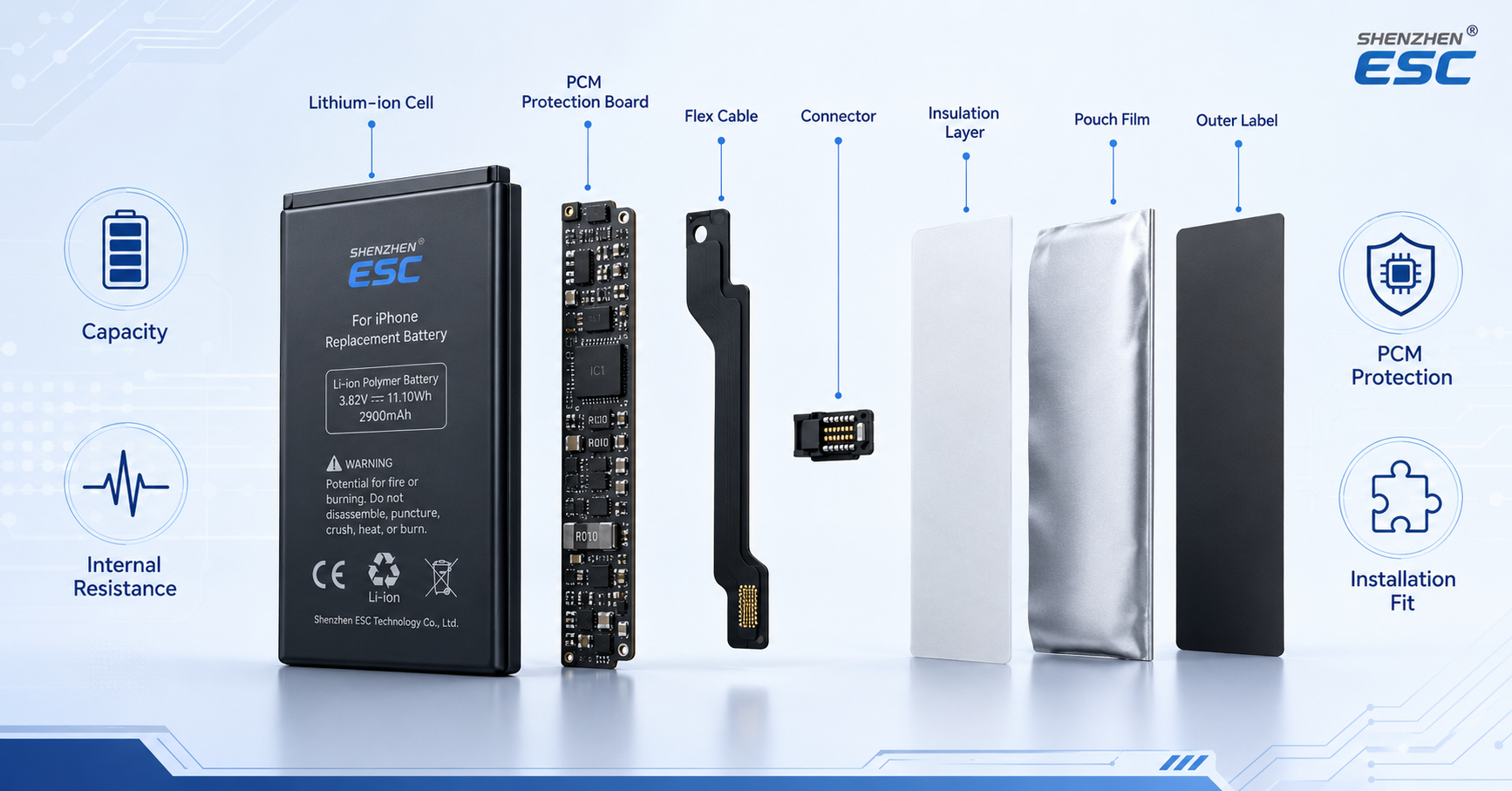
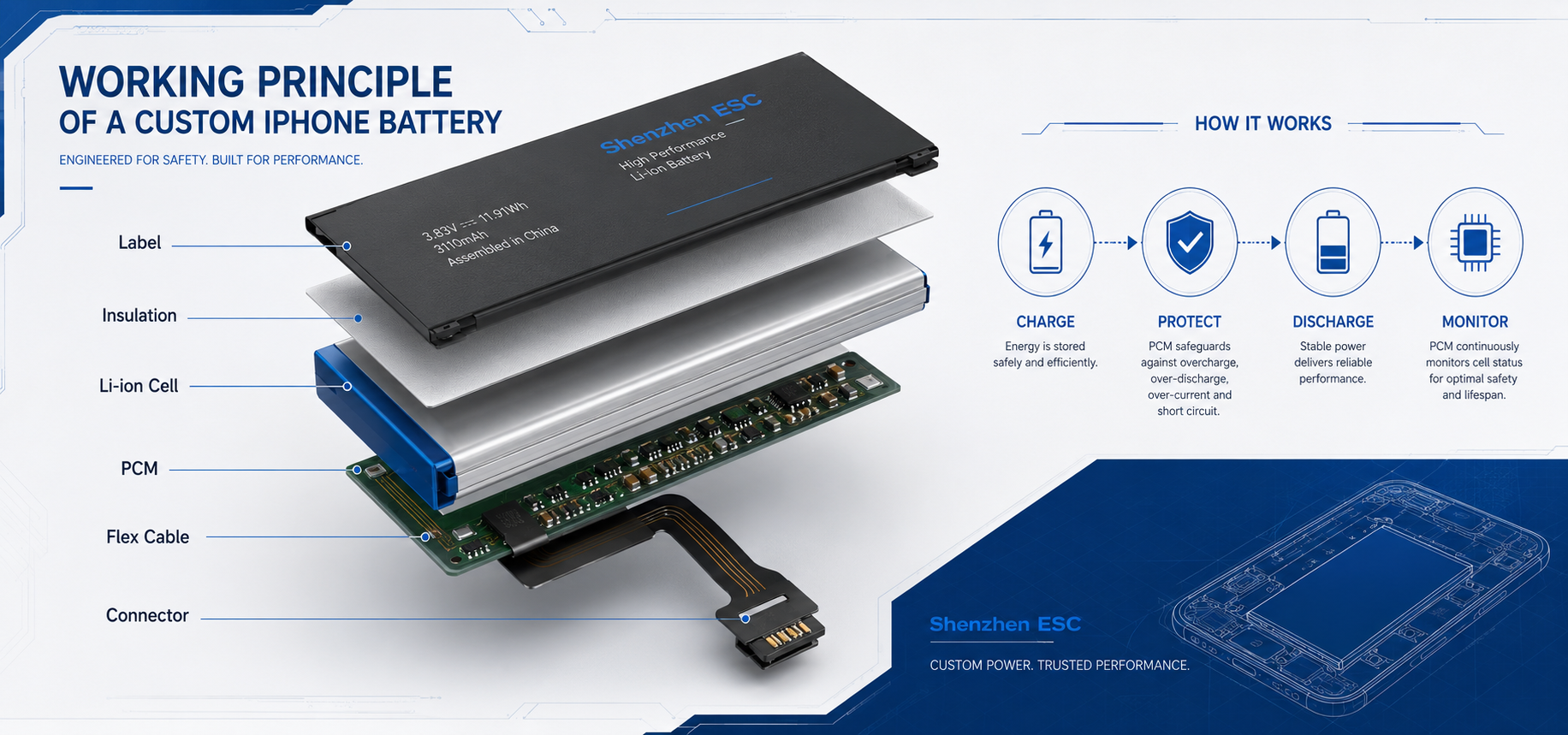
An iPhone replacement battery usually includes a lithium-ion polymer cell, pouch film, protection circuit module, flex cable, connector, insulation materials, temperature-related components, adhesive structure, label and packaging.
The battery cell determines energy storage and discharge capability.
The PCM protection board helps manage overcharge, over-discharge, over-current, short circuit and abnormal working conditions.
The flex cable and connector affect installation fit and signal connection.
The label and packaging affect compliance information, model identification, brand presentation and transportation protection.
Battery performance depends on the relationship between these parts. If the cell is acceptable but the protection board is unstable, the battery may still create charging or shutdown problems. If the connector is poorly matched, installation becomes risky. If the capacity label is exaggerated, the customer’s expectation becomes impossible to satisfy.
Apple’s Parts and Service History support page explains that iPhone may identify parts as Genuine, Unknown, Used or Unverified depending on the model, software version and repair condition. It also notes that these messages do not necessarily prevent use, but they do affect the customer-facing repair experience.
For professional B2B buyers, this means iPhone battery sourcing must consider both hardware performance and post-repair user experience.
Illustration 2: Working Principle
Create a 1200×628px technical exploded-view illustration of an AOVOLT iPhone replacement battery. Show the lithium-ion cell, PCM protection board, flex cable, connector, NTC temperature component, insulation layer, label and pouch film. On the side, show four clean icons: Cell Quality, PCM Protection, Connector Fit, Batch Testing. Use minimal text and a premium blue-white engineering style.
Supplier Comparison: Low-Price Vendor vs Reliable iPhone Battery Manufacturer
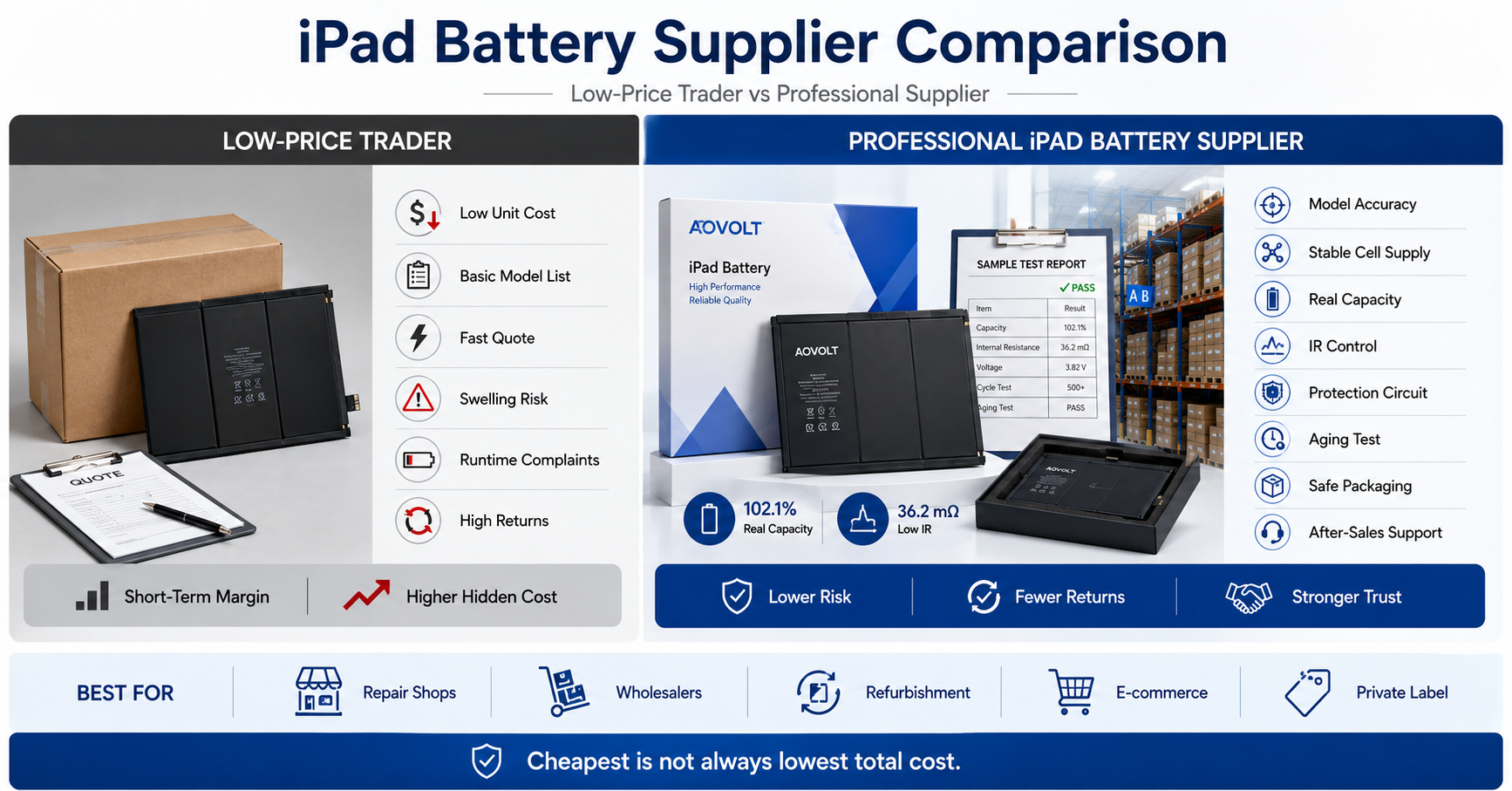
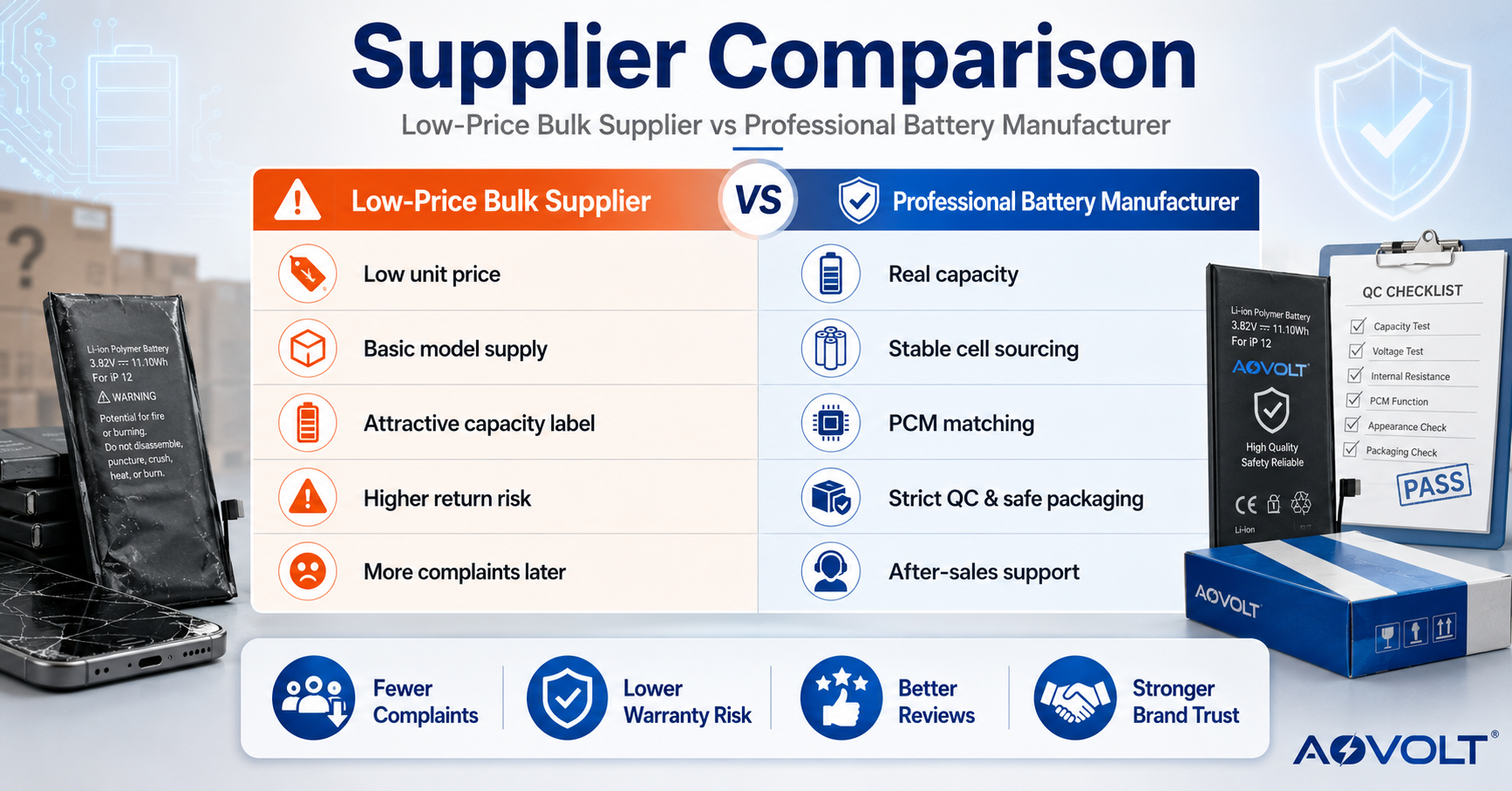
A low-price vendor usually focuses on fast quotation, basic model availability and attractive capacity labels.
A reliable iPhone replacement battery manufacturer focuses on product stability, real capacity, internal resistance control, protection board matching, installation compatibility, battery health behavior, testing process and after-sales response.
The difference is not always obvious before the order. It becomes obvious after customers start using the batteries.
A low-price vendor may offer a cheaper unit cost but create higher hidden costs through returns, complaints, replacements and damaged reputation.
A reliable supplier may not always offer the lowest price, but the total business cost is usually lower because quality stability protects the buyer’s downstream customers.
For repair shops, reliability means fewer complaints after installation.
For wholesalers, reliability means fewer warranty disputes.
For e-commerce sellers, reliability means better reviews and lower return rates.
For private label brands, reliability means stronger long-term trust.
This is the core logic of B2B battery sourcing. The lowest price is not the same as the lowest cost.
Solution: How to Find a Reliable iPhone Battery Manufacturer
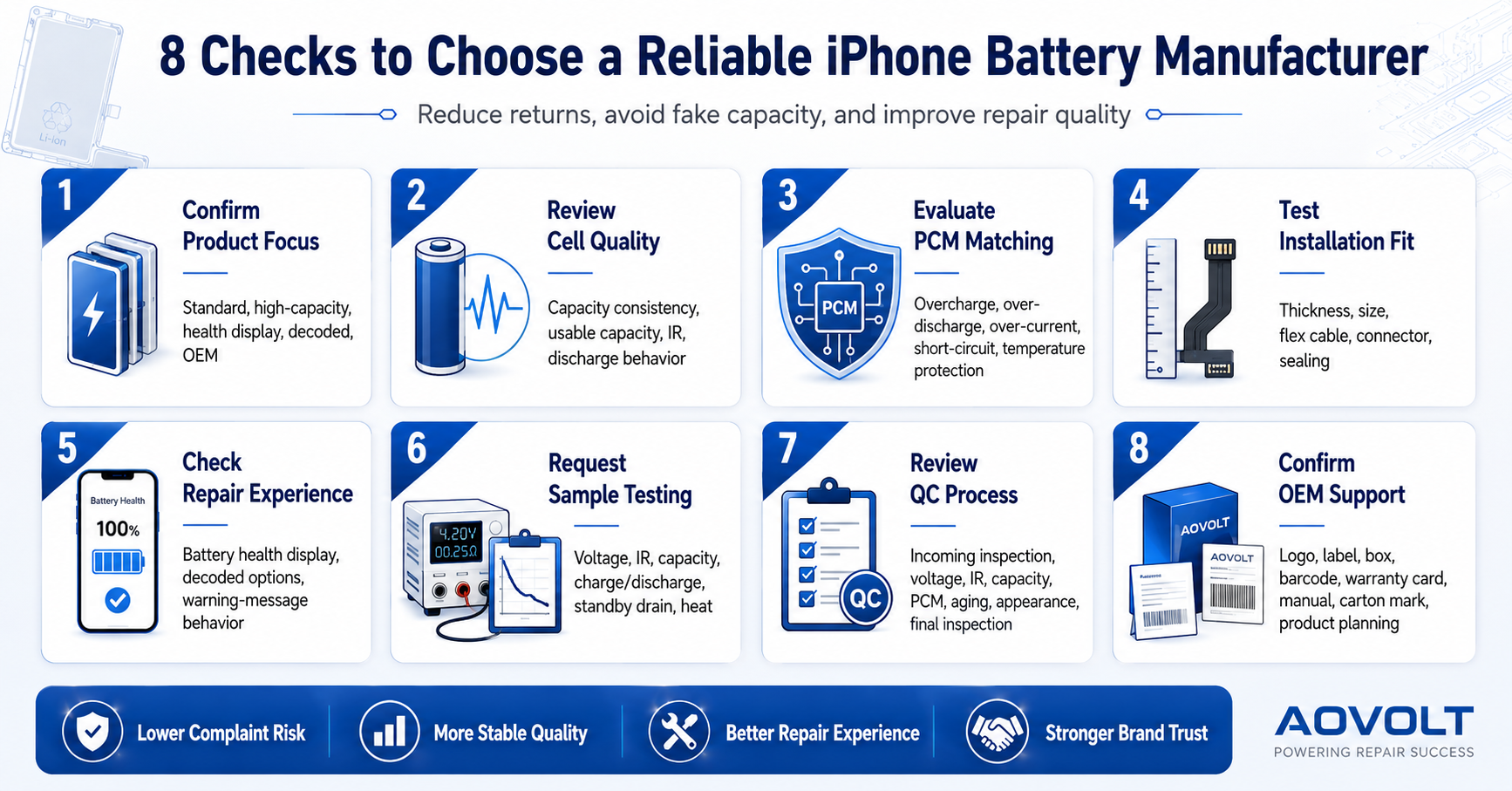
To evaluate a supplier properly, buyers should use a structured checklist instead of only asking for a price list.
Check 1: Confirm Real Product Focus
A serious supplier should understand iPhone replacement battery categories clearly, including standard capacity batteries, high capacity batteries, battery health display batteries, decoded battery solutions, no-pop-up warning solutions and OEM private label battery lines.
If a supplier cannot explain the difference between these options, it may not be suitable for professional B2B cooperation.
Check 2: Review Cell Quality and Capacity Logic
Ask how the supplier controls battery cell consistency, rated capacity, usable capacity, internal resistance and discharge behavior.
Do not only ask whether the battery is “high capacity.” Ask whether the capacity is realistic for the battery size and whether the supplier can support sample testing.
A professional manufacturer should avoid exaggerated capacity claims because fake capacity creates after-sales risk.
Check 3: Evaluate PCM Protection Board Matching
The PCM protection board is critical for safety and stability.
Buyers should ask whether the battery includes overcharge protection, over-discharge protection, over-current protection, short-circuit protection and temperature-related protection.
Poor PCM matching can lead to abnormal charging, shutdown, heating, percentage jumping or higher warranty risk.
Check 4: Test Installation Fit
An iPhone battery must fit the device precisely.
Buyers should inspect battery thickness, length, width, flex cable direction, connector alignment, adhesive area and edge sealing.
A small structural mismatch can make installation slower and increase repair shop complaints.
Check 5: Check Battery Health and Repair Experience
For newer iPhone models, buyers should ask about battery health display options, decoded battery solutions and possible warning-message behavior.
Apple’s official repair information shows that parts and service history may display information about replaced batteries on supported iPhone models, so repair shops must manage customer expectations and choose suitable battery solutions for their service level.
Check 6: Request Sample Testing Before Bulk Orders
Buyers should test samples before placing a large order.
Useful tests include open-circuit voltage, internal resistance, capacity test, charge-discharge test, installation check, battery health behavior, standby drain observation and heat observation during charging.
One sample is not enough. Buyers should test several samples from the same batch to judge consistency.
Check 7: Review Quality-Control Process
A reliable supplier should have a clear inspection process.
The process should include incoming material inspection, cell voltage testing, internal resistance testing, capacity testing, PCM function testing, spot welding inspection, aging test, charge-discharge testing, appearance inspection, label inspection, packaging inspection and final random inspection.
IEC 62133-2 covers safety requirements for portable sealed secondary lithium cells and batteries under intended use and reasonably foreseeable misuse, which reinforces why professional lithium battery sourcing must rely on safety testing and controlled quality systems.
Check 8: Confirm OEM and Private Label Support
If the buyer wants to build a local battery brand, the supplier should support logo, label, retail box, barcode, warranty card, user manual, carton mark and product series planning.
A good OEM iPhone battery manufacturer does not only print a logo. It helps the buyer build a product line with clear positioning.
AOVOLT Solution: A Reliable iPhone Battery Manufacturer for B2B Buyers
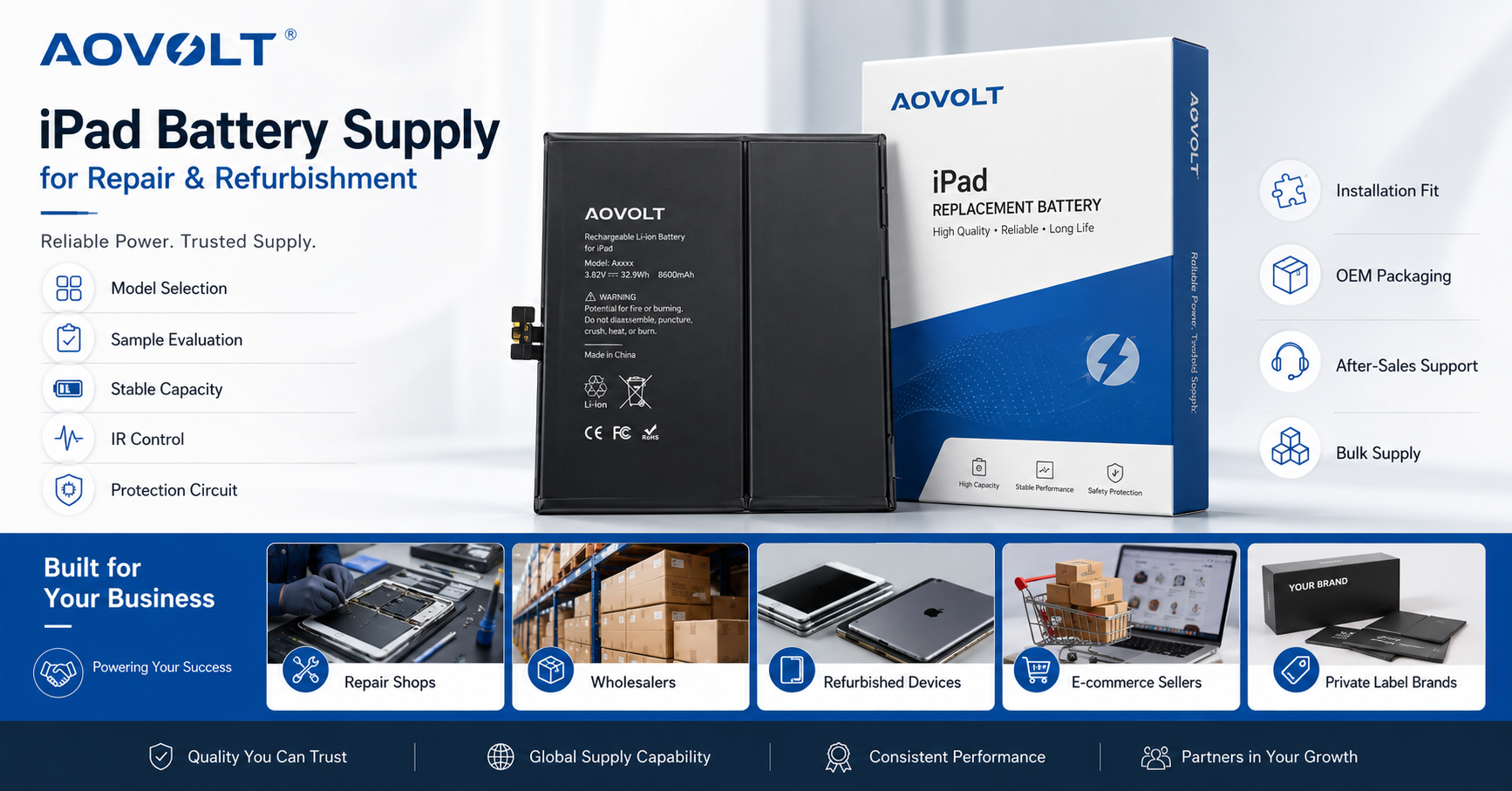
AOVOLT supports repair shops, wholesalers, distributors, refurbished phone suppliers, e-commerce sellers and private label brands with iPhone replacement battery solutions.
The product structure can include standard capacity iPhone batteries for daily repair, high capacity iPhone batteries for premium runtime demand, battery health display options for better customer confidence, decoded battery solutions for professional repair channels and OEM packaging for private label customers.
AOVOLT’s sourcing and production logic focuses on real capacity, stable cell performance, PCM protection, installation compatibility, model coverage, sample evaluation, quality inspection and after-sales support.
For customers who are learning how to find a reliable iPhone battery manufacturer, the key point is simple: the supplier should help you reduce business risk, not only reduce unit price.
Core Advantages: Why AOVOLT Fits Professional Battery Buyers
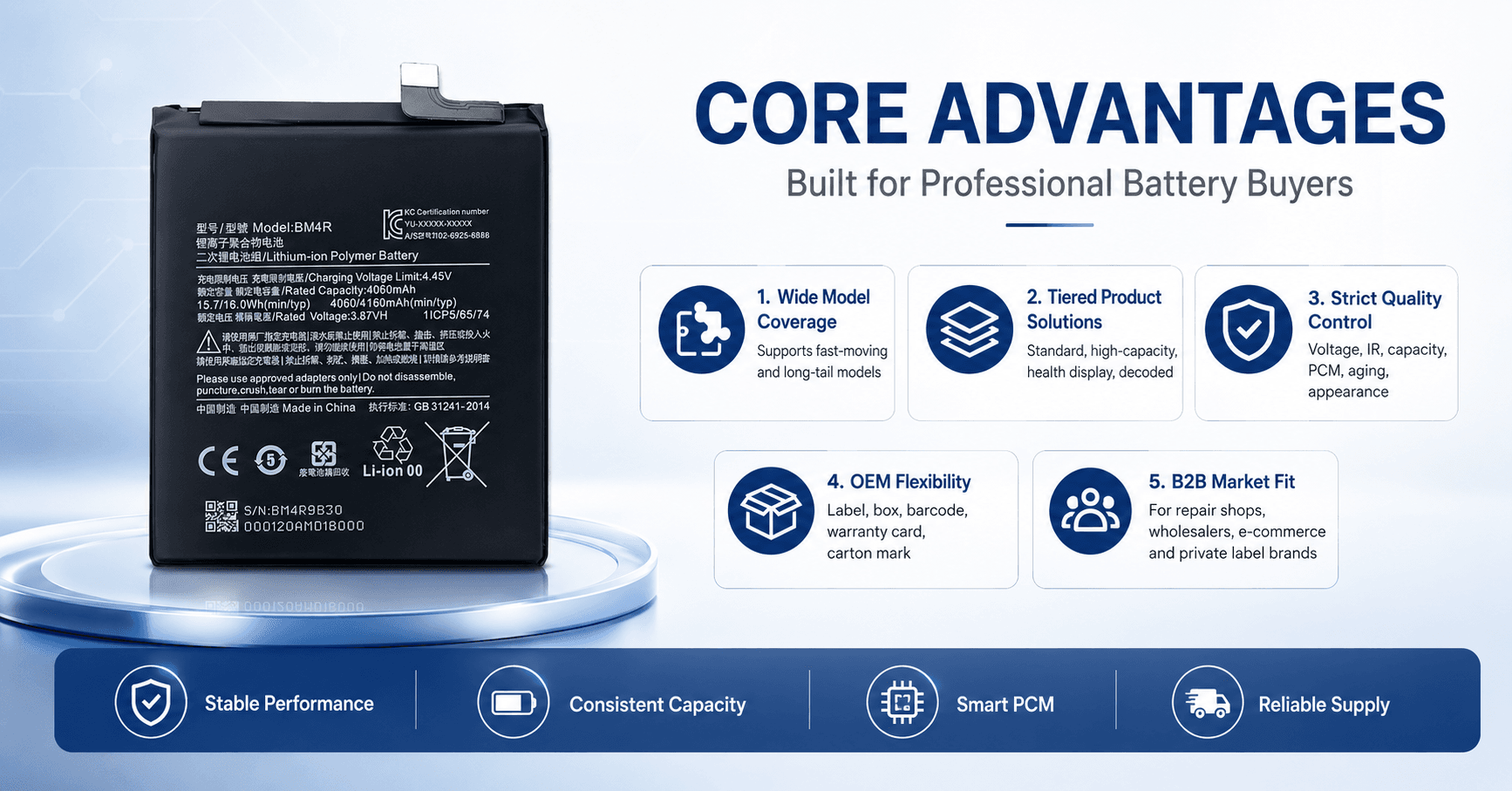
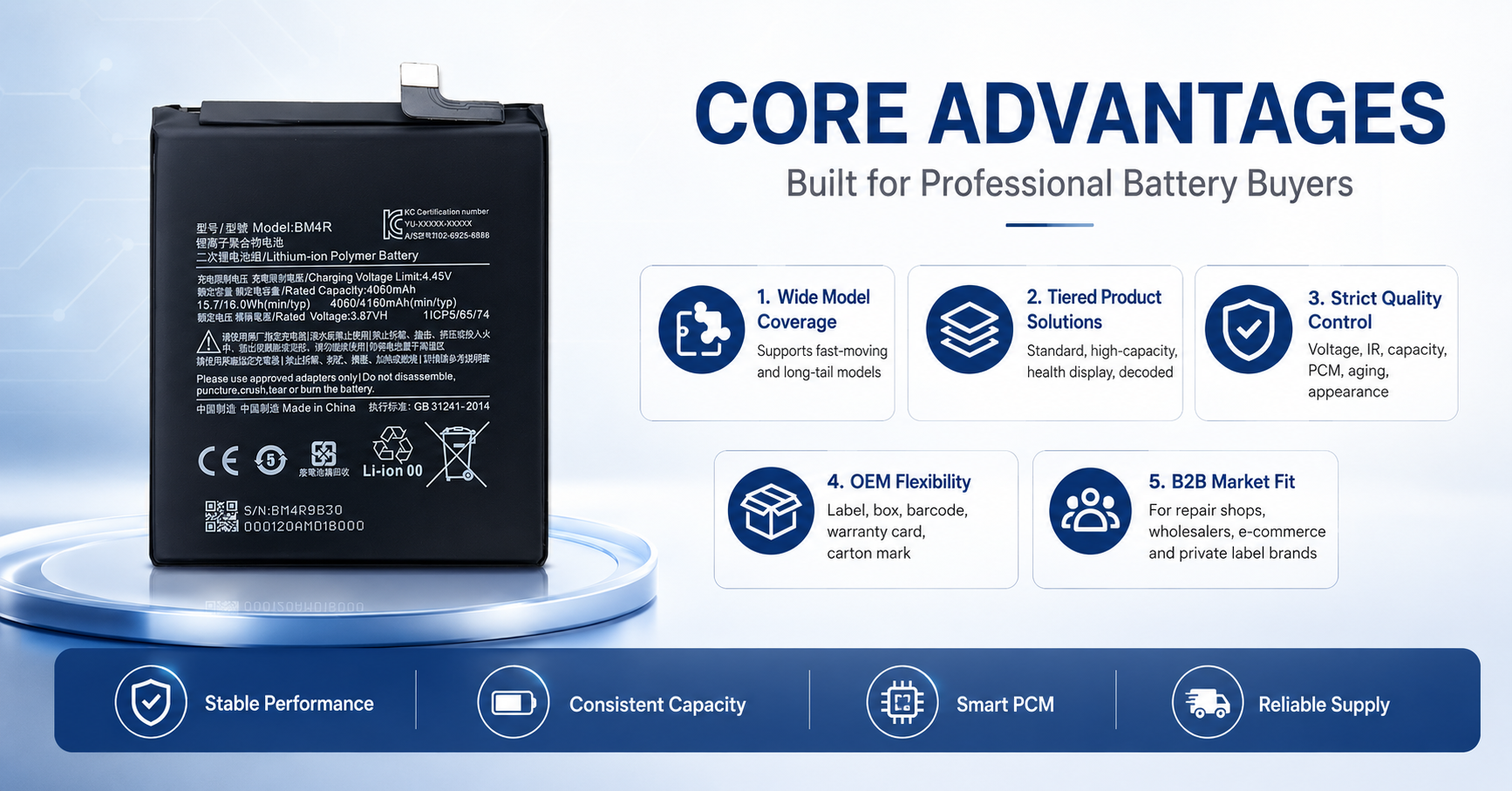
AOVOLT’s first advantage is model coverage.
Repair shops and wholesalers need batteries for multiple iPhone generations, not only one or two hot models. A complete supplier should support both fast-moving models and long-tail demand.
The second advantage is product tier planning.
Customers can build standard, high-capacity, battery health display, decoded and private label series according to their market positioning.
The third advantage is quality-control awareness.
AOVOLT can support testing discussions around voltage, internal resistance, capacity, PCM function, charging behavior, aging performance, appearance and packaging.
The fourth advantage is OEM flexibility.
Private label customers can customize battery labels, packaging boxes, barcodes, warranty cards, user manuals and carton marks.
The fifth advantage is B2B market understanding.
Different customers need different solutions. A repair shop needs installation stability. A wholesaler needs batch consistency. An e-commerce seller needs retail-ready packaging. A private label brand needs product architecture and long-term supply.
Application Scenarios: Where a Reliable Supplier Creates Business Value
Repair shops use iPhone replacement batteries for daily repair services. Their priority is stable installation, fewer complaints, battery health communication and reliable performance after delivery.
Wholesalers use iPhone batteries for distribution to repair stores, online sellers and local parts dealers. Their priority is model coverage, stable supply, consistent batches and manageable warranty risk.
Refurbished phone factories use replacement batteries to restore used iPhones before resale. Their priority is predictable quality, bulk supply, installation efficiency and consistent capacity.
E-commerce sellers use iPhone battery kits for online sales. Their priority is packaging, accurate compatibility information, low return rate and strong customer reviews.
Private label brands use iPhone batteries to build a local product line. Their priority is OEM packaging, brand identity, product tiers, quality stability and repeat orders.
Selection Advice: Which Manufacturer Type Fits Your Business
Repair shops should choose a supplier that can provide stable daily repair models, high-capacity options, battery health display solutions and after-sales technical support.
Wholesalers should choose a supplier with wide model coverage, mixed-order flexibility, stable batch performance and clear warranty communication.
Refurbished phone suppliers should choose a manufacturer that provides consistent capacity, fast installation fit and predictable quality across repeated orders.
E-commerce sellers should choose a private label iPhone battery supplier that understands retail packaging, compatibility labels, tool kit options and return-rate control.
Private label brands should choose an OEM iPhone battery manufacturer that can help build a product architecture, not just supply random SKUs.
Before placing bulk orders, B2B buyers should request samples, test capacity, check internal resistance, verify installation fit, review packaging, confirm warranty terms and evaluate the supplier’s quality-control process.
FAQ
What is the most important factor when choosing an iPhone battery manufacturer?
The most important factor is quality consistency. Price matters, but stable capacity, PCM protection, installation compatibility, battery health behavior, testing process and after-sales response are more important for long-term B2B business.
How can I know if an iPhone battery supplier is reliable?
A reliable supplier should provide clear model information, realistic capacity, sample support, quality-control process, OEM options, batch consistency and professional after-sales communication. If the supplier only talks about low price, that is a warning sign.
Should I choose standard capacity or high capacity iPhone batteries?
Standard capacity batteries are suitable for daily repair and wholesale volume. High capacity batteries are suitable for premium repair services and stronger product differentiation, but the capacity claim must be realistic and supported by testing.
Why is PCM important in iPhone replacement batteries?
PCM helps protect the battery from overcharge, over-discharge, over-current and short circuit. It also affects charging behavior, discharge stability, safety and after-sales failure rate.
Do iPhone replacement batteries affect battery health display?
They can. Battery health display behavior depends on the iPhone model, battery solution and repair process. Apple’s support documentation explains that supported iPhone models can show Parts and Service History after repair, including battery-related information.
Can AOVOLT support private label iPhone batteries?
Yes. AOVOLT can support private label iPhone battery projects, including logo, battery label, retail packaging, barcode, warranty card, user manual, carton mark and product series planning.
What tests should I do before ordering iPhone batteries in bulk?
Buyers should test voltage, internal resistance, capacity, charge-discharge behavior, installation fit, battery health behavior, warning-message behavior, heat during charging and packaging protection.
Is the lowest-price supplier always the best choice?
No. Low price can create higher total cost if the batteries cause returns, complaints, warranty claims and brand damage. B2B buyers should calculate total risk, not only unit price.
Conclusion
Understanding how to find a reliable iPhone battery manufacturer helps B2B buyers avoid fake capacity claims, unstable batches, poor installation fit, warning-message complaints, high return rates and weak after-sales support.
A reliable iPhone battery partner should provide real capacity, stable cell quality, PCM protection, model compatibility, sample testing, quality-control process, OEM packaging and professional B2B support.
AOVOLT helps repair shops, wholesalers, refurbished phone suppliers, e-commerce sellers and private label brands build stable iPhone replacement battery product lines with standard capacity, high capacity, battery health display, decoded battery and OEM solutions.
Contact AOVOLT to request iPhone battery samples, model recommendations, quality-control details and wholesale pricing.