
For decades, the charging accessory market was dominated by a single material: silicon. While reliable, silicon has reached its physical limits in terms of heat dissipation and efficiency, leaving consumers with bulky, hot "bricks" to power their laptops and phones.
Enter Gallium Nitride (GaN). This third-generation semiconductor material has disrupted the industry, enabling power adapters that are physically smaller yet significantly more powerful.
In this guide, we will explore the science behind GaN, compare it directly to traditional silicon chargers, and analyze why forward-looking brands are racing to integrate this technology into their OEM GAN charger supplier product lineups.

Quick Comparison: Silicon vs. GaN Chargers
Before diving into the technical details, here is a quick reference guide on how GaN stacks up against traditional silicon adapters.
| Feature | Traditional Silicon Charger | GaN (Gallium Nitride) Charger |
| Size & Weight | Bulky, heavy, requires large transformers | Up to 50% smaller and lighter |
| Heat Dissipation | Generates significant heat; requires cooling | Runs cooler; superior thermal management |
| Efficiency | Lower; more energy lost as heat | High efficiency (>95%); less energy waste |
| Switching Speed | Slower electron mobility | Faster switching frequencies (3x+) |
| Power Density | Low | High (More watts per cubic inch) |
What is GaN Technology?
Gallium Nitride (GaN) is a material that can be used to produce semiconductor power devices as well as RF components and light-emitting diodes (LEDs). In the context of charging, it is known as a Wide Bandgap (WBG) semiconductor.
The Science Made Simple
All electronics rely on a "bandgap"—essentially the energy range in a solid where no electron states can exist. This gap determines how well a material can conduct electricity.
-
Silicon has a narrower bandgap, meaning it hits a performance ceiling where it can no longer handle higher voltages without getting too hot or requiring massive components to manage the current.
-
GaN has a wider bandgap. It can sustain much higher voltages and temperatures than silicon. This allows electrical current to pass through the charger faster and with less resistance.
Because GaN components are better at conducting electricity, they can switch currents at much higher frequencies. Higher switching frequencies mean the internal components (like transformers and capacitors) can be shrunk down drastically without sacrificing power output.
Why GaN is Better Than Silicon: Key Advantages
The shift to GaN isn't just a minor upgrade; it is a generational leap. Here are the four specific areas where GaN outperforms its predecessors.
1. Unmatched Power Density (Smaller Size)
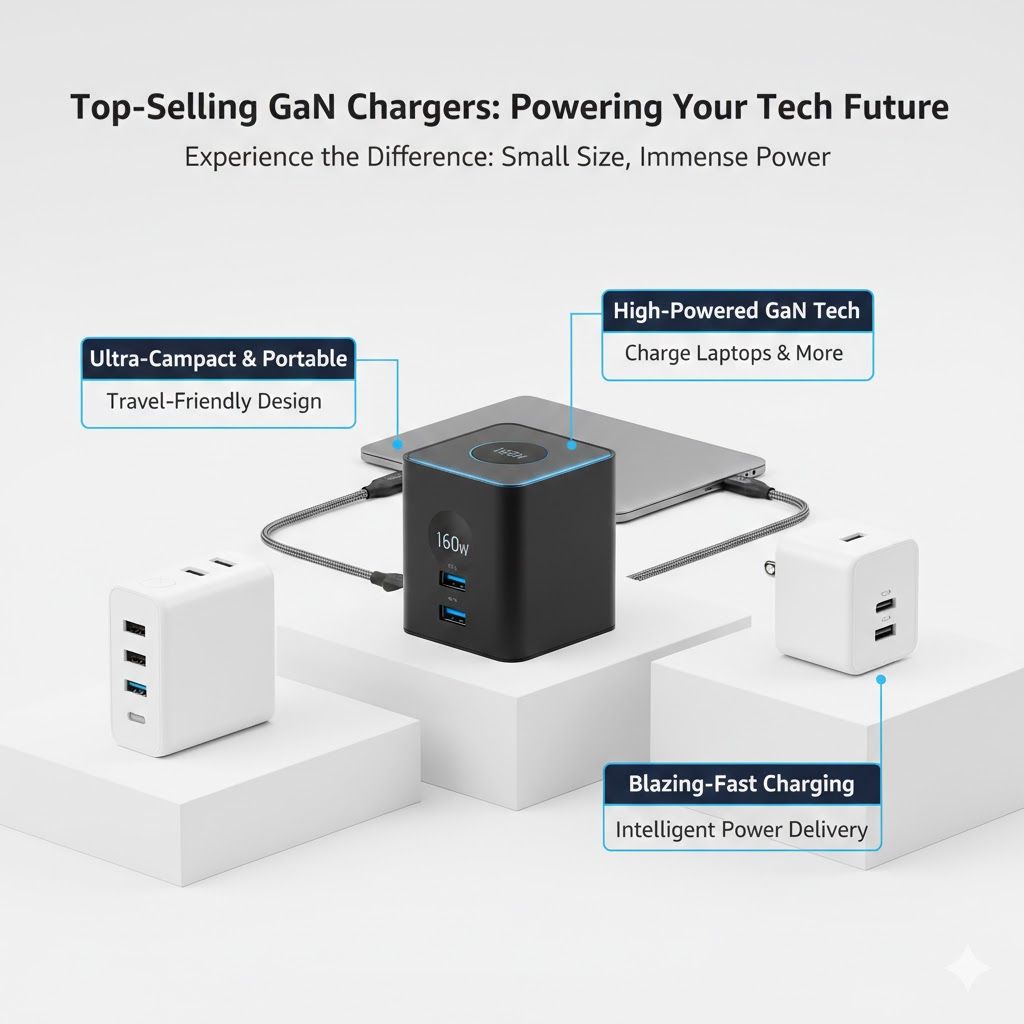
The most visible benefit for the consumer is size. Because GaN chips are efficient and require fewer passive components for cooling, manufacturers can pack 65W, 100W, or even 140W of power into a casing the size of a deck of cards. For travelers and commuters who are tired of carrying heavy power bricks, this is a game-changer.
2. Superior Thermal Performance
Heat is the enemy of electronics. Traditional chargers get hot because they are inefficient—energy that isn't converted into power for your device is lost as waste heat. GaN’s high efficiency means very little energy is wasted. Consequently, the charger stays cool to the touch, which not only improves safety but also extends the lifespan of the charger itself.
3. Faster Electron Movement
GaN allows electrons to move more freely (high electron mobility). In practical terms, this translates to faster charging speeds. When paired with modern standards like USB-C Power Delivery (PD), a GaN charger can negotiate the maximum speed a device can handle, charging a smartphone from 0% to 50% in under 30 minutes or powering a high-performance laptop at full speed.
4. Eco-Friendly Efficiency
With billions of chargers in use globally, energy efficiency matters. GaN chargers reduce energy loss by 10-20% compared to legacy adapters. Over time, this results in a lower carbon footprint and reduced electricity usage for the end consumer.
GaN in the Real World: Applications and Use Cases
The versatility of GaN extends beyond just charging a phone. Its robust thermal profile makes it ideal for high-demand scenarios.
The "One Charger" Solution
Modern consumers often carry a smartphone, a tablet, a smartwatch, and a laptop. Previously, this required carrying multiple chargers. Today, a single multi-port GaN charger (e.g., a 100W 3-port adapter) can simultaneously charge a MacBook Pro, an iPhone, and AirPods. The smart power distribution within the GaN chipset allocates the correct wattage to each port dynamically.
Supercharging Power Banks
GaN technology is also transforming the battery pack market. It’s not just about output; it’s about input. Power banks equipped with GaN circuits can be recharged significantly faster. A high-capacity 20,000mAh power bank, which used to take overnight to recharge, can now be topped up in a fraction of the time, keeping users tethered to wall outlets for shorter periods.
OEM Advantages for Brands
For electronics brands and retailers, switching to GaN accessories offers distinct commercial advantages.
-
Premium Brand Positioning: Offering GaN chargers signals that a brand is at the forefront of technology. It justifies a higher price point compared to generic chargers, increasing profit margins.
-
Reduced Return Rates: One of the most common complaints regarding electronics is overheating. By utilizing GaN’s superior thermal efficiency, brands can reduce product failures and customer returns.
-
Differentiation: In a crowded market, a charger that is 40% smaller than the competition stands out on the shelf.
Product Considerations Before Ordering
If you are a brand manager or procurement officer looking to source OEM GaN chargers, consider the following specifications to ensure quality and compatibility.
1. Power Requirements
Identify the primary device target.
-
30W: Ideal for smartphones and tablets (e.g., iPhone 15, iPad Air).
-
65W: The "sweet spot" for ultrabooks and general laptops.
-
100W - 140W: Required for high-performance laptops (e.g., MacBook Pro 16", Gaming Laptops).
2. Port Configuration
Single-port chargers are compact, but multi-port (2C1A or 3C1A) configurations offer higher perceived value to the consumer. Ensure the chipset supports Intelligent Power Allocation so that when multiple devices are plugged in, the power is split logically (e.g., 65W for the laptop + 20W for the phone).
3. Safety Certifications
Never compromise on safety. Ensure the manufacturer provides certifications such as:
-
UL / ETL (North America)
-
CE / RoHS (Europe)
-
PSE (Japan)
-
CCC (China)
Conclusion
Gallium Nitride is no longer a niche technology reserved for high-end tech enthusiasts; it is becoming the new standard for charging. By replacing bulky silicon transformers with efficient GaN fast charging solutions chips, the industry is moving toward a future where chargers are faster, cooler, and universally compatible.
For brands, the message is clear: adopting GaN technology is essential to staying relevant in the fast-charging era. Whether you are developing a new line of mobile accessories or bundling chargers with consumer electronics, GaN charger manufacturer offers the performance and reliability your customers expect.
Ready to Upgrade Your Product Line?
Are you looking for high-quality, customized GaN charging solutions?
👉 Contact ESC CHARGE today to explore our OEM GaN charger solutions and learn how we can help you outpace the competition with cutting-edge power accessories.
Shenzhen ESC is a leading power bank manufacturer with over 10 years of production experience. Specializing in fast-charging power banks and chargers, we feature an R&D team with listed company expertise and proprietary chip technology. Our high-power products deliver multi-brand fast charging compatibility without overheating.
Certified for quality and safety, our products are exported to dozens of countries worldwide.
Interested in OEM/ODM partnerships? Contact us today!
WhatsApp/WeChat: +86 18576695768
Email: amy@escpowerbank.com
YouTube: https://www.youtube.com/@escpowerbank
We look forward to powering your business!Partner with a leader in fast-charging technology. Powering your business, wherever you go.