
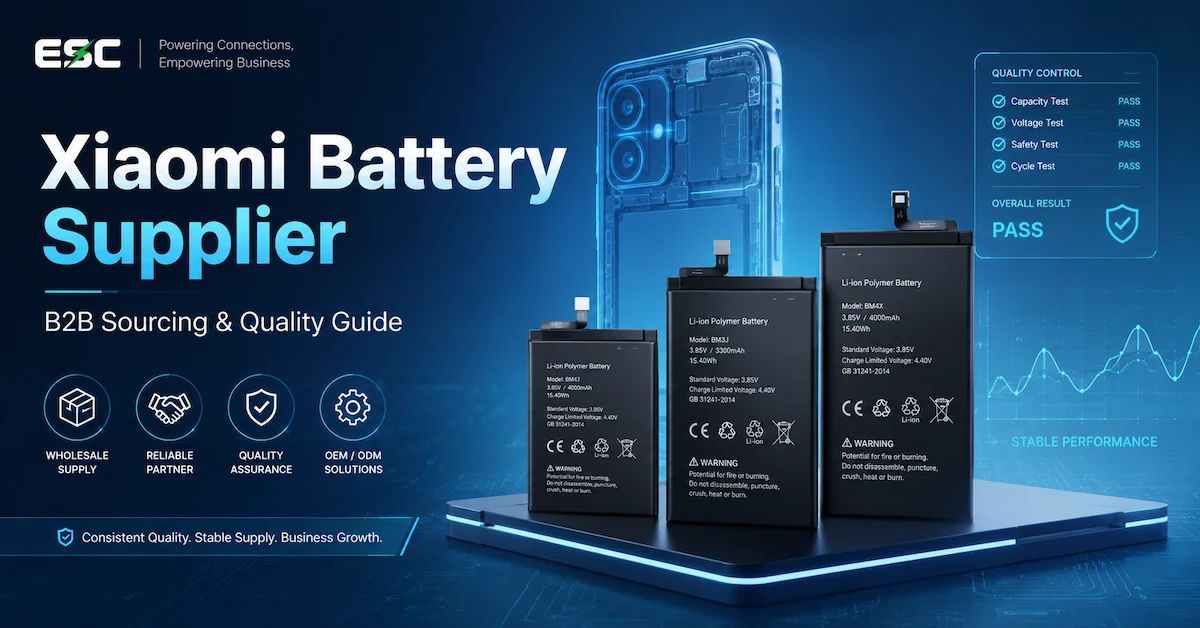
Choosing a Xiaomi battery supplier is not simply about finding a factory with a long model list or the lowest price per battery. For repair centers, refurbishers, wholesalers, distributors and private-label brands sourcing mobile phone replacement batteries, a reliable supplier must control model compatibility, actual capacity, internal resistance, protection circuitry, connector fitment, batch consistency and after-sales risk.
This matters because the Xiaomi ecosystem includes Xiaomi, Redmi and POCO devices, while replacement batteries that appear similar can still differ in dimensions, flex-cable routing, connector position, voltage and internal structure. A wrong battery can create installation delays; an unstable battery can create repeat repairs, warranty claims and customer complaints.
For professional buyers, the better sourcing question is therefore not:
“Who sells the cheapest Xiaomi battery?”
It is:
“Which Xiaomi battery supplier can deliver the correct model, repeatable electrical performance and consistent batches at scale?”
According to Xiaomi's battery replacement guidance, battery replacement for current Xiaomi smartphones should be handled through professional inspection and repair services. For aftermarket buyers, that reinforces an important point: smartphone replacement batteries should be treated as professional repair components, not simple consumer accessories.
What Should a Professional Xiaomi Battery Supplier Provide?
A qualified Xiaomi replacement battery supplier should provide more than finished batteries and a price list.
Professional buyers should be able to verify the following before placing a wholesale order.
| Evaluation Area | What Buyers Should Check | Why It Matters |
|---|---|---|
| Model compatibility | Phone model + battery code | Prevents incorrect sourcing |
| Rated capacity | mAh and Wh | Establishes realistic energy specification |
| Voltage | Nominal battery voltage | Required for electrical compatibility |
| Internal resistance | Sample and batch consistency | Influences voltage drop and thermal behavior |
| Protection circuit | Protection configuration | Supports battery safety |
| Flex cable | Direction, length and structure | Affects installation |
| Connector | Type and location | Prevents fitment failures |
| Dimensions | Length, width and thickness | Ensures mechanical fit |
| Capacity testing | Actual discharge result | Helps identify overstated capacity |
| Aging test | Pre-shipment screening | Helps detect early failures |
| Packaging | Battery and flex protection | Reduces handling damage |
| Traceability | SKU / model / batch information | Simplifies wholesale inventory |
| OEM support | Label and packaging options | Supports private-label programs |
| After-sales | Claim procedure | Controls commercial risk |
Buyers comparing Xiaomi replacement batteries should therefore evaluate the complete battery system rather than relying only on the capacity printed on the label.
A supplier that cannot clearly explain these variables is difficult to evaluate, even if its quotation looks attractive.
Xiaomi, Redmi and POCO Battery Compatibility Is More Complex Than the Phone Name
One of the most common sourcing mistakes is ordering a battery only by the commercial phone name.
Professional buyers should confirm both:
device model + battery identification/code.
ESC's broader mobile phone battery range includes replacement battery solutions for different smartphone platforms, including Xiaomi-related applications.
A professional SKU record should ideally include:
Brand → Series → Phone Model → Battery Code → Voltage → Capacity → Connector / Flex Information
For example:
Xiaomi → Mi Series → Xiaomi 10 / 10S → BM4N → confirmed electrical and mechanical specifications
This approach is more reliable than simply storing:
“Xiaomi 10 Battery”
because wholesalers, distributors and repair chains often manage dozens or hundreds of battery SKUs.
Battery-code-based inventory management can reduce:
- warehouse picking errors;
- incorrect customer shipments;
- repair technician confusion;
- return requests;
- purchasing duplication.
Why Two Similar-Looking Xiaomi Batteries May Not Be Interchangeable
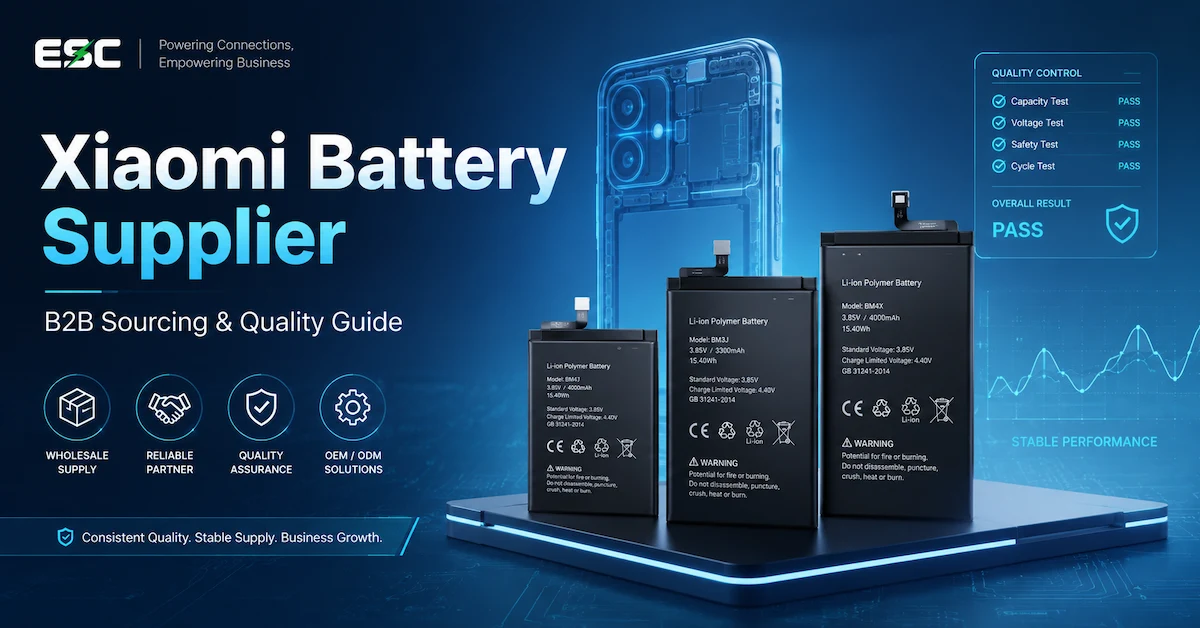
Replacement batteries can look almost identical in a catalog while remaining incompatible in actual repair.
Several technical differences can cause this.
Battery Dimensions
Even a small difference in thickness, width or length can prevent correct installation or create unwanted internal pressure after the device is assembled.
Flex-Cable Direction
The battery may physically fit inside the phone but still fail to connect correctly if the flex cable is positioned differently.
Connector Position
Connector geometry and alignment affect installation accuracy and technician efficiency.
Voltage Specification
A replacement battery must match the intended electrical design of the device.
Protection Circuit Configuration
A replacement battery pack includes more than the cell itself. Its protection circuitry must operate correctly with the intended battery configuration.
Adhesive and Mechanical Structure
The way the battery is positioned and secured inside the phone also affects installation reliability.
For repair chains and refurbishing facilities, these issues have direct commercial consequences.
A battery that costs slightly less but adds several minutes of technician troubleshooting can become more expensive when multiplied across hundreds or thousands of repairs.
Actual Capacity Matters More Than the Number Printed on the Label
One of the most common battery sourcing problems is treating printed capacity as proof of performance.
It is not.
A label may state a specific mAh value, but professional buyers should verify that specification through testing.
Useful evaluation points include:
- rated capacity;
- measured discharge capacity;
- nominal voltage;
- watt-hours;
- internal resistance;
- discharge behavior;
- charging behavior.
A practical rule for professional sourcing is:
Do not approve a Xiaomi battery because its capacity label looks competitive. Approve it after measured electrical performance matches the specification.
This becomes especially important when evaluating so-called high-capacity batteries.
A significantly higher capacity claim should remain physically and technically credible for the size and construction of the cell.
If a supplier emphasizes a dramatically higher mAh figure but cannot provide consistent sample-test results, buyers should treat the claim cautiously.
Why Internal Resistance Should Be Part of Xiaomi Battery QC
Capacity tells only part of the battery story.
Internal resistance helps evaluate how a cell behaves when current is being drawn.
Two batteries may record similar capacity under one test while performing differently during real smartphone operation.
Higher or inconsistent internal resistance may contribute to:
- larger voltage drop under load;
- reduced power delivery;
- additional heat generation;
- inconsistent runtime;
- unexpected shutdown behavior;
- poor batch consistency.
For this reason, professional wholesalers and refurbishers should evaluate internal resistance across multiple samples, not just one ideal unit.
The sourcing objective is not:
one good battery.
It is:
repeatable performance across the full purchasing batch.
What Does the Protection Circuit Do in a Xiaomi Replacement Battery?
A replacement battery is not simply a lithium-ion cell with a cable attached.
The finished battery system can include:
Cell + tabs + protection circuit + flex cable + connector + insulation + label/enclosure structure
The protection circuit helps manage abnormal electrical conditions such as:
- overcharge;
- over-discharge;
- overcurrent;
- short circuit.
Depending on the battery design, temperature monitoring or additional protection mechanisms may also be involved.
For professional buyers, this means the cell itself is only one part of quality evaluation.
A good battery cell combined with poor flex assembly, weak insulation or inconsistent protection components can still produce an unreliable finished replacement battery.
How Should Buyers Test Xiaomi Battery Samples?
Sample testing should take place before large-volume purchasing.
However, testing one battery is not enough to evaluate supplier consistency.
A practical sample-validation process can include the following steps.
1. Verify Model Information
Confirm:
- Xiaomi / Redmi / POCO model;
- battery code;
- voltage;
- rated capacity;
- connector;
- flex-cable structure.
The goal is to eliminate compatibility mistakes before electrical testing begins.
2. Inspect the Battery Physically
Check the battery for:
- deformation;
- damaged flex cables;
- poor insulation;
- connector contamination;
- unusual thickness;
- uneven assembly;
- visible damage.
3. Measure Open-Circuit Voltage
Compare several units from the sample group.
The purpose is not only to obtain an acceptable reading but also to identify abnormal variation between batteries.
4. Measure Internal Resistance
Compare multiple batteries rather than one unit.
Consistency is often more valuable than a single excellent result.
5. Conduct Capacity Testing
Perform a controlled charge-discharge test using an appropriate battery-testing procedure.
Compare actual test results with the rated capacity.
6. Install Batteries in Real Devices
Laboratory testing cannot fully verify mechanical compatibility.
Real-device testing should check:
- connector alignment;
- flex routing;
- physical fitment;
- power-on behavior;
- charging;
- battery-percentage behavior;
- standby performance.
7. Observe Temperature Behavior
Check for abnormal heating during charging and normal use.
8. Perform Aging Observation
Aging and short-term performance observation can help reveal early-stage defects that may not appear immediately after assembly.
Buyers can also review ESC's battery sourcing FAQs when evaluating common battery performance, charging and replacement-related issues.
Sample Quality vs Batch Quality: Which Matters More?
Both matter.
But for B2B buyers, batch consistency determines profitability.
Suppliers know that pre-order samples will be inspected carefully.
The more important question is:
Will the 500th battery perform like the fifth battery?
That is why buyers should understand how a supplier manages:
- incoming battery cells;
- cell grading;
- capacity consistency;
- internal resistance;
- battery assembly;
- protection circuits;
- visual inspection;
- aging;
- finished-battery testing;
- batch identification.
For refurbishing companies, a small increase in battery-related rework can consume significant technician time.
The actual purchasing cost therefore includes more than the battery invoice.
It also includes:
installation labor + repeat repairs + customer claims + logistics + warranty handling.
Cheap Xiaomi Batteries vs a Professional Battery Supplier
The lowest unit price does not automatically create the lowest total sourcing cost.
| Factor | Low-Price-Only Supplier | Professional B2B Supplier |
|---|---|---|
| Model identification | Basic SKU list | Model + battery-code verification |
| Capacity | Label-focused | Test-focused |
| Internal resistance | Often unclear | Included in QC discussion |
| Connector / flex | Visual comparison | Fitment verification |
| Sample support | Limited | Structured validation |
| Batch consistency | Variable | Batch-oriented QC |
| Packaging | Basic | Battery + SKU protection |
| OEM | Logo only | Label + packaging + SKU planning |
| After-sales | Informal | Defined claim process |
| Purchasing focus | Unit price | Total sourcing risk |
The difference becomes visible after batteries enter the buyer's operation.
For a repair shop, poor quality becomes a repeat repair.
For a refurbisher, it becomes rework and lower throughput.
For a wholesaler, it becomes a customer claim.
For an e-commerce seller, it becomes a return or negative review.
For a private-label brand, it becomes a brand reputation problem.
Which Xiaomi Battery Buyers Need Different Sourcing Strategies?
Different customer groups should not evaluate a Xiaomi battery supplier in exactly the same way.
Repair Shops and Repair Chains
Repair businesses typically prioritize:
- correct compatibility;
- easy installation;
- consistent battery runtime;
- stable charging;
- low repeat-repair rate.
They do not necessarily need every Xiaomi battery model available.
A more efficient purchasing strategy is usually to identify the models generating the most repair demand in the local market.
Smartphone Refurbishers
Refurbishing companies are more concerned with:
- batch consistency;
- installation efficiency;
- predictable electrical performance;
- stable supply;
- low rework rates.
For this buyer group, consistency can be more valuable than aggressive marketing specifications.
A battery that requires additional troubleshooting slows the refurbishment line and affects resale margins.
Mobile Parts Wholesalers and Distributors
Wholesalers usually care about:
- model coverage;
- fast-moving SKUs;
- mixed-model purchasing;
- inventory identification;
- stable replenishment;
- warranty management.
A professional supplier should therefore help the buyer manage a product portfolio rather than simply sell one battery model.
E-Commerce Repair-Part Sellers
Online sellers should prioritize:
- accurate compatibility information;
- safe packaging;
- clear product labels;
- barcode and SKU management;
- low return rates.
Many returns occur because customers order the wrong model.
Therefore, compatibility information is part of product quality.
Private-Label Battery Brands
Private-label buyers need more than generic batteries with a logo sticker.
They should evaluate:
- battery label design;
- model identification;
- barcode structure;
- retail packaging;
- warranty information;
- carton markings;
- batch traceability;
- long-term SKU planning.
Before investing in a branded product line, buyers should also evaluate the supplier's broader OEM and ODM capabilities.
A strong private-label program combines battery performance with easier inventory management and clearer channel positioning.
How Should Wholesalers Build a Xiaomi Battery SKU List?
A distributor should not begin by ordering the supplier's complete Xiaomi catalog.
Start with market demand.
A simple way to classify inventory is:
| SKU Group | Meaning | Purchasing Strategy |
|---|---|---|
| A | High-volume repair models | Maintain deeper stock |
| B | Moderate but regular demand | Maintain controlled inventory |
| C | Long-tail models | Purchase flexibly or on demand |
Then maintain a purchasing database containing:
Phone Model
Battery Code
Capacity
Voltage
Stock Level
Monthly Demand
Supplier Lead Time
Claim Rate
This turns battery purchasing into inventory management.
Over time, the wholesaler can identify:
- which models deserve deeper inventory;
- which models generate most claims;
- which models have declining market demand;
- which SKUs should be reordered more frequently.
That information also improves supplier negotiations.
What Should Buyers Ask Before Requesting a Xiaomi Battery Quote?
A professional RFQ should contain more information than:
“Send Xiaomi battery price list.”
A useful inquiry should include the following.
1. Target Models or Battery Codes
For example:
BM3L
BM4E
BM4F
BM4N
Providing battery codes can reduce quotation errors.
2. Quantity by Model
A mixed-model quantity list allows the supplier to evaluate inventory and production availability more accurately.
3. Capacity Requirement
Specify whether the project requires standard-capacity batteries or another defined specification.
4. Destination Market
Different markets and transport methods may have different commercial and documentation requirements.
5. Packaging Requirement
Specify:
- bulk packaging;
- standard packaging;
- retail packaging;
- private-label packaging.
6. Branding Requirement
This may include:
- battery labels;
- retail boxes;
- barcodes;
- instruction information;
- carton marks.
7. Sample Requirement
Identify which models should be tested before bulk purchasing.
8. Compliance and Transport Documentation
Documentation should always be confirmed against the exact battery configuration and shipping method.
A detailed RFQ usually produces a more useful quotation and reduces back-and-forth communication.
What Battery Transport Documentation Should Importers Check?
Lithium batteries are regulated goods for international transportation.
The UN Manual of Tests and Criteria includes subsection 38.3, which addresses lithium cells and batteries.
For importers, transport compliance should therefore not be reduced to:
“The supplier says the battery is certified.”
Instead, buyers should verify documentation for the specific battery configuration being shipped.
Depending on product configuration, shipping method and carrier requirements, relevant information may include:
- UN 38.3 test documentation;
- battery identification;
- packing requirements;
- shipping marks or labels;
- carrier requirements;
- supporting transport documents.
Requirements may vary by battery, route and transport mode.
Professional buyers should therefore confirm compliance requirements for the actual shipment instead of assuming documentation from another battery model automatically applies.
OEM Xiaomi Battery Supply: What Can Private-Label Buyers Customize?
For private-label programs, customization can extend beyond adding a brand logo.
Battery Label
Possible information can include:
- brand name;
- model number;
- battery code;
- capacity;
- voltage;
- warning information;
- barcode / SKU.
Retail Packaging
Private-label buyers may require:
- brand colors;
- model compatibility information;
- barcode;
- warranty information;
- local-language text;
- installation guidance.
Carton Identification
Carton organization becomes especially important when one shipment includes many Xiaomi, Redmi and POCO battery models.
Clear inner-box and carton identification can reduce warehouse picking mistakes.
Product-Line Planning
A capable supplier should help private-label customers organize different battery models into a coherent product range.
This is especially useful for wholesalers developing their own regional replacement-battery brand.
Why ESC Can Support Xiaomi Replacement Battery Buyers
ESC supplies mobile phone replacement batteries for professional repair, refurbishment, wholesale, distribution and private-label sourcing.
For Xiaomi-related projects, buyers can evaluate ESC in four practical areas.
Model Sourcing
Identify the required Xiaomi, Redmi or POCO device and corresponding battery reference before purchasing.
Sample Validation
Evaluate battery capacity, electrical behavior and physical fitment before moving into bulk orders.
B2B Multi-Model Supply
Professional buyers often need multiple replacement battery models rather than one consumer SKU.
This is especially relevant for repair chains, parts wholesalers and regional distributors.
OEM and Private-Label Support
Private-label buyers may require customized battery labels, retail packaging and product-line organization.
Buyers who want to understand ESC's wider company and service positioning can learn more about ESC.
Specific capacity, MOQ, lead time, packaging, certification and documentation requirements should always be confirmed according to the actual Xiaomi battery model and purchasing project.
Common Xiaomi Battery Sourcing Mistakes
Several sourcing mistakes can significantly increase purchasing risk.
Choosing by Price Alone
A lower unit price cannot compensate for repeated repair labor, returns and warranty claims.
Ordering Only by Phone Name
Confirm both the phone model and battery reference.
Trusting Printed Capacity
Measure representative samples instead of relying only on the label.
Testing Only One Battery
One sample cannot demonstrate batch consistency.
Ignoring Internal Resistance
Capacity alone does not describe full battery performance.
Skipping Real-Device Installation Tests
Electrical testing cannot confirm connector alignment, flex routing and mechanical fitment.
Buying Every SKU in Equal Quantities
Inventory depth should reflect actual repair demand.
Assuming One Test Report Covers Every Battery
Confirm documentation for the exact battery configuration being purchased.
Treating OEM as Logo Printing Only
Private-label sourcing also involves packaging, model identification, barcode management and warranty planning.
Xiaomi Battery Supplier Evaluation Checklist
Before approving a supplier, professional buyers can use the following checklist:
- Exact Xiaomi / Redmi / POCO models are confirmed
- Battery code is verified
- Nominal voltage is confirmed
- Rated capacity is documented
- Sample capacity can be tested
- Internal resistance can be evaluated
- Protection configuration is understood
- Flex cable and connector match the device
- Mechanical fitment is verified
- Multiple samples are tested
- Batch QC process is explained
- Aging or finished-product testing is discussed
- Packaging protects the battery and flex cable
- SKU identification is clear
- OEM packaging is available if required
- Transport documentation can be confirmed
- After-sales claim procedures are clear
If several of these questions cannot be answered before ordering, the sourcing risk may be higher than the quotation suggests.
FAQ About Xiaomi Battery Suppliers
How do I choose a reliable Xiaomi battery supplier?
Evaluate model accuracy, battery-code compatibility, actual capacity, voltage, internal resistance, protection circuitry, connector fitment, sample testing, batch consistency, packaging and after-sales support.
Do not choose a supplier using unit price alone.
Should Xiaomi battery buyers test samples before placing a bulk order?
Yes.
Sample testing should include:
- physical inspection;
- voltage;
- internal resistance;
- capacity;
- charging and discharging behavior;
- installation fitment;
- temperature behavior.
Testing multiple batteries is more useful than approving a supplier based on one unit.
What is the difference between a Xiaomi battery supplier and a general phone-parts trader?
A professional battery supplier should be able to discuss battery-specific issues such as:
cells, capacity, voltage, internal resistance, protection circuits, flex cables, connectors, aging and batch QC.
A general parts trader may mainly provide a catalog and quotation without deeper battery engineering or QC information.
Can wholesalers buy Xiaomi and Redmi batteries together?
Mixed-model purchasing can be useful for wholesalers because repair demand is distributed across Xiaomi, Redmi and POCO devices.
Actual mixed-order options depend on inventory, model availability and project requirements.
Buyers should send a clear model-and-quantity list when requesting a quotation.
Can Xiaomi replacement batteries be private labeled?
Private-label projects may include:
- battery labels;
- retail boxes;
- barcode systems;
- warranty information;
- carton markings.
Actual customization options depend on the project and supplier capabilities.
Product stability should be validated before investing in branded packaging.
How can buyers avoid overstated Xiaomi battery capacity?
Do not rely only on the printed mAh value.
Test:
- actual discharge capacity;
- voltage;
- watt-hours;
- internal resistance;
- multiple units from the same batch.
Measured performance is more useful than marketing claims.
Why is battery-code verification important?
Two replacement batteries can look similar but use different:
- connectors;
- flex-cable routing;
- dimensions;
- voltage specifications;
- internal structures.
Battery-code verification helps reduce compatibility errors.
What documents should importers check for lithium battery shipping?
Importers should confirm transport documentation for the specific battery configuration and shipping method.
The UN Manual of Tests and Criteria provides the framework that includes UN 38.3 testing for lithium cells and batteries.
Carrier, packaging and destination requirements should also be checked for the actual shipment.
Conclusion: Choose a Xiaomi Battery Supplier by Total Sourcing Risk, Not Unit Price
A reliable Xiaomi battery supplier should help professional buyers control four areas at the same time:
compatibility, quality consistency, inventory efficiency and commercial risk.
For repair shops, that means batteries that fit correctly and perform consistently.
For refurbishers, it means repeatable batches and fewer rework problems.
For wholesalers and distributors, it means accurate model management, stable replenishment and fewer customer claims.
For private-label brands, it means combining dependable battery performance with professional packaging and SKU management.
Before moving to bulk purchasing, verify the:
device model
battery code
voltage
capacity
internal resistance
protection circuit
connector
flex structure
physical fitment
and test multiple samples instead of relying on one battery or one printed specification.
If you are sourcing Xiaomi, Redmi or POCO replacement batteries, prepare your target models or battery codes, quantities, destination market and packaging requirements. Contact ESC for Xiaomi battery sourcing to discuss model availability, samples and wholesale requirements.