
Why Choose a Private Label Phone Battery Supplier for Your Brand?
Building a successful mobile battery brand requires more than purchasing generic replacement batteries and adding a logo.
A professional private label phone battery supplier helps companies develop their own battery products through customized specifications, branding, packaging, quality control and supply chain management.
For battery brands, wholesalers, repair networks and distributors, private label cooperation can provide more control over:
- product positioning;
- brand identity;
- packaging design;
- customer experience;
- inventory management;
- long-term supplier relationships.
Unlike simple trading suppliers, a private label manufacturer works with buyers to create products that match their market requirements.
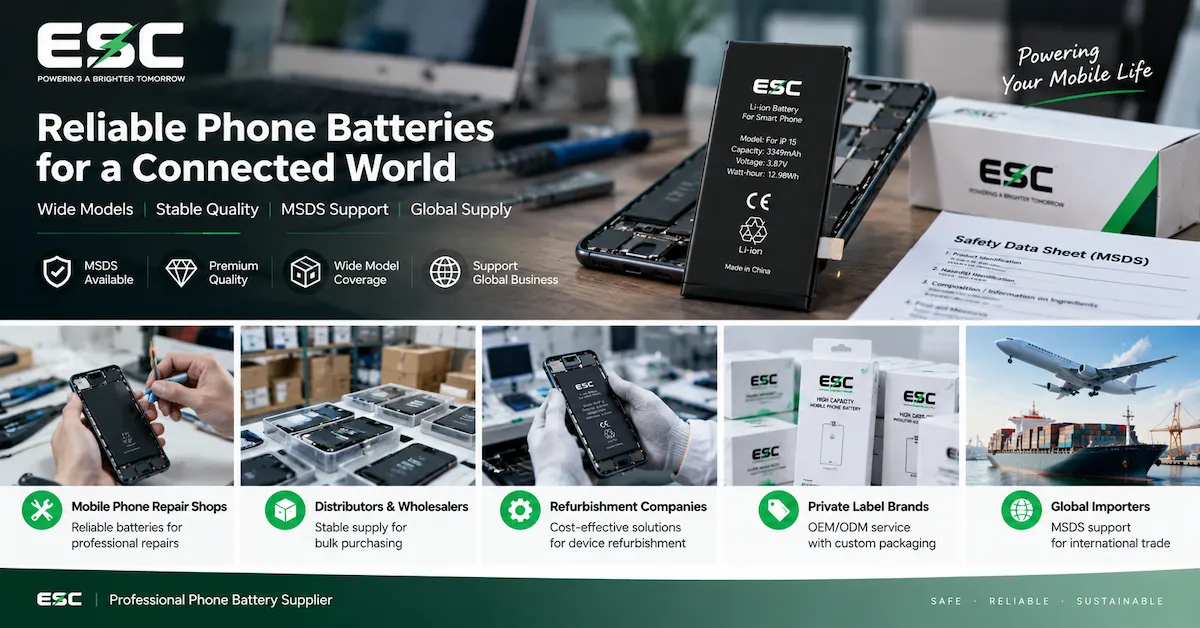
ESC provides mobile phone battery solutions for professional buyers looking for replacement batteries, wholesale supply and customized battery projects.
For B2B buyers, the key question is not:
“Can this supplier provide phone batteries?”
The more important question is:
“Can this supplier help us build a consistent battery product line under our own brand?”
Who Needs Private Label Phone Battery Solutions?
Private label battery programs are suitable for companies that want to create differentiated products instead of only reselling existing inventory.
Mobile Battery Brands
Battery brands need control over product appearance, quality standards and customer experience.
Typical requirements include:
- branded battery labels;
- customized packaging;
- product naming;
- barcode systems;
- warranty information;
- consistent product specifications.
A reliable supplier becomes an extension of the brand's manufacturing capability.
Phone Accessories Distributors
Distributors often want to expand from selling accessories into their own branded battery products.
Private labeling allows distributors to create:
- exclusive product lines;
- stronger customer loyalty;
- improved margin control;
- differentiated market positioning.
Repair Chain Businesses
Large repair networks frequently consume replacement batteries at scale.
Private label cooperation can help them maintain:
- consistent battery quality;
- standardized packaging;
- easier inventory management;
- unified purchasing.
E-Commerce Battery Sellers
Online sellers face strong competition from generic battery products.
A private label strategy helps sellers build differentiation through:
- unique packaging;
- brand recognition;
- product consistency;
- customer trust.
Importers and Regional Brands
Importers often need suppliers that can support:
- multiple phone models;
- local market requirements;
- customized packaging;
- stable replenishment.
A private label manufacturer can help create a complete regional battery product portfolio.
What Is the Difference Between OEM and Private Label Phone Batteries?
OEM and private label are related but focus on different business goals.
| Category | OEM Phone Battery | Private Label Phone Battery |
|---|---|---|
| Main purpose | Produce according to buyer requirements | Build products under buyer brand |
| Customization | Technical customization | Branding + packaging + product customization |
| Label | Optional | Usually required |
| Packaging | May be standard | Usually customized |
| Brand ownership | Buyer controlled | Buyer controlled |
| Product strategy | Manufacturing cooperation | Brand development |
Many private label battery projects use OEM manufacturing as the production foundation.
The manufacturer produces the battery while the buyer controls branding, packaging and market positioning.
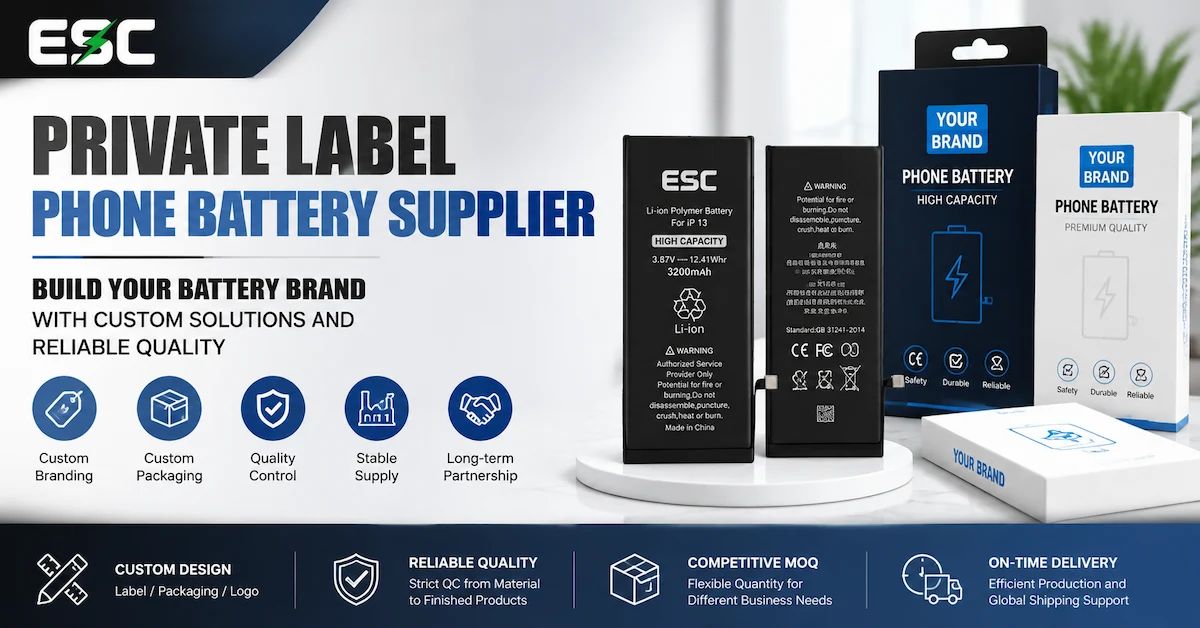
What Can a Private Label Phone Battery Supplier Customize?
A professional supplier should support customization beyond simply printing a logo.
Battery Label Customization
Battery labels may include:
- brand name;
- model information;
- capacity;
- voltage;
- safety information;
- barcode;
- product identification.
Clear labeling helps both customers and distributors identify products correctly.
Packaging Customization
Packaging is an important part of private label development.
Options may include:
- retail boxes;
- instruction materials;
- warranty cards;
- barcode labels;
- shipping cartons.
For online sellers and distributors, professional packaging improves product presentation.
Product Portfolio Customization
A private label brand needs a planned product range.
Instead of offering every possible battery model, brands often start with:
- high-demand smartphone models;
- popular repair models;
- profitable product categories.
Then they expand according to market feedback.
SKU Management Customization
A professional battery brand should create a clear SKU system.
A useful structure includes:
Brand → Phone Model → Battery Reference → Capacity → Supplier Code
This improves:
- inventory management;
- ordering accuracy;
- customer support;
- warehouse efficiency.
How Does Private Label Phone Battery Development Work?
A successful private label project usually follows a structured process.
Step 1: Define Market Requirements
Before production begins, buyers should define:
- target customers;
- phone models;
- sales channels;
- quantity requirements;
- packaging style;
- quality expectations.
Clear requirements help the supplier recommend suitable solutions.
Step 2: Select Battery Models
Product selection should consider:
- market demand;
- repair frequency;
- device popularity;
- replacement trends.
A focused product range is usually easier to manage than an oversized catalog.
Step 3: Confirm Technical Specifications
Each battery model should confirm:
- phone compatibility;
- battery reference;
- capacity;
- voltage;
- dimensions;
- connector type;
- flex structure.
Technical accuracy prevents costly compatibility problems.
Step 4: Sample Testing
Before bulk production, buyers should evaluate samples.
Testing may include:
- physical inspection;
- capacity testing;
- charging performance;
- installation compatibility;
- appearance inspection.
Approved samples become the production reference.
Step 5: Production and Quality Control
During mass production, suppliers should control:
- incoming materials;
- assembly quality;
- battery performance;
- packaging accuracy;
- finished product inspection.
Step 6: Packaging and Delivery
Before shipment, confirm:
- product quantity;
- labels;
- packaging;
- cartons;
- shipping requirements.
How Should Buyers Evaluate Private Label Battery Quality?
Quality is one of the biggest factors affecting a private label brand reputation.
A battery failure does not only create a replacement cost.
It may also cause:
- customer complaints;
- negative reviews;
- warranty claims;
- distributor dissatisfaction.
Battery Specification Verification
Buyers should confirm:
- capacity;
- voltage;
- battery dimensions;
- connector;
- protection circuit;
- compatibility.
Capacity Testing
The printed capacity value should be verified through actual testing.
Professional buyers should compare:
- rated capacity;
- measured discharge capacity;
- sample consistency.
Internal Resistance Testing
Internal resistance can provide useful information about battery consistency.
For private label buyers, the key is not only the value of one battery.
The important factor is whether multiple units from the same batch show stable performance.
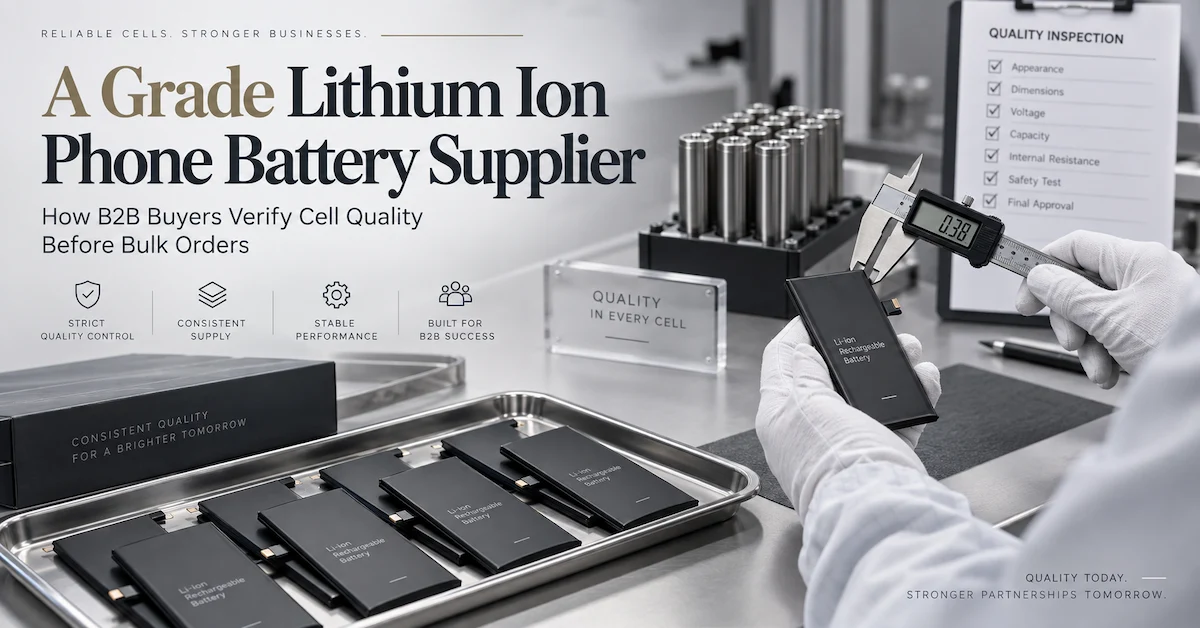
Physical Inspection
Inspect:
- battery appearance;
- flex cable;
- connector;
- insulation;
- labeling;
- packaging.
Batch Consistency
A private label brand depends on repeatable quality.
The supplier should have systems for:
- production tracking;
- quality records;
- defect management;
- batch identification.
Why Packaging Matters for Private Label Phone Batteries?
Packaging is not only protection.
It is part of the customer's perception of the brand.
Professional packaging helps with:
Brand Recognition
Customers can quickly identify your products.
Warehouse Management
Clear labels reduce inventory mistakes.
Distribution Efficiency
Standard packaging helps distributors handle products faster.
Market Trust
Professional presentation increases buyer confidence.
A private label supplier should support both technical products and commercial presentation.
How Can Private Label Buyers Reduce Battery Sourcing Risks?
A structured sourcing process helps reduce problems.
Work With Clear Specifications
Avoid vague requirements.
Provide:
- phone models;
- battery references;
- quantities;
- packaging requirements.
Approve Samples Before Mass Production
Never rely only on supplier descriptions.
Sample approval creates a quality benchmark.
Define Quality Standards
Agree on:
- testing methods;
- inspection requirements;
- acceptable defect levels.
Maintain Production Records
Batch tracking helps identify problems quickly.
Build Long-Term Cooperation
Stable supplier relationships improve:
- communication;
- product consistency;
- production planning;
- inventory management.
What Should Be Included in a Private Label Battery RFQ?
A complete inquiry should include:
Product Information
- phone models;
- battery references;
- required capacity;
- quantity.
Branding Requirements
- logo;
- label design;
- packaging style;
- barcode.
Quality Requirements
- testing standards;
- inspection requirements;
- warranty expectations.
Logistics Information
- destination;
- shipping method;
- required documents.
A detailed RFQ allows suppliers to provide more accurate solutions.
What Makes a Good Private Label Phone Battery Supplier?
Before choosing a supplier, evaluate:
Manufacturing Capability
Can the supplier support long-term production?
Technical Support
Can the supplier help confirm specifications and solve compatibility issues?
Quality Management
Does the supplier have testing and inspection procedures?
Customization Ability
Can the supplier provide:
- labels;
- packaging;
- SKU management;
- OEM support?
Supply Stability
Can the supplier support repeat orders?
A private label brand depends on consistency over time.
FAQ About Private Label Phone Battery Suppliers
What is a private label phone battery supplier?
A private label phone battery supplier manufactures batteries that are sold under the buyer's own brand.
The supplier usually supports battery production, labeling, packaging and quality control according to customer requirements.
What is the difference between OEM and private label batteries?
OEM focuses mainly on manufacturing according to customer specifications.
Private label focuses on creating products under the buyer's brand, including branding and packaging.
Many private label programs use OEM manufacturing processes.
Can private label battery suppliers customize packaging?
Yes.
Private label projects commonly include:
- battery labels;
- retail packaging;
- barcodes;
- cartons;
- product information.
What information should I provide when requesting private label phone batteries?
Provide:
- target phone models;
- battery specifications;
- quantity;
- branding requirements;
- packaging requirements;
- destination market.
This allows the supplier to evaluate the project accurately.
How do I verify a private label battery supplier?
Evaluate:
- sample quality;
- technical capability;
- QC process;
- production consistency;
- packaging capability;
- communication efficiency.
Can private label suppliers support multiple phone brands?
Yes.
Professional battery suppliers often support multiple smartphone battery categories for different markets.
ESC provides mobile phone battery products covering different smartphone replacement battery requirements.
Is private label battery business suitable for wholesalers?
Yes.
Wholesalers can use private labeling to create exclusive product lines, improve brand recognition and build stronger customer relationships.
What is the MOQ for private label phone batteries?
MOQ depends on:
- battery model;
- packaging requirements;
- customization level;
- production requirements.
Buyers should confirm MOQ directly with the supplier based on their project.
Conclusion: Build a Strong Battery Brand With the Right Private Label Partner
Choosing the right private label phone battery supplier is an important step for companies that want to build a sustainable battery business.
A reliable supplier should provide:
- technical support;
- customization capability;
- stable quality;
- professional packaging;
- consistent production;
- long-term cooperation.
Private label success is not only about putting a brand name on a battery.
It requires a complete supply system covering product selection, specifications, testing, quality control and customer experience.
ESC provides customizable mobile phone battery solutions for brands, wholesalers, repair businesses and distributors.
Companies planning a private label battery project can prepare their target models, quantity requirements, packaging ideas and market information, then contact ESC to discuss suitable supply solutions.