
What Should B2B Buyers Expect From an OPPO Battery Supplier?
A reliable OPPO battery supplier should do more than send buyers a price list. For repair centers, refurbishment facilities, wholesalers and private-label brands, the supplier must help control three major risks: wrong-model batteries, inconsistent battery performance and unstable batch quality.
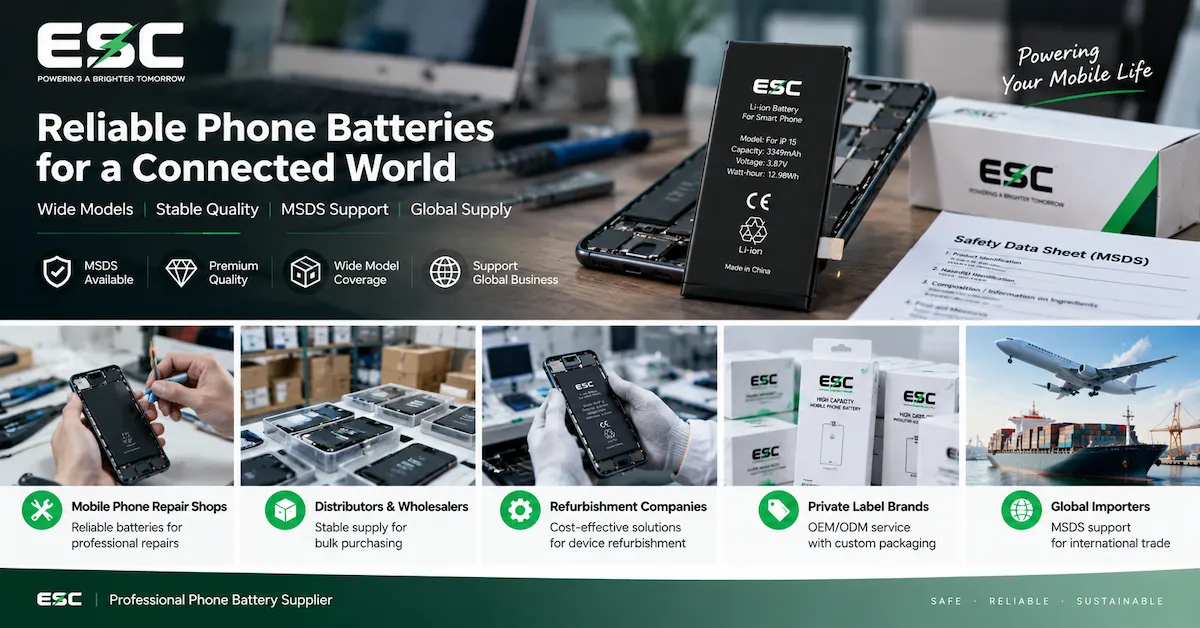
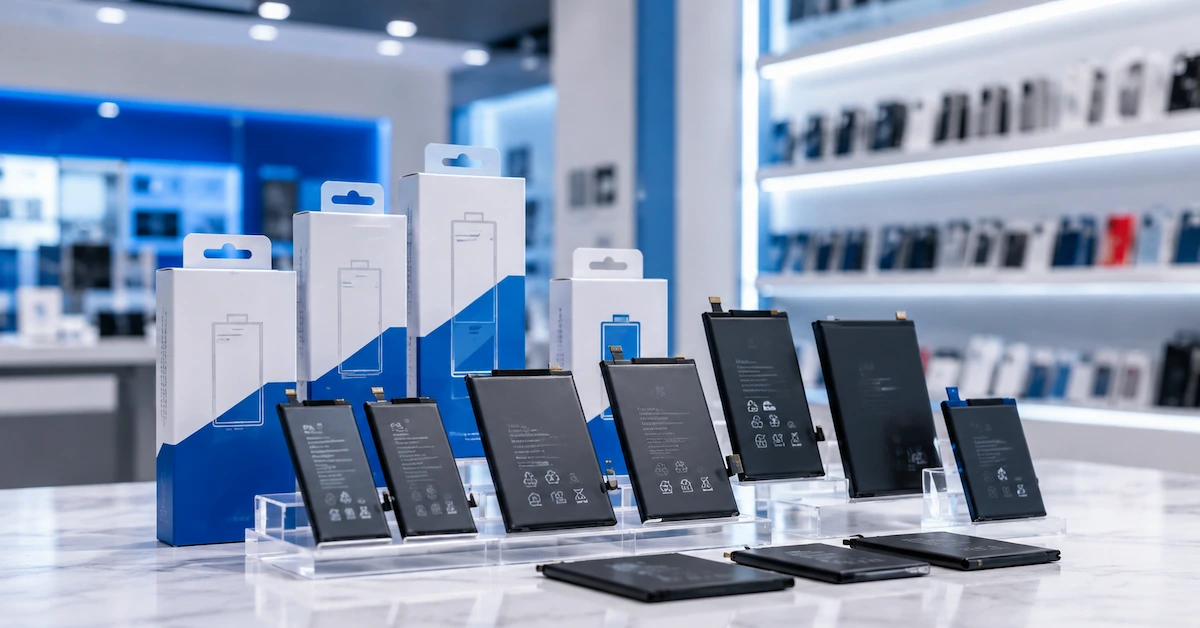
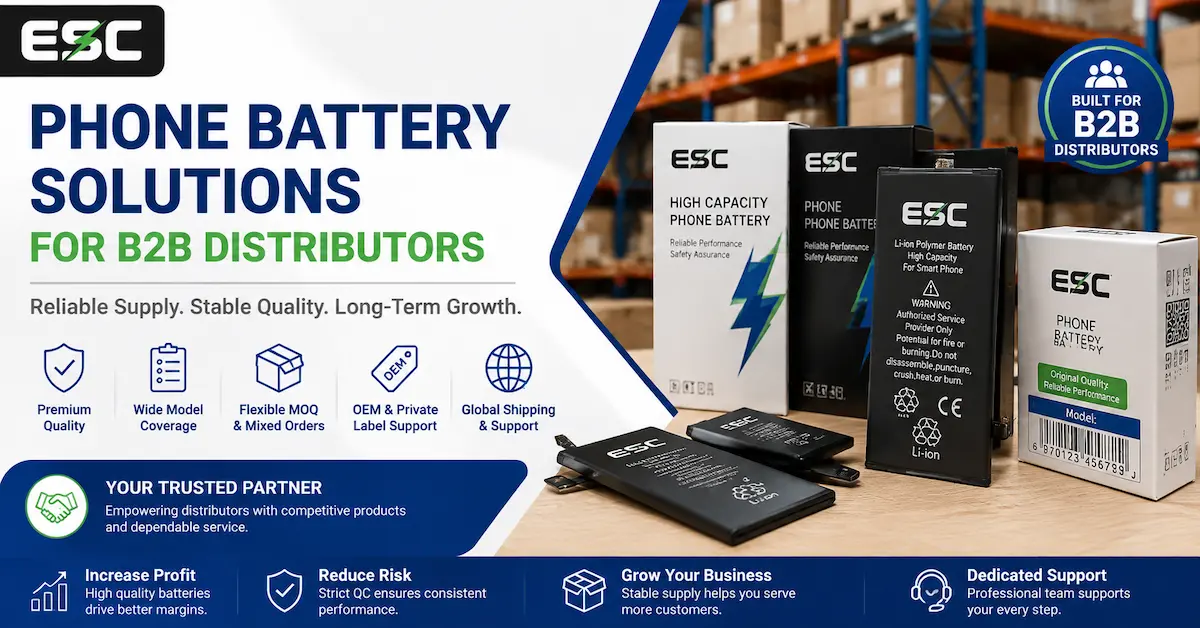
ESC currently lists OPPO among the smartphone brands covered by its mobile phone replacement battery business, alongside iPhone, Samsung, Xiaomi, Huawei and Vivo. Its mobile battery line is positioned for repair centers, refurbishing companies, wholesalers, distributors and private-label projects.
For professional buyers, the real question is therefore not:
“Which supplier has the cheapest OPPO battery?”
It is:
“Which supplier can repeatedly deliver batteries that match the correct device, meet the agreed electrical specification and remain consistent across bulk orders?”
That distinction matters because one battery failure affects more than the component cost. It can create technician rework, customer returns, warranty claims, lost marketplace reviews and damaged distributor relationships.
OPPO's own customer-service channels direct users with battery replacement needs toward professional service centers, reinforcing that battery replacement is a repair operation rather than a simple consumer accessory purchase.
Who Is This OPPO Battery Sourcing Guide For?
Different buyers face different risks when sourcing replacement batteries.
Repair Shops and Repair Chains
Repair shops need batteries that technicians can identify, install and test efficiently.
Their main concerns usually include:
- correct device compatibility;
- connector and flex-cable fit;
- stable charging;
- predictable runtime;
- low repeat-repair rate;
- fast access to common models.
For a repair chain processing many devices every month, even a small compatibility problem becomes an operational problem.
Smartphone Refurbishment Facilities
Refurbishers work with repeated batches rather than occasional repairs.
Their purchasing priorities are therefore more focused on:
- batch consistency;
- standardized incoming inspection;
- repeatable capacity;
- low rework rate;
- predictable fitment;
- reliable replenishment.
A sample that performs well is useful, but it does not prove that future production batches will perform the same way.
Mobile Phone Parts Wholesalers
Wholesalers need broader model coverage and better inventory organization.
They should evaluate:
- fast-moving OPPO battery models;
- model identification;
- mixed-SKU ordering;
- packaging;
- inventory labels;
- replenishment stability;
- after-sales procedures.
Their real product is not just a battery. It is a reliable replacement-parts program that downstream repair shops can reorder.
E-Commerce Parts Sellers
Online sellers are especially sensitive to compatibility mistakes.
An incorrectly listed battery can generate returns even if the battery itself is electrically sound.
For this buyer group, accurate product data, model mapping, packaging and SKU identification are essential.
Private-Label Battery Brands
Private-label buyers need consistent batteries plus a commercially organized product line.
They may also require:
- branded battery labels;
- retail boxes;
- barcodes;
- warning information;
- model identification;
- carton markings;
- long-term SKU planning.
Buyers developing a broader phone-battery line can also review ESC's phone battery manufacturer guide for additional sourcing considerations.
Why OPPO Battery Compatibility Must Be Verified Before Ordering
One of the most expensive mistakes in replacement-battery sourcing is assuming that batteries are interchangeable because the phone names, dimensions or photographs look similar.
Professional buyers should verify the exact battery specification before approval.
Device Model
Start with the complete OPPO phone model rather than a shortened commercial description.
Different generations within the same product family may use different battery structures.
Battery Reference
If the original pack carries a battery code or part reference, record it in the purchasing database.
A useful inventory structure is:
Brand → Phone Model → Battery Reference → Voltage → Capacity → Connector → Supplier SKU
This provides much better traceability than storing products simply as “OPPO Battery.”
Physical Dimensions
Length, width and thickness affect mechanical fit.
A battery that is slightly too thick can create installation difficulty or unwanted pressure inside the device.
Connector and Flex Structure
The connector type, location and flex-cable routing must match the intended device.
This is one reason a product photo alone is not enough for professional model verification.
Electrical Specification
Nominal voltage, rated capacity and the pack's protection configuration should correspond to the intended replacement application.
A professional buyer should therefore approve both mechanical fitment and electrical performance.
Which Battery Specifications Should Buyers Verify?
A serious OPPO battery sourcing specification should contain more than the printed mAh value.
| Item | What to Verify | Purchasing Value |
|---|---|---|
| Phone model | Exact supported device | Reduces model errors |
| Battery reference | Original/reference code | Improves SKU traceability |
| Rated capacity | mAh | Defines expected charge capacity |
| Energy | Wh when available | Helps cross-check specification |
| Nominal voltage | Battery voltage | Electrical compatibility |
| Dimensions | L × W × T | Mechanical fit |
| Connector | Type and position | Installation compatibility |
| Flex cable | Shape and routing | Technician efficiency |
| Internal resistance | Sample/batch readings | Performance consistency |
| Protection circuit | Pack protection design | Electrical protection |
| Capacity test | Measured discharge result | Verifies label claims |
| Aging test | Pre-shipment screening | Helps detect early failures |
| Packaging | Battery/flex protection | Reduces handling damage |
This table is also useful as an RFQ template when comparing several suppliers.
Why Printed Capacity Should Not Be the Only Quality Standard
Battery capacity is important, but the number printed on the label is only a specification claim.
Professional buyers should verify actual performance through controlled sample testing.
A practical inspection can compare:
- rated capacity;
- actual measured discharge capacity;
- voltage behavior;
- charge behavior;
- discharge behavior;
- internal resistance;
- consistency between multiple samples.
This is particularly important when evaluating batteries advertised with unusually high capacity.
The correct B2B approach is:
verify first, approve second, scale third.
A supplier should not be selected because its battery label shows the largest mAh figure.
Why Internal Resistance Matters in Replacement Battery QC
Internal resistance is a useful battery-health and performance indicator.
Research on lithium-ion battery aging consistently links battery degradation with capacity decline and resistance increase. Recent experimental analysis has also treated capacity and resistance together when evaluating lithium-ion cell health.
For B2B sourcing, this means buyers should not compare only capacity.
Internal-resistance variation across multiple samples can provide additional information about cell consistency and batch uniformity.
A useful purchasing question is not:
What is the internal resistance of your best sample?
It is:
How consistent are internal-resistance readings across representative units from the same batch?
For repair and refurbishment businesses, consistency is usually more valuable than one exceptional test unit.
What Role Does the Battery Protection Circuit Play?
A smartphone replacement battery is a complete pack rather than only a lithium-ion cell.
Depending on design, the finished pack can include:
cell + tabs + protection circuit + flex structure + connector + insulation + label or enclosure components.
The protection circuit helps protect the battery pack against abnormal electrical conditions such as overcharge, over-discharge, excessive current or short circuit.
That means buyers should not judge a battery only by the cell brand or printed capacity.
Assembly quality matters too.
A good cell combined with weak welding, inconsistent insulation, damaged flex cables or poor protection-board assembly can still create an unreliable finished product.
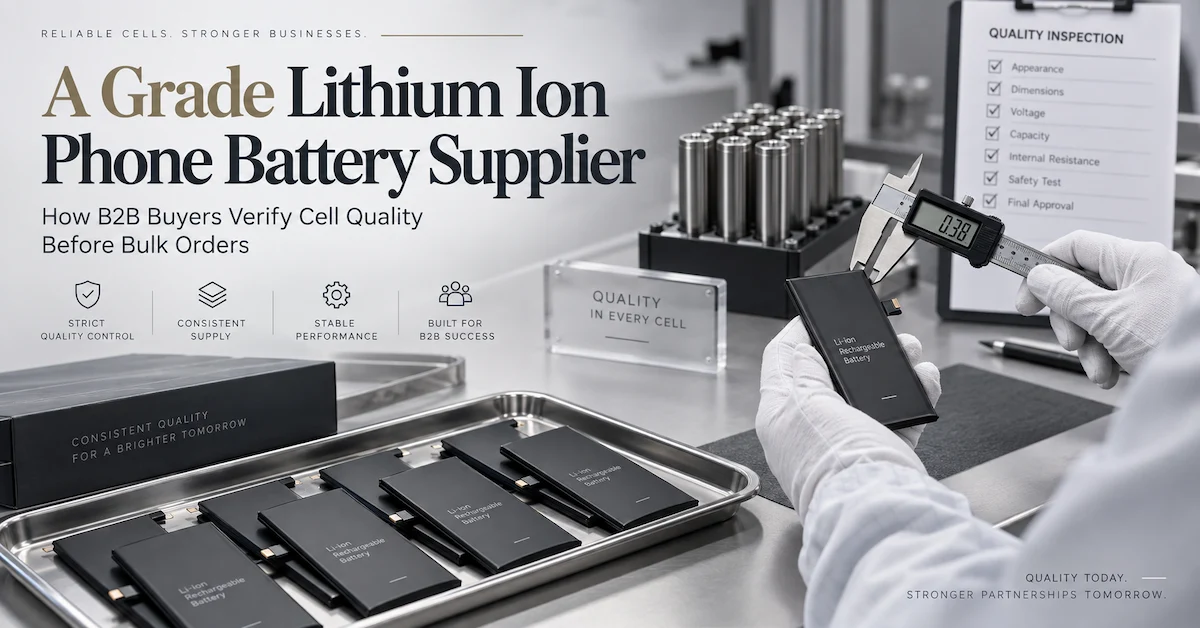
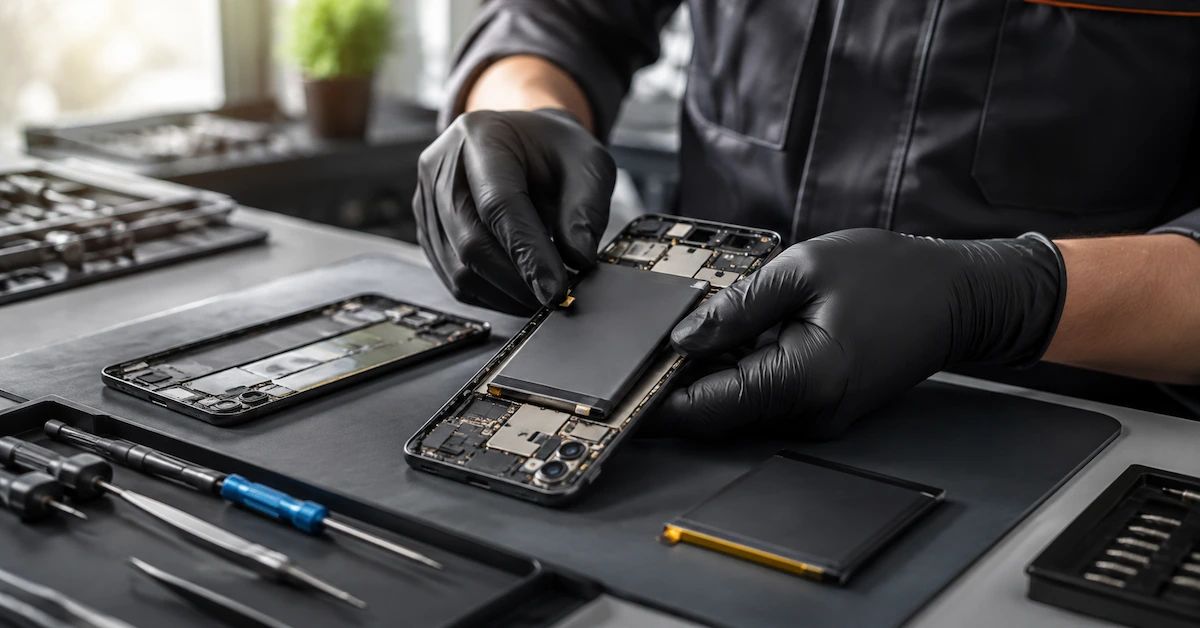
How Should Repair Businesses Test OPPO Battery Samples?
Sample testing should be completed before moving to a larger purchasing volume.
Step 1: Confirm Model Information
Verify:
- OPPO phone model;
- battery reference;
- rated voltage;
- rated capacity;
- connector;
- flex configuration.
Do this before opening a testing program.
Step 2: Perform Visual Inspection
Inspect several batteries for:
- swelling or deformation;
- scratches;
- damaged flex cables;
- connector contamination;
- poor insulation;
- irregular sealing;
- unusual thickness.
The purpose is to identify both individual defects and repeated workmanship problems.
Step 3: Check Voltage
Measure the battery voltage using an appropriate test setup.
More importantly, compare several units to identify abnormal variation within the sample batch.
Step 4: Measure Internal Resistance
Record results across multiple units rather than selecting a single sample.
This provides a clearer picture of batch consistency.
Step 5: Conduct Capacity Testing
Use a controlled charge-discharge procedure to compare measured capacity against the agreed specification.
Buyers should define acceptance criteria before the bulk order rather than after receiving a problematic shipment.
Step 6: Test in Real OPPO Devices
Bench measurements cannot verify every installation issue.
Real-device testing should check:
- connector alignment;
- flex-cable routing;
- physical installation;
- power-on behavior;
- charging;
- standby performance;
- battery-percentage behavior.
OPPO itself maintains service-center and spare-parts support for professional device servicing, which underlines the importance of proper repair procedures when batteries need replacement.
Step 7: Observe Charging and Temperature
Look for abnormal heating or unstable charging behavior during sample evaluation.
If a battery behaves differently from comparable units, investigate before approving the batch.
Step 8: Record Results
For B2B purchasing, test records become useful supplier-management data.
Record:
supplier + SKU + lot + model + capacity result + resistance result + installation result + defects
This gives buyers evidence for future supplier comparison.
Why Batch Consistency Matters More Than One Excellent Sample
A supplier can provide a strong pre-order sample.
The bigger challenge is maintaining the same result during repeated production.
For a wholesaler buying hundreds or thousands of batteries, the key question is:
Will unit 800 behave like unit 8?
That is why supplier evaluation should cover:
- incoming cell control;
- cell grading;
- component consistency;
- assembly processes;
- protection-board installation;
- welding;
- insulation;
- visual inspection;
- electrical testing;
- aging;
- finished-product inspection;
- lot identification.
ESC states that its mobile phone battery business supports strict quality inspection and customized battery supply for professional repair and distribution customers. Exact testing criteria should still be confirmed for the specific OPPO battery project rather than assumed across every SKU.
Low Price vs Total Sourcing Cost
Unit price is easy to compare.
Total cost is harder.
| Cost Area | What a Buyer May Pay |
|---|---|
| Battery purchase | Initial unit price |
| Technician labor | Extra troubleshooting or reinstallation |
| Returns | Reverse logistics and handling |
| Warranty | Replacement batteries and service cost |
| Inventory errors | Wrong SKU / wrong model |
| Customer complaints | Support workload |
| Marketplace returns | Refunds and ratings impact |
| Distributor claims | Commercial relationship risk |
| Brand damage | Long-term private-label cost |
This is why the cheapest quotation can become the most expensive supply source.
A professional buyer should evaluate:
purchase price + defect risk + installation time + claim cost + inventory efficiency.
How Should Wholesalers Plan OPPO Battery Inventory?
Ordering every model in equal quantities is rarely efficient.
Wholesalers can classify SKUs into three groups.
A-Class Models
High-turnover repair models.
These deserve deeper inventory and frequent replenishment.
B-Class Models
Moderate but predictable demand.
Maintain controlled safety stock.
C-Class Models
Long-tail or aging models.
Purchase more flexibly to avoid slow-moving inventory.
A basic wholesale battery database can track:
| Field | Purpose |
|---|---|
| OPPO model | Product identification |
| Battery reference | Compatibility |
| Supplier SKU | Purchasing |
| Monthly sales | Demand |
| Inventory | Stock planning |
| Lead time | Reorder timing |
| Claim rate | Quality tracking |
| Purchase cost | Margin analysis |
This makes supplier selection a data-driven purchasing process rather than a simple catalog comparison.
What Should an OPPO Battery RFQ Include?
A clear RFQ helps the supplier quote accurately and helps the buyer compare offers consistently.
Required Models
Provide exact phone models or battery references whenever possible.
Quantity Per Model
Do not send only the total quantity if the purchase contains many models.
Capacity Requirement
Define standard or project-specific requirements clearly.
Destination Market
The destination can affect labeling, packaging and shipping requirements.
Packaging
State whether you require:
- factory bulk packaging;
- neutral packaging;
- retail packaging;
- private-label packaging.
OEM Requirements
Provide requirements for:
- logo;
- battery label;
- barcode;
- retail box;
- warranty information;
- carton marks.
Sample Plan
Tell the supplier which models should be sampled before final approval.
Quality Criteria
Define the tests you expect rather than asking only whether the supplier has “good quality.”
This makes quotations easier to compare.
What Should Buyers Confirm About Lithium Battery Shipping?
Replacement smartphone batteries are lithium batteries, so international transportation requires proper handling and documentation.
The UN Manual of Tests and Criteria contains subsection 38.3 for lithium cells and batteries; UNECE's current Revision 8 materials also include updates affecting subsection 38.3. Buyers should verify the applicable documentation for the exact battery configuration and shipment instead of assuming one report covers every product.
Professional importers should discuss items such as:
- battery identification;
- applicable UN 38.3 documentation;
- packaging;
- shipment labeling;
- carrier requirements;
- transport mode;
- destination requirements.
For the official framework, buyers can review the UN Manual of Tests and Criteria.
Do not treat transport compliance as a generic supplier badge. Confirm it at the model and shipment level.
What Can Private-Label OPPO Battery Buyers Customize?
OEM battery programs can extend beyond printing a logo.
Battery Labels
A private-label battery may need:
- brand identity;
- battery reference;
- rated capacity;
- voltage;
- warnings;
- barcode;
- SKU information.
Retail Packaging
Packaging can communicate:
- compatible phone model;
- battery reference;
- brand;
- warranty;
- distributor information;
- installation notes.
Warehouse Identification
For multi-model orders, inner boxes and cartons should clearly identify contents.
Good labeling can reduce warehouse errors before the battery ever reaches a technician.
Product-Line Structure
Private-label brands should also decide which OPPO models belong in the initial line.
Starting with strong-demand SKUs and expanding based on sales data is usually more manageable than launching an oversized catalog immediately.
ESC supports customized battery solutions and OEM packaging within its mobile-phone-battery business. Buyers can review ESC's company profile when evaluating broader supplier capabilities.
What Should Buyers Ask an OPPO Battery Supplier Before Ordering?
Before approving a new supplier, ask direct questions.
- Which OPPO models can you currently supply?
- How do you verify phone-model and battery-reference compatibility?
- What capacity specification is used for each model?
- Can you provide sample capacity-test results?
- Is internal resistance checked?
- How are incoming battery cells controlled?
- What finished-battery testing is performed?
- Is aging performed before shipment?
- How are defective units traced to a production lot?
- Can you support mixed-model wholesale orders?
- What OEM label and packaging options are available?
- Which shipment documents can be supplied for the exact battery?
- How are warranty claims handled?
- What information do you need before quoting lead time and MOQ?
The answers reveal much more about a supplier than a price list.
Common OPPO Battery Sourcing Mistakes
Choosing Only by Lowest Price
Unit price does not include rework, claims and lost customers.
Ordering by Phone Name Only
Use exact model and battery-reference information whenever possible.
Trusting Capacity Labels Without Testing
Measured sample results are more useful than printed marketing claims.
Testing Only One Battery
Multiple samples provide better information about consistency.
Ignoring Mechanical Fit
Battery performance is irrelevant if the connector or flex does not install properly.
Approving the Sample but Ignoring Production QC
A successful sample is the beginning of supplier validation, not the end.
Using Vague OEM Requirements
“Add our logo” is not a complete private-label specification.
Assuming Every Battery Uses the Same Compliance Documentation
Confirm documentation for the actual model being shipped.
FAQ About OPPO Battery Suppliers
How do I choose a reliable OPPO battery supplier?
Evaluate the supplier's model-matching process, actual capacity, voltage, internal resistance, connector and flex compatibility, protection circuit, sample testing, batch QC, packaging and after-sales procedure.
For professional buyers, supplier consistency is usually more important than obtaining the lowest initial quotation.
Should repair shops test OPPO replacement batteries before bulk purchasing?
Yes. Sample evaluation should cover physical condition, voltage, capacity, internal resistance, connector fitment, installation and real-device charging behavior.
Multiple samples provide a better indication of batch consistency than a single unit.
What is the difference between an OPPO battery supplier and a general phone-parts trader?
A specialized battery supplier should be able to discuss battery-specific issues such as capacity, voltage, internal resistance, protection circuitry, flex structures, connectors, aging and quality testing.
A general parts trader may primarily focus on availability and price.
Can OPPO replacement batteries be private labeled?
Private-label battery projects can potentially include battery labels, packaging, barcode systems, model identification and carton markings, depending on project requirements and supplier capability.
ESC states that OEM packaging and customized battery solutions are supported within its mobile phone battery business.
How can wholesalers reduce OPPO battery returns?
Start with accurate model mapping, verify battery references, test samples, create clear SKU data, inspect representative production units and track claim rates by SKU and supplier.
Many avoidable sourcing problems begin with poor compatibility data rather than purchasing price.
Why should internal resistance be checked?
Capacity and resistance are both useful indicators when evaluating lithium-ion battery performance and degradation. Published battery research shows that resistance changes and capacity changes can be closely associated during aging.
For sourcing, the practical value is comparing consistency across batteries rather than relying on a single reading.
Does a higher-capacity OPPO battery automatically mean better quality?
No. Capacity should be technically credible for the cell design and confirmed through testing.
A larger number on the battery label is not sufficient evidence of better performance.
What information should I send when requesting an OPPO battery quotation?
Send the target OPPO models or battery references, quantity per model, destination market, packaging requirements, OEM requirements and sample needs.
This helps the supplier provide a more accurate proposal.
Does ESC supply OPPO replacement batteries?
ESC's current mobile phone battery category states that it supplies replacement batteries for OPPO and other major smartphone brands for repair centers, refurbishers, wholesalers, distributors and private-label projects.
Buyers should contact ESC with their exact OPPO model list to confirm current availability, specifications, samples and project terms.
Conclusion: Choose an OPPO Battery Supplier by Compatibility, Consistency and Commercial Risk
Choosing an OPPO battery supplier is not simply a search for the lowest battery price.
Repair shops need accurate fitment. Refurbishers need repeatable batches. Wholesalers need manageable SKUs and stable replenishment. Private-label brands need product quality that can support their own reputation.
Before approving a bulk order, verify the phone model, battery reference, dimensions, connector, flex structure, voltage, capacity, internal resistance, protection design and real-device fitment.
Then evaluate how the supplier manages samples, production quality, packaging, traceability, OEM requirements and after-sales claims.
ESC supplies mobile phone replacement batteries for professional repair, refurbishment, wholesale, distribution and private-label applications, with OPPO included in its stated smartphone brand coverage.
If you are sourcing OPPO batteries, send your target models, battery references, quantities, destination and packaging requirements through the ESC contact page to discuss model availability and sample evaluation.