
What Should Brands Expect From an OEM Phone Battery Manufacturer?
An experienced OEM phone battery manufacturer should provide more than standard replacement batteries. For brands, wholesalers, repair chains and distributors, OEM battery sourcing involves product customization, technical verification, quality control, packaging development and stable production capability.
The right manufacturer helps buyers transform battery requirements into a reliable commercial product, including:
- compatible battery models;
- customized labels;
- packaging solutions;
- quality inspection standards;
- production consistency;
- supply chain support.
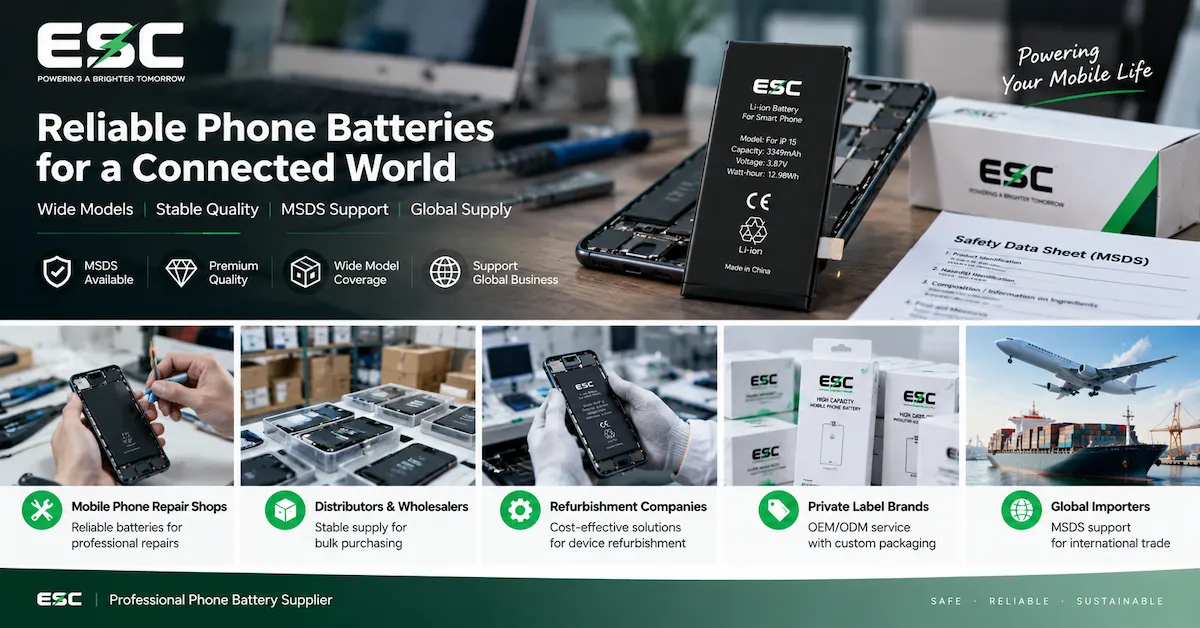
ESC provides mobile phone replacement batteries for professional repair, wholesale, distribution and customized battery projects, supporting buyers who need different smartphone battery models for commercial applications.
For B2B buyers, selecting an OEM supplier is not simply about finding a factory that can produce batteries.
The more important question is:
Can the manufacturer consistently deliver batteries that meet technical requirements, quality expectations and market needs?
Who Needs an OEM Phone Battery Manufacturer?
Different customer groups require different levels of customization and supply support.
Smartphone Brands
Phone battery brands and accessory companies often need customized products instead of generic replacement batteries.
Typical requirements include:
- brand labels;
- customized packaging;
- product specifications;
- barcode systems;
- warranty information;
- consistent SKU management.
For these companies, the battery is part of their product identity.
A stable OEM partner helps maintain consistent product quality across different markets.
Mobile Phone Wholesalers
Wholesalers usually focus on:
- product availability;
- competitive pricing;
- multiple models;
- inventory efficiency;
- reliable replenishment.
An OEM phone battery manufacturer can help wholesalers develop their own battery product line instead of only reselling third-party products.
Repair Chains
Repair businesses need batteries that technicians can install quickly and confidently.
Their main concerns include:
- correct compatibility;
- stable capacity;
- connector accuracy;
- low failure rates;
- consistent batches.
For repair networks operating multiple locations, supplier consistency directly affects service efficiency.
Refurbishment Companies
Refurbishers purchase batteries in volume and need predictable performance.
Important factors include:
- batch stability;
- testing procedures;
- production traceability;
- low replacement rates;
- reliable delivery.
A battery supplier that only provides attractive samples but cannot maintain production quality creates operational risk.
Private Label Battery Companies
Private-label brands need both manufacturing capability and commercial support.
They may require:
- customized battery labels;
- retail packaging;
- product naming;
- barcode management;
- carton design;
- market-specific information.
A capable OEM manufacturer helps customers build a complete battery product portfolio.
What Can an OEM Phone Battery Manufacturer Customize?
OEM battery manufacturing is not limited to adding a logo.
A professional manufacturer may support customization in several areas.
Battery Label Customization
Battery labels can include:
- brand name;
- model number;
- capacity;
- voltage;
- battery warnings;
- barcode;
- production information.
Clear labeling improves warehouse management and customer recognition.
Packaging Customization
OEM packaging may include:
- retail boxes;
- instruction materials;
- warranty cards;
- barcode labels;
- shipping cartons;
- private brand designs.
Packaging is especially important for distributors and online sellers because it affects product presentation.
Product Selection Customization
Different customers may need different battery portfolios.
For example:
A repair chain may focus on fast-moving smartphone models.
A distributor may require wider brand coverage.
A private-label company may start with selected high-demand models.
A flexible OEM supplier should help customers plan suitable product ranges.
Technical Specification Customization
Battery requirements may include:
- capacity;
- voltage;
- battery dimensions;
- connector type;
- flex cable structure;
- protection circuit;
- packaging requirements.
Each battery model should be evaluated individually rather than applying one specification to all products.
How Does OEM Phone Battery Development Work?
A professional OEM battery project normally follows a structured process.
Requirement Confirmation
The first step is defining the product requirements.
Buyers should provide:
- target phone models;
- battery references;
- expected quantity;
- destination market;
- packaging requirements;
- branding requirements.
Clear requirements reduce communication problems during development.
Sample Development
Before mass production, buyers should evaluate samples.
Sample testing should include:
- physical appearance;
- battery dimensions;
- connector compatibility;
- capacity;
- charging performance;
- installation fitment.
A sample approval process creates a reference standard for future production.
Testing and Validation
Professional battery validation should consider:
- actual capacity;
- voltage;
- internal resistance;
- charging behavior;
- discharge performance;
- device compatibility.
The goal is not only to confirm one battery.
The goal is to confirm that the product meets commercial requirements.
Mass Production
After sample approval, production should follow defined specifications.
Important production controls include:
- incoming material inspection;
- assembly consistency;
- protection circuit inspection;
- finished-product testing;
- batch identification.
Packaging and Delivery
Before shipment, OEM manufacturers should confirm:
- product quantity;
- packaging condition;
- labeling accuracy;
- shipping documentation;
- customer requirements.
What Quality Control Should an OEM Phone Battery Manufacturer Provide?
Quality control is one of the most important differences between a professional manufacturer and a simple trading supplier.
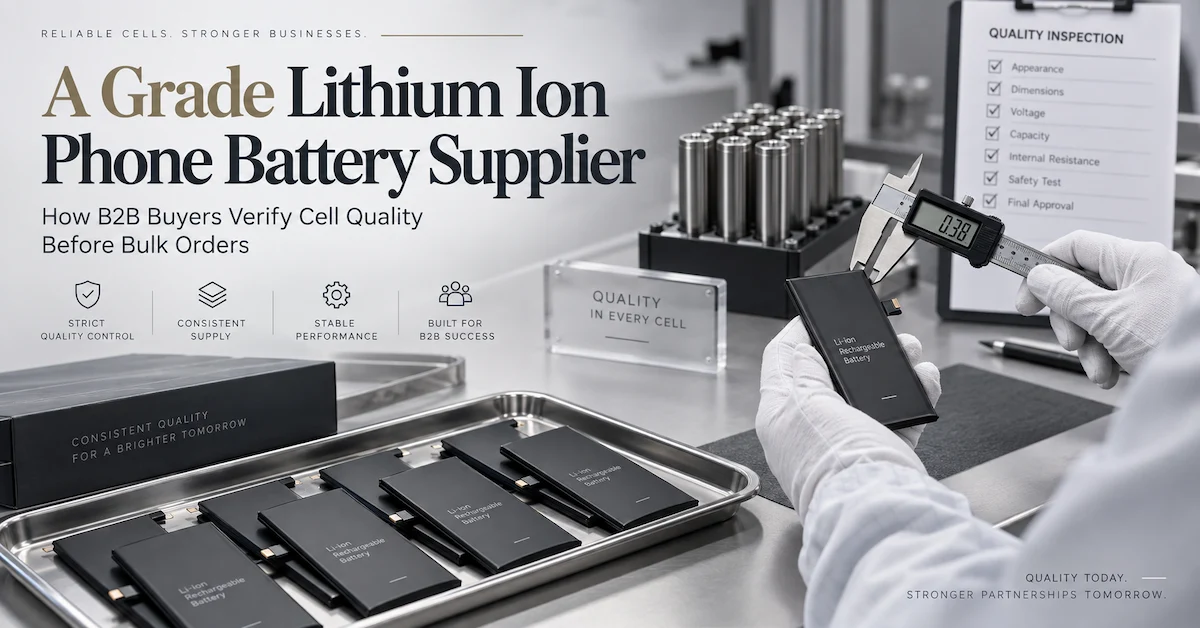
A complete QC system may include:
Incoming Material Inspection
Check:
- battery cells;
- protection components;
- connectors;
- cables;
- packaging materials.
Assembly Inspection
Monitor:
- welding quality;
- cable connection;
- insulation;
- battery structure;
- label placement.
Electrical Testing
Evaluate:
- voltage;
- capacity;
- charging;
- discharge behavior;
- internal resistance.
Finished Product Inspection
Before shipment, inspect:
- appearance;
- dimensions;
- labeling;
- packaging;
- quantity;
- documentation.
For B2B buyers, quality control should be part of supplier evaluation rather than an after-sales solution.
Why Battery Specifications Matter in OEM Projects
One common sourcing mistake is starting customization before confirming the technical foundation.
Every OEM battery project should define:
| Specification | Importance |
|---|---|
| Phone model | Ensures compatibility |
| Battery reference | Avoids incorrect matching |
| Capacity | Defines performance |
| Voltage | Ensures electrical compatibility |
| Dimensions | Ensures installation |
| Connector | Prevents assembly issues |
| Flex structure | Affects device fitting |
| Protection circuit | Supports safety |
| Packaging | Supports market requirements |
Without clear specifications, customization can create unnecessary cost and delays.
OEM Phone Battery Manufacturer vs Regular Supplier
| Factor | Regular Supplier | OEM Manufacturer |
|---|---|---|
| Product selection | Existing catalog | Custom product support |
| Branding | Limited | Label customization |
| Packaging | Standard | Customized packaging |
| Product development | Limited | Sample development |
| QC process | Basic inspection | Defined quality system |
| SKU planning | Buyer-managed | Cooperation support |
| Long-term supply | Variable | Production planning |
For companies building a battery business, OEM cooperation usually provides more control over product positioning and supply stability.
How Should Buyers Evaluate an OEM Phone Battery Manufacturer?
Before selecting a supplier, buyers should evaluate several areas.
Manufacturing Capability
Ask:
- What battery categories can you produce?
- Which smartphone brands are supported?
- Can you handle repeated bulk orders?
Technical Capability
Confirm:
- testing methods;
- battery specifications;
- sample process;
- engineering support.
Quality Management
Review:
- inspection process;
- defect handling;
- batch tracking;
- quality documentation.
Customization Capability
Check:
- labels;
- packaging;
- barcodes;
- private branding.
Supply Capability
Understand:
- MOQ;
- lead time;
- production capacity;
- reorder process.
How Can OEM Buyers Reduce Battery Sourcing Risks?
A professional sourcing process should include several steps.
Define Requirements Clearly
Avoid vague requests such as:
“Need phone batteries.”
Provide:
- models;
- quantities;
- specifications;
- packaging needs.
Approve Samples
Do not start large production without testing.
Confirm Quality Standards
Agree on:
- acceptance criteria;
- testing methods;
- inspection requirements.
Track Production Batches
Batch information helps identify problems quickly.
Build Long-Term Cooperation
Battery supply is not only a single purchase.
A stable supplier relationship improves:
- product consistency;
- communication efficiency;
- inventory planning.
OEM Phone Battery Manufacturing for Private Label Brands
Private-label battery brands need a supplier that understands both manufacturing and market requirements.
A successful private-label program usually includes:
Product Strategy
Select battery models based on:
- market demand;
- repair trends;
- customer needs.
Branding
Develop:
- battery labels;
- packaging style;
- product naming;
- barcode system.
Quality Consistency
Maintain:
- approved samples;
- production standards;
- inspection records.
Market Support
Ensure products are easy for distributors and customers to identify.
ESC's company information provides additional information about its battery supply capabilities and business positioning.
What Should Buyers Include in an OEM Battery Inquiry?
A professional RFQ should include:
- target smartphone models;
- battery references;
- quantity;
- destination country;
- packaging requirements;
- private-label requirements;
- expected delivery schedule;
- quality requirements.
A detailed inquiry helps manufacturers provide more accurate solutions.
FAQ About OEM Phone Battery Manufacturers
What is an OEM phone battery manufacturer?
An OEM phone battery manufacturer produces batteries according to customer requirements, including specifications, labels, packaging and product standards.
Unlike simple distributors, OEM manufacturers support product customization and long-term supply cooperation.
Can OEM battery manufacturers customize labels and packaging?
Yes.
OEM projects may include customized:
- battery labels;
- retail packaging;
- barcodes;
- carton markings;
- product information.
What information should I provide when requesting OEM phone batteries?
Provide:
- phone models;
- battery references;
- quantity;
- technical requirements;
- packaging requirements;
- destination market.
This helps the manufacturer evaluate feasibility and provide accurate pricing.
How do OEM buyers verify battery quality?
Buyers should evaluate:
- sample performance;
- capacity testing;
- voltage;
- internal resistance;
- charging behavior;
- device compatibility;
- batch consistency.
What is the difference between OEM and private label batteries?
OEM focuses on manufacturing according to customer requirements.
Private label focuses on selling products under the customer's brand.
Many private-label projects use OEM manufacturing as the production foundation.
Can OEM manufacturers supply multiple phone battery models?
Yes.
Professional buyers often need multiple smartphone battery models to support repair businesses, distributors or retail channels.
ESC provides different mobile phone battery solutions for buyers requiring multiple replacement battery categories.
Conclusion: Choosing the Right OEM Phone Battery Manufacturer
Selecting an OEM phone battery manufacturer is a strategic decision for brands, wholesalers, repair businesses and distributors.
The right supplier should provide:
- reliable battery specifications;
- customization support;
- professional quality control;
- stable production;
- packaging solutions;
- long-term cooperation capability.
A successful OEM battery project depends on more than manufacturing.
It requires accurate specifications, effective testing, clear communication and consistent quality management.
ESC provides OEM-oriented mobile phone battery solutions for businesses looking for replacement battery supply, customization and wholesale cooperation.
For OEM phone battery projects, buyers can prepare their target models, quantities, packaging requirements and market information, then contact ESC to discuss available solutions.