
What Should a Phone Battery Supplier with UN38.3 Provide?
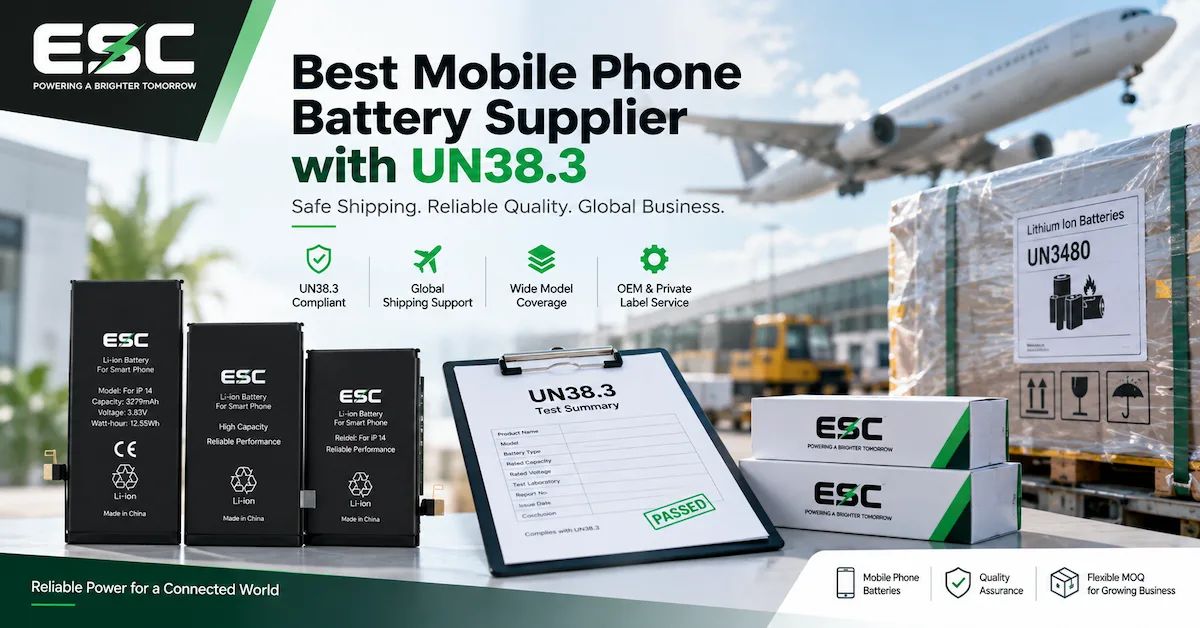
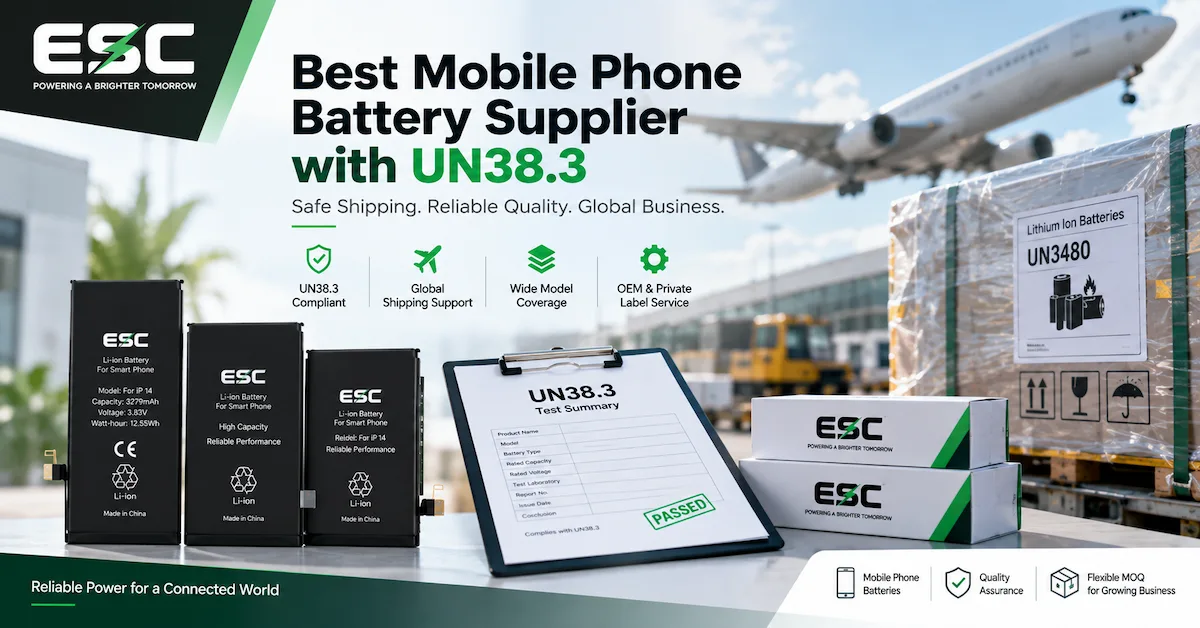
A phone battery supplier with UN38.3 documentation should be able to connect the product you order with the tested design described in its supporting records. Start by requesting the applicable test summary, the battery specification and a clear relationship between the supplier’s model number and your purchasing SKU. Then review production consistency, packaging and shipment arrangements separately. A certificate image on a website is not enough to establish that every battery configuration in a mixed order is covered. ESC’s shipping-document terms identify UN38.3 test summaries among the documents that may be available, depending on the product and shipping method. Confirm availability and applicability for the selected models before placing an order rather than treating a general documentation statement as approval for the entire catalog.
Which Buyers Benefit Most from Model-Specific Document Control?
For an importer, the priority is linking purchased batteries to documents that can be reviewed by logistics providers and downstream customers. For a distributor managing many stock-keeping units, the priority is keeping each model identifiable through mixed deliveries and repeat orders. Repair chains and refurbishment businesses should connect document control with the battery configuration approved for their installation process. Private-label brands also need a reliable relationship between their own product codes and the manufacturer’s design identifiers. ESC’s mobile phone battery portfolio serves these professional purchasing applications across multiple smartphone brands. This guide focuses on sourcing new aftermarket replacement batteries; it is not a procedure for shipping damaged batteries, managing recycling consignments or purchasing genuine device-brand service parts.
Understand What UN38.3 Testing Establishes—and What It Does Not
UN38.3 refers to subsection 38.3 of the UN Manual of Tests and Criteria, which sets out design-type tests for lithium cells and batteries. The test series includes altitude simulation, thermal testing, vibration, shock, external short circuit, impact or crush, overcharge and forced discharge; the applicable combination depends on the cell or battery type. These are defined laboratory tests, not demonstrations for purchasing staff to reproduce. Their purpose is different from verifying everyday runtime, installation compatibility or every unit in a production batch. Consequently, transport-test evidence should not be presented as proof of superior capacity, original-part status or unrestricted shipment acceptance. ESC’s cell-versus-finished-battery sourcing guide likewise emphasizes matching transport evidence to the supplied design and reviewing application requirements separately.
Request a Test Summary, Not Just a Certificate Image
Ask your phone battery supplier with UN38.3 documentation for the test summary specified in paragraph 38.3.5 of the UN Manual of Tests and Criteria. The summary identifies the relevant product and testing information; the full laboratory report is a separate document containing more detailed evidence. A safety data sheet, sometimes called an MSDS, is not a substitute for that summary. The required summary elements are also reproduced in PHMSA’s Lithium Battery Test Summaries, revised July 2024. The table below groups those elements into a purchasing review format; the questions in the final column are recommended buyer checks, not additional mandatory summary fields.
| Review area | Information to identify | Buyer’s verification question |
|---|---|---|
| Manufacturer | Applicable cell, battery or product manufacturer and contact details | Can the supplier explain this entity’s relationship to the offered product? |
| Testing laboratory | Laboratory name and contact information | Is there an identifiable organization to contact about unclear records? |
| Report reference | Unique test-report number and report date | Can the document be distinguished from reports for other designs? |
| Battery identity | Type, model number and physical description | Does the description correspond to the battery being purchased? |
| Physical and energy data | Mass and watt-hour rating, or applicable lithium-content information | Are these consistent with the supplied design and specification? |
| Test results | Tests conducted and their pass/fail results | Are applicable tests and outcomes clearly identified? |
| Assembly provisions | Reference to assembled-battery testing requirements, where applicable | Has the supplied construction been considered within the stated scope? |
| Standard reference | Manual edition and applicable amendments | Is the testing basis identifiable? |
| Responsible person | Name and title of the responsible person | Is responsibility for the information stated? |
Match the Tested Design to the Battery You Will Receive
Create a documented chain from your purchase-order SKU to the supplier’s battery model, its approved specification and the relevant test summary. These identifiers do not always have to be identical, but their relationship should be explainable without guesswork. A private-label product code, for example, may differ from the manufacturer’s internal model number. Ask for a written cross-reference rather than assuming that a familiar phone name proves coverage. Review the stated capacity, nominal voltage, energy, physical construction and included electronics alongside that identification. For cell-only purchases, confirm exactly what the document covers before assuming it also supports your completed assembly. The decisive question is not whether the file contains “UN38.3,” but whether its scope can be connected to the actual product configuration.
Compare Real Battery Specifications Before Combining Models
ESC’s published iPhone 11 and iPhone 12 / 12 Pro offerings illustrate why a mixed-model order needs individual product identification. The values below come from the linked product pages and should be reconfirmed in the quotation and approved specification. They are not independently measured results, and the product listings do not replace a reviewed test summary.
| Comparison item | iPhone 11 replacement battery | iPhone 12 / 12 Pro replacement battery |
|---|---|---|
| Product reference | ESC iPhone 11 battery | ESC iPhone 12 / 12 Pro battery |
| Published capacity | 3110mAh | 2815mAh |
| Published nominal voltage | 3.83V | 3.83V |
| Published energy | Approximately 11.91Wh | 10.78Wh |
| Published positioning | Original-capacity aftermarket replacement | Aftermarket replacement with diagnosable functionality |
| Documentation review | Request coverage for the selected iPhone 11 configuration | Request coverage for the selected iPhone 12 / 12 Pro configuration |
| Purchasing control | Keep the approved SKU, configuration and document relationship identifiable | Do not assume coverage solely because nominal voltage matches another model |
Keep Capacity Verification Separate from Document Verification
Matching a battery’s description to a test summary is a document check; confirming that supplied batteries meet the agreed capacity is a performance check. Neither should replace the other. For sample approval, request a defined capacity-test method, relevant conditions, acceptance criteria and records for the samples evaluated. Also confirm dimensions, connector orientation, flex-cable fit and the functions important to your repair workflow. Use nominal voltage and capacity when checking whether an energy value is arithmetically consistent, but ask the supplier to resolve discrepancies rather than changing a label yourself. A higher-capacity option should have its own clearly identified specification and an assessment of applicable documentation. Do not transfer approval from a standard-capacity product simply because both products are advertised for the same phone.
Review Components, Workmanship and Production Quality
A phone battery supplier with UN38.3 evidence still needs a credible method for reproducing the approved product. Request control of the cell model, protection electronics, flex cable, connector, insulation and other critical components. Ask how substitutions are authorized and how assembly inspections connect to production batches. ESC describes incoming inspection, cell grading, capacity testing, battery-management-system checks, charging and discharging, aging and final inspection in its quality-control service information. Use that process description as the starting point for requesting records relevant to your order, not as a substitute for those records. Specify which checks are routine production inspections and which are sample-based evaluations. Transport type testing should not be confused with a claim that every saleable battery undergoes the complete UN38.3 test sequence.
Confirm the Shipping Configuration Before Booking Freight
Battery design evidence and shipment preparation answer different questions. IATA’s 2026 Battery Guidance Document distinguishes lithium-ion batteries shipped alone under UN3480 from batteries packed with or contained in equipment under UN3481. A box of replacement batteries should not be treated as a shipment of phones merely because the batteries are intended for phones. Before booking, have appropriately qualified dangerous-goods personnel confirm the classification, applicable packing instruction, state-of-charge conditions, quantity limits, markings, documentation and carrier acceptance. ESC’s shipping and delivery terms also explain that available methods depend on the product, packaging, destination, carrier and transport documentation. Treat this article as a procurement guide, not a complete shipping instruction. A test summary alone does not establish that a particular consignment is ready for transport.
Approve Protective Packaging as Well as Retail Presentation
For a packaging review, ask how the proposed arrangement prevents contact-related hazards, unwanted movement and mechanical damage during the planned distribution process. Examine an assembled sample rather than approving only a printed layout. Model labels, carton quantities and packing-list entries should remain consistent when different batteries share a shipment. Have the transport packaging assessed against the applicable shipment requirements; a branded retail box is not automatically an adequate transport package. ESC’s custom phone battery packaging guide provides a useful framework for connecting battery specifications, labels, inserts and carton identification. Include your downstream handling plan in the discussion, especially when a distributor will split master cartons into smaller orders. Agree who reviews those later shipping configurations instead of assuming the original arrangement covers them.
Control OEM Branding and Engineering Changes Differently
Separate a branding change from a change to the battery design. Adding your logo or introducing a new retail SKU calls for accurate identification and traceability. Changes to the cell, protective devices, materials, electrical characteristics or construction require a technical assessment of the existing test scope. IATA’s 2026 guidance, referring to UN Manual paragraph 38.3.2.2, identifies changes that can require renewed design-type testing. Do not assume every cosmetic change requires retesting, or that every engineering change is covered by the previous report. Request the manufacturer’s documented assessment before approving the revised product. For an OEM project, retain the approved specification, artwork, manufacturer-model cross-reference and document revision together. This makes it easier to distinguish a new commercial label from a genuinely different battery design.
Agree on MOQ, Capacity and a Document-Ready Delivery Schedule
When comparing a phone battery supplier with UN38.3 support, ask for separate confirmation of minimum quantities, production availability and documentation readiness. A small trial order should not bypass the same model-identification review used for a bulk order. Likewise, “in stock” should not be interpreted as “all documents and shipment arrangements have been reviewed.” Request a schedule covering samples, specification approval, packaging approval, production completion and shipment preparation. ESC discusses mixed-model purchasing in its low-MOQ phone battery sourcing guide, but current terms should be confirmed for the requested model mix. For cost comparison, separate the product price from sampling, packaging development, any additional testing, freight and agreed destination charges. Compare offers against the same approved scope rather than treating the lowest unit price as the lowest completed-order cost.
Use Three Approval Gates for Bulk and Repeat Orders
Organize procurement around three decisions. Document approval confirms that each ordered model can be connected to identifiable, applicable test evidence; unresolved discrepancies remain open rather than being replaced by a general sales assurance. Product approval confirms the selected configuration through agreed sample and production-quality checks. Shipment approval confirms that the actual contents, packaging, paperwork and logistics arrangements have been reviewed by the responsible parties. Record who makes each decision and what evidence is required. For repeat orders, check whether the battery design, component sources, model identifiers or packaging have changed before reusing the previous approval file. A document showing an unrelated model, unexplained energy values or missing identifying information is a reason to pause approval and request clarification—not a problem to defer until the shipment reaches a warehouse.
Prepare a Model-Specific Inquiry for ESC
ESC’s company profile describes replacement-battery supply, mixed-model purchasing, OEM branding and documentation support for applicable products. To turn those services into a usable quotation, provide the device models, original battery references where available, required capacity and configuration, quantity per SKU, target market, packaging requirements and proposed transport method. Ask which UN38.3 test summaries are available for the selected designs and how your order codes will map to them. State whether you need neutral packaging or a private-label range, and identify any carrier or customer documentation requirements already known. This gives the discussion a defined product and shipment scope without assuming that every catalog item shares the same documentation, MOQ or delivery conditions.
Frequently Asked Questions
Is UN38.3 a company-wide battery certification?
No. UN38.3 concerns tests applicable to cell and battery design types. Evaluate the evidence for the product being ordered rather than treating a company-level statement or website logo as confirmation that every model and customization is covered.
Is an MSDS the same as a UN38.3 test summary?
No. They serve different purposes. A safety data sheet does not replace the design-testing information required in a UN38.3 test summary. Request the applicable summary explicitly, and clarify why any additional document is being requested.
Must every battery model have a separate test-summary file?
Not necessarily. IATA’s 2026 guidance allows multiple products in one summary when the required information is included. The important purchasing check is whether every model in your order is clearly covered, not whether there is one PDF per SKU.
Does a test summary need to accompany every shipment as a paper copy?
Not universally. IATA’s guidance distinguishes making the summary available from including a paper copy with every consignment. Confirm how the document can be retrieved and what your carrier or customer needs before dispatch.
Does a UN38.3 test summary expire after one year?
IATA’s guidance does not assign a fixed validity period when the design remains unchanged in a way that would require retesting. Review design continuity, the testing basis and applicable requirements rather than accepting or rejecting a document solely by its age.
Can a cell test summary cover a finished phone replacement battery?
Coverage depends on the tested design and supplied configuration. Under the UN framework, a single-cell product may be treated as a cell despite being marketed as a battery. Ask the manufacturer or laboratory to confirm applicability; neither automatic acceptance nor automatic rejection is appropriate.
Does UN38.3 evidence guarantee that a battery will fit a phone?
No. Confirm mechanical fit, connector and flex arrangement, electrical specifications and relevant device functions separately. Use an approved sample and written specification for compatibility decisions rather than relying on transport-test documentation.
Can I use the same paperwork after changing capacity or protection electronics?
Do not assume so. Request an assessment of whether the revised configuration remains within the tested scope or requires further testing. Record the outcome before approving production, especially when the same sales name will be retained.
Does a phone battery supplier with UN38.3 guarantee express delivery?
No. Shipment acceptance depends on the actual batteries, packaging, route, applicable rules and carrier conditions. Confirm a suitable service and completed shipment review before promising a delivery date to your own customer.
Can damaged or swollen batteries be returned using the original outbound arrangements?
Do not assume that new-product shipping arrangements apply to a damaged return. Stop using the affected product, obtain supplier authorization and seek qualified guidance on its condition and permitted return or disposal route. Do not place it into an ordinary return parcel.
Conclusion
Choosing a phone battery supplier with UN38.3 documentation means checking the relationship between the tested design, the approved product and the shipment you intend to receive. Start with identifiable test summaries, verify coverage against each SKU, and keep capacity testing, production quality and logistics approval as separate decisions. For private-label and repeat orders, preserve that relationship through controlled specifications, clear labels and documented change reviews. Contact ESC with your phone battery model list and documentation requirements to discuss applicable products, available test summaries, sample arrangements and a quotation aligned with your quantities, packaging and destination market.