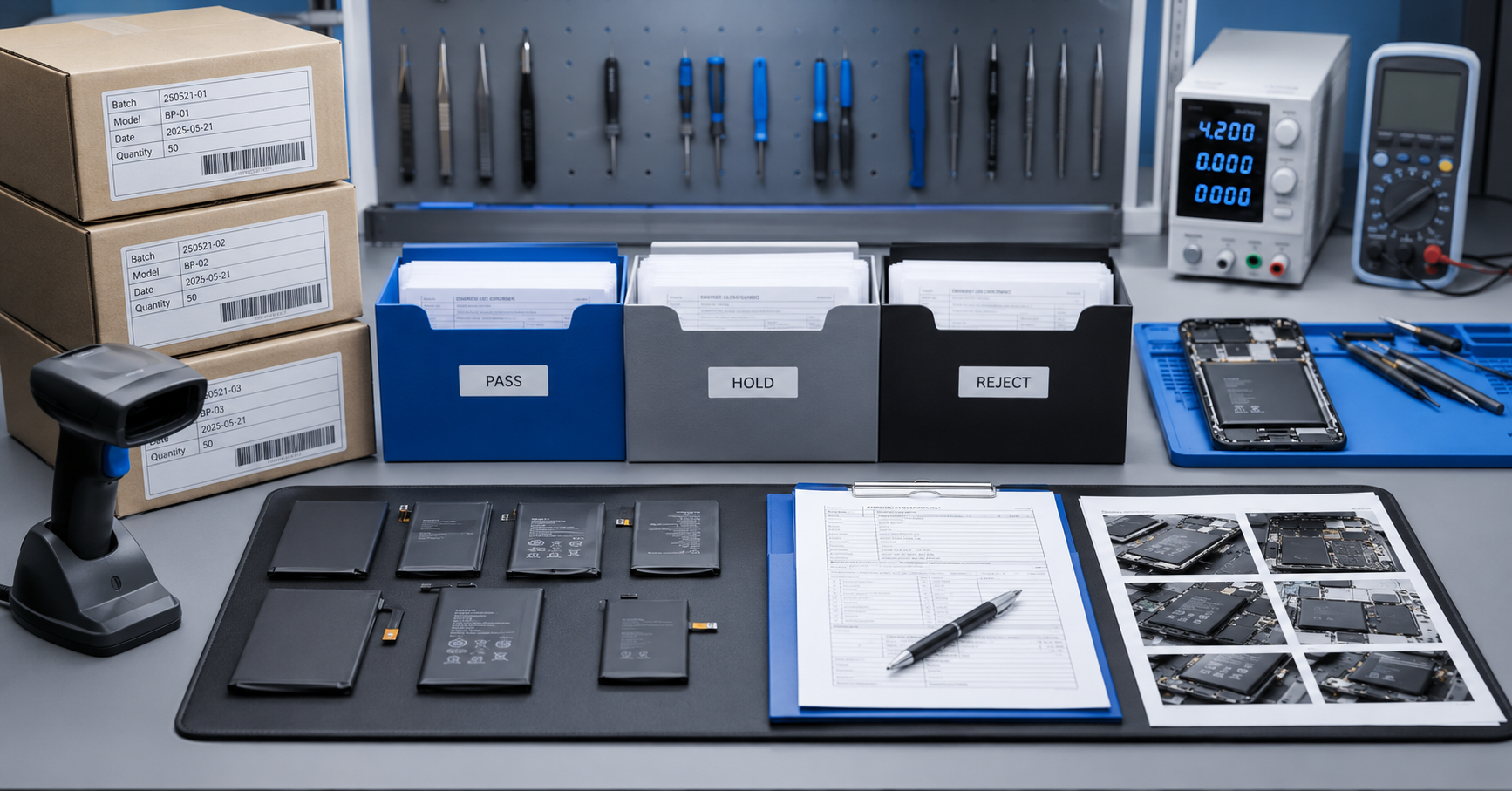


A mobile phone battery sampling plan defines how a buyer will select, inspect, accept, reject, or escalate each production lot. It should connect the purchase specification to a repeatable inspection method instead of relying on one approved sample or an informal “random check.”
For wholesalers, repair chains, refurbishment facilities, and private-label brands, the plan must answer six questions:
-
What constitutes one inspection lot?
-
How will samples be selected?
-
Which characteristics will be checked?
-
How will defects be classified?
-
What causes acceptance, rejection, or additional inspection?
-
What happens after a failed result?
The plan should be agreed before mass production. If sampling rules are discussed only after a disagreement, the buyer and supplier may use different definitions of a defect, different test methods, and different expectations about whether the lot should be released.
What a Mobile Phone Battery Sampling Plan Can and Cannot Do
A sampling plan helps buyers make consistent lot-level decisions without testing every characteristic on every unit. It can reduce arbitrary inspection, improve traceability, and show when supplier performance is deteriorating.
However, sampling does not prove that every untested battery is conforming. An accepted lot may still contain defects, while a rejected lot may contain many usable units. Sampling is a decision tool based on defined risks—not a zero-defect guarantee.
A complete battery quality system may combine:
-
Supplier process controls
-
Incoming material inspection
-
In-process inspection
-
Finished-product testing
-
Lot-based acceptance sampling
-
Targeted performance tests
-
Installation verification
-
Complaint and warranty feedback
Buyers who need a broader receiving workflow can review ESC’s mobile phone battery incoming inspection guide. The sampling plan determines how units enter that inspection workflow.
Step 1: Define the Inspection Lot
A sample is meaningful only when the lot is clearly defined. Units grouped into one inspection lot should come from a sufficiently consistent production condition.
The lot record should identify:
-
Buyer SKU
-
Supplier model code
-
Compatible device model
-
Production or assembly batch
-
Cell batch when traceable and applicable
-
Protection-board or flex-cable version
-
Label and packaging version
-
Production period
-
Quantity submitted for inspection
-
Relevant process or material changes
Do not combine different models, connector versions, capacities, packaging revisions, or production conditions into one lot merely to simplify paperwork.
If a material, cell, protection-board, connector, firmware-related function, assembly process, or label version changes, the buyer should decide whether the affected units need a separate lot or enhanced validation.
A poorly defined lot weakens the entire mobile phone battery sampling plan. A sample taken from one stable subgroup cannot reliably represent unrelated products mixed under the same shipment number.
Step 2: Freeze the Specification and Test Methods
Before selecting an AQL or sample quantity, define what the battery must meet. The inspection team needs an approved specification, test method, equipment requirement, conditioning requirement, and acceptance limit for every checked characteristic.
The specification may cover:
-
Model identity and compatibility
-
Physical dimensions and thickness
-
Connector position and flex-cable structure
-
Label content and barcode
-
Declared capacity and rated voltage
-
Open-circuit voltage
-
Internal resistance
-
Protection-board functions
-
Charge and discharge behavior
-
Installation fit
-
Battery information or warning-message behavior where applicable
-
Packaging condition
-
Batch identification and traceability
Numerical requirements must be tied to the specific model and approved test method. A measurement without defined equipment, conditions, timing, and acceptance limits cannot support a defensible acceptance decision.
For performance-test planning, ESC’s iPhone battery capacity testing guide explains why buyers should compare multiple samples and record the test conditions instead of relying only on the printed capacity.
Step 3: Classify Defects by Business and Safety Impact
Defect classification determines how seriously each finding affects the lot decision. The buyer and supplier should approve the definitions before inspection begins.
A practical classification structure is:
| Defect class | Decision meaning | Battery-related examples requiring buyer approval |
|---|---|---|
| Critical | A condition that may create an unacceptable safety, regulatory, or identity risk | Leakage, abnormal swelling, exposed conductive parts, prohibited model substitution, missing safety-critical protection, or a condition judged unsafe by qualified personnel |
| Major | A condition likely to cause installation failure, functional failure, a return, or a material customer complaint | Wrong connector, incorrect flex position, failure to charge, unacceptable capacity result, incorrect compatibility label, or protection-function failure |
| Minor | A condition that does not normally prevent intended use but fails an agreed workmanship or presentation requirement | Limited cosmetic or printing variation within a buyer-defined boundary |
These examples are not universal acceptance criteria. Each battery model, market, and sales channel needs an approved defect catalogue with photographs or boundary samples.
Avoid vague labels such as “poor appearance” or “bad performance.” Inspectors need observable criteria. If two trained inspectors can reach opposite conclusions, the defect definition is not yet clear enough.
Step 4: Select the Sampling Scheme
ISO 2859-1:2026 provides acceptance-sampling schemes indexed by the acceptance quality limit, commonly abbreviated as AQL, for lot-by-lot inspection by attributes. The standard includes single, double, or multiple sampling approaches and switching rules for different inspection conditions.
A buyer should not copy an AQL value from an unrelated product checklist and treat it as a universal battery rule. The selected plan should reflect:
-
The consequence of the defect
-
Lot size
-
Supplier history
-
Process maturity
-
Inspection cost
-
Destructive versus nondestructive testing
-
Customer and market requirements
-
The buyer’s tolerance for acceptance and rejection risk
The parties should record the applicable standard edition, inspection level, sampling type, AQL or other decision parameter, and switching rules in the quality agreement.
The 2026 edition replaced the former 1999 edition. Buyers using legacy inspection forms should confirm which edition their tables, software, or third-party inspection company applies.
ISO 28590:2017 provides an introduction to the ISO 2859 series and guidance for selecting an appropriate attribute-inspection system. This is useful when the buyer needs to decide whether lot-by-lot acceptance sampling is suitable for the inspection objective.
Step 5: Make Sample Selection Truly Random
Taking the most accessible box from the top of a pallet is convenient, but it may not represent the lot. Samples should be distributed across the submitted quantity.
The selection instruction can require inspectors to:
-
Select from multiple outer cartons
-
Include cartons from different pallet positions
-
Avoid supplier-preselected “inspection samples”
-
Record carton numbers or locations
-
Use a random-number method where practical
-
Preserve sample-to-batch traceability
-
Prevent exchanged or substituted samples after selection
When production spans multiple shifts, lines, days, or material batches, the sampling pattern should cover those sources or separate them into different lots.
Random selection is especially important when a supplier knows which units will be tested. A beautiful presentation sample does not demonstrate mass-production consistency.
How to Structure a Four-Layer Inspection Plan
Battery inspection should not apply one sample quantity to every test. Visual checks may be fast and nondestructive, while controlled capacity tests take longer and may require different preparation.
A layered plan can separate four inspection groups:
| Inspection layer | Typical checks | Sampling logic | Main decision |
| Packaging and identity | SKU, batch, label, barcode, carton, quantity, model code | Wider coverage because checks are fast and nondestructive | Correct product and traceability |
| Physical and electrical screening | Appearance, thickness, connector, flex cable, voltage, internal resistance | Lot-based random sample using approved limits | Workmanship and basic consistency |
| Controlled performance testing | Capacity, charge-discharge behavior, protection functions, thermal observations under defined conditions | Smaller planned sample because testing is slower or more intensive | Performance against the specification |
| Installation verification | Fit, connector engagement, charging, device behavior, applicable battery information | Model-specific sample tested in compatible devices or fixtures | Real repair-channel usability |
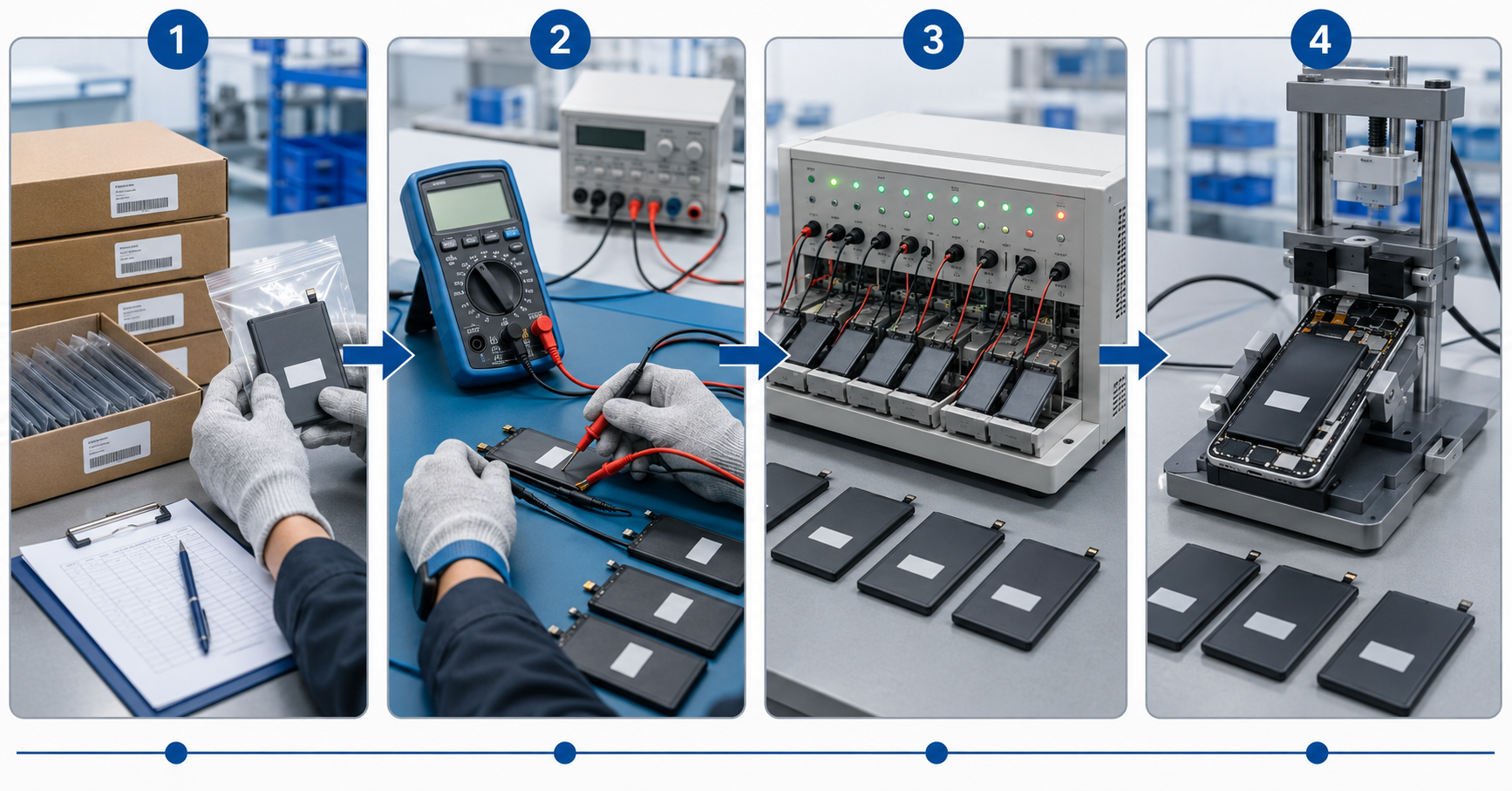
The exact checks and quantities depend on the approved product specification and risk assessment. Do not publish universal voltage, internal-resistance, capacity, temperature, or sample-size limits without model-specific evidence.
Some characteristics may require 100% screening, automated process control, or separate validation rather than ordinary acceptance sampling. Sampling should never be used to avoid a mandatory safety, legal, customer, or traceability requirement.
Step 6: Define Acceptance, Rejection, and Escalation
The inspection instruction must explain what the inspector does after counting defects.
A lot decision may be:
-
Accept: The observed results meet the selected sampling plan and all mandatory release conditions.
-
Reject: The observed defects reach the rejection threshold or a defined non-negotiable condition occurs.
-
Hold: The result is incomplete, disputed, or awaiting additional testing, documentation, or engineering review.
-
Screen: The supplier or buyer performs an approved 100% inspection to remove specified nonconforming units.
-
Retest: A new test is performed only under a predefined rule that prevents repeated testing until the lot passes.
Avoid automatic resampling after a failed result unless the quality agreement explicitly permits it. Uncontrolled retesting can hide process instability and turn the sampling plan into a negotiation.
If rework or screening is allowed, require:
-
Identification of the affected lot
-
Containment of all related stock
-
Documented rework or screening instructions
-
Separation of conforming and nonconforming units
-
Verification after rework
-
Updated quantity and traceability records
-
Root-cause and corrective-action review where required
Step 7: Link the Approved Sample to Mass Production
A golden sample is useful only when it is supported by a written specification. One physical sample cannot fully define internal resistance, capacity, protection behavior, batch consistency, or allowable cosmetic variation.
The approval package should include:
-
Approved physical sample
-
Product specification
-
Approved label and packaging artwork
-
Compatibility and version information
-
Test methods and limits
-
Defect catalogue
-
Sampling plan
-
Change-control requirements
-
Authorized approval record
Mass-production samples should be compared with this complete approval package. If a supplier changes an important material, component, process, structure, label, or test method, the buyer should receive the agreed notification and decide whether requalification is required.
Step 8: Turn Inspection Results into Supplier Control
A sampling report should do more than state “pass” or “fail.” It should show whether performance is improving, stable, or deteriorating.
Track results by:
-
Supplier
-
Product model
-
Batch
-
Defect category
-
Defect class
-
Inspection date
-
Accepted, held, screened, or rejected status
-
Complaint or warranty outcome
-
Corrective-action status
Repeated minor findings can indicate process drift even when individual lots pass. A recurring connector, label, capacity, or packaging issue should trigger supplier analysis before it becomes a major return problem.
ESC’s mobile phone battery warranty-claims guide explains how structured evidence helps buyers separate isolated claims from possible batch-level issues.
RFQ Checklist for a Battery Sampling Plan
Include the following questions when requesting a quotation or approving a new supplier:
-
How does the supplier define a production lot?
-
Which batch identifiers appear on the battery and packaging?
-
Which specification revision applies?
-
Which checks are performed during production and before shipment?
-
Which characteristics receive 100% screening?
-
Which characteristics use acceptance sampling?
-
Which sampling standard and edition apply?
-
How are critical, major, and minor defects defined?
-
How are samples randomly selected?
-
Which tests are destructive or time-consuming?
-
Who authorizes lot release?
-
What happens after rejection?
-
How are reworked units identified and verified?
-
Which changes require buyer notification?
-
How are inspection results linked to warranty feedback?
Buyers planning model coverage should also review ESC’s wholesale mobile phone battery guide. A sampling plan should be practical across the intended SKU portfolio, not designed for only one convenient model.
FAQ
Does AQL mean the supplier may intentionally produce that percentage of defects?
No. AQL is used to index an acceptance-sampling scheme; it is not a production target or permission to manufacture defects. The supplier remains responsible for meeting the agreed product specification and quality requirements.
Can one AQL value be used for all battery defects?
It should not be assumed. Critical, major, and minor defects have different consequences, and some characteristics may require 100% control or separate validation. The buyer should define risk-based rules in the quality agreement.
Is one approved battery sample enough for mass production?
No. A physical sample cannot define every electrical, functional, dimensional, labeling, and consistency requirement. Pair the approved sample with specifications, test methods, defect definitions, sampling rules, and change control.
Should rejected lots be sampled again?
Only when a predefined procedure allows it. The procedure should prevent repeated testing until a favorable result appears. Rejected lots normally require containment, investigation, documented rework or screening, and controlled verification.
How should samples be selected from mixed-model orders?
Each model or materially different version should normally be treated as its own inspection lot or sampling group. Do not use samples from one model to represent batteries with different connectors, flex structures, capacities, labels, or compatibility requirements.
Build a Sampling Plan Before the Purchase Order
An effective mobile phone battery sampling plan is not just an AQL table. It connects the lot definition, specification, defect catalogue, random-selection method, inspection layers, acceptance rules, escalation process, and supplier corrective actions.
This structure gives both parties a common decision method before production begins. It also makes inspection results more useful for supplier management, warranty analysis, and repeat orders.
Send ESC your target battery models, expected lot quantities, sales market, inspection requirements, packaging plan, and critical quality concerns. ESC can help you review a suitable sample-validation and bulk-order quality-control workflow.
External Source References
-
International Organization for Standardization (ISO) — ISO 2859-1:2026: Sampling procedures for inspection by attributes — Part 1 — 2026
-
International Organization for Standardization (ISO) — ISO 28590:2017: Introduction to the ISO 2859 series — 2017